
The transmission of mechanical power is fundamental to modern engineering, and among the various methods available, gear drives stand as one of the most critical and ubiquitous. Their ability to transmit motion and torque efficiently, reliably, and with precise speed ratios makes them indispensable in industries ranging from automotive and aerospace to robotics and heavy machinery. At the heart of countless gearboxes lie spur and pinion gears, the simplest and most common form of gearing. Understanding the complex mechanical behavior of these spur and pinion gear pairs during operation is paramount for designing systems that are not only powerful and efficient but also durable and quiet. The dynamic meshing process, where teeth continuously engage and disengage, is governed by a complex interplay of stresses, strains, and inertial forces. These factors directly influence transmission accuracy, efficiency, vibrational noise, and ultimately, the fatigue life of the spur and pinion gear components. Therefore, a deep analysis of the structural field—encompassing stress, strain, velocity, and acceleration—during this dynamic interaction is essential for advancing gear technology.
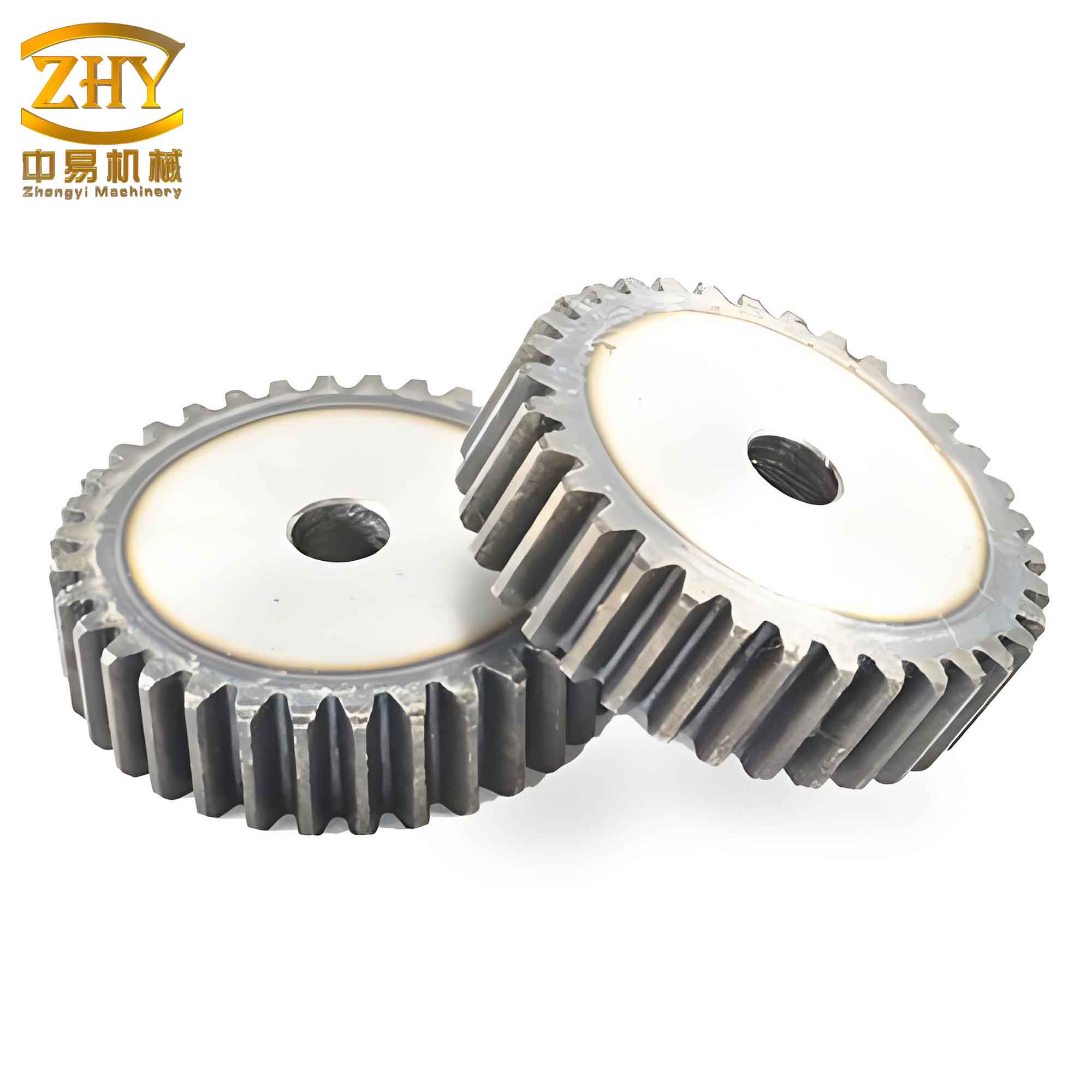
Traditional analytical methods, such as those based on Hertzian contact theory, provide valuable foundational formulas for contact stress. However, they often rely on simplifications regarding load distribution, geometry, and dynamic effects. The advent of the Finite Element Method (FEM) has revolutionized this field by allowing for the numerical simulation of the spur and pinion gear meshing process with remarkable fidelity. FEM enables us to discretize the complex geometry of a spur and pinion gear into a finite number of simple elements, solve the governing equations of elasticity and dynamics for each, and assemble a comprehensive picture of the system’s response under load. This approach allows for the investigation of stress concentrations, transient dynamic effects, and the impact of design parameters in ways that analytical methods cannot easily match. This article delves into a detailed finite element analysis of a spur and pinion gear pair, focusing on the evolution of equivalent stress and strain, as well as kinematic quantities, throughout the dynamic meshing cycle. The goal is to identify critical failure locations, elucidate the nature of vibrational冲击, and provide a theoretical foundation for optimizing the design of spur and pinion gear systems and controlling drive motor characteristics.
Theoretical Foundation: From Elasticity to Contact
Finite Element Formulation for Gear Teeth
The analysis begins by considering the gear tooth as a two-dimensional plane stress problem, a valid simplification for spur and pinion gears where the stress state is uniform across the face width. The core principle is to approximate the displacement field within a gear tooth using simple interpolation functions defined over small, interconnected elements. For a typical triangular element with nodes i, j, and m, the displacement components (u, v) can be expressed as linear functions of the coordinates (x, y):
$$ u(x,y) = a_1 + a_2x + a_3y $$
$$ v(x,y) = a_4 + a_5x + a_6y $$
The coefficients \(a_1\) to \(a_6\) are determined from the nodal displacements. This leads to the formulation of shape functions, \(N_i, N_j, N_m\), which describe the displacement within the element based solely on nodal values:
$$ N_i = \frac{1}{2A}(a_i + b_i x + c_i y), \quad N_j = \frac{1}{2A}(a_j + b_j x + c_j y), \quad N_m = \frac{1}{2A}(a_m + b_m x + c_m y) $$
where \(A\) is the element area, and the constants \(a, b, c\) are derived from nodal coordinates. The displacement field for the element can then be compactly written in matrix form:
$$ \begin{Bmatrix} u \\ v \end{Bmatrix} = \begin{bmatrix} N_i & 0 & N_j & 0 & N_m & 0 \\ 0 & N_i & 0 & N_j & 0 & N_m \end{bmatrix} \begin{Bmatrix} u_i \\ v_i \\ u_j \\ v_j \\ u_m \\ v_m \end{Bmatrix} = [\mathbf{N}] \{\mathbf{\delta}^e\} $$
Here, \([\mathbf{N}]\) is the shape function matrix and \(\{\mathbf{\delta}^e\}\) is the element nodal displacement vector. The strain-displacement relationship (geometry) and stress-strain relationship (constitutive law) are given by:
$$ \{\mathbf{\varepsilon}\} = \begin{Bmatrix} \varepsilon_x \\ \varepsilon_y \\ \gamma_{xy} \end{Bmatrix} = [\mathbf{B}]\{\mathbf{\delta}^e\}, \quad \text{where } [\mathbf{B}] = \frac{1}{2A} \begin{bmatrix} b_i & 0 & b_j & 0 & b_m & 0 \\ 0 & c_i & 0 & c_j & 0 & c_m \\ c_i & b_i & c_j & b_j & c_m & b_m \end{bmatrix} $$
$$ \{\mathbf{\sigma}\} = \begin{Bmatrix} \sigma_x \\ \sigma_y \\ \tau_{xy} \end{Bmatrix} = [\mathbf{D}]\{\mathbf{\varepsilon}\} = [\mathbf{D}][\mathbf{B}]\{\mathbf{\delta}^e\} = [\mathbf{S}]\{\mathbf{\delta}^e\} $$
The matrix \([\mathbf{D}]\) is the elastic property matrix for plane stress, \([\mathbf{B}]\) is the strain-displacement matrix, and \([\mathbf{S}]\) is the stress matrix. Applying the principle of virtual work leads to the elemental stiffness equation \([\mathbf{k}^e]\{\mathbf{\delta}^e\} = \{\mathbf{f}^e\}\), which are assembled into a global system to solve for displacements and subsequently, stresses and strains throughout the spur and pinion gear model.
Hertzian Contact Theory and Load Sharing
While FEM handles the complete solution, Hertzian contact theory provides an analytical benchmark for contact stress between two elastic bodies, such as the teeth of a spur and pinion gear. For parallel cylinders (an approximation for gear teeth contact along the line of action), the maximum contact pressure \(p_0\) is given by:
$$ p_0 = \sqrt{\frac{F_t E^*}{\pi b^* R^*}} $$
where \(F_t\) is the normal load per unit width, \(E^*\) is the equivalent elastic modulus, and \(R^*\) is the equivalent radius of curvature at the contact point. For a spur and pinion gear pair, this formula is adapted into the standardized contact stress equation:
$$ \sigma_H = Z_B Z_H Z_E Z_\varepsilon Z_\beta \sqrt{\frac{1+u}{u} \cdot \frac{F_t}{b_H d} \cdot K} $$
The factors \(Z_*\) account for gear geometry, elasticity,重合度, and spiral angle. The load distribution factor \(K\) is critical and dynamic: \(K = K_A K_V K_{H\beta} K_{H\alpha}\). The齿间载荷分布系数 \(K_{H\alpha}\) is particularly important as it governs how the total load is shared between two pairs of teeth during the double-pair meshing phase of a spur and pinion gear set. For a gear pair with contact ratio \(\varepsilon_\alpha\) between 1 and 2, the load sharing varies periodically. If \(\lambda_i\) represents the profile parameter of the \(i\)-th tooth pair in contact, the load share for that pair can be modeled as:
$$ K_{H\alpha}^{(i)} = \frac{\cos[b_0(\lambda_i – \lambda_m)]}{\cos[b_0(\lambda_{i-1} – \lambda_m)] + \cos[b_0(\lambda_i – \lambda_m)]} \quad \text{(during engagement/disengagement)} $$
$$ K_{H\alpha}^{(i)} = 1 \quad \text{(during single-pair contact)} $$
where \(b_0\) and \(\lambda_m\) are derived from the gear geometry and contact ratio. This periodic load sharing is a fundamental source of time-varying stiffness and dynamic excitation in spur and pinion gear systems.
Finite Element Model of a Spur and Pinion Gear Pair
To conduct the dynamic analysis, a precise 3D model of a spur and pinion gear pair is created. The primary parameters for the model are summarized in the table below. Notably, the pinion (driving gear) has a larger face width than the gear (driven gear), a common design scenario worth investigating.
| Parameter | Symbol | Value | Unit |
|---|---|---|---|
| Pinion (Driver) Face Width | b₁ | 25 | mm |
| Gear (Driven) Face Width | b₂ | 20 | mm |
| Pinion Teeth Number | Z₁ | 16 | – |
| Gear Teeth Number | Z₂ | 24 | – |
| Module | m | 4.5 | mm |
| Pressure Angle | α | 20 | ° |
| Contact Ratio | ε_α | 1.55 | – |
| Pinion Speed | n₁ | 900 | rpm |
| Pinion Torque | T₁ | 300 | Nm |
| Material (Steel) Elastic Modulus | E | 210 | GPa |
| Material Poisson’s Ratio | ν | 0.3 | – |
The model is discretized using a high-quality hex-dominant mesh, with refined elements in the contact regions around the teeth of the spur and pinion gear to capture stress gradients accurately. The contact between the gear teeth is defined using a surface-to-surface formulation with a Lagrange multiplier algorithm, a friction coefficient of 0.1, and automatic adjustment of contact stiffness. The boundary conditions apply a rotational velocity to the gear and a constant torque to the pinion, simulating a steady-state driven load condition. A transient dynamic analysis is performed to capture the complete meshing cycle over time.
Analysis of Stress and Strain Fields in Dynamic Meshing
Evolution and Distribution of Equivalent Stress
The dynamic finite element simulation reveals the complex, time-varying nature of the stress field within the spur and pinion gear. The maximum equivalent (von-Mises) stress does not remain constant but fluctuates with the meshing phase. The figure below conceptually illustrates the meshing sequence (A to E) along the path of contact for a spur and pinion gear pair with a contact ratio of 1.55, where AB and DE are double-pair contact zones and BD is the single-pair contact zone.
The analysis shows that the maximum stress in the driven gear occurs precisely at the transition from single-pair to double-pair contact (point D), reaching a peak value of approximately 856 MPa. This value is slightly higher than the theoretical Hertzian calculation (~790 MPa) due to the inclusion of dynamic inertia and system vibration effects in the FEM. Crucially, the stress distribution along the face width is highly non-uniform. Due to the narrower face width of the driven gear and edge effects, significant stress concentrations appear near the two end-faces of the contact zone. The stress is minimum at the center of the face width and rises sharply towards the edges. This identifies the contact zone near the end faces of the narrower spur and pinion gear component as a critical region for pitting and surface fatigue failure.
Deformation and Equivalent Strain Patterns
The strain field, indicative of elastic deformation, provides complementary insight. The maximum equivalent strain follows a similar pattern, also peaking at the single-to-double pair contact transition on the driven spur and pinion gear. To understand the internal deformation through the gear body, radial paths from the tooth contact point down to the bore are analyzed. The results show that deformation is not localized only at the surface:
- Tooth Root Region: Exhibits the largest deformation (~0.467 μm), even larger than at the direct point of contact. This aligns perfectly with the common failure mode of bending fatigue at the tooth root fillet.
- Contact Point Region: Shows significant but slightly lower deformation (~0.427 μm).
- Gear Bore Region: Experiences the least but still notable deformation (~0.260 μm) due to the transmitted torque.
This radial strain profile confirms that both contact fatigue (surface) and bending fatigue (root) are primary concerns in spur and pinion gear design. After a tooth disengages, the strain field relaxes, and the maximum residual deformation is primarily located around the bore, reflecting the torsional load.
Dynamic Response: Velocity, Acceleration, and Vibration冲击
Beyond stresses and strains, the dynamic response of the spur and pinion gear system in terms of kinematic quantities is vital for understanding noise and vibration. The transient analysis records the linear velocity and acceleration of a point on the driven gear. The results show clear periodic fluctuations synchronized with the meshing cycle.
Velocity Fluctuation and Stability
The velocity of the driven spur and pinion gear is not perfectly constant. Distinct dips and peaks occur at the transitions between single and double-pair contact.
- At the Double-to-Single Pair Transition (Point B): When one tooth pair disengages, the load is suddenly transferred to a single pair, causing a momentary drop in effective mesh stiffness. This can lead to a slight increase in velocity (to ~5.1 m/s in the simulation) due to reduced constraint.
- At the Single-to-Double Pair Transition (Point D): The engagement of a new tooth pair introduces a sudden stiffness increase, causing a decelerative冲击 and a local velocity minimum (~4.2 m/s).
The key observation is that the velocity variation during the double-pair meshing phase (regions AB and DE) is significantly smaller and more stable than during the single-pair phase (region BD). Quantitatively, the velocity stability—defined by the flatness of the velocity curve—is approximately 25% higher during double-pair contact. This demonstrates the natural vibration-damping effect of having overlapping tooth contact in a spur and pinion gear set.
Acceleration Peaks and Meshing冲击
Acceleration, being the derivative of velocity, highlights the冲击 phenomena even more dramatically. Sharp peaks in acceleration occur precisely at the meshing phase transition points.
- The most severe acceleration spike is observed at the double-to-single pair contact transition (B). The sudden change in loaded tooth count and the accompanying step change in mesh stiffness generate a significant inertial冲击.
- A smaller, yet distinct, spike occurs at the single-to-double pair contact transition (D), associated with the impact of the new tooth pair coming into load.
These acceleration spikes are the direct numerical manifestation of “meshing冲击” or “transmission error excitation,” which is a primary source of gear whine and vibration in spur and pinion gear systems. The FEM simulation successfully pinpoints the exact timing and relative magnitude of these dynamic events.
| Meshing Phase | Contact Condition | Velocity Characteristic | Acceleration Characteristic | Dynamic Stability |
|---|---|---|---|---|
| AB / DE | Double-Pair | High stability, low fluctuation | Low, smooth | High (~25% more stable than single) |
| BD | Single-Pair | Lower stability, higher fluctuation | Higher baseline | Lower |
| Point B | Transition (Double→Single) | Local peak | Maximum spike (Primary冲击) | Low (High冲击) |
| Point D | Transition (Single→Double) | Local minimum | Significant spike (Secondary冲击) | Low (High冲击) |
Conclusion: Implications for Spur and Pinion Gear Design and Control
The comprehensive finite element analysis of the dynamic meshing process for a spur and pinion gear pair yields critical insights with direct engineering implications. Firstly, the investigation pinpoints the most vulnerable locations for failure. The driven gear, especially when it has a narrower face width than its mating pinion, is subjected to higher stress. The most critical areas are the tooth root fillet (maximum bending strain) and the contact zone near the gear’s end faces (maximum contact stress concentration). Design optimizations for a spur and pinion gear set, such as profile modifications, root fillet optimization, and careful management of face width ratio and alignment, must specifically target these regions to enhance bending and contact fatigue life.
Secondly, the dynamic analysis conclusively demonstrates the source and nature of vibration in spur and pinion gear transmissions. The periodic fluctuations in mesh stiffness, caused by the alternating single and double-tooth contact, generate predictable velocity variations and sharp acceleration冲击. The most severe dynamic excitation occurs at the instant a double-pair contact changes to a single-pair contact. This understanding is vital for acoustic design. Furthermore, the results show that a higher contact ratio, which extends the double-pair contact duration, inherently improves velocity stability by approximately 25% and dampens these冲击. This advocates for design choices that promote a higher contact ratio within the spur and pinion gear geometry.
Finally, the detailed mapping of velocity and acceleration transients provides a valuable theoretical basis for active control strategies. By anticipating the timing of meshing冲击 (e.g., at points B and D in the cycle), advanced motor control algorithms can be developed to implement slight, compensatory torque adjustments at precisely those moments. This active damping could potentially neutralize the source of vibration, leading to quieter and smoother operation of systems utilizing spur and pinion gear drives. In summary, this level of finite element analysis transcends basic strength checking; it provides a dynamic performance blueprint that guides the optimization of gear geometry, system layout, and control parameters for the next generation of high-performance spur and pinion gear applications.