
In the realm of automotive engineering, the differential system plays a pivotal role in enabling smooth vehicle motion, especially during turns. At the heart of this system lie the planetary gear shafts, which are critical components responsible for torque distribution between wheels. However, during operation, these gear shafts are subjected to complex mechanical loads, often leading to failures such as fractures at the root of the cross-shaped sections. This not only compromises differential functionality but also poses safety risks. From my perspective as an engineer, addressing this issue requires a deep dive into the mechanical behavior of planetary gear shafts under operational stresses. In this article, I will explore a comprehensive analysis, leveraging mechanical models and empirical insights, to propose viable solutions for enhancing the durability of these gear shafts. Throughout, I will emphasize the importance of understanding stress distributions and material responses, with a focus on the term ‘gear shafts’ to underscore their centrality in automotive drivetrains.
The planetary gear shafts in a differential, often designed as cross-shaped or cruciform structures, are typically manufactured from high-strength alloys like 20CrMnTi. Their primary function is to transmit torque from the differential case to the side gears, allowing for speed differentiation between wheels. However, due to cyclic loading and stress concentrations at geometric discontinuities, such as the transition between the hollow splined section and the cross arms, these gear shafts are prone to fatigue-induced fractures. This phenomenon is exacerbated during high-torque events, such as acceleration or off-road driving. To mitigate this, I will dissect the gear shaft into three conceptual segments for analysis: the internal splined hollow sleeve, the cross-stepped shaft, and the involute splined section. This segmentation allows for a targeted examination of stress factors, enabling a holistic approach to design improvements. By integrating principles from torsion and bending theory, I aim to derive formulas that quantify stress levels and identify key parameters for optimization.
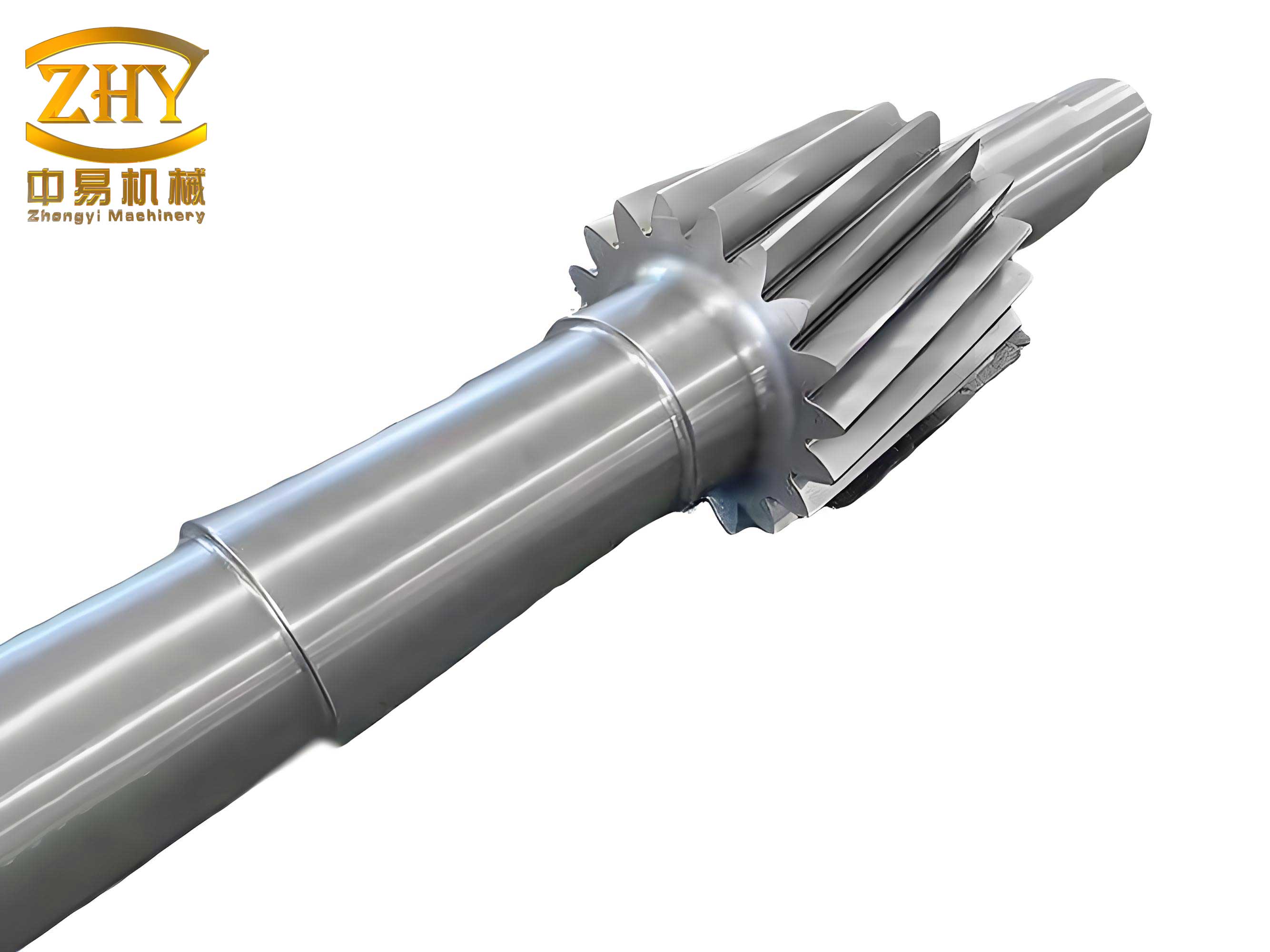
Beginning with the internal splined hollow sleeve, this segment of the planetary gear shafts is primarily subjected to torsional loads during torque transmission. When torque is applied, the sleeve undergoes twist, leading to shear stresses across its cross-section. Assuming a hollow cylindrical geometry, the torsion analysis can be based on the plane hypothesis, where cross-sections rotate rigidly about the axis without longitudinal deformation. Consequently, normal stresses are negligible, but shear stresses arise due to the relative angular displacement between adjacent sections. For a hollow circular shaft, the maximum shear stress ($\tau_p$) occurs at the outer radius and is given by the torsion formula: $$\tau_p = \frac{M_T \cdot \rho_{\text{max}}}{J}$$ where $M_T$ is the applied torque, $\rho_{\text{max}}$ is the outer radius, and $J$ is the polar moment of inertia. For a hollow shaft with outer diameter $D$ and inner diameter $d$, $J = \frac{\pi}{32}(D^4 – d^4)$. In the context of planetary gear shafts, the torque is related to the power $P$ and rotational speed $n$ through $M_T = 9.55 \times 10^6 \frac{P}{n}$ (in N·mm for $P$ in kW and $n$ in rpm). Letting $d_1$ represent the outer diameter of the hollow sleeve and $d_{f2}$ the inner diameter (often linked to spline dimensions), the shear stress condition for safe operation is: $$\tau_p = \frac{9.55 \times 10^6 \frac{P}{n} \cdot \frac{d_1}{2}}{\frac{\pi}{32}(d_1^4 – d_{f2}^4)} = 4.864 \times 10^7 \frac{P}{n} \frac{d_1}{d_1^4 – d_{f2}^4} \leq [\tau]$$ where $[\tau]$ is the allowable shear stress of the material. This equation highlights four factors influencing torque capacity: power $P$, speed $n$, outer diameter $d_1$, and inner diameter $d_{f2}$. For automotive manufacturers, directly altering $P$ or $n$ is often constrained by vehicle performance requirements, leaving $d_1$ and $d_{f2}$ as design variables. However, modifying $d_{f2}$ or increasing $d_1$ beyond certain limits may necessitate changes to the differential’s overall geometry, potentially affecting gear ratios and assembly compatibility. Therefore, a practical approach involves adjusting the wall thickness $h$ of the hollow sleeve, where $h = \frac{d_1 – d_{f2}}{2}$. By increasing $h$, $d_1$ can be enhanced indirectly while maintaining $d_1 < d_2$ (where $d_2$ is a neighboring diameter, as shown in the analysis model). This adjustment reduces the maximum shear stress, thereby improving the torsional strength of the gear shafts. For instance, consider an increment $\Delta h = 1$ mm, changing $d_1$ from $44^{+0.05}_{-0.05}$ mm to $45$ mm. The revised stress $\tau’_p$ becomes: $$\tau’_p \approx (105.28 \text{ to } 107.96) \times \frac{P}{n} \text{ MPa}$$ compared to the original $\tau_p \approx (118.33 \text{ to } 123.43) \times \frac{P}{n} \text{ MPa}$, indicating a significant reduction. This underscores the sensitivity of planetary gear shafts to dimensional tweaks.
Moving to the cross-stepped shaft segment, this part of the gear shafts is critical due to stress concentrations at the fillets or roots of the cross arms. Under load, these arms experience bending moments from the tangential forces exerted by the side gears. Drawing analogies from cross-type universal joint design, the dangerous section is typically at the neck root (denoted as point $k$ in the analysis model). The bending stress $\sigma$ at this location can be derived from beam theory. Assuming a concentrated force $F$ acts at a distance $t$ from the root, with the force derived from torque transmission: $F = \frac{M_T}{4r}$, where $r$ is the pitch radius of the gear engagement. The bending stress is then: $$\sigma = \frac{M_b \cdot y}{I}$$ where $M_b = F \cdot t$ is the bending moment, $y$ is the distance from the neutral axis (equal to $\frac{d_v}{2}$ for a circular cross-section), and $I$ is the area moment of inertia. For a circular shaft with diameter $d_v$, $I = \frac{\pi d_v^4}{64}$. However, in planetary gear shafts, the cross-section at the root may be complex due to stepped geometry. For simplicity, an equivalent diameter $d_v$ can be defined based on the weighted average of adjacent sections: $$d_v = \frac{d_3 l_3 + d’_4 l_4}{l_3 + l_4}$$ where $d_3$ and $d’_4$ are diameters of neighboring segments, and $l_3$, $l_4$ are their lengths. Substituting, the bending stress formula becomes: $$\sigma = \frac{32 \cdot F \cdot t}{\pi \cdot d_v^3} = \frac{32 \cdot \frac{9.55 \times 10^6 \frac{P}{n}}{4r} \cdot t}{\pi \cdot \left( \frac{d_3 l_3 + d’_4 l_4}{l_3 + l_4} \right)^3} = 2.399 \times 10^8 \frac{P}{n} \cdot \frac{t}{r \cdot \left( \frac{d_3 l_3 + d’_4 l_4}{l_3 + l_4} \right)^3}$$ This expression reveals that bending stress in gear shafts depends on power, speed, geometric parameters ($t$, $r$, $d_3$, $d’_4$, $l_3$, $l_4$), and indirectly on $h$ through $d_1$ changes. For the same $\Delta h = 1$ mm increase, calculations show that the maximum bending stress decreases slightly from $\sigma \approx (647.68 \text{ to } 689.93) \times \frac{P}{n}$ MPa to $\sigma’ \approx (643.1 \text{ to } 683.1) \times \frac{P}{n}$ MPa. While this reduction is marginal (about 0.7% to 1%), it complements the more substantial gain in torsional strength, making the overall design of planetary gear shafts more robust.
To synthesize these insights, I propose a design optimization strategy for planetary gear shafts that focuses on incremental wall thickness augmentation. This approach balances torsional and bending requirements without overhauling the differential architecture. Below, I present tables summarizing key parameters and formulas, which can guide engineers in recalibrating gear shafts for enhanced performance.
| Parameter | Symbol | Typical Value/Range | Description |
|---|---|---|---|
| Power | $P$ | Vehicle-dependent (kW) | Transmitted power through differential |
| Rotational Speed | $n$ | Engine speed-related (rpm) | Operating speed of gear shafts |
| Outer Diameter of Hollow Sleeve | $d_1$ | 44-45 mm (example) | Critical for torsion resistance |
| Inner Diameter of Hollow Sleeve | $d_{f2}$ | Spline-dependent (mm) | Influences wall thickness |
| Wall Thickness | $h$ | Derived from $d_1$ and $d_{f2}$ | Design variable for optimization |
| Equivalent Root Diameter | $d_v$ | Calculated from stepped sections | Determines bending stress |
| Allowable Shear Stress | $[\tau]$ | Material property (MPa) | Maximum safe shear stress |
| Allowable Bending Stress | $[\sigma]$ | Material property (MPa) | Maximum safe bending stress |
| Stress Type | Formula | Variables Explanation | Application to Gear Shafts |
|---|---|---|---|
| Maximum Shear Stress (Torsion) | $$\tau_p = 4.864 \times 10^7 \frac{P}{n} \frac{d_1}{d_1^4 – d_{f2}^4}$$ | $P$: power (kW), $n$: speed (rpm), $d_1$: outer diameter, $d_{f2}$: inner diameter | Assesses torsional strength of hollow sleeve section |
| Maximum Bending Stress (Root) | $$\sigma = 2.399 \times 10^8 \frac{P}{n} \cdot \frac{t}{r \cdot \left( \frac{d_3 l_3 + d’_4 l_4}{l_3 + l_4} \right)^3}$$ | $t$: moment arm, $r$: pitch radius, $d_3, d’_4, l_3, l_4$: geometric parameters | Evaluates bending fatigue at cross-arm roots |
In practice, implementing the thickness increase requires concomitant adjustments to mating components, such as narrowing the width of the planetary gears to maintain assembly clearances. This underscores the systemic nature of gear shafts design, where alterations propagate through the differential. To validate the proposed method, finite element analysis (FEA) can be employed to simulate stress distributions under operational loads. FEA results often corroborate analytical predictions, showing reduced von Mises stresses at critical junctions when $h$ is increased. Moreover, fatigue life calculations based on stress-life (S-N) curves for materials like 20CrMnTi can demonstrate extended service life for the optimized gear shafts. It is also prudent to consider manufacturing tolerances; for instance, the $44^{+0.05}_{-0.05}$ mm specification implies variability that must be accounted for in worst-case scenarios. By adopting statistical methods, such as Six Sigma, engineers can ensure that the enhanced gear shafts meet reliability targets across production batches.
Beyond dimensional changes, material selection and heat treatment play vital roles in the performance of planetary gear shafts. Case hardening processes, like carburizing, can impart a hard, wear-resistant surface while retaining a tough core to withstand shock loads. For gear shafts subjected to high cyclic stresses, surface treatments such as shot peening can introduce compressive residual stresses, mitigating crack initiation. Additionally, advanced alloys with higher fatigue strength, such as modified chromium-molybdenum steels, could be explored, though cost and processing constraints may limit their adoption in mass-produced vehicles. Another avenue is geometric optimization through fillet radius enlargement at the cross-root transitions, which reduces stress concentration factors (Kt). Computational tools like topology optimization can generate organic shapes that distribute stresses more evenly, but these may clash with manufacturing feasibility for gear shafts. Thus, a balanced approach combining incremental size adjustments, material enhancements, and process improvements is key to advancing gear shafts durability.
From a broader perspective, the analysis of planetary gear shafts intersects with trends in automotive lightweighting and electrification. As electric vehicles (EVs) gain prominence, differentials may evolve or even be replaced by integrated drive units. However, gear shafts will remain relevant in multi-motor setups or hybrid drivetrains, where torque vectoring demands robust differential components. In these contexts, the lessons from traditional differentials can inform the design of next-generation gear shafts, perhaps incorporating hollow, composite structures or additive manufacturing for weight reduction. Simulation-driven design, leveraging digital twins, could enable virtual testing of gear shafts under diverse driving cycles, accelerating development while reducing physical prototypes. Ultimately, the continuous improvement of gear shafts epitomizes the engineering ethos of resilience through analysis and innovation.
In conclusion, the fracture issue in planetary gear shafts of automotive differentials can be effectively addressed by a targeted increase in the wall thickness of the internal splined hollow sleeve. This modification, exemplified by a 1 mm increment in $h$, significantly boosts torsional strength while marginally improving bending resistance at the cross-root. The analytical frameworks presented—rooted in torsion and bending theory—provide quantifiable metrics for evaluating gear shafts performance. By integrating these insights with practical design constraints, automotive engineers can enhance the reliability and longevity of differential systems. Future work may explore dynamic loading effects, thermal influences, and advanced materials to further optimize gear shafts. As vehicles continue to evolve, the principles elucidated here will remain foundational for ensuring the integrity of these indispensable components.