
In the field of precision transmission systems, the RV reducer stands out due to its compact size, lightweight design, wide range of transmission ratios, and high efficiency. These characteristics make the RV reducer indispensable in applications such as industrial robotics, where precision and reliability are paramount. However, the widespread adoption of domestically produced RV reducers has been hindered by issues related to service life and accuracy, largely stemming from the crank bearing, which is the weakest link in the system. As an engineer focused on advanced manufacturing technologies, I have extensively studied the operating conditions of crank bearings in RV reducers. In this article, I will share my analysis and propose practical improvement methods to enhance the performance and longevity of RV reducers. The goal is to provide insights that can aid in the refinement of existing products and the independent development of new ones, thereby reducing dependency on foreign technology.
The crank bearing in an RV reducer is subjected to harsh conditions, including high speeds, variable loads, and potential misalignment. Common failure modes include needle roller cracking, severe wear, and discoloration due to overheating. These failures are often attributed to excessive stress, poor lubrication, and thermal oxidation. To address these issues, it is essential to analyze the crank bearing’s operating parameters—namely speed, force, and deflection angle—and identify ways to mitigate their adverse effects. By optimizing the reducer’s design, we can reduce the demands on the crank bearing and extend its service life. This approach not only improves the RV reducer’s reliability but also contributes to the advancement of the robotics industry.
Before delving into the analysis, let’s briefly review the working principle of an RV reducer. The RV reducer is a type of epicyclic gear train that typically consists of two stages: a primary spur gear stage and a secondary cycloidal stage. In the common configuration where the output shaft is fixed, the primary stage involves a fixed-axis transmission where a central gear drives a crank shaft. The secondary stage is a planetary transmission where the crank shaft’s rotation causes cycloidal gears to orbit around a stationary pin gear, resulting in speed reduction and torque amplification. The transmission ratios can be expressed as follows. The primary transmission ratio is given by:
$$i_1 = \frac{z_2}{z_1}$$
where $z_1$ is the number of teeth on the central gear and $z_2$ is the number of teeth on the planetary gear. The secondary transmission ratio is:
$$i_2 = \frac{z_4}{z_4 – z_3}$$
where $z_3$ is the number of teeth on the cycloidal gear and $z_4$ is the number of teeth on the pin gear. The total transmission ratio of the RV reducer is:
$$i = i_1 \cdot i_2 = \frac{z_2}{z_1} \cdot \frac{z_4}{z_4 – z_3}$$
This two-stage design allows for high reduction ratios in a compact package, but it places significant demands on the crank bearing, which must accommodate both the rotational motion and the torque transmission between stages.
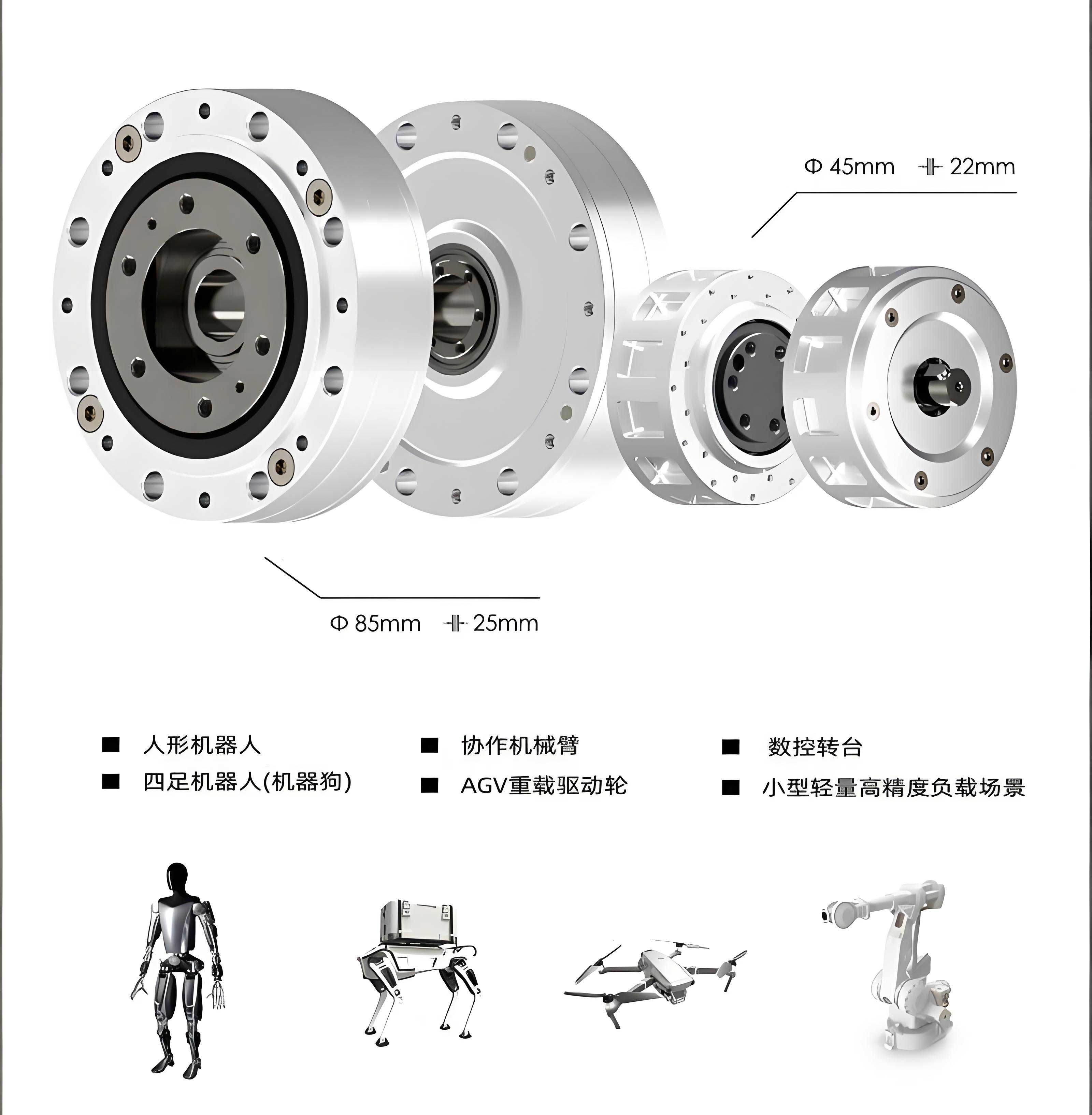
The crank bearing’s service life is a critical factor in the overall durability of the RV reducer. According to bearing life theory, the basic rating life $L_h$ in hours for a roller bearing can be calculated using the formula:
$$L_h = \frac{10^6}{60n} \left( \frac{C}{P} \right)^{\epsilon}$$
where $n$ is the bearing speed in revolutions per minute (rpm), $C$ is the basic dynamic load rating, $P$ is the equivalent dynamic load, and $\epsilon$ is the life exponent. For needle roller bearings, which are commonly used as crank bearings in RV reducers, $\epsilon = 10/3$. Since the crank bearing primarily experiences radial loads, $P$ equals the radial force $F$. Thus, the life equation can be rewritten as:
$$L_h = \frac{10^6}{60} \cdot \frac{1}{n} \cdot \left( \frac{C}{F} \right)^{10/3}$$
This equation highlights that both speed $n$ and force $F$ significantly impact bearing life. Reducing either parameter can substantially increase $L_h$, with force having a more pronounced effect due to the exponent $10/3$. Additionally, deflection angle (misalignment) is not directly included in the life formula but can cause stress concentration and premature failure. Therefore, a comprehensive analysis must consider speed, force, and deflection angle to develop effective improvement strategies for RV reducers.
Speed Analysis and Improvement Methods
The speed of the crank bearing in an RV reducer is determined by the output speed and the transmission ratios. Using the principle of relative motion, we can fix the output shaft to simplify analysis. In this case, the crank bearing’s speed is influenced by the secondary transmission ratio $i_2$. For a given output speed $N_{out}$, the crank bearing speed $n$ can be expressed as:
$$n = N_{out} \cdot i_2$$
This relationship shows that reducing $i_2$ directly lowers $n$, which in turn increases bearing life. However, the total transmission ratio $i$ must often be maintained for application requirements. Thus, to reduce $i_2$ while keeping $i$ constant, we can increase the primary transmission ratio $i_1$. This adjustment shifts more of the speed reduction to the first stage, alleviating the speed burden on the crank bearing. For example, consider an RV reducer with a rated output speed of 15 rpm. The effect of varying $i_2$ on crank bearing speed is summarized in Table 1.
| Secondary Transmission Ratio ($i_2$) | Crank Bearing Speed ($n$, rpm) |
|---|---|
| 20 | 300 |
| 25 | 375 |
| 30 | 450 |
| 35 | 525 |
| 40 | 600 |
| 45 | 675 |
| 50 | 750 |
As evident from the table, a decrease in $i_2$ from 50 to 20 reduces the crank bearing speed by 60%, which can lead to a dramatic improvement in life according to the life equation. Therefore, during the design phase of an RV reducer, optimizing the gear teeth numbers to achieve a lower $i_2$ is a viable strategy. It’s important to note that the primary stage mainly affects the selection of servo motor speed and power, but it has no direct impact on crank bearing speed. Hence, focusing on the secondary stage is key for speed-related improvements in RV reducers.
Force Analysis and Improvement Methods
The force acting on the crank bearing in an RV reducer is complex due to its dual role in transmitting rotation and torque. To analyze this, we start with the torque output $M_1$ from the pin gear. Let $D$ be the pitch circle diameter of the pin gear, and $\alpha$ be the pressure angle of the cycloidal gear. The meshing force $F_0$ between the cycloidal gear and pin gear can be derived from the torque balance:
$$F_0 \cos \alpha \cdot D = M_1 \Rightarrow F_0 = \frac{M_1}{D \cos \alpha}$$
Next, consider the forces on the cycloidal gear. The cycloidal gear is driven by $N$ crank shafts (where $N$ is typically 2 or 3), each equipped with a crank bearing. The force $F_1$ on each crank bearing due to the meshing force is evenly distributed:
$$F_1 = \frac{F_0}{N}$$
Additionally, the crank bearing must provide a torque to the cycloidal gear to counteract the torque from meshing. Let $d_1$ be the pitch circle diameter of the cycloidal gear, and $d_2$ be the distribution circle diameter of the crank shafts. The force $F_2$ required for torque transmission is given by:
$$\frac{F_0 d_1}{2} = N \cdot \frac{F_2 d_2}{2} \Rightarrow F_2 = \frac{F_0 d_1}{N d_2}$$
The total force $F$ on each crank bearing is the vector sum of $F_1$ and $F_2$. If $\theta$ is the angle between $F_1$ and $F_2$, the magnitude of $F$ can be calculated as:
$$F = \sqrt{(F_1 + F_2 \sin \theta)^2 + (F_2 \cos \theta)^2}$$
This equation shows that $F$ depends on several parameters: the pressure angle $\alpha$, the crank shaft distribution circle diameter $d_2$, and the number of crank shafts $N$. To illustrate their effects, let’s analyze each parameter using typical values from an RV reducer model similar to RV-40E, with $M_1 = 412 \text{ Nm}$, $D = 0.126 \text{ m}$, $d_1 = 0.1 \text{ m}$, $d_2 = 0.0785 \text{ m}$, and $N=2$ for baseline comparison.
Effect of Pressure Angle $\alpha$
The pressure angle $\alpha$ influences both the magnitude and variability of the crank bearing force. A smaller $\alpha$ reduces $F_0$ and thus decreases $F$. Moreover, it stabilizes the force over time, reducing fluctuations that can accelerate fatigue. Table 2 demonstrates how different pressure angles affect the average and range of $F$ over a full rotation ( $\theta$ from 0 to $2\pi$ ).
| Pressure Angle $\alpha$ (degrees) | Average Force $F_{avg}$ (N) | Force Range $F_{max} – F_{min}$ (N) |
|---|---|---|
| 0 | 2,500 | 800 |
| 20 | 2,800 | 1,000 |
| 40 | 3,500 | 1,500 |
As shown, reducing $\alpha$ lowers both the average force and the force range, leading to more stable and favorable loading conditions for the crank bearing in the RV reducer. Therefore, optimizing the cycloidal gear tooth profile to achieve a low pressure angle is beneficial.
Effect of Crank Shaft Distribution Circle Diameter $d_2$
Increasing $d_2$ reduces the force $F_2$ required for torque transmission, thereby decreasing the total force $F$ on the crank bearing. Although design constraints may limit the maximum $d_2$, even modest increases can yield significant improvements. Table 3 compares the effect of different $d_2$ values on crank bearing force, with $\alpha=20^\circ$ and $N=2$.
| $d_2$ (m) | Average Force $F_{avg}$ (N) | Maximum Force $F_{max}$ (N) |
|---|---|---|
| 0.0735 | 3,200 | 4,500 |
| 0.0785 | 2,800 | 4,000 |
| 0.0835 | 2,500 | 3,600 |
The data indicates that enlarging $d_2$ from 0.0735 m to 0.0835 m reduces the average force by about 22%. This reduction directly enhances bearing life, as per the life equation. Thus, in RV reducer design, maximizing $d_2$ within spatial limits is a practical approach to mitigate crank bearing loads.
Effect of Number of Crank Shafts $N$
Increasing the number of crank shafts $N$ is one of the most effective ways to reduce the force on each crank bearing. As $N$ rises, both $F_1$ and $F_2$ decrease proportionally, leading to a substantial drop in $F$. However, this comes at the cost of increased complexity, higher manufacturing precision requirements, and more parts. Table 4 illustrates the impact of $N$ on crank bearing force, with $\alpha=20^\circ$ and $d_2=0.0785 \text{ m}$.
| Number of Crank Shafts $N$ | Average Force $F_{avg}$ (N) | Force Range $F_{max} – F_{min}$ (N) |
|---|---|---|
| 2 | 2,800 | 1,000 |
| 3 | 1,900 | 700 |
| 4 | 1,400 | 500 |
Doubling $N$ from 2 to 4 cuts the average force by half, which can exponentially increase bearing life. While this may raise production costs, the reliability gains can justify the investment for high-performance RV reducers. Therefore, designers should consider trade-offs between force reduction and manufacturability when selecting $N$.
Deflection Angle Analysis and Improvement Methods
Deflection angle, or misalignment, is a critical factor for needle roller bearings used in RV reducers. Even small misalignments can cause stress concentration on the needle rollers, leading to cracking or accelerated wear. The primary sources of deflection angle in an RV reducer are structural deformation due to loads and manufacturing errors. To analyze this, we can simplify the RV reducer structure as a beam supported by bearings. Let $k_1$ be the radial stiffness of each crank support bearing, and $k_2$ be the radial stiffness of each main bearing. For $N$ crank shafts, the total stiffness on one side from crank support bearings is $N k_1$. Define $b_1$ as the distance between the two cycloidal gears, $b_2$ as the span between crank support bearings, and $b_3$ as the span between main bearings.
The deformation $c_1$ at the crank support bearings due to the meshing force $F_0$ can be approximated as:
$$c_1 = \frac{F_0 b_1}{N b_2 k_1}$$
If the output shaft experiences an external tilting torque $M_2$, the deformation $c_2$ at the main bearings is:
$$c_2 = \frac{M_2 + F_0 b_1}{b_3 k_2}$$
The total deflection angle $\phi$ at the crank bearing location can be estimated by combining these deformations:
$$\phi \approx \arctan\left( \frac{2c_1}{b_2} \right) + \arctan\left( \frac{2c_2}{b_3} \right)$$
This equation reveals that reducing deflection angle involves minimizing $F_0$, increasing bearing stiffness $k_1$ and $k_2$, and enlarging spans $b_2$ and $b_3$. Manufacturing errors, such as misalignment of bearing seats, also contribute to $\phi$ and must be controlled through precision machining.
Strategies to Reduce Deflection Angle
To mitigate deflection angle in RV reducers, several improvement methods can be employed. First, enhancing the stiffness of support bearings (both crank support bearings and main bearings) directly reduces deformation under load. This can be achieved by selecting bearings with higher rigidity or using preloaded bearing arrangements. Second, increasing the spans $b_2$ and $b_3$ lowers the deformation per unit force, though this may increase the overall size of the RV reducer. Third, reducing the meshing force $F_0$ through the previously discussed methods (e.g., optimizing pressure angle or increasing crank shaft number) also helps decrease deflection. Lastly, stringent quality control during manufacturing to minimize errors in bearing alignment and gear positioning is essential. Table 5 summarizes these strategies and their expected impacts on deflection angle.
| Method | Key Action | Effect on Deflection Angle $\phi$ |
|---|---|---|
| Increase Support Bearing Stiffness | Use high-rigidity bearings or preloading | Significant reduction |
| Enlarge Bearing Spans | Increase distances $b_2$ and $b_3$ | Moderate reduction |
| Reduce Meshing Force | Optimize gear parameters ( $\alpha$, $N$, $d_2$ ) | Indirect reduction |
| Improve Manufacturing Precision | Tighten tolerances on bearing seats and gears | Substantial reduction in error-induced misalignment |
Implementing these methods collectively can ensure that the crank bearing operates within acceptable misalignment limits, thereby preventing stress concentration and extending the service life of the RV reducer.
Integrated Improvement Framework
To achieve optimal performance, the improvement methods for speed, force, and deflection angle should be integrated into a cohesive design framework for RV reducers. This involves balancing trade-offs between various parameters. For instance, reducing the secondary transmission ratio $i_2$ to lower speed may require increasing $i_1$, which could affect the size of the primary stage gears. Similarly, adding more crank shafts $N$ reduces force but complicates assembly. A systematic approach using multi-objective optimization can help designers find the best compromises. Computer-aided engineering tools, such as finite element analysis and dynamic simulation, are valuable for evaluating different design variants and predicting crank bearing life.
Moreover, lubrication plays a crucial role in crank bearing performance. Proper lubrication reduces friction, wear, and overheating, complementing the mechanical improvements discussed. For RV reducers, using high-quality grease or oil with appropriate viscosity and ensuring adequate lubrication channels can mitigate issues like discoloration and wear. Regular maintenance and monitoring of operating conditions also contribute to longevity.
Conclusion
In summary, the crank bearing is a critical component whose operating conditions dictate the service life of RV reducers. Through detailed analysis of speed, force, and deflection angle, we can identify effective improvement methods. To reduce speed, decreasing the secondary transmission ratio $i_2$ is a viable strategy, often compensated by increasing the primary ratio $i_1$. For force reduction, increasing the number of crank shafts $N$ offers the most significant benefit, while optimizing the pressure angle $\alpha$ and enlarging the crank shaft distribution circle diameter $d_2$ also contribute to lower and more stable loads. To minimize deflection angle, enhancing support bearing stiffness, increasing bearing spans, reducing meshing force, and improving manufacturing precision are key approaches. By integrating these methods into the design and manufacturing processes, we can substantially improve the reliability and durability of RV reducers, advancing their application in robotics and other precision industries. Future work may focus on advanced materials for bearings, real-time condition monitoring, and further optimization algorithms to push the boundaries of RV reducer performance.
The journey toward mastering RV reducer technology is ongoing, but with a deep understanding of crank bearing dynamics and continuous innovation, we can overcome current limitations and contribute to the development of high-performance, domestically produced RV reducers that meet global standards.