
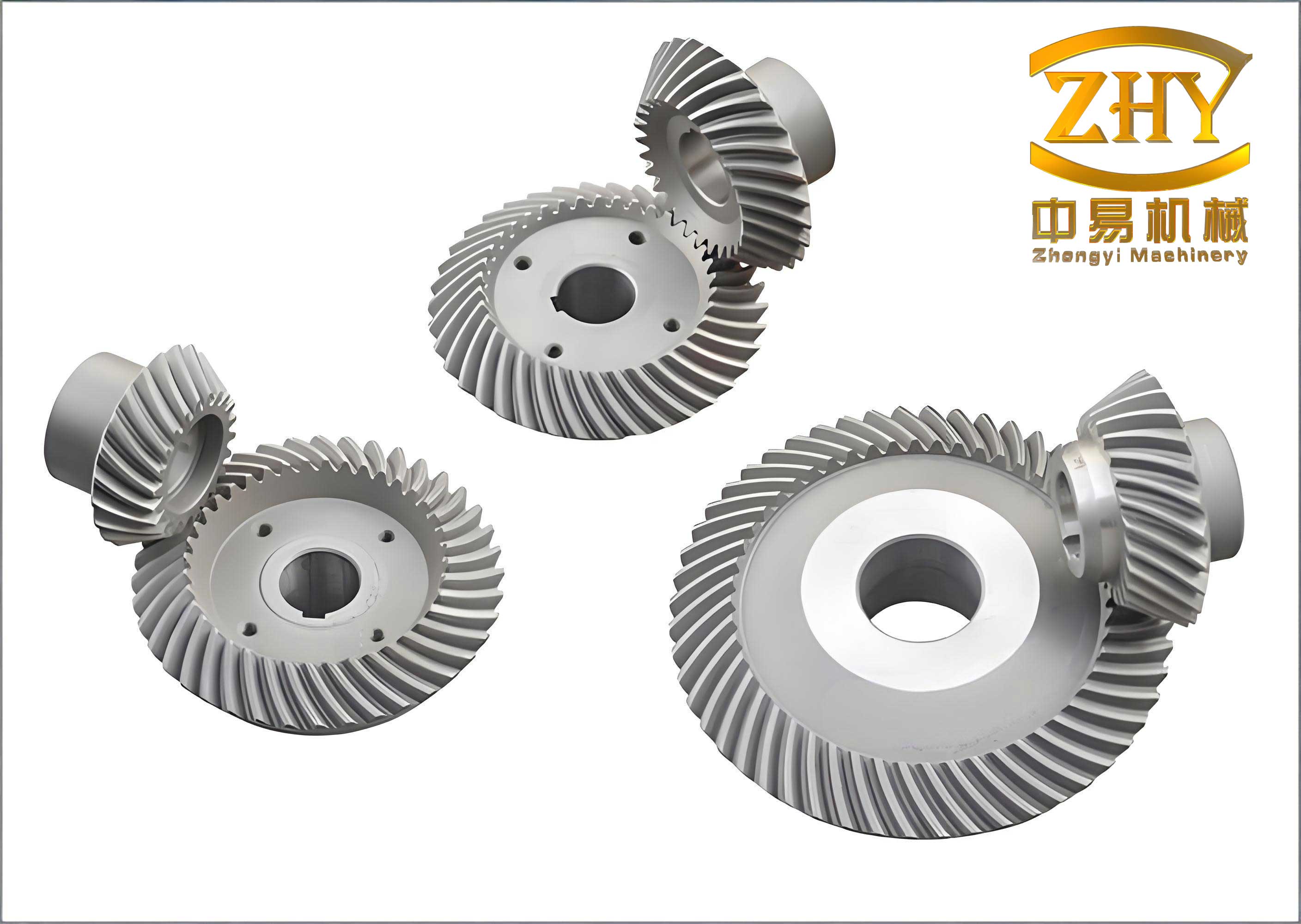
The pursuit of refinement in vehicle powertrain systems, particularly concerning noise, vibration, and harshness (NVH), places significant emphasis on the dynamic behavior of final drive components. Among these, the hyperbolic gear set, often referred to as hypoid gear, is a cornerstone of automotive drive axles. Renowned for their high load capacity, smooth power transmission, and ability to allow a lower propeller shaft placement, hyperbolic gears are the preferred choice for rear and all-wheel-drive configurations. However, their complex spatial meshing action is a primary source of gear whine, a tonal noise highly correlated with a key dynamic parameter: Transmission Error (TE).
Transmission Error is defined as the deviation of the actual angular position of the driven gear from its theoretical position, given a specific rotation of the drive gear. In an ideal, rigid gear pair with perfect geometry, the TE would be zero. In reality, manufacturing tolerances, deflections under load, and assembly misalignments cause a time-varying TE, which acts as a primary excitation force for gearbox vibration and radiated noise. For electric vehicles, where the masking effect of the internal combustion engine is absent, the control of hyperbolic gear transmission error becomes even more critical for passenger comfort. This article presents a comprehensive methodology, integrating detailed Finite Element Analysis (FEA) of a complete drive axle assembly with experimental validation on a driveline test rig, to investigate the characteristics of hyperbolic gear transmission error under varying operational loads.
Fundamentals of Hyperbolic Gear Transmission Error
The theoretical kinematic motion of a gear pair dictates a constant ratio between input and output rotation. Transmission Error quantifies the departure from this ideal motion. For a hyperbolic gear pair, it is mathematically expressed as:
$$ TE(\phi_1) = \left( \phi_2 – \phi_{2}^{(0)} \right) – \frac{Z_1}{Z_2} \left( \phi_1 – \phi_{1}^{(0)} \right) $$
where:
- $ \phi_1, \phi_2 $ are the instantaneous rotational angles of the pinion and ring gear, respectively.
- $ \phi_{1}^{(0)}, \phi_{2}^{(0)} $ are the initial reference angles.
- $ Z_1, Z_2 $ are the number of teeth on the pinion and ring gear.
The units are typically micro-radians (μrad) or arc-seconds (arcsec), with the conversion: $$ 1 \text{ arcsec} = \frac{1^\circ}{3600} \approx 4.848 \times 10^{-6} \text{ rad} $$
A designed hyperbolic gear pair aims for a specific TE curve, often a low-amplitude, symmetric parabola-like shape over one mesh cycle. The relationship between the design intent, load application, and the resulting TE is crucial:
- Light Load: TE is dominated by geometric deviations (manufacturing errors, ease-off topography).
- Medium Load: Elastic deflections of the teeth, shafts, and bearings can partially compensate for geometric errors, potentially reducing the TE amplitude.
- Heavy Load: Excessive deflection may cause the contact pattern to shift towards the tooth edges. This “edge contact” not only increases stress concentration but also alters the meshing kinematics, often leading to a significant increase in TE amplitude and dynamic excitation.
Finite Element Modeling of a Complete Drive Axle Assembly
Accurate prediction of hyperbolic gear TE necessitates modeling beyond the isolated gear pair. The compliance of the housing, bearings, and shafts significantly influences the meshing conditions. Therefore, a system-level FEA model of the entire drive axle was developed.
Model Preparation and Meshing Strategy
The 3D CAD model of the drive axle was simplified by removing non-structural components like bolts and seals. The critical components—gears, differential case, pinion shaft, ring gear carrier, axle shafts, and housing—were retained. A mixed meshing strategy was employed using specialized pre-processing software. The hyperbolic gear teeth, where high stress gradients and contact occur, were discretized with high-quality, structured hexahedral elements. Less critical volumes, such as complex regions of the housing, were filled with tetrahedral elements. The final assembly model contained approximately 500,000 elements, with the gear pair itself comprising about 200,000 elements to ensure resolution of contact stresses and tooth bending.
Material Properties and Boundary Conditions
Realistic material properties were assigned to all components, as summarized in Table 1. The model was constrained to replicate the vehicle mounting condition, with the spring seat locations on the axle housing fully fixed. Load was applied in a multi-step simulation process to ensure numerical stability and replicate real operating conditions.
| Component | Material | Young’s Modulus (GPa) | Poisson’s Ratio | Density (t/m³) |
|---|---|---|---|---|
| Axle Housing | Steel Plate | 206 | 0.30 | 7.85 |
| Differential Carrier | QT450 | 173 | 0.30 | 7.00 |
| Gears (Pinion & Ring) | 20CrMnTi | 212 | 0.30 | 7.90 |
| Bearings (Rollers/Races) | GCr15 | 208 | 0.30 | 7.81 |
Definition of Contacts and Connectors
The nonlinearity of the problem stems primarily from contact. Surface-to-surface contact was defined between the pinion and ring gear tooth flanks, using a “hard” normal contact property and a Coulomb friction model with a coefficient of 0.1. Modeling each rolling element contact in the bearings explicitly would be computationally prohibitive. Instead, connector elements (RADIAL-THRUST) were used to simulate the bearing behavior. These connectors, linking reference points coupled to the inner and outer races, define realistic stiffness in radial, axial, and torsional directions, efficiently representing the load-dependent stiffness of the bearing assembly.
Load Steps and TE Extraction
The analysis was performed using a static, implicit procedure with three sequential steps:
- Pre-load Step: A small rotation was applied to the pinion to eliminate initial gear backlash and establish stable contact, preventing rigid body motion.
- Load Application Step: A resisting torque was gradually applied to the output axle flanges, simulating the vehicle driving torque.
- Rotation Step: A finite angular displacement was imposed on the pinion input shaft, forcing the gears to mesh through several tooth engagements while under the constant resisting torque.
The time history of the pinion rotation ($\alpha$) and the resulting ring gear rotation ($\beta$) were extracted from the simulation results. The hyperbolic gear transmission error was then calculated post-processing using the simplified form of the TE equation:
$$ TE_{FEA} = \beta – \frac{Z_1}{Z_2} \alpha $$
Model Validation: Modal Analysis
Prior to transmission error analysis, the validity of the finite element model was confirmed through a correlation study with experimental modal analysis. The physical drive axle was suspended with soft bungee cords to approximate free-free boundary conditions. A roving hammer test with multiple fixed accelerometers was conducted to extract the natural frequencies and mode shapes. Table 2 compares the first six bending mode frequencies from test and simulation. The excellent correlation, with errors generally below 6%, confirms the model’s accuracy in representing the global stiffness and mass distribution of the assembly.
| Mode Description | Experimental Freq. (Hz) | FEA Freq. (Hz) | Error (%) |
|---|---|---|---|
| 1st Bending (Horizontal) | 73.6 | 78.9 | +7.2 |
| 1st Bending (Vertical) | 99.0 | 104.7 | +5.7 |
| 2nd Bending (Horizontal) | 281.9 | 270.4 | -4.1 |
| 2nd Bending (Vertical) | 343.4 | 337.6 | -1.7 |
| 3rd Bending (Horizontal) | 624.6 | 614.5 | -1.6 |
| 3rd Bending (Vertical) | 837.0 | 793.7 | -5.2 |
FEA Results: Transmission Error under Load
The validated model was used to simulate the hyperbolic gear meshing under a range of output torques, from a light load of 10 N·m up to a heavy load of 1000 N·m. The contact pattern on the ring gear evolved from a centered elliptical shape under light load to a larger, more elongated pattern under higher load, confirming realistic load sharing across multiple tooth pairs.
The computed Transmission Error curves over several mesh cycles are presented conceptually in Figure 1 (Note: This is a descriptive summary of the graphical result). The key findings are:
- Curve Shape and Offset: Under very light load (e.g., 10 N·m), the TE curve exhibits the characteristic parabolic shape. As the load torque increases, the entire TE curve shifts downward on the amplitude axis. This global offset is due to the increasing average torsional wind-up in the system (shafts, gears) under load.
- Amplitude Variation: The peak-to-peak amplitude of the TE curve shows a non-monotonic relationship with load. Initially, as torque increases from 10 N·m to approximately 500 N·m, the TE amplitude decreases. This is the manifestation of “deflection compensation,” where elastic deformations of the tooth surfaces under load help to conform the gears more closely to their intended conjugate motion, smoothing out geometric imperfections.
- Onset of Edge Contact: Beyond a certain torque threshold (around 500 N·m for this specific hyperbolic gear design), the trend reverses. The TE amplitude begins to increase with further load. Analysis of the contact pressure distribution reveals the cause: the loaded gear teeth deflect so much that the contact ellipse moves towards the toe and/or heel of the ring gear tooth, leading to edge contact. This undesirable condition creates a non-linear jump in the meshing compliance, generating a larger kinematic error. The stress concentration associated with this edge contact also poses a risk for reduced fatigue life.
This behavior is summarized in Table 3, highlighting the dual role of elastic deformation in hyperbolic gear TE performance.
| Load Condition | Torque Range | TE Curve Trend | TE Amplitude Trend | Dominant Physical Mechanism |
|---|---|---|---|---|
| Light Load | Low (~10-200 N·m) | Parabolic shape, high vertical position | High initial amplitude | Geometric errors dominate |
| Medium / Design Load | Medium (~200-500 N·m) | Shape retained, curve shifts down | Amplitude decreases (min. at ~500 N·m) | Elastic deflection compensates geometry |
| Heavy / Overload | High (>500 N·m) | Shape distortion, significant downshift | Amplitude increases | Edge contact and non-linear compliance |
Experimental Measurement of Transmission Error
To validate the FEA predictions, a dedicated test was conducted on a driveline dynamometer. Measuring the TE of a hyperbolic gear set within a complete, assembled drive axle presents specific challenges, particularly the inherent differential action which would allow the two output shafts to rotate independently under slight load variations.
Test Setup and Methodology
The drive axle was mounted on a test rig with its spring seats bolted down to simulate vehicle installation. To enable the measurement of a single, well-defined output rotation, the differential was locked by welding the side gears to the differential case. This ensured both axle shafts rotated in unison. High-resolution rotary encoders (hollow-shaft type) were installed on the pinion input shaft and on one of the output axle shafts. These encoders measured absolute angular position with extreme precision. An electric motor provided a constant input speed of 120 RPM to the pinion. Two independent dynamometers acting on the axle shafts applied precisely controlled braking torques to load the hyperbolic gear set. The test matrix covered the same torque range as the FEA study.
Data Processing and Results
The raw data consisted of synchronized time-series signals for pinion angle $\theta_p(t)$ and axle shaft angle $\theta_a(t)$. The experimental TE was calculated as:
$$ TE_{Exp}(t) = \theta_a(t) – \frac{Z_p}{Z_r} \theta_p(t) $$
where $Z_p$ and $Z_r$ are the tooth counts of the pinion and ring gear, respectively. Due to small speed fluctuations, mounting eccentricities, and other system vibrations, the raw TE signal is a complex waveform. To isolate the component primarily due to gear meshing, order tracking and spectral analysis were performed. The dominant amplitude at the gear mesh frequency (input RPM × pinion tooth count) was extracted as the characteristic TE amplitude for each load condition.
The experimental results confirmed the non-monotonic relationship between load and TE amplitude. At low torques, a measurable TE amplitude was present. As the load increased, this amplitude reduced, reaching a minimum value at a medium load level. Upon further increasing the torque into the high load range, the measured TE amplitude showed a clear increase. This trend aligns perfectly with the FEA predictions, validating the simulation model’s ability to capture the essential physics of loaded hyperbolic gear meshing, including the detrimental onset of edge contact at high loads.
| Parameter | Specification / Result |
|---|---|
| Input Speed | 120 RPM (Constant) |
| Load Torque Range | 50 N·m to 900 N·m (in steps) |
| Differential State | Locked (Welded) |
| Primary Measurement | Angular position of input and output shafts |
| Key Observed Trend | TE amplitude decreases initially with load, reaches a minimum, then increases at higher loads. |
| Agreement with FEA | Excellent qualitative and good quantitative agreement on the load-TE amplitude relationship. |
Conclusion
This integrated study combined a sophisticated system-level finite element model with rigorous experimental testing to analyze the transmission error of an automotive drive axle hyperbolic gear set. The FEA model, validated through modal correlation, successfully simulated the complex, load-dependent meshing behavior. The analysis revealed the critical interplay between geometric design and system elasticity: elastic deflections can beneficially compensate for geometric transmission error under medium loads, reducing TE amplitude. However, exceeding the design load leads to edge contact, causing a significant and detrimental increase in transmission error amplitude and associated dynamic forces.
The experimental measurements on a fully assembled axle confirmed this non-linear load-TE relationship, providing strong validation for the FEA approach. The methodology and findings underscore the importance of considering the complete system compliance—housing, bearings, and shafts—when designing or analyzing hyperbolic gears for low-noise applications. For the specific gear set studied, the results indicate an optimal operating load range. To extend the smooth, low-TE operation to higher torques, a redesign of the gear macro-geometry (ease-off) to provide a larger “design amplitude” would be necessary, intentionally creating a geometry that deflects into an optimal contact pattern under the target load. This work provides a reliable framework for optimizing hyperbolic gear performance, contributing directly to the development of quieter and more refined vehicle drivetrains, a factor of paramount importance in the era of electric mobility.