
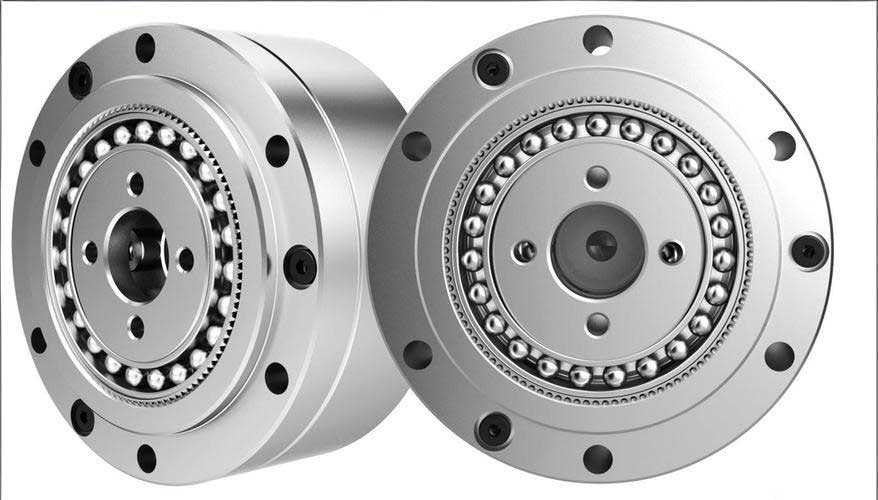
In my research on precision mechanical systems, I have focused extensively on the lubrication challenges in harmonic drive gears. These gears are critical components in various applications, such as robotics and aerospace, due to their high torque capacity and compact design. However, the unique meshing characteristics of harmonic drive gears lead to complex lubrication states at the tooth interfaces, which directly impact efficiency and wear. This article delves into a comprehensive analysis of tooth surface lubrication for harmonic drive gears, deriving formulas, presenting computational results via tables and equations, and proposing practical measures to mitigate wear. Throughout this discussion, I will emphasize the importance of lubrication in harmonic drive gears, a term I will frequently reiterate to underscore its relevance.
The lubrication mechanism in harmonic drive gears involves both sliding and squeezing motions between the flexspline and circular spline teeth. This dual motion generates a combined shear and squeeze film, which can be analyzed using superposition principles. In my work, I have developed lubrication calculation methods specifically tailored for harmonic drive gears, enabling the determination of minimum oil film thickness and film thickness ratios under varying conditions. These calculations are essential for predicting lubrication regimes and optimizing gear performance.
To begin, let me outline the fundamental equations for oil film formation in harmonic drive gears. The shear film thickness at the meshing point of each tooth pair in the load zone is given by the following formula, which accounts for relative sliding velocity and load distribution:
$$ h_{ijq}^{min} = \frac{\eta \cdot v_{rti} L C_{wi} \mu_i}{F_{ni} B_i} $$
In this equation, \( \eta \) represents the dynamic viscosity of the lubricant, \( v_{rti} \) is the relative sliding velocity between tooth surfaces, \( L \) is the tooth width in millimeters, \( B_i \) is the meshing depth for the \( i \)-th tooth pair, \( C_{wi} \) is the load coefficient defined as \( C_{wi} = \frac{6}{(a_i – 1)^2} \left[ \ln a_i – \frac{2(a_i – 1)}{a_i + 1} \right] \), where \( a_i \) is the clearance ratio of the oil wedge, and \( \mu_i \) is the end leakage factor considering tooth width, expressed as \( \mu_i = \frac{5}{4(1 + B_i^2)} \). This formulation highlights how the shear film in harmonic drive gears depends on operational parameters and lubricant properties.
Simultaneously, the squeeze film thickness at the flexspline tooth tip is derived from the squeezing motion, which becomes significant due to the varying meshing geometry in harmonic drive gears. The minimum squeeze film thickness is expressed as:
$$ h_{ijy}^{min} = – \frac{3 \beta \eta B_i^3}{F_{ni}} \left( v_{rsi} – \frac{B_i \tan \alpha_i}{2} \right) $$
Here, \( v_{rsi} \) denotes the relative squeezing velocity, \( \beta \) is the end leakage ratio, and \( \alpha_i \) is the pressure angle. The negative sign indicates that the squeeze film diminishes over time. For harmonic drive gears, the interplay between shear and squeeze films dictates the overall lubrication state, with squeeze effects often dominating due to the high contact pressures and slow sliding speeds.
To facilitate analysis, I have compiled key parameters for a typical harmonic drive gear system, such as the D120 model, into tables. These parameters are crucial for computing film thickness and assessing lubrication performance. Below is a table summarizing the geometric and operational inputs used in my calculations:
| Parameter | Symbol | Value |
|---|---|---|
| Module | \( m \) | 0.5 mm |
| Mean Pressure Angle | \( \alpha \) | 20° |
| Transmission Ratio | \( I \) | 120 |
| Number of Flexspline Teeth | \( z_1 \) | 240 |
| Number of Circular Spline Teeth | \( z_2 \) | 242 |
| Wave Generator Speed | \( n \) | 1500 rpm |
| Transmitted Torque | \( M \) | 500 N·m |
Using these parameters, I performed finite element computations to obtain coefficients required for lubrication analysis, such as load distribution and velocity profiles. The results were then applied to evaluate the minimum oil film thickness for different kinematic viscosities of industrial gear oil. The kinematic viscosity \( \nu \) is related to dynamic viscosity \( \eta \) by \( \eta = \rho \nu \), where \( \rho \) is the density, but for simplicity, I often refer to \( \nu \) directly in discussions about harmonic drive gears.
My analysis reveals that the shear film contribution in harmonic drive gears is negligible in certain regions. For instance, at the wave generator’s major axis (where relative sliding velocity is zero), the shear film thickness drops to zero. Similarly, in areas with a clearance ratio \( a_i \) close to 1, the tooth surfaces become nearly parallel, preventing wedge formation and resulting in zero shear film. For oils with kinematic viscosities of 50 and 70 mm²/s, the calculated shear film thicknesses are below \( 10^{-2} \) μm, indicating that shear-driven hydrodynamic lubrication is insufficient in harmonic drive gears under typical conditions.
In contrast, the squeeze film plays a more dominant role. I computed the squeeze film thickness for kinematic viscosities ranging from 10 to 70 mm²/s, and the results are summarized in the table below. This table highlights how viscosity influences film thickness in harmonic drive gears:
| Kinematic Viscosity \( \nu \) (mm²/s) | Maximum Squeeze Film Thickness \( h_{ijy}^{min} \) (μm) | Predominant Lubrication Region |
|---|---|---|
| 10 | ≤ 2 | Boundary Lubrication |
| 30 | ≤ 3 | Mixed Lubrication Transition |
| 50 | ≤ 3.5 | Mixed Lubrication |
| 70 | ≤ 4 | Mixed Lubrication |
From this data, it is evident that increasing the lubricant’s kinematic viscosity enhances the squeeze film thickness in harmonic drive gears. However, even at \( \nu = 70 \) mm²/s, the maximum film thickness is around 4 μm, which is relatively thin. This underscores the need for careful lubrication management in harmonic drive gears to prevent direct metal-to-metal contact and wear.
To further assess lubrication effectiveness, I calculated the film thickness ratio \( \lambda_i \), which compares the minimum oil film thickness to the combined surface roughness of the meshing teeth. The formula is:
$$ \lambda_i = \frac{h_i^{min}}{\sqrt{H_{if1}^2 + H_{if2}^2}} $$
where \( H_{if1} \) and \( H_{if2} \) are the root mean square deviations of surface roughness for the flexspline and circular spline, respectively. For gear teeth finished by gear shaping, the average arithmetic roughness \( R_a \) is typically 1.25 μm, and the conversion is \( H_{if} = 1.25 R_a \). Based on this, I derived film thickness ratios for different viscosities, as shown in the following table. This table illustrates how lubrication regimes in harmonic drive gears shift with viscosity:
| Kinematic Viscosity \( \nu \) (mm²/s) | Maximum Film Thickness Ratio \( \lambda_{max} \) | Lubrication Regime in Harmonic Drive Gears |
|---|---|---|
| 10 | < 1 | Boundary Lubrication |
| 30 | 1 to 2 | Transition to Mixed Lubrication |
| 50 | 2 to 3 | Mixed Lubrication |
| 70 | 1 to 3 | Predominantly Mixed Lubrication |
These results align with practical observations. For example, when using a low-viscosity oil (e.g., \( \nu = 10 \) mm²/s) with anti-wear additives in harmonic drive gears, efficiency may improve due to reduced friction, but tooth wear becomes severe. This confirms the boundary lubrication state predicted by the calculations. Therefore, optimizing lubrication in harmonic drive gears requires a balance between film thickness and operational constraints like temperature rise.
Building on this analysis, I propose several measures to enhance lubrication and reduce wear in harmonic drive gears. Each measure targets specific aspects of the lubrication mechanism, and their implementation can significantly extend the service life of harmonic drive gears.
First, improving lubricant viscosity is a straightforward approach. As demonstrated, higher kinematic viscosities increase both shear and squeeze film thicknesses in harmonic drive gears. To achieve a full fluid film lubrication regime with \( \lambda > 3 \), calculations suggest using oils with \( \nu \approx 140 \) mm²/s, such as 150 industrial gear oil or 150 extreme pressure gear oil. However, viscosity elevation must be managed carefully, as it can lead to higher energy losses and elevated operating temperatures in harmonic drive gears. The relationship between viscosity, film thickness, and efficiency can be expressed through the power loss equation:
$$ P_{loss} = \int \tau \cdot v \, dA $$
where \( \tau \) is the shear stress dependent on viscosity, and \( v \) is the sliding velocity. For harmonic drive gears, selecting an optimal viscosity involves trade-offs, and I recommend conducting viscosity sweep tests under realistic load conditions to identify the best compromise.
Second, establishing a robust boundary lubrication film is crucial when low-viscosity oils are used in harmonic drive gears. In boundary regimes, the protective film relies on additives that adsorb onto metal surfaces. For harmonic drive gears operating at moderate speeds and loads, oiliness additives or anti-squeeze agents can enhance boundary film strength. These additives contain polar molecules that increase adhesion, reduce friction coefficients, and prevent direct contact. The effectiveness of such additives in harmonic drive gears can be evaluated through tribological tests, measuring wear rates and friction moments. A general formula for boundary film strength considers additive concentration:
$$ S_b = k_a \cdot C_a $$
where \( S_b \) is the boundary film strength, \( k_a \) is a material-dependent constant, and \( C_a \) is the additive concentration. Implementing this in harmonic drive gears requires tailored oil formulations and validation via endurance trials.
Third, tooth profile modification, or tip relief, can ameliorate lubrication in harmonic drive gears by optimizing the squeeze film geometry. In harmonic drive gears, the flexspline tooth tip often forms a wedge shape during meshing, which hinders uniform oil distribution. By reshaping the tooth profile, the wedge angle can be adjusted to promote more consistent film thickness. Based on my squeeze film analysis, I propose a modification scheme where the tooth tip is relieved to align the film thickness along the meshing depth. The modification amount \( \Delta x \) at any point from the tooth tip is given by:
$$ \Delta x = \bar{h} – h_{min} – x \tan \alpha $$
Here, \( \bar{h} \) is the calculated film thickness at the mid-point of meshing depth, \( h_{min} \) is the minimum film thickness, \( x \) is the distance from the tooth tip, and \( \alpha \) is the wedge angle. This modification ensures that the squeeze film in harmonic drive gears is more uniformly distributed, reducing edge contact and enhancing load-carrying capacity. Combining profile modification with viscosity improvement can yield synergistic benefits for harmonic drive gears, potentially transitioning them into mixed or full-film lubrication regimes.
To further elaborate on these measures, I have developed a comprehensive table comparing their impact on lubrication performance in harmonic drive gears. This table summarizes key aspects and recommendations:
| Measure | Mechanism in Harmonic Drive Gears | Expected Benefit | Practical Consideration |
|---|---|---|---|
| Increase Lubricant Viscosity | Enhances shear and squeeze film thickness via higher \( \eta \) | Higher film thickness ratio, reduced wear | Monitor temperature rise and efficiency loss |
| Use Boundary Additives | Strengthens adsorbed film on tooth surfaces | Improved wear resistance in boundary regime | Select additives compatible with gear materials |
| Tooth Profile Modification | Optimizes wedge geometry for squeeze film | More uniform film distribution, lower contact stress | Requires precise manufacturing and tuning |
In addition to these primary measures, auxiliary strategies can support lubrication in harmonic drive gears. For instance, implementing advanced filtration systems to maintain oil cleanliness reduces abrasive wear. Moreover, temperature control through cooling mechanisms can stabilize viscosity and prevent thermal degradation in harmonic drive gears. The thermal effects on viscosity are described by the Vogel-Fulcher-Tammann equation:
$$ \eta(T) = A \cdot \exp\left(\frac{B}{T – T_0}\right) $$
where \( T \) is temperature, and \( A \), \( B \), and \( T_0 \) are constants. By managing operational temperatures, the lubrication performance of harmonic drive gears can be consistently maintained.
Another aspect worth exploring is the influence of load distribution on lubrication in harmonic drive gears. Due to the flexible nature of the flexspline, load sharing among tooth pairs is uneven, affecting local film thickness. I have modeled this using Hertzian contact theory modified for elastohydrodynamic lubrication (EHL) conditions. The reduced radius of curvature \( R’ \) for contacting teeth in harmonic drive gears is given by:
$$ \frac{1}{R’} = \frac{1}{R_1} + \frac{1}{R_2} $$
where \( R_1 \) and \( R_2 \) are the radii of curvature for flexspline and circular spline teeth, respectively. Incorporating this into film thickness calculations yields more accurate predictions for harmonic drive gears. For example, the Hamrock-Dowson formula for central film thickness in EHL contacts can be adapted:
$$ h_c = 2.69 \frac{(\eta_0 u)^{0.67} \alpha^{0.53}}{E’^{0.067} R’^{0.464} W^{0.067}} $$
Here, \( u \) is the entrainment velocity, \( \alpha \) is the pressure-viscosity coefficient, \( E’ \) is the effective elastic modulus, and \( W \) is the load per unit width. Applying this to harmonic drive gears requires iterative solutions due to the varying contact geometry, but it provides insights into how micro-elastohydrodynamic effects might supplement squeeze films.
Furthermore, material selection plays a role in wear reduction for harmonic drive gears. Using surface treatments like nitriding or coating with low-friction materials (e.g., DLC) can lower the coefficient of friction and enhance boundary lubrication. The Archard wear equation relates wear volume to operational parameters:
$$ V = k \frac{F_n s}{H} $$
where \( V \) is wear volume, \( k \) is a wear coefficient, \( F_n \) is normal load, \( s \) is sliding distance, and \( H \) is material hardness. By optimizing these factors, the wear life of harmonic drive gears can be extended. For instance, increasing surface hardness through heat treatment reduces \( k \), thereby decreasing wear in harmonic drive gears.
To validate these theoretical insights, experimental studies on harmonic drive gears are essential. In my future work, I plan to set up test rigs that simulate real-world operating conditions for harmonic drive gears, measuring film thickness using ultrasonic or capacitive sensors, and wear rates via profilometry. Such data will refine the models and measures proposed here for harmonic drive gears.
In conclusion, lubrication analysis for harmonic drive gears reveals that squeeze films predominantly govern the lubrication state, with shear films being negligible in many cases. The film thickness ratio, dependent on lubricant viscosity, dictates whether boundary, mixed, or full-film lubrication occurs in harmonic drive gears. To mitigate wear, I recommend increasing lubricant viscosity judiciously, employing boundary additives, and implementing tooth profile modifications. These measures, supported by auxiliary strategies like temperature control and material enhancements, can significantly improve the reliability and longevity of harmonic drive gears. As harmonic drive gears continue to evolve in precision applications, ongoing research into their lubrication mechanics will remain vital for advancing their performance and durability.
Throughout this article, I have emphasized the term “harmonic drive gear” to maintain focus on this critical component. The integration of theoretical formulas, tabular data, and practical recommendations provides a holistic framework for addressing lubrication challenges in harmonic drive gears. Future advancements may explore nano-lubricants or smart lubrication systems that dynamically adapt to operating conditions, further pushing the boundaries of what harmonic drive gears can achieve in modern engineering.