
In the field of high-performance precision linear actuation, the planetary roller screw assembly stands out for its exceptional load capacity, rigidity, and longevity. Among its variants, the differential planetary roller screw assembly (DPRSA) presents a unique and advanced configuration. My focus here is to delve into the critical aspect of preload torque in such assemblies. Unlike standard designs where preload primarily enhances stiffness and eliminates backlash, in a DPRSA, it is fundamentally required to generate sufficient internal friction to ensure synchronous motion and prevent skidding, especially under no-load or low-load conditions. This necessity stems directly from its distinctive spatial meshing kinematics, which introduce specific sliding phenomena. I will construct a comprehensive analytical model for preload torque, accounting for these complex interactions, and explore the influence of key design parameters.
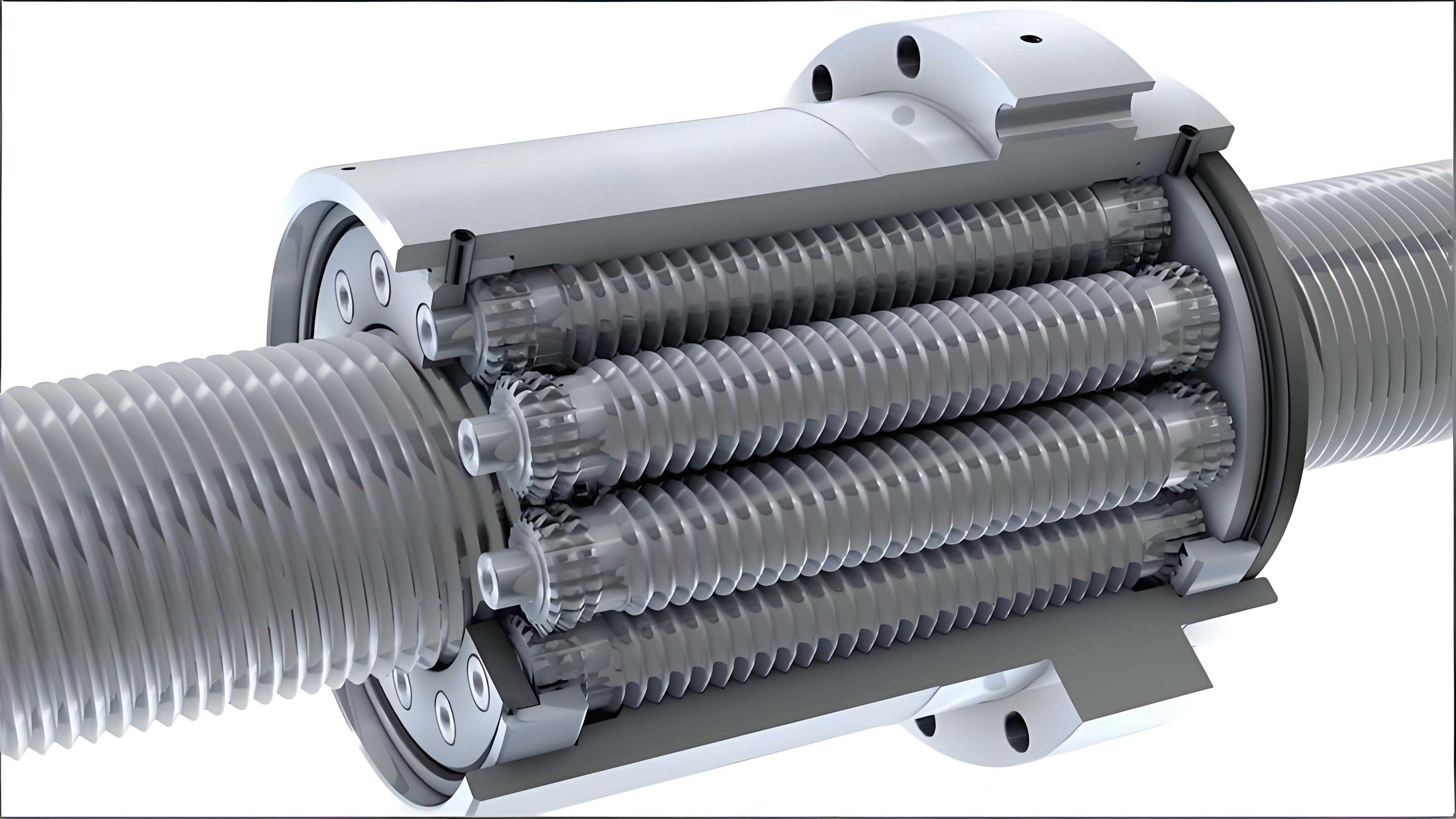
The core principle of a differential planetary roller screw assembly involves a screw, a nut, and multiple threaded rollers arranged planetarily within a cage. The key differential feature lies in the thread profiles. The rollers feature two distinct threaded sections: a major diameter segment that meshes with the screw and a minor diameter segment that meshes with the nut. Both the nut and roller engagement zones typically use circular arc (roller) and straight-sided (nut) profiles, creating an equivalent “ring groove” interface. This deliberate mismatch in effective diameters between the screw-roller and nut-roller interfaces is what creates the differential action, allowing for fine leads and high rotational speeds. However, this very geometry dictates that the points of contact between the roller and the screw are not located in the plane containing the screw and roller axes, leading to the inherent sliding mechanisms that dominate its friction behavior.
To analyze this, we must first establish the spatial meshing geometry. Let’s define a Cartesian coordinate system O-XYZ where the Z-axis coincides with the screw axis. The X-axis is directed radially outward through a roller’s axis toward the nut side. For a single roller, its engagement with the screw occurs at two symmetric points, P and P’. Its engagement with the nut occurs at points Q and Q’, which lie in the X-Z plane. Due to the screw’s helix angle, points P and P’ are symmetrically displaced on either side of the X-Z plane. The geometry is defined by several key parameters which are summarized in the table below for a representative assembly.
| Parameter Symbol | Description | Typical Value / Range |
|---|---|---|
| \( P \) | Screw Lead | 1 – 5 mm |
| \( R_s \) | Pitch Radius of Screw | 20 mm |
| \( R_n \) | Pitch Radius of Nut | 38 mm |
| \( r_{s} \) | Major Pitch Radius of Roller (screw side) | 10 mm |
| \( r_{n} \) | Minor Pitch Radius of Roller (nut side) | 8 mm |
| \( \gamma \) | Thread Profile Half-Angle | 30° – 45° |
| \( r \) | Radius of Curvature of Roller Thread Profile | 4 – 15 mm |
| \( f \) | Coefficient of Friction | 0.05 – 0.12 |
| \( E \) | Young’s Modulus (Steel) | 210 GPa |
| \( \nu \) | Poisson’s Ratio (Steel) | 0.3 |
Preload in a planetary roller screw assembly is typically applied by using oversized rollers (analogous to oversized balls in ball screws) or an oversized screw. This creates elastic deformation at all contact interfaces, generating internal contact forces even under no external load. The relationship between this deformation and the contact force is governed by Hertzian contact theory. For a general point contact, the approach \(\delta\) between two bodies is given by:
$$
\delta = \left[ \frac{9}{16} \left( \frac{1-\nu_1^2}{E_1} + \frac{1-\nu_2^2}{E_2} \right)^2 \Sigma \rho \right]^{1/3} Q^{2/3}
$$
where \(Q\) is the normal contact load and \(\Sigma \rho\) is the sum of principal curvatures. For the screw-roller and nut-roller contacts, the principal curvatures differ. For the screw-roller contact at P:
$$
\Sigma \rho_s = \frac{1}{r} + \frac{\sin \gamma}{r_s} + 0 + \frac{\sin \gamma}{R_s} = \frac{1}{r} + \sin \gamma \left( \frac{1}{r_s} + \frac{1}{R_s} \right)
$$
For the nut-roller contact at Q:
$$
\Sigma \rho_n = \frac{1}{r} + \frac{\sin \gamma}{r_n} + 0 – \frac{\sin \gamma}{R_n} = \frac{1}{r} + \sin \gamma \left( \frac{1}{r_n} – \frac{1}{R_n} \right)
$$
The contact deformation can thus be expressed as a function of the normal load:
$$
\delta_s = C_s F_{sn}^{2/3}, \quad \delta_n = C_n F_{nn}^{2/3}
$$
where \(F_{sn}\) and \(F_{nn}\) are the normal loads per thread flank at the screw and nut contacts, respectively, and \(C_s\), \(C_n\) are the contact compliance coefficients derived from the Hertz formula.
The fundamental challenge in modeling the planetary roller screw assembly’s preload torque lies in accurately characterizing the internal sliding and the resulting friction forces. Two primary types of sliding occur: meshing slippage and geometrical slippage.
Meshing Slippage at Screw-Roller Interface (Points P/P’): When the screw rotates with angular velocity \(\omega_s\), it drives the roller. However, because the contact points P and P’ are offset from the X-Z plane, the instantaneous velocities of the screw and roller at these points are not collinear. Their projections onto the X-Y plane have a relative difference, leading to a sliding velocity component \(V_{rs}\) tangential to the contact within that plane. This is the meshing slippage. Its magnitude can be derived from the kinematics. The axial component of relative velocity is simply the lead-related speed:
$$
V_z = \frac{P \cdot \omega_s}{2\pi}
$$
The in-plane sliding velocity \(V_{rs}\) is a function of the geometry. The ratio \(k\) between the in-plane and axial sliding speeds is critical:
$$
k = \frac{V_{rs}}{V_z} = \frac{P \cdot \cos \alpha}{2\pi \cdot OP \cdot \sin \beta}
$$
where \(\alpha\) and \(\beta\) are angles defined by the contact geometry. This ratio directly links the friction force components.
Geometrical Slippage at Nut-Roller Interface (Elliptical Contact Zone around Q/Q’): The contact between the roller and nut, under load, forms a Hertzian contact ellipse. When the roller rotates about the intended instantaneous center (initially point Q), different points on this contact ellipse have different velocities relative to the nut. This velocity mismatch causes a distributed sliding across the entire contact patch, known as geometrical slippage. This slippage generates a distributed friction force that opposes motion. Crucially, for the roller to be in moment equilibrium, the resultant of these distributed friction forces must balance the moments from the screw contacts. This requires the instantaneous center of rotation to shift from the geometric center Q to a point ‘c’ along the Y-axis of the contact ellipse. The offset ‘c’ is determined by the force equilibrium condition.
Now, let’s perform a detailed force and moment balance analysis on a single roller. The roller is subjected to forces and moments at four contact zones: two with the screw (P, P’) and two with the nut (Q, Q’).
1. Forces and Moments from Screw Contacts (P & P’):
At point P, the screw exerts a normal force \(F_{sn}\) and a friction force \(F_f\). Due to the sliding ratio \(k\), the friction force has components:
$$
F_{fxy} = \frac{F_{sn} \cdot f}{\sqrt{1+k^2}}, \quad F_{fz} = k \cdot F_{fxy}
$$
The normal force \(F_{sn}\) has a direction defined by the surface normal vector \(\vec{n}\) at P. Its components are:
$$
F_{nz} = F_{sn} \cdot \cos(n_z), \quad F_{nxy} = F_{sn} \cdot \sin(n_z)
$$
These forces create moments about the roller’s axis (the line QQ’). The friction force component \(F_{fxy}\) has a moment arm \(L_f = QP \cdot \sin \alpha\). The normal force component \(F_{nxy}\) has a moment arm \(L_n\), which is the perpendicular distance from the roller axis to its line of action. Due to symmetry, the forces and moments from P’ are of equal magnitude but have specific directional changes. The net axial force from both screw contacts must be zero for the roller’s axial equilibrium:
$$
F_{nz} – F_{fz} – F’_{nz} – F’_{fz} = 0
$$
This equation, combined with the Hertzian deformation compatibility condition \(\delta_s = \delta_n\) (which relates \(F_{sn}\) and \(F’_{sn}\) to the preload deformation), allows solving for the individual flank loads \(F_{sn}\) and \(F’_{sn}\).
2. Moments from Nut Contacts (Elliptical Zones around Q & Q’):
The geometrical slippage in the contact ellipses generates a resisting friction torque \(M_Q\). The pressure distribution over the ellipse is semi-ellipsoidal:
$$
p(x,y) = p_0 \sqrt{1 – \frac{x^2}{a^2} – \frac{y^2}{b^2}}
$$
where \(p_0\) is the maximum Hertzian pressure and \(a, b\) are the semi-axes of the contact ellipse. The friction force at an infinitesimal area \(dA\) is \(dF_f = f \cdot p(x,y) \cdot dA\). This force, acting at a distance \(L_m = \sqrt{x^2 + (y-c)^2}\) from the shifted instantaneous center ‘c’, creates a moment \(dM = L_m \cdot dF_f\). The total friction torque from one nut contact ellipse is the integral over the area \(\Omega\):
$$
M_Q = \iint_{\Omega} f \cdot p_0 \sqrt{1 – \frac{x^2}{a^2} – \frac{y^2}{b^2}} \cdot \sqrt{x^2 + (y-c)^2} \, dx \, dy
$$
By symmetry, \(M_Q = M_{Q’}\).
3. Roller Equilibrium Equations:
For the roller to be in steady-state rotation, the sum of moments about its axis must be zero, and the sum of axial forces must be zero. The moment equilibrium equation is:
$$
N_s \left( M_{n} – M’_{n} – M_{f} – M’_{f} \right) = 2 N_n M_Q
$$
Here, \(N_s\) is the number of active thread flanks per roller on the screw side (usually 2), and \(N_n\) is the same for the nut side (usually 2). \(M_n, M’_n, M_f, M’_f\) are the moments from the normal and friction forces at P and P’ about the roller axis. This complex equation, combined with the force equilibrium and Hertzian compatibility equations, forms a system that can be solved numerically (e.g., using the Newton-Raphson method) for the unknown contact loads \(F_{sn}, F’_{sn}, F_{nn}\) and the shift ‘c’, given a total applied preload \(F_{pre}\).
4. Total Preload Torque on the Screw:
Finally, the preload torque \(T_{pre}\) that must be applied to the screw to overcome the internal friction is calculated by summing the moments from all roller contacts on the screw. For each contact point P (and P’), the screw experiences reaction forces \(-F_{fxy}\) and \(-F_{nxy}\). These forces act at a radial distance from the screw axis. The total torque is:
$$
T_{pre} = N_r \cdot N_s \left[ F_{fxy} \cdot L_{sf} + F’_{fxy} \cdot L’_{sf} + (F_{nxy} – F’_{nxy}) \cdot L_{sn} \right]
$$
where \(N_r\) is the number of rollers, \(L_{sf}\) is the moment arm for the screw friction force (approximately \(OP\)), and \(L_{sn}\) is the moment arm for the screw normal force component. For symmetric geometry, \(L_{sf}=L’_{sf}\) and \(L_{sn}=L’_{sn}\).
To illustrate the model’s application and the parametric trends, let’s consider a numerical example with the parameters from the table and a preload force \(F_{pre} = 1000\,N\). The following results are derived from solving the system of equilibrium equations.
Effect of Lead (\(P\)): The lead is a primary driver of the helix angle and thus the sliding kinematics. The preload torque increases significantly with lead, as shown conceptually below:
| Lead, \(P\) (mm) | Relative Preload Torque \(T_{pre}\) |
|---|---|
| 1.0 | 1.0 (Baseline) |
| 2.0 | ~ 1.8 x Baseline |
| 3.0 | ~ 2.7 x Baseline |
The relationship is nearly linear for a fixed preload because a larger lead increases the axial sliding component \(V_z\) and alters the ratio \(k\), amplifying the friction force components that contribute to the torque. This is a critical design trade-off in a planetary roller screw assembly: a finer lead reduces preload torque and may improve efficiency but might compromise other factors like maximum speed or resolution.
Effect of Thread Profile Angle (\(2\gamma\)): The thread profile angle influences the contact curvature sum and the orientation of the normal force vector. While a smaller angle increases the normal force for a given preload deformation (due to stiffer contact), it also increases the offset of the contact point, lengthening the moment arms \(L_f\) and \(L_n\). The net effect, as observed in the model, is that preload torque generally decreases as the profile angle increases from 60° to 90°, tending to flatten out at higher angles. An angle in the range of 70°-80° often provides a good compromise between torque, load capacity, and manufacturability for a differential planetary roller screw assembly.
Effect of Roller Profile Radius (\(r\)): The radius of curvature \(r\) of the roller thread profile is a crucial Hertzian parameter. It directly affects the contact ellipse dimensions and the pressure distribution. The model reveals a non-monotonic relationship between \(r\) and \(T_{pre}\). There typically exists an optimal value (for the given example, near \(r = 10\,mm\)) that minimizes the preload torque. At smaller \(r\), the contact is more conformal, increasing the geometrical slippage area and friction torque. At very large \(r\), the contact approaches a line-like condition, altering the pressure distribution and potentially increasing meshing friction components. This optimization is unique to the planetary roller screw assembly’s specific geometry and must be evaluated during design.
The complete mathematical model for the preload torque in a differential planetary roller screw assembly integrates several key equations:
1. Kinematic Ratio:
$$
k = \frac{P \cos \alpha}{2\pi R_s \sin \lambda \sin \beta}
$$
where \(\lambda\) is the screw helix angle at \(R_s\).
2. Screw-Roller Friction Force Components:
$$
F_{fxy} = \frac{F_{sn} f}{\sqrt{1+k^2}}, \quad F_{fz} = k F_{fxy}
$$
3. Force Equilibrium (Z-direction per roller):
$$
F_{sn}\cos(n_z) – F’_{sn}\cos(n_z) – F_{fz} – F’_{fz} = 0
$$
4. Deformation Compatibility (Hertz):
$$
C_s F_{sn}^{2/3} + C_n F_{nn}^{2/3} = C_s (F’_{sn})^{2/3} + C_n (F’_{nn})^{2/3} = \Delta
$$
where \(\Delta\) is the total preload-induced elastic approach.
5. Global Preload Force:
$$
F_{pre} = N_r \left( F_{nn} + F’_{nn} \right) \sin \gamma \quad \text{(approximate relation)}
$$
6. Roller Moment Equilibrium:
$$
\left[ F_{nxy} L_n – F’_{nxy} L_n – F_{fxy} L_f – F’_{fxy} L_f \right] = 2 M_Q(F_{nn}, a, b, c)
$$
7. Preload Torque Final Expression:
$$
T_{pre} = N_r N_s \left[ 2 F_{fxy} L_{sf} + (F_{nxy} – F’_{nxy}) L_{sn} \right]
$$
In conclusion, the preload torque in a differential planetary roller screw assembly is not a simple linear function of preload force. It is the result of a complex interplay between spatial meshing kinematics, Hertzian contact mechanics, and tribological sliding at two distinct interfaces. The model presented here, which carefully accounts for both meshing slippage at the screw-roller interface and geometrical slippage at the nut-roller interface, provides a robust framework for its prediction. The analysis confirms that preload torque increases proportionally with the applied preload and more significantly with the screw lead. It also identifies the thread profile angle and the roller profile radius as key design parameters that can be optimized to minimize the no-load friction torque, thereby improving the efficiency of the planetary roller screw assembly. This understanding is fundamental for the design of high-performance actuation systems in demanding aerospace, robotic, and precision industrial applications where predictable friction, high stiffness, and reliable motion are paramount. Future work integrating thermal effects and detailed lubricant rheology into this mechanical model would further enhance its predictive accuracy for real-world operating conditions.