
The operational performance and longevity of heavy-duty rotary hydraulic actuators are critically dependent on the efficiency and stability of their power transmission core. A key design employs a two-stage spiral gears mechanism to convert linear piston motion into high-torque rotary output. During operation, a pressurized hydraulic oil film forms within the clearance of these meshing spiral gears. The characteristics of this film—its pressure distribution, flow dynamics, and load-bearing capacity—directly govern the transmission efficiency, leakage losses, and overall mechanical performance of the actuator. Therefore, a detailed analysis of the oil film behavior within the spiral gears pair is paramount for achieving optimal design. This work focuses on investigating the relationship between the circumferential clearance of the spiral gears and the resulting oil film properties, ultimately aiming to identify an optimal clearance value and suitable hydraulic fluid to maximize actuator performance under high-pressure, low-speed, and high-load conditions.
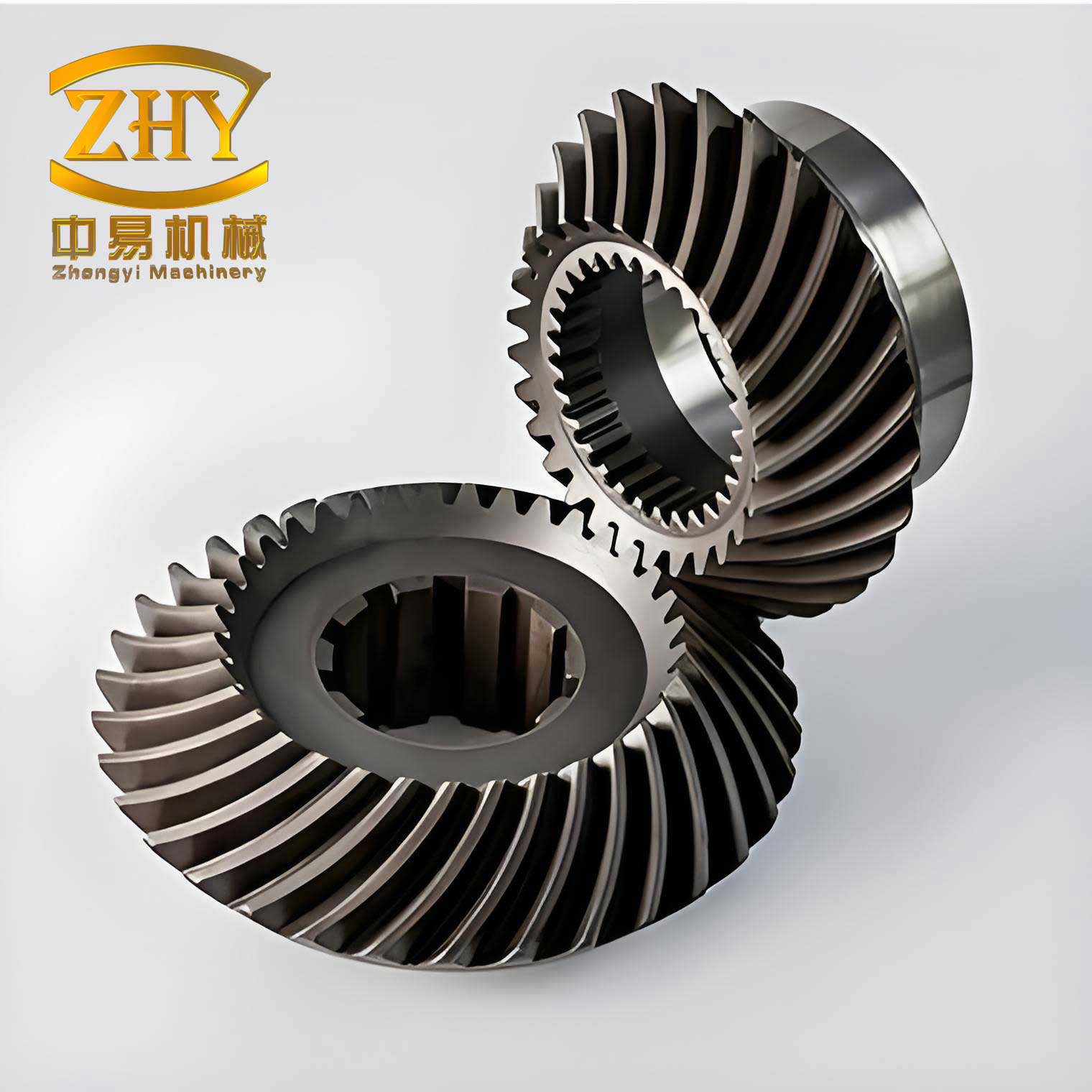
The fundamental working principle relies on the interaction between two pairs of spiral gears. A hollow screw, featuring external and internal threads of opposite hand, interfaces with a stationary threaded sleeve (forming the first-stage pair) and a rotating output shaft (forming the second-stage pair). Pressurizing one side of the piston forces the hollow screw to translate. Due to the helix angles of the spiral gears, this translation is converted into rotation of the hollow screw via the first stage, which in turn drives the output shaft via the second stage, resulting in a large rotary output from a short linear stroke. The clearance between the mating flanks of these spiral gears is filled with hydraulic oil, creating a complex, three-dimensional flow path. The lubrication regime is hybrid, combining hydrostatic pressure from the system and hydrodynamic pressure generated by the relative motion of the gear surfaces.
To analyze this system, governing equations for fluid flow are applied. For an incompressible fluid, the mass conservation (continuity) equation is:
$$\frac{\partial u_x}{\partial x} + \frac{\partial u_y}{\partial y} + \frac{\partial u_z}{\partial z} = 0$$
where $u_x$, $u_y$, and $u_z$ are velocity components in the Cartesian coordinate directions. The momentum conservation equations (Navier-Stokes) for a Newtonian fluid are:
$$\frac{\partial (\rho u_x)}{\partial t} + \nabla \cdot (\rho u_x \vec{v}) = -\frac{\partial p}{\partial x} + \frac{\partial \tau_{xx}}{\partial x} + \frac{\partial \tau_{yx}}{\partial y} + \frac{\partial \tau_{zx}}{\partial z} + F_x$$
$$\frac{\partial (\rho u_y)}{\partial t} + \nabla \cdot (\rho u_y \vec{v}) = -\frac{\partial p}{\partial y} + \frac{\partial \tau_{xy}}{\partial x} + \frac{\partial \tau_{yy}}{\partial y} + \frac{\partial \tau_{zy}}{\partial z} + F_y$$
$$\frac{\partial (\rho u_z)}{\partial t} + \nabla \cdot (\rho u_z \vec{v}) = -\frac{\partial p}{\partial z} + \frac{\partial \tau_{xz}}{\partial x} + \frac{\partial \tau_{yz}}{\partial y} + \frac{\partial \tau_{zz}}{\partial z} + F_z$$
where $\rho$ is density, $p$ is pressure, $\tau_{ij}$ are viscous stress components, and $F_i$ are body forces. For thermal effects, the energy equation may be considered, but for an initial isothermal analysis focused on flow mechanics, the energy equation is often omitted. The dynamic pressure $p_d$, representing the kinetic energy contribution to support, is given by:
$$p_d = \frac{1}{2} \rho v^2$$
where $v$ is the local flow velocity. The stiffness $K$ of the oil film, a critical indicator of its load-carrying capacity and positional stability, is defined as the change in supporting force $F$ per unit change in film gap $h$:
$$K = \frac{\partial F}{\partial h}$$
To solve these equations for the complex geometry of the spiral gears clearance, Computational Fluid Dynamics (CFD) is employed. Three-dimensional models of the oil film domain were created for six different uniform circumferential clearance values: 0.05 mm, 0.10 mm, 0.15 mm, 0.20 mm, 0.25 mm, and 0.30 mm. The models were discretized using a high-quality swept mesh, with local refinement in the thin film region, resulting in approximately 2.5 million cells to ensure accuracy. The fluid was modeled as incompressible with constant properties. The standard $k$-$\epsilon$ turbulence model was selected for its robustness and computational efficiency in modeling internal flows. Boundary conditions included a pressure inlet (21 MPa), a pressure outlet (1.5 MPa), a rotating wall for the inner gear surface (60 RPM), and a stationary wall for the outer surface. The pressure-velocity coupling was solved using the COUPLED algorithm.
| Parameter | Value / Description |
|---|---|
| Spiral Gears Model | Two-stage, opposite hand |
| Clearances Analyzed (h) | 0.05, 0.10, 0.15, 0.20, 0.25, 0.30 mm |
| Base Fluid (Default) | ISO VG 32 Hydraulic Oil |
| Density ($\rho$) | 889 kg/m³ |
| Kinematic Viscosity ($\nu$) | 32 mm²/s |
| Inlet Pressure | 21 MPa |
| Outlet Pressure | 1.5 MPa |
| Inner Wall Speed | 60 RPM |
| Turbulence Model | Standard $k$-$\epsilon$ |
The CFD simulations revealed distinct flow field characteristics. The pressure distribution showed a clear gradient from the high-pressure inlet to the low-pressure outlet. The maximum pressure was consistently at the inlet (~21 MPa), and the minimum at the outlet (~1.2 MPa). The shape of the spiral gears clearance had a negligible effect on the overall pressure contour pattern. The velocity field, however, was significantly influenced by the clearance size. The maximum axial flow velocity within the film exhibited a non-linear relationship with clearance, as summarized below:
| Clearance, h (mm) | Max Axial Velocity (m/s) | Dynamic Pressure, $p_d$ (MPa) | Flow Rate (L/min) | Film Stiffness, K (N/m) | Torque on Wall (N·m) |
|---|---|---|---|---|---|
| 0.05 | ~3.8 | ~6.4 | 0.85 | 4.82e8 | ~1250 |
| 0.10 | ~4.5 | ~9.2 | 2.10 | 3.15e8 | ~1850 |
| 0.15 | ~4.3 | ~8.2 | 3.65 | 1.98e8 | ~2350 |
| 0.20 | ~4.0 | ~7.1 | 5.80 | 1.20e8 | ~2700 |
| 0.25 | ~3.7 | ~6.1 | 8.50 | 0.88e8 | ~2750 |
| 0.30 | ~3.4 | ~5.1 | 11.90 | 0.72e8 | ~2780 |
The data indicates that velocity and dynamic pressure peak at a clearance around 0.10 mm to 0.15 mm, suggesting optimal hydrodynamic lubrication conditions in this range. However, other factors are crucial. The transmitted torque increases with clearance but plateaus significantly beyond 0.20 mm, offering diminishing returns. Conversely, the flow rate (directly related to internal leakage) increases dramatically with clearance, adversely affecting volumetric efficiency. Most critically, the oil film stiffness, essential for precise positioning and load support, decreases monotonically with increasing clearance. The rate of stiffness degradation slows after 0.20 mm. Therefore, selecting the optimal clearance involves a multi-objective trade-off: maximizing torque transmission while minimizing leakage and maintaining adequate film stiffness. Based on this analysis, a clearance of h = 0.20 mm represents a balanced optimum, providing high torque (near the plateau), manageable leakage, and reasonably high stiffness before its steep decline.
The performance of the spiral gears assembly is also highly sensitive to the viscosity of the hydraulic fluid. To investigate this, simulations were conducted with the optimal 0.20 mm clearance using four common ISO viscosity grades (VG). The results demonstrate clear trends related to fluid viscosity.
| Oil Grade (ISO VG) | Kinematic Viscosity, $\nu$ (mm²/s) | Avg. Flow Velocity (m/s) | Flow Rate (L/min) | Film Stiffness, K (N/m) |
|---|---|---|---|---|
| 22 | 22 | 4.25 | 6.35 | 1.05e8 |
| 32 | 32 | 4.00 | 5.80 | 1.20e8 |
| 46 | 46 | 3.65 | 5.10 | 1.15e8 |
| 68 | 68 | 3.20 | 4.40 | 1.02e8 |
The analysis shows that as viscosity increases, the average flow velocity and volumetric flow rate (leakage) within the spiral gears clearance decrease. This reduction in leakage improves the volumetric efficiency of the actuator. However, the relationship between viscosity and film stiffness is non-monotonic. Stiffness increases from VG 22 to VG 32, peaks around VG 32-46, and then decreases for VG 68. Higher viscosity fluids experience greater shear-related friction losses, which can reduce mechanical efficiency. For the typical operating regime of these actuators—high pressure, low speed, and high load—the primary goals are to minimize internal leakage for power density and maintain high film stiffness for positional accuracy and load capacity. While higher viscosity reduces leakage, excessively high viscosity can lead to poor mechanical efficiency and potentially lower stiffness due to altered flow dynamics. Therefore, a mid-range viscosity fluid like ISO VG 32 is recommended. It offers a favorable balance, providing relatively low leakage, near-maximum film stiffness, and acceptable mechanical friction losses, contributing to the overall optimal performance of the rotary actuator employing two-stage spiral gears.
In conclusion, this detailed numerical investigation into the oil film dynamics of a two-stage spiral gears transmission provides critical design insights. The circumferential clearance between the mating spiral gears is a dominant parameter. A clearance of 0.20 mm is identified as an optimal compromise, yielding high torque transmission, sufficient oil film stiffness, and acceptable internal leakage levels. Furthermore, the choice of hydraulic fluid significantly impacts performance. An ISO VG 32 grade oil is recommended to achieve an optimal balance between minimizing leakage, maximizing film load-bearing capacity (stiffness), and maintaining good mechanical efficiency. These findings, derived from rigorous CFD modeling of the complex flow within the spiral gears engagement, offer practical guidance for the design and optimization of high-performance rotary hydraulic actuators, ensuring their reliability and efficiency in demanding industrial applications. Future work could explore the impact of non-uniform clearances, thermal effects on viscosity, and transient dynamic behavior during start-up and reversal of the spiral gears mechanism.