
The pursuit of higher power density, efficiency, and reliability in modern mechanical transmissions places stringent demands on gear lubrication systems. For high-speed applications, oil jet lubrication is the predominant method, serving the dual critical functions of reducing friction and wear at the meshing interface and dissipating the significant heat generated. The efficacy of this lubrication is not merely a function of the oil properties but is profoundly influenced by the complex, transient interaction between the injected oil jet and the high-velocity air flow field generated by the rotating gears. This aerodynamic interaction, often termed the “air barrier” or “windage” effect, can deflect or atomize the oil jet, severely hindering its ability to penetrate the gear mesh and deliver lubricant to the critical contact zones. Therefore, a deep understanding of this multiphase flow phenomenon is essential for the optimal design of lubrication systems.
This analysis focuses on a specific and advanced type of cylindrical gear: the cylindrical gear with a Variable Hyperbolic Circular-Arc-Tooth-Trace (VH-CATT). Unlike standard involute spur or helical gears, this cylindrical gear features a longitudinally curved tooth trace in the form of a circular arc, while its transverse profile is derived from an enveloping family of variable hyperbolas. This unique geometry of the cylindrical gear results in localized point contact under no load, which spreads into an elliptical area under operational loads, offering potential benefits in load distribution and misalignment tolerance. However, this non-standard, three-dimensional tooth surface geometry of the cylindrical gear fundamentally alters the surrounding airflow patterns during high-speed operation. The curved tooth faces act like impellers, generating a complex, three-dimensional air velocity field that differs significantly from that of conventional cylindrical gears. This unique aerodynamic environment necessitates a specialized investigation into how the oil jet lubrication performs for this particular cylindrical gear design.
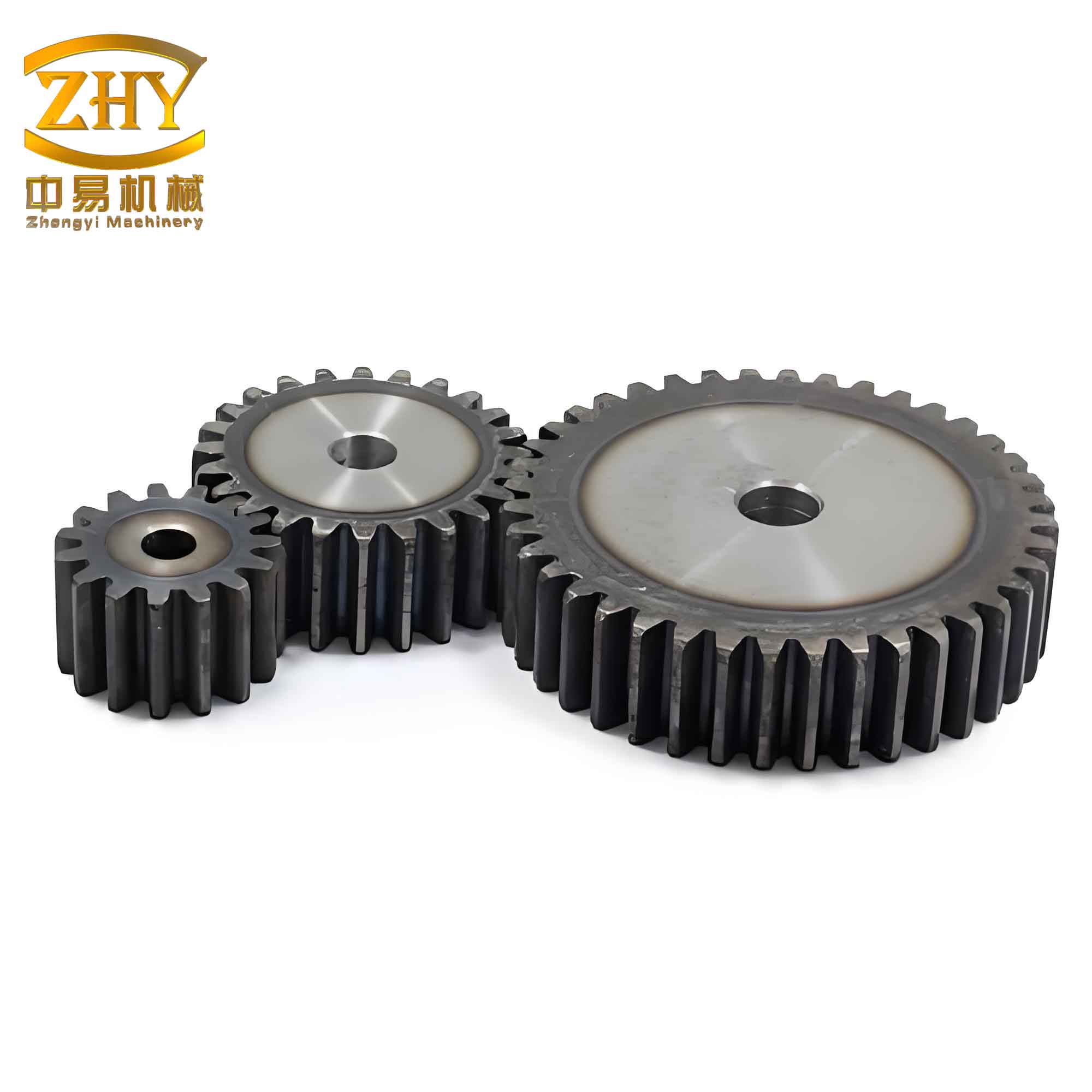
The primary objective of this work is to investigate the lubrication performance of oil jet lubrication for the VH-CATT cylindrical gear pair using Computational Fluid Dynamics (CFD). We aim to elucidate the mechanism by which the special tooth form of this cylindrical gear influences the airflow and consequently the oil jet trajectory and deposition. A key goal is to identify the optimal jet orientation that minimizes aerodynamic interference. Furthermore, we will systematically analyze the impact of key operational parameters—including injection velocity, nozzle distance (height), and gear rotational speed—on lubrication effectiveness. The findings will provide a theoretical foundation for designing and optimizing the lubrication and cooling systems for this advanced cylindrical gear transmission.
Mathematical Foundation of the VH-CATT Cylindrical Gear
The unique tooth surface of the VH-CATT cylindrical gear is generated via a dual-cutter head in a specific machining process. One cutter forms the convex flank, while the other forms the concave flank. The mathematical model is derived using gear generation theory and coordinate transformations. The fundamental coordinate systems include a static frame attached to the cutter axis (\(o_1 – x_1, y_1, z_1\)), a rotating frame attached to the cutter (\(o_c – x_c, y_c, z_c\)), a static frame attached to the gear blank axis (\(o_i – x_i, y_i, z_i\)), and a rotating frame attached to the finished gear (\(o_d – x_d, y_d, z_d\)), where \(i = p, g\) denotes the pinion and gear respectively.
The surface position vector \(\mathbf{r}_i^{(d)}\) and unit normal vector \(\mathbf{n}_i^{(d)}\) for the gear tooth flanks in the gear rotating coordinate system are given by the following transformation:
$$\begin{cases}
\mathbf{r}_i^{(d)}(u_i, \theta_i, \phi_i) = \mathbf{M}_{di}(\phi_i) \mathbf{M}_{i1}(\theta_i) \mathbf{r}_1(u_i, \theta_i) \\
\mathbf{n}_i^{(d)}(u_i, \theta_i, \phi_i) = \mathbf{L}_{di}(\phi_i) \mathbf{L}_{i1}(\theta_i) \mathbf{n}_1(u_i, \theta_i)
\end{cases}$$
Here, \(u_i\) and \(\theta_i\) are the cutter surface parameters, \(\phi_i\) is the gear rotation angle, \(\mathbf{M}_{di}\) and \(\mathbf{L}_{di}\) are the coordinate transformation matrices for position and orientation from the gear static to the gear rotating frame, and \(\mathbf{M}_{i1}\) and \(\mathbf{L}_{i1}\) are the matrices from the cutter static to the cutter rotating frame. Solving these equations within defined parameter ranges yields the point cloud data for the cylindrical gear tooth surface, which can be used to construct a solid 3D model for simulation.
Contact Characteristics and Lubrication Assessment Zone
The contact between the convex pinion flank and the concave gear flank in this cylindrical gear pair is theoretically a point contact. Under load, due to elastic deformation, this contact point expands into an elliptical area. The size and orientation of this contact ellipse are determined by the principal curvatures and directions of the two contacting surfaces. The equation defining the contact ellipse boundary is:
$$A x^2 + B y^2 = \delta$$
where \(\delta\) is the normal deformation at the contact point. The coefficients \(A\) and \(B\) are functions of the surface curvatures:
$$A = \frac{1}{4}(g_p^2 + g_g^2 – 2g_p g_g \cos 2\sigma) + (K_{\Sigma p} – K_{\Sigma g})^2$$
$$B = \frac{1}{4}(g_p^2 + g_g^2 + 2g_p g_g \cos 2\sigma) + (K_{\Sigma p} – K_{\Sigma g})^2$$
with \(K_{\Sigma i} = K_{1i} + K_{2i}\) and \(g_i = K_{1i} – K_{2i}\) for \(i = p, g\). \(\sigma\) is the angle between the principal directions of the two surfaces. The semi-major axis \(a\), semi-minor axis \(b\), and the orientation angle \(\alpha_p\) of the ellipse relative to the pinion’s principal direction are:
$$a = \sqrt{\delta / A}, \quad b = \sqrt{\delta / B}, \quad \tan 2\alpha_p = \frac{g_g \sin 2\sigma}{g_p – g_g \cos 2\sigma}$$
To quantitatively assess lubrication performance in simulations, the Tooth Contact Analysis (TCA) technique is used to identify the complete path of contact on the cylindrical gear tooth surface over a mesh cycle. A representative section of this path is defined as a “probe surface” or “inspection surface.” Key metrics such as the average oil volume fraction and pressure distribution on this surface are extracted to evaluate the lubricant delivery effectiveness to the meshing zone of the cylindrical gear.
Theoretical Model for Oil Jet Lubrication Flow
The analysis of the oil-air multiphase flow during jet lubrication of the cylindrical gear is performed using an Eulerian multiphase framework, specifically the Volume of Fluid (VOF) model. This model solves a single set of momentum equations for the fluid mixture while tracking the volume fraction of each phase (oil and air) throughout the domain. No chemical reactions or heat transfer are considered in this isothermal analysis.
The governing equations are as follows. The sum of volume fractions for all phases is unity:
$$\sum_{\alpha=1}^{N} r_\alpha = 1$$
where \(r_\alpha\) is the volume fraction of phase \(\alpha\), and \(N=2\). The mixture density \(\rho\) is \(\rho = \sum r_\alpha \rho_\alpha\).
The continuity equation for the mixture is:
$$\frac{\partial \rho}{\partial t} + \nabla \cdot (\rho \mathbf{U}) = 0$$
The momentum conservation equation for the mixture is:
$$\frac{\partial (\rho \mathbf{U})}{\partial t} + \nabla \cdot (\rho \mathbf{UU}) = -\nabla p + \nabla \cdot \left[ \mu (\nabla \mathbf{U} + \nabla \mathbf{U}^T) \right] + \rho \mathbf{g} + \mathbf{F}$$
Here, \(p\) is pressure, \(\mathbf{U}\) is the velocity vector, \(\mu\) is the dynamic viscosity of the mixture, \(\mathbf{g}\) is gravity, and \(\mathbf{F}\) represents external body forces.
To model turbulence, the standard \(k\)-\(\epsilon\) model is employed. The turbulent viscosity \(\mu_t\) is calculated as:
$$\mu_t = \rho C_\mu \frac{k^2}{\epsilon}$$
where \(C_\mu\) is a model constant. The transport equations for turbulent kinetic energy \(k\) and its dissipation rate \(\epsilon\) are:
$$\begin{aligned}
\frac{\partial (\rho k)}{\partial t} + \frac{\partial (\rho k u_i)}{\partial x_i} &= \frac{\partial}{\partial x_j}\left[ \left( \mu + \frac{\mu_t}{\sigma_k} \right) \frac{\partial k}{\partial x_j} \right] + G_k + G_b – \rho \epsilon – Y_M + S_k \\
\frac{\partial (\rho \epsilon)}{\partial t} + \frac{\partial (\rho \epsilon u_i)}{\partial x_i} &= \frac{\partial}{\partial x_j}\left[ \left( \mu + \frac{\mu_t}{\sigma_\epsilon} \right) \frac{\partial \epsilon}{\partial x_j} \right] + C_{1\epsilon}\frac{\epsilon}{k}(G_k + C_{3\epsilon}G_b) – C_{2\epsilon}\rho\frac{\epsilon^2}{k} + S_\epsilon
\end{aligned}$$
In these equations, \(G_k\) represents the generation of turbulence kinetic energy due to mean velocity gradients, \(G_b\) is the generation due to buoyancy (neglected here), \(Y_M\) represents compressibility effects, and \(\sigma_k\), \(\sigma_\epsilon\), \(C_{1\epsilon}\), \(C_{2\epsilon}\), \(C_{3\epsilon}\) are model constants. \(S_k\) and \(S_\epsilon\) are user-defined source terms.
To simulate the rotation of the cylindrical gears, dynamic meshing is employed. User-Defined Functions (UDF) prescribe the rotational motion, and the spring-based smoothing method updates the mesh nodes in the deforming regions to prevent excessive distortion. The displacement \(\Delta x_i\) of a node \(i\) is based on Hooke’s law from its connected springs:
$$\Delta x_i = \frac{\sum_{j}^{n_i} k_{ij} \Delta x_j}{\sum_{j}^{n_i} k_{ij}}$$
where \(n_i\) is the number of neighboring nodes, \(k_{ij}\) is the spring constant, and \(\Delta x_j\) is the displacement of the neighboring node. The node position is updated each time step as \(x_i^{n+1} = x_i^n + \Delta x_i^{converged}\).
CFD Simulation Model Setup
The analysis focuses on lubrication from the gear mesh entry side. The geometric and operational parameters for the VH-CATT cylindrical gear pair are summarized in Table 1.
| Parameter | Pinion | Gear |
|---|---|---|
| Number of Teeth, \(z\) | 21 | 29 |
| Module, \(m\) (mm) | 4 | 4 |
| Pressure Angle, \(\alpha_0\) (°) | 20 | 20 |
| Rotational Speed, \(n\) (rpm) | 6000 | 4345 |
| Center Distance, \(a\) (mm) | 100 | |
| Face Width, \(B\) (mm) | 40 | 40 |
| Nozzle Diameter, \(D\) (mm) | 5 | |
| Oil Density, \(\rho_{oil}\) (kg/m³) | 960 | |
| Injection Height, \(d\) (mm) | 45 (Baseline) | |
| Injection Velocity, \(v_{inj}\) (m/s) | 60 (Baseline) | |
The injection layout is defined by two key parameters: the injection height \(d\), which is the distance from the nozzle to the line of centers, and the injection angle \(\alpha\), defined relative to the tangent line at the pitch point. The fluid domain encompassing the gear pair and housing is modeled in the CFD software. To prevent severe mesh distortion in the tight meshing zone during gear rotation, a small clearance is virtually created by slightly offsetting the tooth surfaces. The computational mesh is unstructured, with local refinement applied around the nozzle and the gear teeth to accurately capture the jet development and gear surface interaction. The mesh model for the gearbox is constructed accordingly.
Determination and Validation of Optimal Injection Angle
The interaction between the high-speed air flow and the oil jet is first analyzed by examining the flow field without injection. Streamlines on the mid-plane of the cylindrical gear pair reveal a distinct aerodynamic pattern. The rotating teeth act as centrifugal fans, ejecting air radially and creating a high-velocity “air barrier” around the tooth tips, particularly on the pinion side. This barrier can impede oil jet penetration. Upon injecting oil, the jet interacts with this air flow, causing deflection and potential breakup, which reduces the effective lubricant volume reaching the mesh.
A critical observation from the air-only flow simulation is the existence of a path of relatively weaker airflow above the meshing zone. This path represents a trajectory where the opposing aerodynamic forces from the rotating cylindrical gears are minimized. If the oil jet is directed along this path, it should experience the least resistance. For the specific cylindrical gear geometry and operating conditions studied, this optimal trajectory forms an angle of approximately 10.73° relative to the pitch line tangent, directed towards the pinion.
To validate this, simulations were conducted with four different injection angles: -5°, 0°, 5°, and the proposed 10.73°. The oil volume fraction distribution on the tooth surface and the average oil volume fraction on the inspection surface over a mesh cycle were compared. The results clearly show that the 10.73° angle provides the most concentrated and highest volume of lubricant in the meshing zone. The -5° angle, directed away from the pinion, performs worst as the jet must traverse the stronger air barrier on the pinion’s windward side.
Furthermore, the oil pressure distribution near the meshing zone serves as another performance indicator. A higher pressure differential (between positive and negative pressure zones) promotes a stronger “entrainment” or pumping effect, drawing oil into the contact. The statistical analysis of pressure on the pinion tooth surface confirms that the 10.73° injection angle generates the largest pressure differential, signifying the strongest oil entrainment capability and corroborating its status as the optimal angle for lubricating this cylindrical gear pair.
Influence of Operational Parameters on Lubrication Performance
With the optimal angle established, the influence of other key parameters on the lubrication of the cylindrical gear is systematically investigated by monitoring the average oil volume fraction on the inspection surface and the pressure in the meshing zone.
Effect of Injection Velocity
Simulations were run with injection velocities ranging from 30 m/s to 80 m/s. The oil distribution shows that higher velocities lead to a more concentrated and penetrating jet, effectively delivering more oil to the meshing region of the cylindrical gear. At lower velocities, the jet spreads more and is less effective at reaching the critical contact zone. The average oil volume fraction curve reveals a significant increase as velocity rises from 30 to 60 m/s. Beyond 60 m/s, the rate of improvement diminishes. The pressure differential in the mesh also increases monotonically with injection velocity, enhancing the entrainment effect. Therefore, while higher velocity is beneficial, an optimal range exists (around 60 m/s for this setup) beyond which gains in lubrication efficiency become marginal relative to the increased pump power required.
Effect of Injection Height (Nozzle Distance)
The distance from the nozzle to the gear centerline, or injection height \(d\), was varied from 30 mm to 55 mm. A shorter distance results in a more focused oil pattern on the cylindrical gear tooth because the jet has less time to interact with and be disrupted by the air flow before impact. As the distance increases, the jet decelerates and disperses due to air drag, leading to a wider but thinner oil film on the tooth surface. The average oil volume fraction in the mesh peaks for distances below 40 mm and then steadily declines. The pressure differential follows a similar trend, decreasing significantly for distances greater than 40 mm. This indicates that placing the nozzle too far severely weakens the jet’s momentum and the associated entrainment, degrading lubrication. An injection height between 30-40 mm is recommended for this cylindrical gear configuration.
Effect of Gear Rotational Speed
The gear speed was varied from 3000 rpm to 8000 rpm. As speed increases, the aerodynamic forces become more intense. The oil distribution patterns show that at higher speeds, the oil is increasingly pushed towards the center of the tooth facewidth due to stronger centrifugal and air drag forces, and the overall volume fraction decreases. The time-history of the average oil volume fraction shows that its peak value during the mesh cycle generally decreases with increasing cylindrical gear speed. Furthermore, after the mesh cycle passes the nozzle, the residual oil left on the inspection surface is scant at high speeds due to powerful centrifugal shedding. The pressure differential in the meshing zone also decreases with higher rotational speeds, meaning the natural pumping action that draws oil into the mesh is weaker. This combination of effects makes effective lubrication more challenging at very high speeds for this cylindrical gear, potentially requiring adjusted injection parameters (like higher velocity) to compensate.
Conclusion
This comprehensive CFD-based analysis provides significant insights into the oil jet lubrication mechanics for the advanced VH-CATT cylindrical gear. The unique curved tooth geometry of this cylindrical gear creates a specific three-dimensional airflow field that critically impacts lubrication. The key findings are:
- Optimal Injection Angle: The high-speed airflow generates a significant barrier effect. A trajectory of minimal airflow resistance was identified. Directing the oil jet along this path, at an angle of 10.73°偏向 the pinion relative to the pitch line tangent, was proven to maximize lubricant delivery and entrainment pressure differential, representing the optimal injection orientation for this cylindrical gear.
- Parameter Influence:
- Injection Velocity: Increasing velocity improves lubrication up to a point (~60 m/s), enhancing jet penetration and meshing zone pressure. Further increases yield diminishing returns.
- Injection Height: A shorter nozzle distance (30-40 mm) is favorable, maintaining jet coherence and momentum for effective penetration into the cylindrical gear mesh. Greater distances lead to jet dispersion and reduced performance.
- Gear Rotational Speed: Higher speeds intensify the air barrier and centrifugal shedding, reducing oil retention and meshing zone pressure differential, thereby challenging effective lubrication.
- Design Guidance: To optimize the lubrication system for the VH-CATT cylindrical gear, the nozzle should be oriented at the identified optimal angle (10.73° towards the pinion). The system should operate with a sufficiently high injection velocity (targeting the identified efficient range), a relatively short injection distance, and must account for the more demanding lubrication environment at higher operational speeds of the cylindrical gear.
This work establishes a fundamental understanding and a methodological framework for analyzing and improving jet lubrication in non-standard cylindrical gear geometries like the VH-CATT gear, contributing to the development of more reliable and efficient gear transmission systems.