
The pursuit of high-performance power transmission for intersecting axes has driven continuous innovation in gear design and manufacturing. Among the various gear types, straight bevel gears, particularly miter gears with a 1:1 ratio, hold a fundamental position due to their simple geometry, compact design, and the absence of axial thrust forces under ideal conditions. They are indispensable components in differentials, right-angle drives, and various industrial machinery. However, traditional manufacturing methods for these gears, such as planing or formative machining, often fall short in achieving the high precision, controlled tooth surface modifications, and production efficiency demanded by modern applications like electric vehicle drivetrains, aerospace actuators, and precision robotics. The limitations in implementing sophisticated flank corrections lead to sensitive meshing behavior under misalignment, increased transmission error, and consequently, higher noise and vibration levels. This necessitates the exploration of advanced machining strategies capable of generating high-quality, low-noise miter gear tooth surfaces.
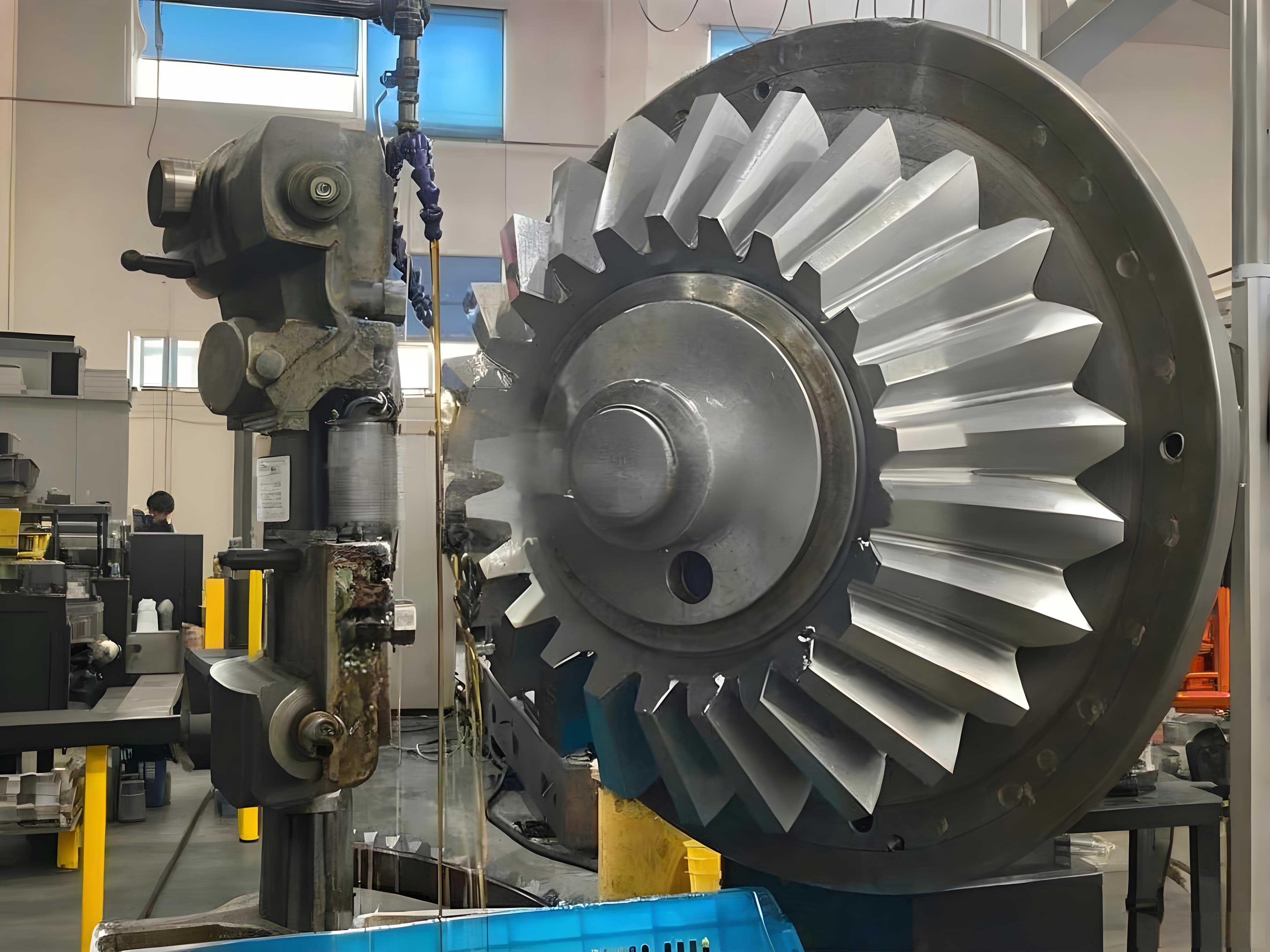
This article delves into an advanced machining methodology employing a dual interlocking circular cutter system to mill or grind straight bevel and miter gear teeth. This approach simulates a crown generating gear, enabling the simultaneous machining of both flanks of a tooth space without a generating roll motion along the face width, thereby significantly enhancing machining efficiency. The core advantage lies in the inherent flexibility it offers for comprehensive tooth surface modification—both in profile and lengthwise directions—directly through controllable tool parameters. We establish a complete mathematical model for the tooth surface generation, considering these modifications. Subsequently, we perform Tooth Contact Analysis (TCA) and Loaded Tooth Contact Analysis (LTCA) to evaluate the meshing performance. Finally, a systematic optimization of the tool parameters is conducted to minimize the loaded transmission error fluctuation, a primary source of gear whine, resulting in a superior miter gear design for quiet and reliable operation.
Mathematical Modeling of Tooth Surface Generation
1.1 Dual Circular Cutter Model and Tool Positioning
The machining process utilizes two identical circular cutters (or grinding wheels), each representing one side of a tooth on a virtual crown gear. The cutter profile in its normal section is defined by a straight line (the cutting edge) and a tip fillet. Crucially, a parabolic modification is introduced into the straight-edge portion to enable profile crowning. The position vector of a point Q on the cutting edge in the tool’s normal section coordinate system \(S_m\) is given by:
$$
\mathbf{r}_m^{(Q)}(u) = [0, \quad (u_0 + u), \quad a_t (u_0 + u)^2, \quad 1]^T
$$
Here, \(u\) is a variable parameter along the cutting edge, \(u_0\) defines the origin position of the parabolic modification, and \(a_t\) is the tool parabolic modification coefficient. When \(a_t = 0\), the edge is straight, generating a standard spherical involute or octoidal profile. A non-zero \(a_t\) introduces a controlled profile curvature change, essential for tolerance to misalignment.
This local edge is then transformed into the cutter body coordinate system \(S_{cd}\), which rotates about its axis to form the tool surface. The positioning of this cutter body relative to the virtual crown gear \(S_{cg}\) is critical. The cutter axis is tilted relative to the crown gear’s pitch plane. The orientation is defined such that an angle \(\delta\), known as the blade angle, is applied. This angle \(\delta\) is the rotation of the cutting edge vector around an axis defined at the mean point. The effect of \(\delta\) is to create a lengthwise curvature on the generated gear tooth, effectively introducing a small amount of “crowning” along the face width. The smaller the effective radius of the cutter path (related to the mean cutter radius \(\rho_m\)) and the larger the \(\delta\), the more pronounced this lengthwise modification becomes. The homogeneous transformation from \(S_{cd}\) to \(S_{cg}\) is:
$$
\mathbf{M}_{cg,cd} = \begin{bmatrix}
\mathbf{x}_{cd} \cdot \mathbf{x} & \mathbf{x}_{cd} \cdot \mathbf{y} & \mathbf{x}_{cd} \cdot \mathbf{z} & \mathbf{r}_{O_{cd}} \cdot \mathbf{x} \\
\mathbf{y}_{cd} \cdot \mathbf{x} & \mathbf{y}_{cd} \cdot \mathbf{y} & \mathbf{y}_{cd} \cdot \mathbf{z} & \mathbf{r}_{O_{cd}} \cdot \mathbf{y} \\
\mathbf{z}_{cd} \cdot \mathbf{x} & \mathbf{z}_{cd} \cdot \mathbf{y} & \mathbf{z}_{cd} \cdot \mathbf{z} & \mathbf{r}_{O_{cd}} \cdot \mathbf{z} \\
0 & 0 & 0 & 1
\end{bmatrix}
$$
The surface of the crown generating gear, formed by the sweeping motion of the cutter, is therefore described in \(S_{cg}\) by the vector function \(\mathbf{r}_{cg}(u, \phi) = \mathbf{M}_{cg,cd} \mathbf{r}_{cd}(u, \phi)\), where \(\phi\) is the rotation parameter of the cutter.
1.2 Generation of the Miter Gear Tooth Surface
The tooth surface of the work gear (pinion or wheel) is the envelope of the crown gear surface family as it undergoes a generating roll motion with the workpiece. For a miter gear pair, the pinion and gear have equal numbers of teeth and complementary pitch angles. The coordinate systems for the generation process involve the crown gear \(S_{cg}\), the machine settings, and the workpiece \(S_i\) (where \(i=1\) for pinion, \(i=2\) for gear). The sequence of coordinate transformations models the relative rolling motion. The position vector of a point on the generated miter gear tooth surface is:
$$
\mathbf{r}_i(u, \phi, \psi_i) = \mathbf{M}_{i,l}(\psi_i) \mathbf{M}_{l,k} \mathbf{M}_{k,j} \mathbf{M}_{j,cg} \mathbf{r}_{cg}(u, \phi)
$$
Here, \(\psi_i\) is the generating rotation angle of the workpiece. The equation of meshing between the tool and the workpiece must be satisfied for the point to belong to the envelope (the real tooth surface). This equation states that the relative velocity at the contact point is perpendicular to the common normal:
$$
f_i^{cg}(u, \phi, \psi_i) = \left( \frac{\partial \mathbf{r}_i}{\partial u} \times \frac{\partial \mathbf{r}_i}{\partial \phi} \right) \cdot \frac{\partial \mathbf{r}_i}{\partial \psi_i} = 0
$$
Solving the system \(\mathbf{r}_i(u, \phi, \psi_i)\) and \(f_i^{cg}(u, \phi, \psi_i) = 0\) yields the definitive mathematical description of the pinion and gear tooth surfaces as functions of two independent parameters (e.g., \(u\) and \(\psi_i\)). The unit normal vector \(\mathbf{n}_i\) at any point on the miter gear surface can be derived from the partial derivatives of \(\mathbf{r}_i\).
Meshing Simulation: TCA and LTCA Models
2.1 Tooth Contact Analysis (TCA) Model
TCA simulates the unloaded meshing of the conjugate gear pair. The fundamental condition for contact is that the position vectors and unit normals of both tooth surfaces coincide at the contact point in a fixed coordinate system \(S_h\). For a given instant, defined by the pinion rotation angle \(\varphi_1\), the following system of equations must be solved:
$$
\begin{cases}
\mathbf{r}_h^{(1)}(u_1, \phi_1, \psi_1, \varphi_1) = \mathbf{r}_h^{(2)}(u_2, \phi_2, \psi_2, \varphi_2) \\
\mathbf{n}_h^{(1)}(u_1, \phi_1, \psi_1, \varphi_1) = \mathbf{n}_h^{(2)}(u_2, \phi_2, \psi_2, \varphi_2)
\end{cases}
$$
This is a system of six independent scalar equations (three from vector equality, two from normal vector equality—since unit vectors have constant magnitude, the third component is dependent). The unknowns are the seven parameters \(u_1, \phi_1, \psi_1, u_2, \phi_2, \psi_2,\) and \(\varphi_2\). By prescribing \(\varphi_1\) as the input, the system can be solved numerically to find the corresponding contact point and the output gear angle \(\varphi_2\). Repeating this process for a sequence of \(\varphi_1\) values yields the path of contact across the tooth flank and the static transmission error (often called geometric transmission error), defined as the deviation from perfectly conjugate motion:
$$
\Delta \varphi_2 = (\varphi_2 – \varphi_{20}) – \frac{N_1}{N_2} (\varphi_1 – \varphi_{10})
$$
For a perfect miter gear pair (\(N_1/N_2 = 1\)), this simplifies to \(\Delta \varphi_2 = \varphi_2 – \varphi_1 – \text{constant}\). An ideal, unmodified conjugate pair would have zero transmission error. The purpose of modifications (\(a_t, \delta, \rho_m\)) is to shape this error curve into a symmetric, parabolic-like function that provides tolerance to misalignment and avoids edge contact.
2.2 Loaded Tooth Contact Analysis (LTCA) Model
LTCA predicts the contact pattern, load distribution, and loaded transmission error under operating torque. It accounts for tooth bending, shear, contact deformation, and the geometric separation (gap) between non-contacting flanks. The model used here is based on a mathematical programming formulation that minimizes the total elastic potential energy of the system under load.
The tooth contact zone is discretized along the potential line of contact. Let \(\mathbf{w}\) be the initial separation vector (gap) at these discrete points, \(\mathbf{F}\) be the total compliance matrix (incorporating both contact and bending deflections), \(\mathbf{p}\) be the vector of unknown contact loads, and \(\mathbf{d}\) be the vector of final separations after deformation. The force equilibrium and compatibility conditions lead to a quadratic programming problem:
$$
\begin{aligned}
& \text{minimize} \quad \sum_{j=1}^{n+1} X_j \\
& \text{subject to} \quad -\mathbf{F}\mathbf{p} + \mathbf{Z} + \mathbf{d} + \mathbf{X} = \mathbf{w} \\
& \quad \quad \quad \quad P = \mathbf{e}^T \mathbf{p} + X_{n+1} \\
& \quad \quad \quad \quad p_j \ge 0, \quad d_j \ge 0, \quad Z_j \ge 0, \quad X_j \ge 0 \\
& \quad \quad \quad \quad p_j \cdot d_j = 0 \quad \text{(Complementarity Condition)}
\end{aligned}
$$
Here, \(\mathbf{Z}\) is a uniform approach vector, \(\mathbf{X}\) are artificial variables, \(P\) is the total normal load (torque divided by pitch radius), and \(\mathbf{e}\) is a vector of ones. The complementarity condition enforces that at any point, either the load is zero (no contact) or the final separation is zero (contact). Solving this model provides the load distribution \(\mathbf{p}\). The loaded transmission error \(TE\) is then calculated from the rigid-body approach \(Z\):
$$
TE = \frac{Z}{|\mathbf{r}_2 \times \mathbf{n}_2|} \times \frac{180}{\pi} \times 3600 \quad \text{[arcsec]}
$$
where \(\mathbf{r}_2\) and \(\mathbf{n}_2\) are the position and normal vectors at the contact reference point. The fluctuation amplitude \(\Delta TE\) of this signal is a direct indicator of vibratory excitation from the miter gear mesh.
Systematic Optimization of Miter Gear Meshing Performance
The primary goal of optimizing a miter gear pair is to minimize the dynamic excitation, which is directly linked to the amplitude of the loaded transmission error (\(\Delta TE\)) under design torque. The design variables are the tool parameters that control the tooth surface geometry: the profile modification coefficient \(a_t\), the blade angle \(\delta\), and the mean cutter radius \(\rho_m\). The optimization problem is formalized as:
$$
\begin{aligned}
& \text{Find:} \quad \mathbf{x} = [a_t, \delta, \rho_m]^T \\
& \text{To minimize:} \quad f(\mathbf{x}) = \Delta TE(\mathbf{x}) = \max(TE(\mathbf{x})) – \min(TE(\mathbf{x})) \\
& \text{Subject to:} \quad a_t^{L} \le a_t \le a_t^{U}, \quad \delta^{L} \le \delta \le \delta^{U}, \quad \rho_m^{L} \le \rho_m \le \rho_m^{U}
\end{aligned}
$$
However, before this load-based optimization, a prerequisite is to achieve a symmetric and favorable unloaded transmission error curve by adjusting the modification origin \(u_0\). This ensures good meshing behavior even at light loads.
Given the nonlinear and computationally expensive nature of the problem (each function evaluation requires a full LTCA simulation), a Genetic Algorithm (GA) is employed. GA is a population-based stochastic search method inspired by natural selection, well-suited for global optimization with non-convex objectives. The optimization workflow is as follows:
- Initialization: Define GA parameters (population size, crossover/mutation probability) and variable bounds.
- Pre-optimization Step: Manually adjust \(u_0\) for the nominal design to achieve a symmetric static transmission error curve.
- GA Loop: For each generation:
- Encoding & Population: Each individual (design vector \(\mathbf{x}\)) is encoded.
- Fitness Evaluation: For each individual:
- Generate the pinion and gear tooth surfaces based on \(\mathbf{x}\).
- Perform TCA to verify contact path.
- Perform LTCA under the design torque to compute \(\Delta TE(\mathbf{x})\).
- The fitness value is \(1/\Delta TE(\mathbf{x})\) (for maximization).
- Selection, Crossover, Mutation: Create a new population based on fitness.
- Termination: Stop after a specified number of generations or convergence. The individual with the smallest \(\Delta TE\) is the optimized miter gear design.
Parametric Study and Optimization Results
To illustrate the influence of tool parameters and the optimization outcome, a case study on a miter gear pair (1:1 ratio) is presented. Basic gear data is shown in Table 1.
| Parameter | Pinion & Gear Value |
|---|---|
| Number of Teeth, \(N\) | 25 |
| Module, \(m_n\) (mm) | 5.0 |
| Pressure Angle, \(\alpha\) (°) | 25.0 |
| Shaft Angle, \(\Sigma\) (°) | 90.0 |
| Face Width, \(F_w\) (mm) | 29.2 |
3.1 Influence of Tool Parameters
The effects of the key parameters on the meshing of the miter gear are summarized below.
Effect of Mean Cutter Radius (\(\rho_m\)): This parameter primarily controls the lengthwise curvature. A smaller \(\rho_m\) increases the effective “crowning” effect.
| \(\rho_m\) (mm) | Contact Pattern Size | Static TE Amplitude | Loaded TE Amplitude (\(\Delta TE\)) |
|---|---|---|---|
| 120 | Small | Asymmetric, ~0 arcsec | Large |
| 160 | Medium | Asymmetric, ~0 arcsec | Medium |
| 200 | Large | Asymmetric, ~0 arcsec | Smaller |
The static TE remains asymmetric and near-zero because \(a_t=0\). The main observation is that increasing \(\rho_m\) enlarges the contact area and reduces the load concentration, thereby lowering \(\Delta TE\).
Effect of Blade Angle (\(\delta\)): Similar to \(\rho_m\), this parameter controls lengthwise modification. A larger \(\delta\) increases crowning.
| \(\delta\) (°) | Contact Pattern Size | Static TE Amplitude | Loaded TE Amplitude (\(\Delta TE\)) |
|---|---|---|---|
| 1.5 | Larger | Asymmetric, ~0 arcsec | Smaller |
| 2.0 | Medium | Asymmetric, ~0 arcsec | Medium |
| 2.5 | Smaller | Asymmetric, ~0 arcsec | Larger |
Effect of Profile Modification Coefficient (\(a_t\)): This is the most critical parameter for shaping the static transmission error curve and influencing load behavior.
| \(a_t\) | Static TE Amplitude | Static TE Symmetry | Loaded TE Amplitude (\(\Delta TE\)) |
|---|---|---|---|
| 0.0001 | Small | Asymmetric | Relatively Small |
| 0.0002 | Medium | Asymmetric | Medium |
| 0.0003 | Large | Asymmetric | Larger |
A non-zero \(a_t\) introduces a parabolic static TE. However, its symmetry depends critically on \(u_0\). Without adjusting \(u_0\), the TE curve is one-sided, leading to a high risk of edge contact under misalignment.
3.2 Optimization Process and Final Results
The optimization was carried out with the following variable bounds, estimated from practical design guidelines for modification amounts (e.g., 20 μm crown):
- \(a_t \in [0, 0.0008]\)
- \(\delta \in [0^\circ, 2.5^\circ]\)
- \(\rho_m \in [100, 300] \text{ mm}\)
Step 1 – Symmetrization: For the initial guess, the parameter \(u_0\) was adjusted independently to transform the initially asymmetric parabolic static TE into a symmetric one. This is a crucial step to ensure the optimization starts from a feasible, well-behaved geometry.
Step 2 – GA Optimization: The GA was run to minimize \(\Delta TE\) under a nominal pinion torque of 700 Nm. The algorithm converged to an optimal set of parameters, as shown in Table 5 alongside the initial reference design (a near-standard gear with very large \(\rho_m\) and no modifications).
| Parameter | Initial (Reference) Design | Optimized Design |
|---|---|---|
| Profile Coeff., \(a_t\) | ~0 | 0.00056 |
| Blade Angle, \(\delta\) | ~0° | 1.78° |
| Mean Cutter Radius, \(\rho_m\) (mm) | Very Large (~10m) | 181.65 |
| Loaded TE Amplitude, \(\Delta TE\) (arcsec) | 25.57 (Reference \(\Delta TE_0\)) | 11.11 |
| Reduction in \(\Delta TE\) | 56.54% | |
The optimized miter gear shows a dramatic 56.54% reduction in the loaded transmission error fluctuation. The optimized contact pattern is more compact due to the intentional lengthwise crowning from \(\delta\) and \(\rho_m\), but the load distribution remains favorable. The static TE curve is symmetric, providing tolerance to assembly misalignments. The final tooth surface deviation from a standard involute/octoid form shows a distinct crowned shape, with the maximum modification of approximately 20 μm located near the toe and tip of the tooth.
Furthermore, the performance of the optimized miter gear was evaluated across a load range. While the reference design’s \(\Delta TE\) increased nearly linearly with torque, the optimized design exhibited a characteristic “saucer” curve: \(\Delta TE\) initially decreased, reached a minimum near the design torque (700 Nm), and then increased gradually at higher loads. This demonstrates that the optimization successfully tailored the tooth contact for the specific operational load, minimizing dynamic excitation at and around that condition, a highly desirable trait for noise-critical miter gear applications.
Conclusion
This comprehensive analysis demonstrates the efficacy of the dual circular cutter method for producing high-performance straight miter gears. The key conclusions are:
- The mathematical model successfully integrates controlled profile modification (via \(a_t\)) and lengthwise modification (via \(\delta\) and \(\rho_m\)) into the tooth surface generation process for a miter gear.
- The tool modification origin parameter \(u_0\) is critical for achieving a symmetric static transmission error curve, which is the foundation for a robust design tolerant to misalignment.
- Among the tool parameters, the profile modification coefficient \(a_t\) has the most direct influence on the amplitude of both static and loaded transmission error. The lengthwise parameters (\(\delta\), \(\rho_m\)) primarily govern the size and shape of the contact pattern, with smaller \(\rho_m\) and larger \(\delta\) producing more pronounced crowning and a smaller contact area.
- Through a systematic optimization framework combining TCA, LTCA, and a Genetic Algorithm, the tool parameters can be tailored to minimize the loaded transmission error fluctuation—a primary gear noise excitation—for a given operating load. The case study resulted in a reduction of over 56% in \(\Delta TE\), signifying a substantial potential for vibration and noise reduction in the final miter gear application.
- The optimized tooth surface provides superior performance not only at the design load but over a range of loads, showcasing the robustness of the designed modifications.
This methodology provides a powerful digital design and optimization toolset for developing quiet, durable, and efficient straight miter gears and straight bevel gears, bridging advanced manufacturing capability with superior meshing performance.