
In high-speed aerospace transmission systems, spiral bevel gears are widely used due to their high load capacity, smooth operation, and excellent lubrication performance. However, windage power loss becomes significant when gear tooth velocities exceed 50 m/s. This study investigates windage power loss reduction through computational fluid dynamics (CFD) simulations and proposes an optimized shroud configuration for spiral bevel gear pairs.
1. Governing Equations
1.1 Fundamental Fluid Dynamics Equations
The governing equations for fluid motion in gear systems include:
Continuity equation:
$$ \frac{\partial \rho}{\partial t} + \nabla \cdot (\rho \mathbf{u}) = 0 $$
Momentum conservation equation:
$$ \frac{\partial (\rho \mathbf{u})}{\partial t} + \nabla \cdot (\rho \mathbf{u} \mathbf{u}) = -\nabla p + \mu \nabla^2 \mathbf{u} + \mathbf{F} $$
1.2 Turbulence Modeling
The RNG k-ε turbulence model was adopted for its superior performance in handling high strain rates and curved streamlines:
$$ \frac{\partial (\rho k)}{\partial t} + \frac{\partial (\rho k u_i)}{\partial x_i} = \frac{\partial}{\partial x_j} \left( \alpha_k \mu_{\text{eff}} \frac{\partial k}{\partial x_j} \right) + G_k – \rho \epsilon $$
$$ \frac{\partial (\rho \epsilon)}{\partial t} + \frac{\partial (\rho \epsilon u_i)}{\partial x_i} = \frac{\partial}{\partial x_j} \left( \alpha_\epsilon \mu_{\text{eff}} \frac{\partial \epsilon}{\partial x_j} \right) + C_{1\epsilon} \frac{\epsilon}{k} G_k – C_{2\epsilon} \rho \frac{\epsilon^2}{k} $$
2. CFD Modeling of Spiral Bevel Gear Pairs
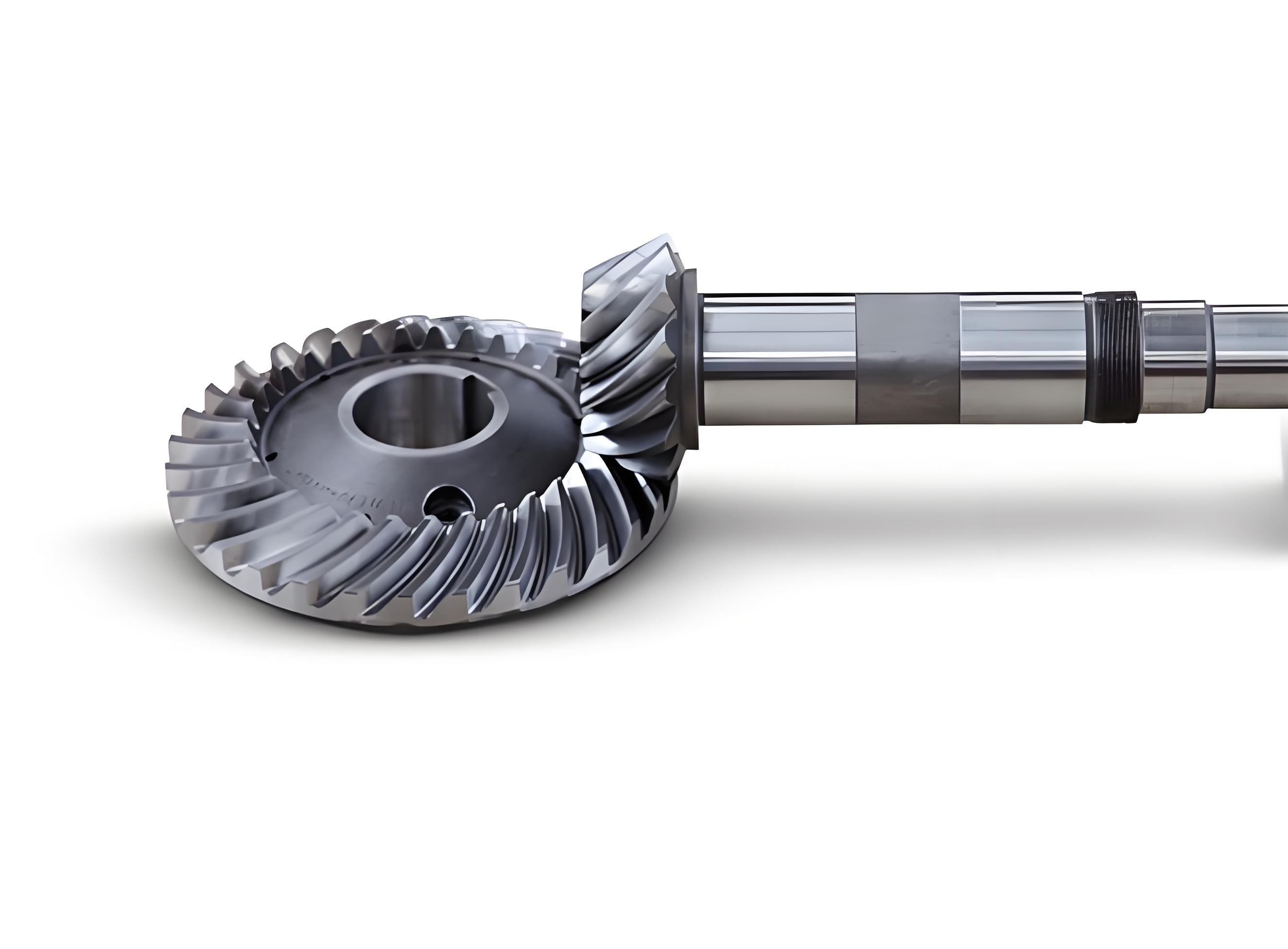
2.1 Gear Parameters
| Parameter | Pinion | Gear |
|---|---|---|
| Number of teeth | 30 | 76 |
| Speed (rpm) | 20,900 | 7,626 |
| Module (mm) | 3.85 | |
| Pressure angle (°) | 20 | |
2.2 Computational Domain
The fluid domain was divided into three regions:
$$ V_{\text{total}} = V_{\text{gear}} + V_{\text{shroud}} + V_{\text{clearance}} $$
Mesh characteristics:
- Total elements: 13 million
- Boundary layer thickness: 1 mm
- Y+ value: < 5
3. Windage Power Loss Calculation
The total windage power loss is calculated as:
$$ P_w = \sum_{i=1}^{2} \frac{2\pi n_i T_i}{60} $$
Where:
$$ T_i = T_{fi} + T_{di} + T_{si} $$
| Configuration | Windage Torque (Nm) | Power Loss (W) | |
|---|---|---|---|
| Pinion | Gear | ||
| Unshrouded | 0.422 | 2.23 | 2704.4 |
| 7mm clearance | 0.405 | 1.60 | 2164.1 |
| 1mm clearance | 0.397 | 0.997 | 1665.1 |
4. Flow Field Characteristics
The pressure distribution on gear teeth follows:
$$ \Delta p = \frac{1}{2} \rho \omega^2 (r_o^2 – r_i^2) $$
Where maximum pressure occurs at the meshing entry region due to air compression.
5. Shroud Optimization
The optimized shroud configuration achieves:
- 55.3% reduction in total windage loss
- Flow velocity reduction from 340 m/s to 210 m/s
- Turbulent kinetic energy decrease by 68%
| Parameter | Optimal Value |
|---|---|
| Tooth clearance | 1 mm |
| Shroud opening angle | 45° |
| Radial clearance | 3% of gear diameter |
6. Conclusion
This study demonstrates that properly designed shrouds can significantly reduce windage power loss in spiral bevel gear pairs. The optimal configuration features 1mm clearance and 45° meshing zone opening, achieving 55.3% power loss reduction while maintaining structural feasibility. Future work should consider multiphase flow effects with lubrication oil.