
In the field of power transmission for intersecting axes, the spiral bevel gear stands as a critical component. Its design, characterized by curved teeth that engage gradually, offers superior performance in terms of load capacity, smoothness, and noise reduction compared to straight bevel gears. Among the various manufacturing methodologies for spiral bevel gears, the Klingelnberg system, introduced from Germany, represents a significant and efficient approach, particularly well-suited for small-batch production. This article delves into the fundamental principles of the Klingelnberg process, with a focused investigation on a critical machining challenge: cutter head interference, often termed “secondary cutting.” Based on a detailed kinematic and geometric analysis, I will establish a mathematical model to predict this phenomenon and provide clear, formula-based guidelines for selecting an appropriate cutter head radius to ensure the production of high-quality gear sets.
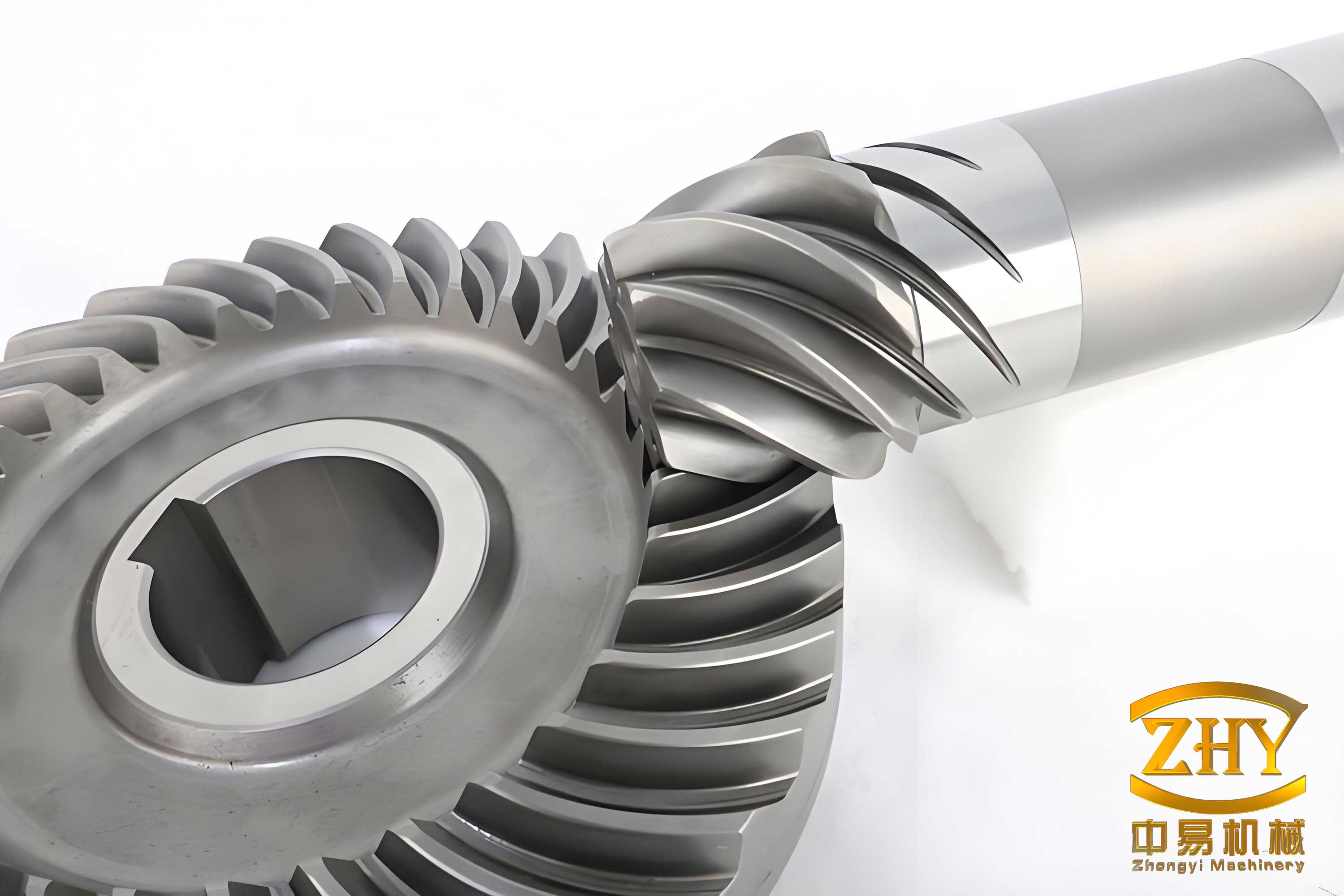
The geometry of a spiral bevel gear is complex. Its teeth are not straight but follow a curvilinear path along the face cone. The Klingelnberg system specifically produces a *constant height tooth* with an *extended epicycloid* tooth trace. This means the tooth depth remains equal from the toe (inner end) to the heel (outer end), and the tooth flanks are generated via an extended epicycloidal motion. The fundamental principle behind its generation involves simulating the meshing of the workpiece with a theoretical *crown gear* or *planar gear*. In the Klingelnberg method, this crown gear has a planar pitch surface, meaning its root cone angle equals its pitch cone angle. This is a key distinction from other systems like Gleason, which uses a *conformal* crown gear with a non-parallel root and pitch cone. The planar crown gear principle simplifies tooling and adjustment, as the same basic blade profile can be used for both members of a gear pair without inherent profile angle errors that require corrective machine settings for contact pattern alignment.
The actual cutting is performed by a rotating cutter head, which carries a set of indexed blades. The envelope of the cutting edges of these blades, as the cutter head rolls with the imaginary planar crown gear, generates the tooth flanks of the spiral bevel gear. The following table summarizes the key characteristics of the Klingelnberg spiral bevel gear system in comparison to other prevalent systems.
| Feature | Klingelnberg / Oerlikon System | Gleason System |
|---|---|---|
| Tooth Depth | Constant Height (Equal from toe to heel) | Tapered (Decreasing from heel to toe) |
| Tooth Trace | Extended Epicycloid | Circular Arc |
| Crown Gear Type | Planar (Flat) | Conformal (Non-parallel root & pitch cone) |
| Primary Advantage | Simpler setup, fewer tool variants, suited for small batches. | Optimized for high-volume production with specific machines. |
| Key Machining Challenge | Risk of Cutter Head Interference, especially on large gears. | Profile angle correction and contact pattern development. |
While the planar crown gear principle offers significant setup advantages, it introduces a specific geometrical constraint related to the constant tooth height. Since the tooth is equally deep at the small end as it is at the large end, the small-end tooth space is inherently narrower and shallower relative to the local diameter. This geometrical reality becomes critically important when selecting the physical diameter of the cutter head. If the cutter head radius is too small relative to the gear blank geometry, a phenomenon called *cutter head interference* or *secondary cutting* can occur. This is not a problem of the cutting edge but of the physical body of the cutter head or the non-working side of the blade. As the working-side cutting edge machines the tooth space to its full depth, the opposite, non-working flank or the cutter body itself may encroach upon and gouge the already-finished or yet-to-be-finished tooth flank of the adjacent space. This destructive event renders the gear component scrap. The risk is most pronounced when machining the larger member of a spiral bevel gear pair due to its more acute local geometry at the small end.
Kinematic and Geometric Model for Interference Analysis
To prevent this failure, a precise mathematical verification of the cutter head path is essential before machining. The analysis involves modeling the relative motion between the cutter head (representing the planar crown gear) and the gear blank at the extreme points of the cutting cycle. The goal is to calculate the minimum permissible distance from the cutter head center to critical points on the gear blank’s root line projection. The cutter head radius must be greater than this distance to avoid interference.
Let’s establish a right-handed coordinate system to analyze the geometry at the heel (large end) and toe (small end) of the gear. We consider the equivalent spur gear representation in the plane normal to the tooth trace at the point of interest. The key elements are the cutter head center \( O_c \), the crown gear (machine cradle) center \( O_m \), the point of tangency between the blade top (land) and the gear root cone (\( B \)), and the critical point on the gear root line projection (\( P \)) where interference would first occur.
The condition for non-interference is straightforward: the cutter head radius \( R_c \) must be greater than the distance from the cutter head center \( O_c \) to the critical point \( P \) on both the heel and toe cross-sections. Symbolically:
$$ R_c > \overline{O_c P}_{heel} \quad \text{and} \quad R_c > \overline{O_c P}_{toe} $$
Our task is to derive formulas for \( \overline{O_c P}_{heel} \) and \( \overline{O_c P}_{toe} \).
1. Cutter Head and Blade Geometry Parameters
The basic parameters defining the tool and its setting are:
- \( \alpha_n \): Normal pressure angle of the tool blade.
- \( h_{a0} \): Tool tip height (from the mean point to the blade tip).
- \( x \): Addendum modification coefficient (profile shift).
- \( R_c \): Nominal cutter head radius (to be verified).
- \( \Delta R \): Radial distance from cutter head center to crown gear center (machine setting).
2. Coordinate of Point \( B \): Blade Tip / Root Cone Intersection
Point \( B \) is where the top of the working blade intersects the root line of the gear in the equivalent spur gear plane. Its coordinates can be found relative to the crown gear center \( O_m \).
Let \( \theta \) be the instantaneous roll angle. The coordinate of the cutter head center \( O_c \) relative to \( O_m \) is:
$$ O_c: (X_{O_c}, Y_{O_c}) = (\Delta R \cos \theta, \Delta R \sin \theta) $$
The direction vector from \( O_c \) to point \( B \) is influenced by the blade pressure angle and the geometry. A simplified derivation for the coordinate of \( B \) relative to \( O_m \) yields:
$$ X_B = \Delta R \cos \theta – (h_{a0} + x m_n) \sin(\theta \pm \alpha_n) $$
$$ Y_B = \Delta R \sin \theta + (h_{a0} + x m_n) \cos(\theta \pm \alpha_n) $$
where \( m_n \) is the normal module. The sign (\( \pm \)) depends on whether the left or right flank is being considered. For the critical interference check on the non-working side, the appropriate angle must be used.
3. Coordinate of Critical Point \( P \) on Gear Root Line Projection
Point \( P \) lies on the projection of the gear’s root line (outer diameter of the root cone) at a specific angular location corresponding to the edge of an adjacent tooth space. We need to calculate this for both the heel and toe cross-sections.
Let \( R_{a\_heel} \) and \( R_{a\_toe} \) be the outer cone radii (at the root) at the heel and toe, respectively. Let \( \phi_{heel} \) and \( \phi_{toe} \) be the half tooth space angles (angle corresponding to half the tooth thickness on the root circle) at the heel and toe.
The coordinates of point \( P \) at the heel section, in a coordinate system aligned with the gear axis, are:
$$ X_{P\_heel} = R_{a\_heel} \cos(\phi_{heel}) $$
$$ Y_{P\_heel} = R_{a\_heel} \sin(\phi_{heel}) $$
Similarly, for the toe section:
$$ X_{P\_toe} = R_{a\_toe} \cos(\phi_{toe}) $$
$$ Y_{P\_toe} = R_{a\_toe} \sin(\phi_{toe}) $$
These coordinates must then be transformed into the same coordinate system as point \( B \) and the cutter head center \( O_c \), which involves a rotation by the gear’s root cone angle \( \delta_f \) and the machine orientation angle.
4. Final Non-Interference Distance Calculation
After transforming all points into a common global coordinate system (e.g., the machine plane), we can compute the critical distances. The vector from the cutter head center \( O_c \) to the critical point \( P \) is:
$$ \overrightarrow{O_c P} = \overrightarrow{P} – \overrightarrow{O_c} $$
The required non-interference distance is the magnitude of this vector:
$$ \overline{O_c P} = \sqrt{ (X_P – X_{O_c})^2 + (Y_P – Y_{O_c})^2 } $$
This calculation must be performed for both the heel and toe sections, considering the specific machine settings (cradle angle, swivel angle, etc.) and gear geometry at those sections.
The final verification condition is:
$$ R_c > \max(\overline{O_c P}_{heel}, \overline{O_c P}_{toe}) $$
If the chosen nominal \( R_c \) does not satisfy this inequality, a larger cutter head radius must be selected to machine this specific spiral bevel gear safely.
The following table summarizes the key input parameters and the verification steps for the spiral bevel gear cutter head interference check.
| Step | Parameter / Calculation | Description |
|---|---|---|
| Inputs | Gear Data: \( m_n, z, \delta, \delta_a, \delta_f, b, \text{hand} \). Tool Data: \( \alpha_n, h_{a0}, x, R_c \). Machine Settings: \( \Delta R, \theta, \text{cradle angle} \). |
Basic geometry of the spiral bevel gear, cutter, and machine setup. |
| 1. Section Geometry | Calculate \( R_{a\_heel}, R_{a\_toe}, \phi_{heel}, \phi_{toe} \). | Determine root radii and half-space angles at heel and toe. |
| 2. Point Coordinates | Compute \( (X_P, Y_P)_{heel/toe} \) in gear coordinates. Compute \( (X_{O_c}, Y_{O_c}) \) for relevant roll position. Compute \( (X_B, Y_B) \). |
Establish the spatial position of critical points. |
| 3. Coordinate Transformation | Apply rotation matrices to transform all points into the machine working plane. | Bring gear-based points and machine-based points into a common system. |
| 4. Distance Calculation | \( \overline{O_c P}_{heel} = \sqrt{ (X_{P\_heel}^’ – X_{O_c})^2 + (Y_{P\_heel}^’ – Y_{O_c})^2 } \) \( \overline{O_c P}_{toe} = \sqrt{ (X_{P\_toe}^’ – X_{O_c})^2 + (Y_{P\_toe}^’ – Y_{O_c})^2 } \) |
Calculate the minimum clearances at both ends of the tooth. |
| 5. Verification | Check: \( R_c > \max(\overline{O_c P}_{heel}, \overline{O_c P}_{toe}) \) | If TRUE, no interference. If FALSE, select a larger \( R_c \). |
Practical Implications and Design Guidance
The mathematical model clearly shows that the risk of interference is a function of the spiral bevel gear’s local geometry at the small end (toe). Factors that increase this risk include:
- Higher Number of Teeth (Larger Gear): The root circle diameter at the toe increases, but the tooth space becomes narrower, pushing point \( P \) closer to the cutter head path.
- Smaller Cutter Head Radius: Obviously, a smaller cutter head has a greater chance of being enclosed within the forbidden zone defined by the \( \overline{O_c P} \) distance.
- Steeper Spiral Angle: This affects the transformation between the gear coordinate system and the machine plane, potentially worsening clearance.
- Larger Pressure Angle: Influences the location of point \( B \) and the overall envelope of the cutting tool path.
Therefore, during the design and process planning phase for a Klingelnberg spiral bevel gear, the following procedure is recommended:
- Complete Gear Design: Define all geometric parameters of the spiral bevel gear pair.
- Preliminary Tool Selection: Based on module and face width, select a standard cutter head radius \( R_c \) from available tooling.
- Perform Interference Verification: Execute the calculations outlined above for both the pinion and the gear, paying special attention to the larger gear member. This is ideally done using specialized gear design software that incorporates this algorithm.
- Iterate if Necessary: If the check fails, select the next larger standard cutter head size and repeat the verification. This may also require recalculating some machine settings (like blade profile shifts) to maintain correct tooth geometry.
In conclusion, the Klingelnberg system offers a robust and flexible method for manufacturing high-quality spiral bevel gears, especially for low-to-medium volume applications. Its constant-height tooth design and planar crown gear principle simplify setup. However, this very design introduces a heightened susceptibility to cutter head interference. By understanding the kinematics of the generation process and applying the derived geometric interference model, engineers can reliably predict and prevent the costly “secondary cutting” defect. The cornerstone of prevention is the rigorous verification that the selected cutter head radius satisfies the condition \( R_c > \overline{O_c P}_{critical} \) across the entire face width of the spiral bevel gear. This mathematical safeguard ensures that the efficiency of the Klingelnberg process is fully realized without compromising the integrity of the manufactured gear teeth.