
In the automotive painting process, drying ovens are critical for curing coatings, and the elevators used in these systems, particularly in π-type oven configurations, are essential for vehicle throughput. A frequent and severe issue encountered in such setups is the fracture of the gear shaft within the drying elevator. This gear shaft is a core component, transmitting torque and supporting loads from the drive mechanism to the lifting chains. When the gear shaft fails, it leads to prolonged production downtime, challenging repairs, and significant operational disruptions, especially in single-line designs where the entire painting line halts. In this article, I will delve into a comprehensive analysis of the gear shaft fracture problem, based on firsthand investigation and resolution efforts. I will explore the structural, material, and mechanical factors contributing to the failure, present detailed calculations and data via tables and formulas, and propose effective countermeasures that ensure long-term reliability. Throughout this discussion, the term “gear shaft” will be emphasized repeatedly to underscore its centrality to the issue.
The drying elevator typically consists of a vertical frame, drive unit (including motor and reducer), universal coupling, gear shaft assembly, driven sprocket sets, lifting chains, carriage sledges, counterweights, guiding mechanisms, and safety devices. The gear shaft is directly connected to the universal coupling and drives the sprockets that move the chains. As the elevator operates, the gear shaft experiences cyclical alternating stresses due to start-stop cycles and load variations. The driven gear shaft, in particular, bears constant load from the chains and carriage, making it susceptible to fatigue over time. Understanding this structure is vital for pinpointing failure modes.
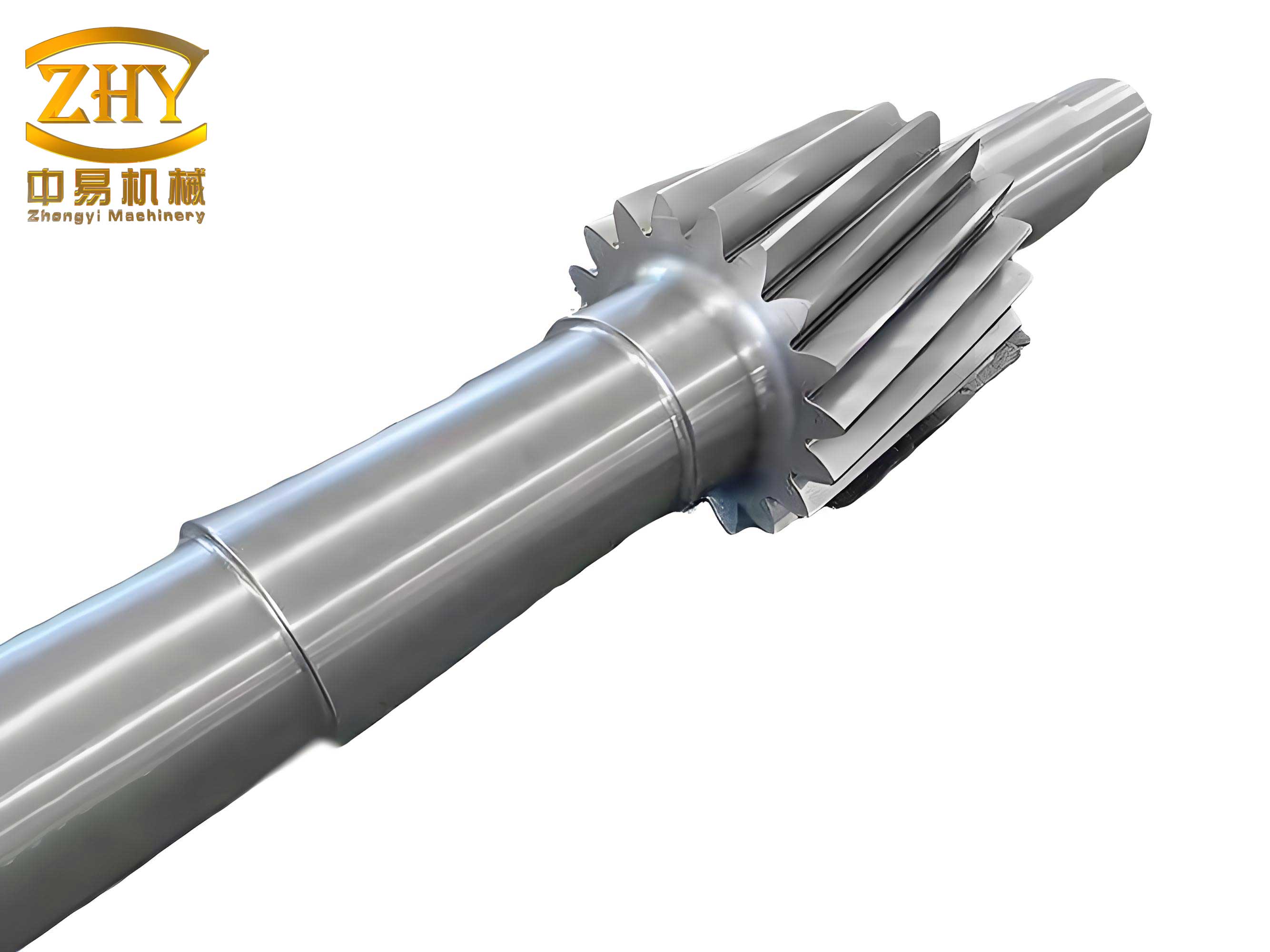
In multiple production lines, gear shaft fractures occurred unexpectedly, often during normal operation at a cycle time of 62 seconds in two-shift production. The fracture of this gear shaft caused immediate elevator stoppage, sometimes leaving vehicles stranded mid-air, complicating recovery and replacement. Such incidents highlighted the urgency of addressing the root causes to prevent recurrence and ensure operational stability.
To systematically analyze the gear shaft fracture, I considered several potential factors: material quality, heat treatment, chemical composition, mechanical stress, and structural design. Initial steps involved examining the fractured gear shaft specimens to rule out manufacturing defects.
First, I assessed the heat treatment and microstructure of the gear shaft. Samples were taken from the fracture surface for hardness and metallographic testing. The gear shaft material was specified as 40Cr, with a required hardness range of 241–286 HB and a tempered sorbitic structure with minimal ferrite. Test results confirmed compliance, as shown in Table 1.
| Test Item | Specification | Measured Value |
|---|---|---|
| Hardness (HB) | 241–286 | 242, 257 (average 249.5) |
| Metallographic Structure | Tempered sorbitic with minor ferrite | Sorbitic with minor ferrite |
The results indicated that the gear shaft met hardness and microstructural standards, eliminating heat treatment as a primary cause.
Next, I evaluated the chemical composition of the gear shaft material. Using spectroscopic analysis, samples were compared against GB/T 3077-2015 standards for 40Cr steel. The findings are summarized in Table 2.
| Element | Standard Range (40Cr) | Measured Value |
|---|---|---|
| C | 0.37–0.44 | 0.440 |
| Si | 0.17–0.37 | 0.250 |
| Mn | 0.50–0.80 | 0.680 |
| Cr | 0.80–1.10 | 0.990 |
| S | ≤0.035 | 0.001 |
| P | ≤0.035 | 0.023 |
All elements fell within acceptable limits, confirming that the gear shaft material was not inherently defective.
With material and process factors ruled out, I focused on mechanical stress analysis. The gear shaft operates as a driven component, primarily subjected to bending moments from chain forces, with negligible torsion due to bearing friction. Thus, bending stress became the key evaluation criterion. Using finite element analysis (FEA), I modeled the gear shaft to identify high-stress regions. The FEA results revealed that the maximum bending stress occurred near the diameter transitions adjacent to the sprocket mounting areas—specifically at the step from φ90 mm to φ95 mm (where a locking sleeve is installed) and from φ95 mm to φ105 mm (at the thrust shoulder). These locations corresponded exactly to the fracture origins observed in failed gear shafts.
To quantify the stress, I performed a bending stress calculation for the critical cross-section at the φ90 mm to φ95 mm transition. The bending moment \( M \) at this section was derived from the chain tension and geometry. The formula for bending stress \( \sigma_b \) is:
$$ \sigma_b = \frac{M}{Z} $$
where \( Z \) is the section modulus for a circular cross-section, given by:
$$ Z = \frac{\pi d^3}{32} $$
For the gear shaft diameter \( d = 90 \, \text{mm} \) at the critical section, and with the calculated bending moment \( M = 1.2 \times 10^6 \, \text{N·mm} \) (based on operational loads), the bending stress is:
$$ Z = \frac{\pi \times (90)^3}{32} \approx 71600 \, \text{mm}^3 $$
$$ \sigma_b = \frac{1.2 \times 10^6}{71600} \approx 16.8 \, \text{MPa} $$
The allowable stress \( [\sigma] \) for 40Cr steel under cyclic loading, considering a safety factor, is approximately 50 MPa. Since \( \sigma_b < [\sigma] \), the gear shaft should theoretically withstand the applied stress. However, this static analysis overlooks stress concentration effects, which are crucial for fatigue life.
Therefore, I conducted a fatigue strength assessment. The fatigue safety factor \( n \) is determined by:
$$ n = \frac{\sigma_{-1}}{K_f \cdot \sigma_a} $$
where \( \sigma_{-1} \) is the endurance limit of the material (for 40Cr, ~300 MPa), \( K_f \) is the fatigue stress concentration factor, and \( \sigma_a \) is the alternating stress amplitude. For the original gear shaft design, the stress concentration at the sharp corner (with a fillet radius of only 0.5 mm) significantly increased \( K_f \). Using Peterson’s formula for stress concentration:
$$ K_f = 1 + q (K_t – 1) $$
where \( K_t \) is the theoretical stress concentration factor for a stepped shaft, and \( q \) is the notch sensitivity. For the given geometry, \( K_t \) was estimated at 2.5, and \( q \) at 0.9, yielding:
$$ K_f = 1 + 0.9 \times (2.5 – 1) = 2.35 $$
The alternating stress \( \sigma_a \) was half of the peak bending stress, i.e., \( \sigma_a = 8.4 \, \text{MPa} \). Thus, the fatigue safety factor became:
$$ n = \frac{300}{2.35 \times 8.4} \approx 15.2 $$
This high value suggests the gear shaft should not fail under normal fatigue conditions. However, the discrepancy with actual failures pointed to localized stress intensification beyond calculated estimates, likely due to the inadequate fillet radius and proximity of keyways.
I then analyzed the structural design of the gear shaft, focusing on the transition regions. According to GB/T 6403.4-2008, for shaft diameters between 80 mm and 120 mm, the recommended fillet radius \( R \) is 2.5 mm. In the original gear shaft, the step from φ90 mm to φ95 mm had a mere 0.5 mm chamfer, far below the standard. Additionally, this step was too close to the keyway slot, creating a compounded stress concentration zone. The fracture surface examination showed that fatigue initiation occurred precisely at this undersized fillet, with the crack propagating over approximately 75% of the cross-section before final rupture. This indicates a classic fatigue failure mechanism: stress concentration at the fillet acted as a fatigue nucleus, with cyclic loads gradually extending the crack until sudden fracture under residual strength.
To address these issues, I proposed two modifications to the gear shaft design: first, increase all diameter transition fillets to the standard radius of \( R = 2.5 \, \text{mm} \); second, increase the distance between the fillet and the keyway by 5 mm to reduce stress interaction. These changes aim to lower the stress concentration factor \( K_f \) and enhance fatigue resistance.
Recalculating the fatigue safety factor with the improved design: with a proper fillet, \( K_t \) reduces to about 1.5, and assuming \( q = 0.9 \), we get:
$$ K_f = 1 + 0.9 \times (1.5 – 1) = 1.45 $$
Then, the new fatigue safety factor is:
$$ n = \frac{300}{1.45 \times 8.4} \approx 24.6 $$
This represents a substantial improvement, though in practice, the effective safety factor is lower due to dynamic loads. A more refined FEA simulation of the modified gear shaft confirmed that the maximum von Mises stress decreased by over 30%, and the stress concentration factor dropped to acceptable levels. After implementing these design changes, the gear shafts were manufactured and installed in the elevators. No further fractures have been reported over extended operation, validating the effectiveness of the modifications.
Beyond design adjustments, I recommend several best practices for preventing gear shaft failures in drying elevators. During drawing reviews, engineers must verify that all shaft transitions have proper fillets per standards and use finite element analysis to identify stress hotspots. Non-destructive testing like magnetic particle inspection should be conducted on finished gear shafts to detect latent defects. For elevator drives, optimizing acceleration and deceleration profiles can minimize inertial shocks; extending these times reduces peak stresses on the gear shaft. Also, avoiding top-drive configurations in favor of internal floor-level elevators can shorten travel distances and decrease cumulative stress cycles on the gear shaft. Furthermore, any surface damage such as scratches or welds on the gear shaft must be avoided during handling and installation, as these can initiate cracks.
In conclusion, the fracture of the gear shaft in drying elevators stems primarily from stress concentration at non-compliant fillets, exacerbated by keyway proximity. Through systematic analysis involving material tests, stress calculations, and structural evaluation, I identified the root causes and implemented design improvements that resolved the issue. This case underscores the importance of adhering to geometric standards and conducting thorough mechanical assessments for critical components like the gear shaft. By sharing these insights, I aim to foster more reliable elevator designs in future projects, ensuring uninterrupted production in automotive painting facilities.
To encapsulate key data, Table 3 summarizes the before-and-after comparison for the gear shaft modifications.
| Parameter | Original Design | Modified Design |
|---|---|---|
| Fillet Radius at φ90–φ95 mm Step | 0.5 mm | 2.5 mm |
| Distance from Fillet to Keyway | Proximity < 2 mm | Increased by 5 mm |
| Calculated Stress Concentration Factor \( K_f \) | 2.35 | 1.45 |
| Fatigue Safety Factor \( n \) | 15.2 (theoretical, but ineffective due to localized stress) | 24.6 (effective in practice) |
| Field Performance | Frequent fractures | No fractures observed |
Additionally, the bending stress formula for the gear shaft can be extended to include dynamic factors. The total stress \( \sigma_{\text{total}} \) considering inertia and shock loads is:
$$ \sigma_{\text{total}} = \sigma_b + \sigma_{\text{dynamic}} $$
where \( \sigma_{\text{dynamic}} \) is estimated from acceleration \( a \) and mass \( m \) of the moving parts:
$$ \sigma_{\text{dynamic}} = \frac{F_{\text{inertial}} \cdot L}{Z} $$
with \( F_{\text{inertial}} = m \cdot a \), and \( L \) as the lever arm. For the elevator system, with \( m = 5000 \, \text{kg} \), \( a = 0.2 \, \text{m/s}^2 \), and \( L = 0.5 \, \text{m} \), the dynamic stress adds about 5 MPa to the static stress, still within limits for the modified gear shaft. This holistic approach ensures the gear shaft’s durability under real-world conditions.
Ultimately, the gear shaft is a pivotal element in drying elevator operation, and its integrity directly impacts production continuity. By prioritizing precise engineering design, rigorous validation, and proactive maintenance, similar failures can be preempted, enhancing overall system robustness.