
In the field of industrial robotics, the quest for compact, precise, and reliable joint actuators is paramount. Among the various solutions, the rotary vector reducer has emerged as one of the most widely adopted transmission mechanisms for robot joints. Its superior performance stems from a unique two-stage design that combines planetary gearing with a cycloidal drive, offering a remarkable blend of high reduction ratio, exceptional torsional stiffness, and excellent positioning accuracy. At the heart of this sophisticated system lies the cycloidal gear (or cycloid disk), a component whose operational integrity directly dictates the overall performance and longevity of the entire rotary vector reducer. Therefore, a thorough understanding of its stress state under load is not merely academic but a critical necessity for ensuring reliable design and application. This article delves into a detailed theoretical and computational investigation of the cycloidal gear within a typical rotary vector reducer, focusing on force distribution, modeling, and Finite Element Analysis (FEA) for strength verification.
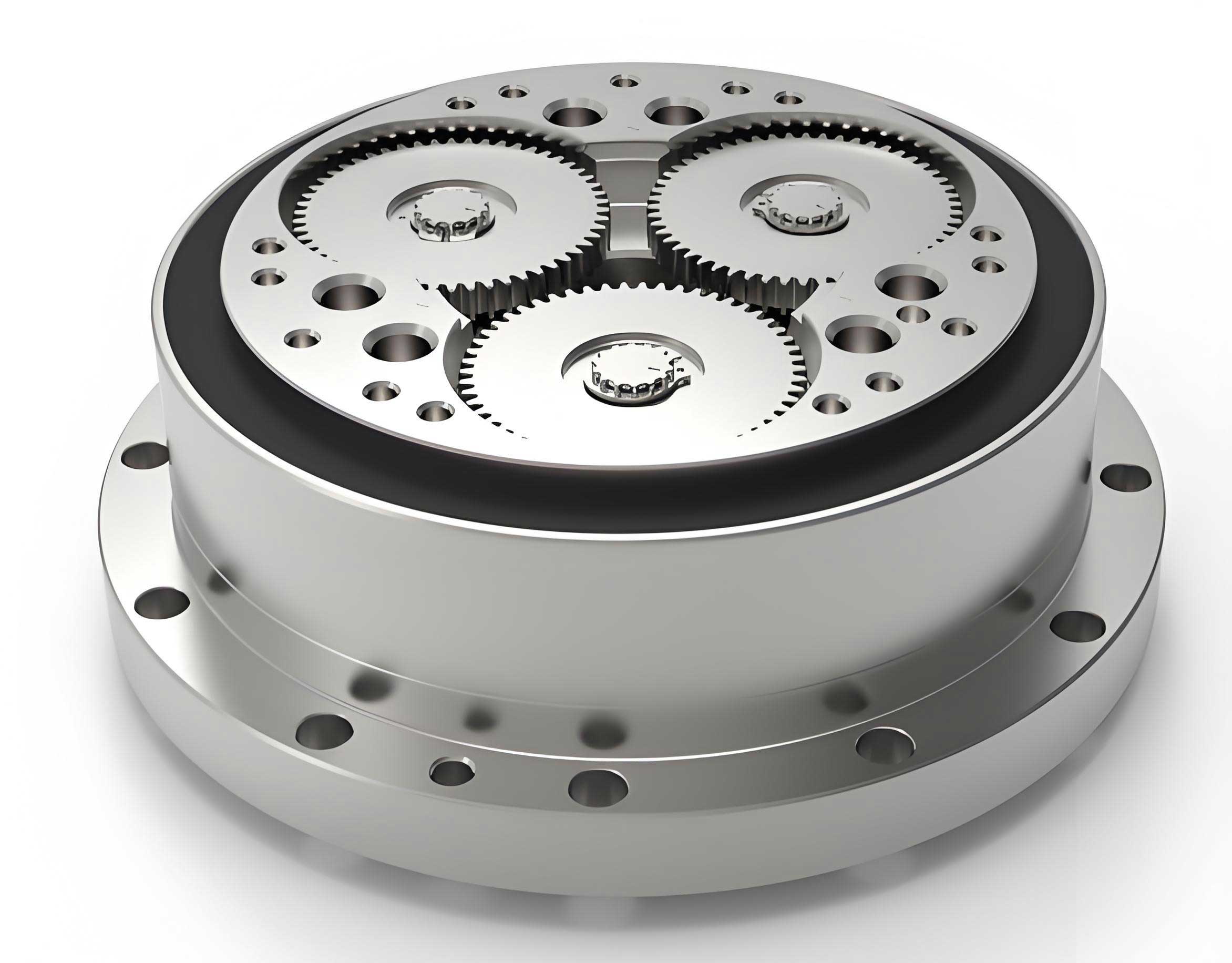
The operational principle of a rotary vector reducer is elegantly complex. Motion is transferred from a servo motor to an input sun gear, which engages with multiple planetary gears to achieve the first stage of speed reduction. This rotation is passed to crank shafts rigidly connected to the reducer’s frame. The eccentric rotation (revolution) of these crank shafts drives the cycloidal gears. With the ring of stationary needle pins (the pin housing) held fixed, the cycloidal gears, influenced by the needle pins, undergo a reverse rotation (spin) relative to their revolution. This spin is then transmitted back to the crank shafts, causing them to revolve around the central axis. Finally, this revolution is conveyed via bearings to the output planet carrier, producing a low-speed, high-torque output. The total transmission ratio \( i_{total} \) of this two-stage rotary vector reducer is given by:
$$ i_{total} = 1 + \frac{Z_2}{Z_1} \cdot Z_5 $$
where \( Z_1 \) is the number of teeth on the input sun gear, \( Z_2 \) is the number of teeth on the planetary gear, and \( Z_5 \) is the number of needle pins. This configuration grants the rotary vector reducer its signature advantages: exceptional structural compactness due to its nested design, smooth transmission and long service life from multiple simultaneously engaged teeth, a wide range of achievable ratios, high rigidity and shock resistance from its double-supported output structure, and superior transmission efficiency and motion accuracy.
The core of the second stage is the cycloidal-pin gear meshing. In an idealized scenario with zero backlash, approximately half of the needle pins would be in contact with the cycloidal gear. However, practical manufacturing tolerances and required clearances significantly alter this load-sharing pattern. Based on empirical and analytical studies, it is established that for a standard rotary vector reducer design, a more accurate number is around seven pairs of teeth sharing the load simultaneously. A force analysis of the cycloidal gear must therefore focus on these seven contact points. To facilitate a clear and tractable analysis, several standard assumptions are made: the cycloidal gear material is homogeneous, isotropic, and continuous; friction forces at the tooth contacts are negligible; and the contact load between the cycloidal gear and each needle pin acts along the common normal line at the point of contact.
The force diagram reveals a specific characteristic: the lines of action of the forces from the seven engaged needle pins all converge at a single instantaneous center point. The magnitude of the force at the \( i \)-th engaging needle pin can be calculated using the following formula, which accounts for the geometry of the meshing:
$$ F_i = \frac{4 T_c}{K_1 Z_c r_p} \cdot \frac{\sin \varphi_i}{(1 + K_1^2 – 2K_1 \cos \varphi_i)^{0.5}} $$
Here, \( T_c \) is the resisting torque on the cycloidal gear. For a standard dual-cycloid rotary vector reducer design, this is typically taken as \( T_c = 0.55T \), where \( T \) is the output torque. \( K_1 \) is the equidistant modification coefficient (shortening factor), \( Z_c \) is the number of lobes on the cycloidal gear (typically \( Z_c = Z_5 – 1 \)), \( r_p \) is the radius of the needle pin center circle, and \( \varphi_i \) is the angular position of the \( i \)-th pin relative to the line of symmetry. The parameters for a specific RV-20E type rotary vector reducer are summarized in the table below:
| Parameter | Symbol | Value |
|---|---|---|
| Pin Center Circle Radius | \( r_p \) | 52.5 mm |
| Pin Radius | \( r_{rp} \) | 2 mm |
| Number of Pins | \( Z_5 \) | 40 |
| Eccentricity | \( a \) | 1 mm |
| Shortening Factor | \( K_1 \) | 0.7619 |
| Crank Bearing Hole Radius | \( r_b \) | 26.5 mm |
| Distance Between Bearing Holes | \( s \) | 55 mm |
| Cycloidal Gear Thickness | \( b_c \) | 9 mm |
Applying the force formula to the seven engaged teeth (numbered 2 through 8 in a typical analysis sequence) yields the following load distribution for a given output torque condition. The direction of each force \( F_i \) is along the line connecting the contact point to the instantaneous center, pointing towards it.
| Tooth Number (i) | Angle \( \varphi_i \) (deg) | Force \( F_i \) (N) |
|---|---|---|
| 2 | 13.5 | 1549.1 |
| 3 | 22.5 | 1920.8 |
| 4 | 31.5 | 2055.0 |
| 5 | 40.5 | 2085.8 |
| 6 | 49.5 | 2063.3 |
| 7 | 58.5 | 2008.1 |
| 8 | 67.5 | 1929.6 |
In addition to these seven meshing forces, the cycloidal gear is supported by two crank shaft bearings located in its central holes. For the purpose of finite element model simplification and boundary condition application, these supports can be effectively modeled as fixed hinge constraints. This simplification allows the analysis to proceed without the complexity of calculating precise, non-uniform bearing reaction forces at this stage, focusing instead on the stress induced in the gear body by the tooth loads.
The foundation for any accurate simulation is a precise geometric model. The complex profile of the cycloidal gear is defined by its trochoidal tooth form, which is generated mathematically. The parametric equations for the tooth profile, considering the standard modification for the rotary vector reducer, are:
$$
\begin{aligned}
x_c &= [r_p – r_{rp} \Phi^{-1}(K_1, \varphi)] \cos[(1 – i_H)\varphi] – [a – K_1 r_{rp} \Phi^{-1}(K_1, \varphi)] \cos(i_H \varphi) \\
y_c &= [r_p – r_{rp} \Phi^{-1}(K_1, \varphi)] \sin[(1 – i_H)\varphi] + [a – K_1 r_{rp} \Phi^{-1}(K_1, \varphi)] \sin(i_H \varphi)
\end{aligned}
$$
where \( \Phi^{-1}(K_1, \varphi) \) is the generating coefficient and \( i_H = Z_5 / Z_c \) is the transmission ratio between the cycloidal gear and the pin ring. Using the parameters from the RV-20E model, these equations were implemented in a dedicated CAD environment to create a fully-defined, three-dimensional solid model of the cycloidal gear, forming the basis for subsequent finite element analysis. The accuracy of this model is crucial for predicting real-world behavior within the rotary vector reducer assembly.
To assess the structural integrity of the cycloidal gear, a finite element analysis was performed. The gear material was specified as bearing steel GCr15, a common choice for such high-precision, high-load components due to its excellent hardness, wear resistance, and fatigue strength. The key material properties used in the simulation are listed below:
| Property | Value |
|---|---|
| Elastic Modulus | 208 GPa |
| Poisson’s Ratio | 0.3 |
| Density | 7.8 g/cm³ |
The boundary conditions were applied as follows: the two cylindrical surfaces of the crank bearing holes were constrained with fixed hinge supports. Applying the seven meshing point loads required careful preparation of the geometry. The contact lines on the tooth flanks, where the needle pins apply force, were identified and used to create split faces. This enabled the precise application of the seven forces \( F_2 \) through \( F_8 \), with their magnitudes as calculated and their directions defined normal to the tooth profile at each split face, pointing inward. This setup accurately replicates the primary loading condition experienced by the cycloidal gear during operation in a rotary vector reducer.
The model was then discretized using a high-quality tetrahedral mesh, ensuring sufficient element density, particularly in the critical areas around the loaded tooth profiles and the bearing hole fillets where stress concentrations are expected. The analysis solved for static structural responses, including displacement, strain, and stress. The results provide a comprehensive visual and quantitative map of the gear’s behavior under the specified service loads. The von Mises stress criterion, which is suitable for ductile materials like GCr15 steel under static yield conditions, was used to evaluate strength.
The simulation results offer clear insights. The displacement plot shows that maximum deformation occurs near tooth #8, with a peak value of approximately 0.0271 mm. This is consistent with the geometry and constraint setup, where this region has less direct support from the bearing constraints. The strain distribution correlates strongly with the applied force magnitudes, with the highest equivalent strain observed in the region of teeth #4, #5, and #6, which bear the largest loads. Most critically, the von Mises stress distribution reveals the stress concentration patterns. The highest stress is localized in the root fillet area adjacent to the heavily loaded tooth #6, with a maximum computed value of 733.2 MPa.
To evaluate safety, this maximum stress must be compared to the material’s allowable stress. For hardened GCr15 steel under high-cycle fatigue conditions typical for a rotary vector reducer, the allowable stress can be on the order of 1200 MPa or higher, depending on the specific heat treatment and required safety factor. The calculated maximum stress of 733.2 MPa is significantly below this conservative threshold. This result provides strong analytical verification that the cycloidal gear, as designed for the RV-20E type rotary vector reducer, possesses adequate strength to handle the operational loads without yielding or initiating fatigue failure. The stress distribution also informs potential design optimization, highlighting areas where minor geometric refinements could further reduce stress concentrations and enhance the already robust performance and durability of this critical component in the rotary vector reducer.
In summary, this integrated analysis—combining theoretical load calculation for the multi-tooth engagement in a rotary vector reducer, precise geometric modeling of the cycloidal profile, and detailed finite element simulation—provides a reliable methodology for assessing the mechanical strength of the cycloidal gear. The process confirms that, for the specified design and loading, the gear operates within a safe stress envelope. This approach is fundamental for the design validation and performance assurance of rotary vector reducers, ensuring they meet the demanding requirements of precision, reliability, and longevity in advanced robotic applications.