
In the domain of heavy-duty mechanical lifting and propulsion systems, the rack and pinion gear mechanism stands as a cornerstone due to its capacity for translating rotational motion into precise linear movement under significant loads. Among these, systems employing large modulus gears are critical in mega-infrastructure projects, such as ship lifts, heavy-lift platforms, and offshore installations, where reliability, longevity, and safety are paramount. The operational environment for these rack and pinion gear drives is often severe, involving slow speeds, heavy loads, and exposure to contaminants, which invariably leads to progressive tooth surface wear. This wear fundamentally alters the gear geometry, redistributing load along the tooth flank and consequently affecting the root bending stress—a primary driver for tooth failure via bending fatigue. Therefore, a rigorous analysis of the bending strength under uniform wear conditions is not merely an academic exercise but a vital necessity for predictive maintenance, remaining life assessment, and ensuring the operational integrity of these critical systems throughout their intended service life.
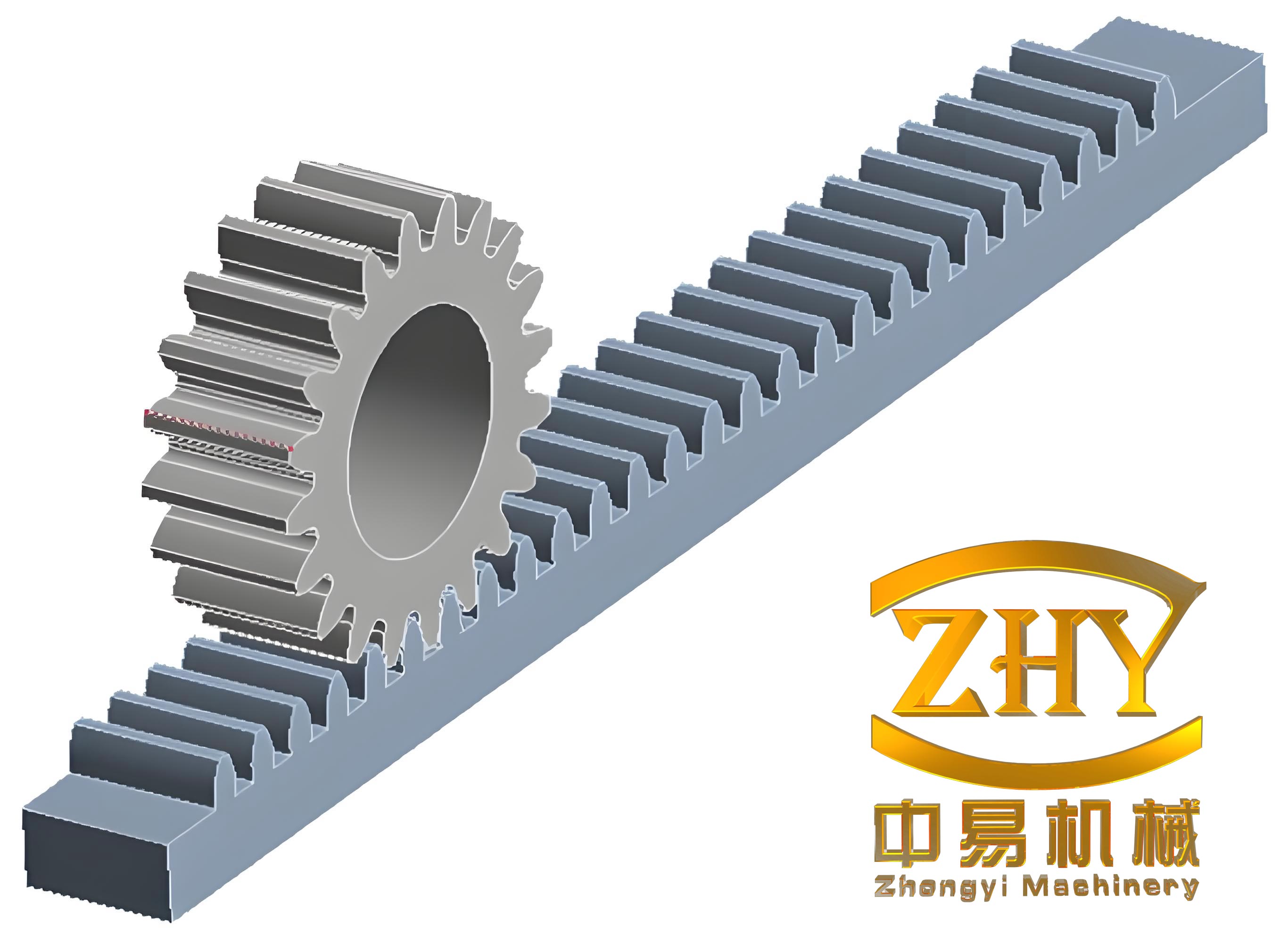
This investigation focuses on the bending stress evolution in the pinion of a large modulus rack and pinion gear pair subjected to progressive, uniform tooth wear. The core methodology integrates analytical modeling rooted in gear displacement theory with experimental validation. The analytical model explicitly accounts for the dynamic changes in key meshing parameters—such as tooth thickness, load distribution along the line of action, profile contact ratio, and form factor—induced by wear, which is simulated via a systematic reduction in the pinion’s addendum modification coefficient. Experimental stress data, acquired under controlled static loading conditions simulating various operational states, serves to verify the fidelity of the analytical predictions. This combined approach provides a comprehensive framework for understanding how uniform wear deteriorates the meshing conditions and accelerates the stress-related degradation within a rack and pinion gear transmission.
1. Theoretical Framework for Bending Stress Under Wear
The bending stress at the root of a gear tooth is calculated based on the Lewis formula, extended with correction factors to account for real-world conditions such as load sharing between multiple tooth pairs and stress concentration at the root fillet. For a pinion in a rack and pinion gear set, the nominal tooth root stress, \(\sigma_F\), is given by the fundamental equation:
$$
\sigma_F = K_F \frac{F_t}{b m_n} Y_{Fa} Y_{Sa} Y_{\epsilon}
$$
where:
\(F_t\) is the nominal tangential load at the reference circle (N).
\(b\) is the face width of the pinion (mm).
\(m_n\) is the normal module (mm).
\(Y_{Fa}\) is the tooth form factor, accounting for the shape of the tooth and the point of load application.
\(Y_{Sa}\) is the stress correction factor, accounting for stress concentration at the root.
\(Y_{\epsilon}\) is the contact ratio factor, which considers the influence of the transverse contact ratio on bending stress.
\(K_F\) is the load factor for bending strength, encompassing various application-specific influences.
The load factor \(K_F\) is a product of several sub-factors:
$$
K_F = K_A \cdot K_v \cdot K_{F\alpha} \cdot K_{F\beta}
$$
Here, \(K_A\) is the application factor, \(K_v\) is the dynamic factor, \(K_{F\beta}\) is the face load factor, and \(K_{F\alpha}\) is the transverse load factor. For the analysis of wear under quasi-static or low-speed conditions typical of large lifting rack and pinion gear systems, \(K_v\) can often be taken as unity. The most critical factor affected by tooth wear is \(K_{F\alpha}\), which governs the distribution of the total load \(F_t\) between simultaneously engaged tooth pairs.
1.1 Modeling Uniform Wear via Gear Displacement Theory
Uniform wear implies a nearly constant reduction in tooth thickness across all teeth of the pinion. This condition can be effectively modeled analytically by treating the worn gear as an equivalent gear with a negative addendum modification (negative shift coefficient, \(x\)). As wear progresses, the effective tooth thickness at the pitch circle, \(s\), decreases. The relationship between the wear-induced reduction and the equivalent negative shift is:
$$
\Delta s = 2 \Delta x \cdot m_n \cdot \tan(\alpha_n)
$$
where \(\Delta s\) is the reduction in tooth thickness, \(\Delta x\) is the change in profile shift coefficient (a negative value for wear), \(m_n\) is the module, and \(\alpha_n\) is the normal pressure angle. This approach allows us to leverage standard gear geometry equations to compute the new, worn-state parameters.
The key geometric and meshing parameters that change with wear (\(x\)) are:
- Tip Diameter (\(d_a\)): Remains constant if wear is not on the tip, but the effective tip circle pressure angle changes: \( \cos(\alpha_{at}) = \frac{d_b}{d_a} \), where \(d_b\) is the base diameter.
- Transverse Contact Ratio (\(\epsilon_{\alpha}\)): Decreases as wear reduces the active length of the line of action. For a rack and pinion gear, it is given by:
$$
\epsilon_{\alpha} = \frac{1}{2\pi} \left[ z_1 (\tan\alpha_{at} – \tan\alpha_t’) + \frac{4(h_{a0}^* – x)}{\sin(2\alpha_n)} \right]
$$
Here, \(z_1\) is the pinion tooth number, \(\alpha_{at}\) is the tip pressure angle, \(\alpha_t’\) is the operating pressure angle (equal to the rack pressure angle in standard mounting), and \(h_{a0}^*\) is the addendum coefficient. - Contact Ratio Factor (\(Y_{\epsilon}\)): Increases as \(\epsilon_{\alpha}\) decreases, raising the bending stress:
$$
Y_{\epsilon} = 0.25 + \frac{0.75}{\epsilon_{\alpha}}
$$ - Tooth Form Factor (\(Y_{Fa}\)) and Stress Correction Factor (\(Y_{Sa}\)): These factors depend on the virtual number of teeth and the geometry of the tooth at the critical root section. Wear alters the point of load application (the intersection of the line of action and the tooth centerline) and the effective geometry of the tooth resisting bending. \(Y_{Fa}\) and \(Y_{Sa}\) must be recalculated for the worn profile using the 30° tangent method or similar, considering the new load application height \(h_{Fa}\) and root chordal thickness \(s_{Fn}\).
1.2 Load Distribution Analysis: Single and Double Tooth Contact
The load is not uniformly borne across the entire path of contact. In a spur rack and pinion gear mesh, there are alternating intervals of single tooth pair contact (STC) and double tooth pair contact (DTC). The bending stress is significantly higher during STC. The boundaries of these intervals along the line of action are determined by the base pitch \(p_b\) and the contact ratio \(\epsilon_{\alpha}\). Wear, by reducing \(\epsilon_{\alpha}\), extends the STC interval and shortens the DTC intervals, thereby increasing the proportion of the meshing cycle during which the tooth experiences peak stress.
The load sharing between two pairs in the DTC zone is not equal. The load distribution factor \(K_{F\alpha}\) varies continuously along the path of contact. A common model defines it as a function of a dimensionless contact parameter \(\xi\):
$$
K_{F\alpha}^{(1)}(\xi) = \frac{\cos[b_0(\xi – \xi_m)]}{\cos[b_0(\xi – \xi_m)] + \cos[b_0(\xi + 1 – \xi_m)]} \quad \text{(for DTC zones)}
$$
$$
K_{F\alpha}^{(1)}(\xi) = 1 \quad \text{(for STC zone)}
$$
where \(\xi\) represents the relative contact position, \(\xi_m\) is the midpoint of the STC zone, and \(b_0\) is a parameter derived from the contact ratio. This model clearly shows that at the boundaries of the DTC zones, one tooth pair carries the full load (\(K_{F\alpha}=1\)), and in the middle of the DTC zone, the load is nearly equally shared (\(K_{F\alpha} \approx 0.5\)). The analytical calculation of bending stress must therefore be performed point-by-point along the meshing cycle, applying the correct \(K_{F\alpha}\) and the corresponding geometry factors for the load application point.
2. Analytical Stress Calculation for Worn States
We consider a large modulus rack and pinion gear system. The pinion parameters are: module \(m_n = 50\) mm, number of teeth \(z_1 = 12\), pressure angle \(\alpha_n = 20^\circ\), and face width \(b = 200\) mm. Four states are analyzed: a new pinion (reference state), and three uniformly worn states modeled by negative profile shifts equivalent to 1/12, 1/6, and 1/4 of the nominal tooth thickness reduction. The corresponding profile shift coefficients and key derived parameters are summarized in Table 1.
| Parameter | New Gear (x=0) | 1/12 Wear | 1/6 Wear | 1/4 Wear |
|---|---|---|---|---|
| Profile Shift Coeff., \(x\) | 0 | -0.072 | -0.133 | -0.206 |
| Tooth Thickness at Pitch, \(s\) (mm) | 78.54 | 72.01 | 68.74 | 58.90 |
| Tip Pressure Angle, \(\alpha_{at}\) (deg) | 32.78 | 32.09 | 31.49 | 30.75 |
| Trans. Contact Ratio, \(\epsilon_{\alpha}\) | 1.748 | 1.630 | 1.530 | 1.410 |
| Contact Ratio Factor, \(Y_{\epsilon}\) | 0.679 | 0.710 | 0.740 | 0.782 |
| Form Factor, \(Y_{Fa}\) | 2.47 | 2.56 | 2.58 | 2.79 |
| Stress Corr. Factor, \(Y_{Sa}\) | 1.88 | 1.86 | 1.86 | 1.82 |
The operating conditions are defined by six distinct load cases (LC1 to LC6), representing different scenarios such as lifting with overload or lowering with braking. The nominal tangential force \(F_t\) for the full-scale system is scaled down for laboratory analysis using the principle of equivalent bending stress, ensuring the stress state in the model pinion root is representative. The scaled forces and corresponding experimental pressures are listed in Table 2.
| Load Case | Full-Scale Tangential Force \(F’_t\) (kN) | Scaled Pinion Force \(F_t\) (kN) | Experiment Condition |
|---|---|---|---|
| LC1 | 396 | 18.65 | Light Uplift |
| LC2 | -583 | -27.45 | Moderate Descent |
| LC3 | -770 | -36.25 | Heavy Uplift |
| LC4 | 957 | 45.06 | Heavy Descent |
| LC5 | -1207 | -56.83 | Severe Uplift |
| LC6 | 1362 | 64.13 | Severe Descent |
Using the equations from Section 1 and the parameters in Table 1, the bending stress \(\sigma_F\) is calculated point-by-point along the path of contact for each load case and wear state. The load distribution factor \(K_{F\alpha}\) is computed for each mesh position. The results yield stress profiles that clearly show the stress peaks in the STC zone and the lower, varying stress in the DTC zones.
The analysis reveals two dominant trends. First, for any given wear state, the bending stress increases with applied load (from LC1 to LC6). Second, and more critically, for any given load case, the bending stress increases with the degree of wear. For example, at the most loaded point within the STC zone for LC6, the stress increases by approximately 7%, 12%, and 25% for the 1/12, 1/6, and 1/4 wear states, respectively, compared to the new gear.
A significant finding is the expansion of the Single Tooth Contact (STC) zone proportion with wear. The contact ratio \(\epsilon_{\alpha}\) decreases from 1.748 to 1.410, causing a larger fraction of the meshing cycle to be under high-stress STC conditions. The percentage of the mesh period spent in STC increases as shown in Table 3.
| Gear State | STC Fraction of Mesh Period (%) |
|---|---|
| New | 15.0 |
| 1/12 Wear | 23.5 |
| 1/6 Wear | 31.6 |
| 1/4 Wear | 42.7 |
3. Experimental Setup and Validation
To validate the analytical model, a dedicated test rig simulating a vertical rack and pinion gear lifting mechanism was constructed. The core of the rig is a large modulus pinion, instrumented with strain gauges, that meshes with a fixed rack. Hydraulic actuators apply a vertical force to the carriage connected to the pinion shaft, generating the desired tangential meshing force \(F_t\) corresponding to the load cases in Table 2.
Four physically manufactured pinions represent the wear states: one new, and three with tooth profiles machined to the dimensions corresponding to the 1/12, 1/6, and 1/4 uniform wear (negative shift) conditions. Strain gauges are mounted in a full-bridge configuration at the root fillet on both sides of several teeth to isolate bending stress. A static data acquisition system records the strain while the gear is held in fixed, pre-determined meshing positions that correspond to points within the DTC and STC zones.
For each pinion and each load case, strain measurements are taken at multiple positions along the path of contact. The measured strain \(\epsilon\) is converted to bending stress using Hooke’s Law, \(\sigma_{exp} = E \cdot \epsilon\), where \(E\) is the Young’s modulus of the gear material. The experimental stress profiles for the different wear states under various loads confirm the analytical predictions: stress magnitudes increase with both load and wear, and distinct stress peaks are observed in the STC region.
4. Results Comparison and Discussion
The analytical and experimental results are compared by calculating the average bending stress over the three characteristic meshing intervals: the first DTC zone (DTC-I), the STC zone, and the second DTC zone (DTC-II). Table 4 presents a summary of this comparison for the highest load case (LC6) across all wear states, demonstrating the close correlation.
| Gear State | Meshing Zone | Analytical \(\sigma_{an}\) (MPa) | Experimental \(\sigma_{exp}\) (MPa) | Relative Error (%) |
|---|---|---|---|---|
| New | DTC-I | 58.2 | 57.8 | 0.69 |
| STC | 112.5 | 110.9 | 1.44 | |
| DTC-II | 45.1 | 44.6 | 1.12 | |
| 1/12 Wear | DTC-I | 62.5 | 61.1 | 2.29 |
| STC | 120.6 | 118.3 | 1.94 | |
| DTC-II | 47.9 | 46.8 | 2.35 | |
| 1/6 Wear | DTC-I | 65.7 | 64.5 | 1.86 |
| STC | 126.5 | 123.7 | 2.26 | |
| DTC-II | 49.8 | 49.8 | 0.00 | |
| 1/4 Wear | DTC-I | 73.6 | 72.1 | 2.08 |
| STC | 141.1 | 138.5 | 1.88 | |
| DTC-II | 55.1 | 54.0 | 2.04 |
The agreement between the analytical model and experimental data is excellent, with a maximum relative error of 2.35% and many errors below 1%. This validates the core premise of using gear displacement theory to model uniform wear and the associated analytical framework for calculating bending stress. The minor discrepancies can be attributed to factors such as slight deviations in the machined tooth profile from the ideal geometry, residual stresses from manufacturing, and the idealized assumptions in the load distribution model.
The results conclusively demonstrate the detrimental impact of uniform wear on a rack and pinion gear system:
- Increased Stress Magnitude: Wear causes a systematic increase in root bending stress across all meshing zones for a given load.
- Worsened Load Cycle: The expansion of the Single Tooth Contact zone means each tooth spends a significantly longer portion of its meshing cycle under peak stress conditions. This directly accelerates fatigue damage accumulation.
- System Degradation: The combined effect of higher stress and a more severe stress cycle drastically reduces the fatigue life of the pinion, marking a clear performance degradation of the transmission system.
The analytical methodology, proven by experiment, provides a powerful tool for the condition-based assessment and remaining useful life prediction of critical large modulus rack and pinion gear drives in service.
5. Conclusion
This study has presented a comprehensive analysis of the bending strength in large modulus rack and pinion gear systems subjected to progressive uniform tooth wear. By integrating an analytical model based on gear displacement theory with controlled experimental validation, the work quantifies the direct relationship between wear extent, load distribution, and resulting tooth root stress.
The key findings are:
- Uniform wear, modeled as a negative profile shift, leads to a measurable decrease in the transverse contact ratio and an increase in the form factor and contact ratio factor, all contributing to higher calculated bending stresses.
- The analytical model accurately predicts the stress increase, showing excellent correlation with experimental strain gauge measurements (errors < 2.5%).
- Wear not only raises the stress level but also fundamentally alters the meshing dynamics by extending the duration of single tooth contact—the most critical loading condition—within each mesh cycle. This dual effect significantly accelerates the potential for fatigue-driven failure.
The implications of this research extend directly to the engineering practice surrounding mega-scale lifting and positioning systems that rely on rack and pinion gear technology. The developed framework enables engineers to move from a time-based maintenance paradigm to a condition-based one. By monitoring tooth thickness (a proxy for wear) in service, the associated increase in bending stress and reduction in fatigue life can be estimated, allowing for proactive component replacement before catastrophic failure occurs. This enhances the safety, reliability, and economic efficiency of critical infrastructure such as ship lifts, offshore platforms, and heavy-duty industrial elevators throughout their multi-decade service lives.