
In the field of mechanical transmissions, epicyclic gear trains are prized for their compact structure and versatile power flow capabilities. While traditional analysis methods for parallel-axis systems are well-established, the kinematic study of spatial bevel gear epicyclic trains presents unique challenges. The intersecting axes and three-dimensional motion complicate the application of conventional techniques like the “method of relative velocities” or the “tabular method.” This article presents a systematic, first-principles approach to the kinematic analysis of such systems, combining the topological clarity of graph theory with the geometric precision of screw theory. My objective is to develop a generalized, algorithm-friendly methodology that is not only accurate but also amenable to computer automation, paving the way for the intelligent design of complex, multi-degree-of-freedom bevel gear transmissions.
The cornerstone of this method is the abstraction of the physical bevel gear train into a directed graph model. This graph, denoted as $D = \{V, E\}$, consists of a vertex set $V$ and a directed edge set $E$. Each movable link in the mechanism is represented by a vertex. The fixed frame (or ground) is always assigned as vertex $0$. Movable links are subsequently numbered from $1$ to $n$, where $n$ is the number of movable links. Each kinematic pair (joint) is represented by a directed edge. Revolute joints are depicted as solid directed edges, while bevel gear meshes are represented as dashed directed edges. The direction of an edge is crucial: it points from the tail vertex $n_{tail}$ to the head vertex $n_{head}$. A critical convention is established for consistency: for any joint connected to the ground, the edge is directed from vertex $0$ to the connected link. For joints connected to a planet bevel gear, the edge is directed towards the vertex representing that planet gear. The directed graph provides an unambiguous topological blueprint of the system. The spanning tree is obtained by removing all dashed edges (gear pairs) from the directed graph, leaving a connected tree of $n$ solid edges (revolute joints).
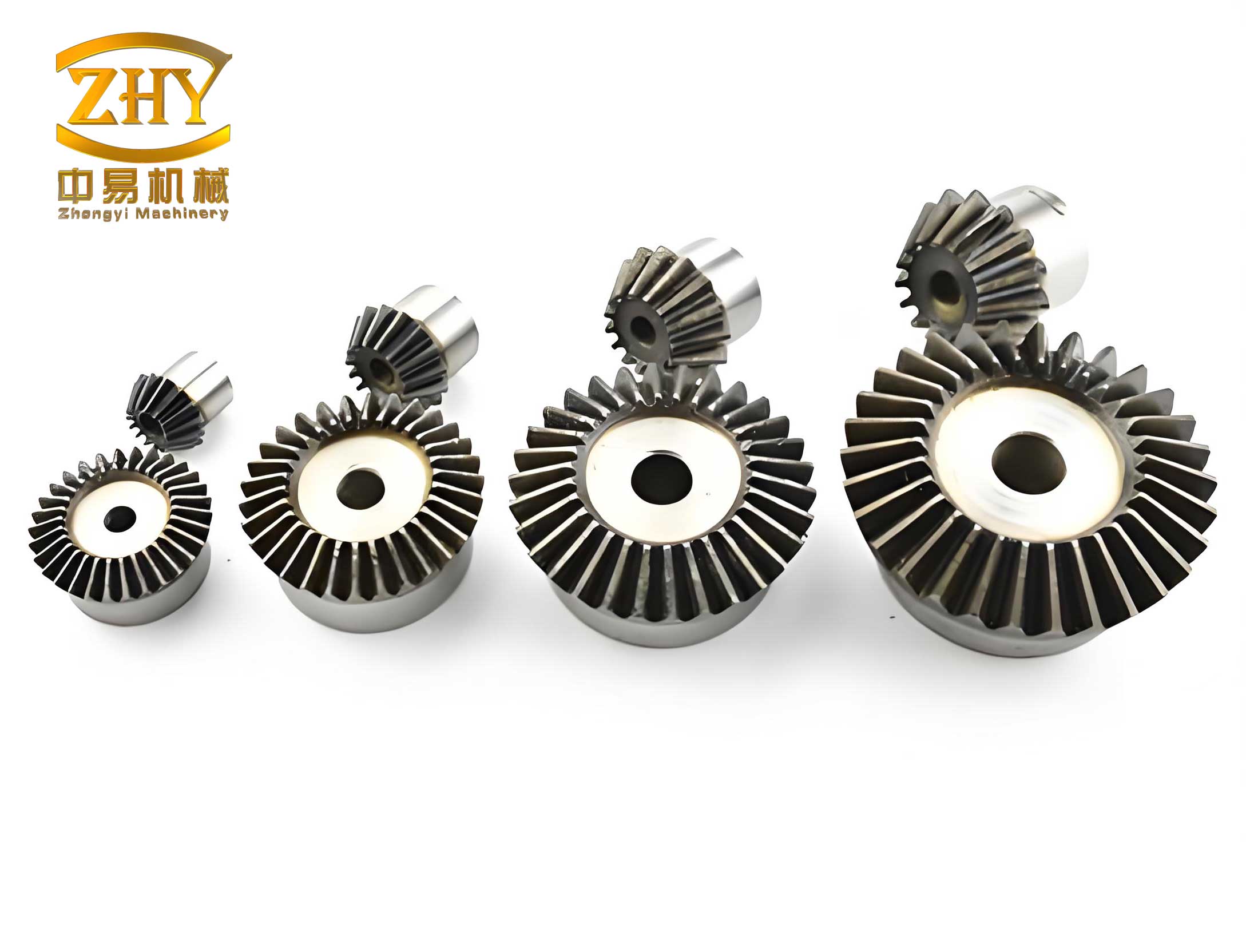
The analysis proceeds by constructing several key matrices from the graph model. First is the complete node-edge incidence matrix $\mathbf{\Gamma}_0$, of dimension $(n+1) \times k$, where $k = t + c$ is the total number of joints ($t$ revolute, $c$ gear). For a column corresponding to edge $e$ connecting vertices $i$ (tail) and $j$ (head), the element at row $i$ is $-1$, at row $j$ is $+1$, and $0$ elsewhere. The first row (ground) is linearly dependent and is removed to form the reduced node-edge incidence matrix $\mathbf{\Gamma}_{n \times k}$. Since in a standard epicyclic train the number of revolute joints typically equals the number of movable links ($t = n$), this matrix can be partitioned into two sub-matrices: an $n \times n$ matrix $\mathbf{G}$ for revolute joints and an $n \times c$ matrix $\mathbf{G}^*$ for gear joints.
$$\mathbf{\Gamma} = [\mathbf{G} | \mathbf{G}^*]$$
From the spanning tree, the path matrix $\mathbf{Z}_{t \times n}$ (which is square, $n \times n$) is determined. Its element $z_{t,n}$ is $+1$ if tree edge $t$ lies on the unique path from vertex $n$ to ground (vertex 0) and its direction agrees with the path direction; it is $-1$ if the direction is opposite; and $0$ if the edge is not on the path. The path matrix is fundamental for computing absolute velocities later. The spanning tree matrix $\mathbf{T}_{c \times t}$ is then calculated as:
$$\mathbf{T} = \mathbf{G}^{*T} \mathbf{Z}^T$$
Finally, the fundamental circuit matrix $\mathbf{C}_{c \times k}$ is assembled. Each row of $\mathbf{C}$ corresponds to a fundamental circuit closed by adding one gear pair (dashed edge) back into the spanning tree. It is constructed as:
$$\mathbf{C} = [\mathbf{T} | \mathbf{U}]$$
where $\mathbf{U}$ is a $c \times c$ identity matrix corresponding to the gear pair edges.
| Matrix | Symbol | Dimension | Derivation | Primary Role |
|---|---|---|---|---|
| Reduced Incidence Matrix | $\mathbf{\Gamma}$ | $n \times k$ | From directed graph | Defines topological connectivity |
| Path Matrix | $\mathbf{Z}$ | $n \times n$ | From spanning tree | Maps relative to absolute motion |
| Spanning Tree Matrix | $\mathbf{T}$ | $c \times n$ | $\mathbf{T} = \mathbf{G}^{*T}\mathbf{Z}^T$ | Relates gear circuits to tree joints |
| Circuit Matrix | $\mathbf{C}$ | $c \times k$ | $\mathbf{C} = [\mathbf{T} | \mathbf{U}]$ | Encodes kinematic closure constraints |
The kinematic constraints are formulated using screw theory, which elegantly captures the geometry of spatial motion. A unit screw $\hat{\$}^0_{c,k}$ is associated with each revolute joint $k$. In a global coordinate frame $O-X_0Y_0Z_0$, this screw represents the axis of the joint. It is defined by its Plücker coordinates:
$$\hat{\$}^0_{c,k} = \begin{Bmatrix} \mathbf{u}^0_k \\ \mathbf{r}^0_{c,k} \times \mathbf{u}^0_k \end{Bmatrix} = \begin{Bmatrix} L_k & M_k & N_k & | & P_{c,k} & Q_{c,k} & R_{c,k} \end{Bmatrix}^T$$
Here, $\mathbf{u}^0_k = [L_k, M_k, N_k]^T$ is the unit vector along the joint axis. For a bevel gear train with axes typically in the $Y_0Z_0$ plane, if the axis of joint $k$ is rotated by an angle $\varphi_k$ from the $Z_0$-axis about the $X_0$-axis, then:
$$\mathbf{u}^0_k = [0, -\sin\varphi_k, \cos\varphi_k]^T$$
The moment part $\mathbf{r}^0_{c,k} \times \mathbf{u}^0_k$ involves the position vector $\mathbf{r}^0_{c,k}$ from a point on the joint axis to a reference point associated with a particular gear mesh $c$. For a bevel gear pair, a convenient reference point is the pitch point of the mesh. The $P_{c,k}$ component of this moment vector is particularly important for the kinematic analysis of bevel gear trains.
The relative motion in each joint $k$ is described by a scalar twist magnitude $\Delta\theta_k = \Delta\theta_{n_{head}/n_{tail}}$, representing the angular speed of the head link relative to the tail link. The instantaneous twist associated with the joint is:
$$\hat{\mathbf{s}}^0_k = \hat{\$}^0_{c,k} \Delta\theta_k = \begin{Bmatrix} \mathbf{u}^0_k \Delta\theta_k \\ (\mathbf{r}^0_{c,k} \times \mathbf{u}^0_k) \Delta\theta_k \end{Bmatrix}$$
The collection of all joint twists is $\hat{\mathbf{s}}^0 = [\hat{\mathbf{s}}^0_t | \hat{\mathbf{s}}^0_c]^T$, where $\hat{\mathbf{s}}^0_t$ and $\hat{\mathbf{s}^0_c}$ correspond to revolute and gear pairs, respectively.
The fundamental kinematic closure equations are derived from the fact that the sum of twists around any independent circuit in the mechanism must be zero for compatible motion. This is enforced by the circuit matrix $\mathbf{C}$ through a Hadamard (element-wise) product:
$$[\mathbf{C} \circ \hat{\mathbf{s}}^0] = \mathbf{0}_{c}$$
Expanding this using the structure $\mathbf{C} = [\mathbf{T} | \mathbf{U}]$ and $\hat{\mathbf{s}}^0 = [\hat{\mathbf{s}}^0_t | \hat{\mathbf{s}}^0_c]^T$ leads to two key matrix equations. The first relates the gear pair relative velocities to the revolute joint relative velocities:
$$\Delta\boldsymbol{\theta}_c = -[\mathbf{T} \circ \mathbf{u}^0_t] \Delta\boldsymbol{\theta}_t$$
The second, and more critical for bevel gear analysis, involves the moment parts. For the common case where the selected reference points yield $Q_{c,k}=R_{c,k}=0$, it simplifies to an equation involving only the $P_{c,k}$ coefficients:
$$[\mathbf{T} \circ \mathbf{P}_{c,t}] \Delta\boldsymbol{\theta}_t = \mathbf{0}_c$$
Here, $\mathbf{P}_{c,t}$ is a matrix whose elements are the scalar $P_{c,k}$ values for each circuit $c$ and tree-edge joint $k$. These $P_{c,k}$ values are geometric parameters proportional to the pitch radii of the bevel gears and depend on the specific circuit. Defining the gear ratio for a mesh between gears on links $i$ and $j$ as $\mu_{ij} = d_i / d_j$ (where $d$ is the pitch diameter), the $\mathbf{P}_{c,t}$ matrix can be expressed in terms of these ratios.
The system’s mobility or degrees of freedom (DOF) $F$ is given by $F = 3n – 2t – c$. For an epicyclic train with $t=n$, this reduces to $F = n – c = t – r$, where $r = c$ is the rank (number of independent circuits). The kinematic equation $[\mathbf{T} \circ \mathbf{P}_{c,t}] \Delta\boldsymbol{\theta}_t = \mathbf{0}_c$ can be partitioned to separate the $F$ independent input velocities from the $r$ dependent ones:
$$[ \mathbf{P}_{r, F} | \mathbf{P}_{r, r} ] \begin{Bmatrix} \Delta\boldsymbol{\theta}_F \\ \Delta\boldsymbol{\theta}_r \end{Bmatrix} = \mathbf{0}$$
This allows solving for the dependent relative angular velocities as:
$$\Delta\boldsymbol{\theta}_r = -\mathbf{P}_{r, r}^{-1} \mathbf{P}_{r, F} \Delta\boldsymbol{\theta}_F$$
This equation is the core relative angular velocity equation for the bevel gear epicyclic train.
Once the relative velocities are known, the absolute angular velocity $\boldsymbol{\omega}^0_n$ of any link $n$ in the global frame is computed efficiently using the path matrix $\mathbf{Z}$:
$$\boldsymbol{\omega}^0_n = -\mathbf{Z}^T [\mathbf{u}^0_t \Delta\boldsymbol{\theta}_t]$$
Here, $[\mathbf{u}^0_t \Delta\boldsymbol{\theta}_t]$ denotes a column vector where each element is the vector $\mathbf{u}^0_k$ scaled by its corresponding scalar $\Delta\theta_k$ for each tree-edge revolute joint.
To solidify the methodology, let’s apply it to the classic automotive rear axle differential, a quintessential bevel gear epicyclic train. The system has $n=5$ movable links: the carrier (1), two side gears (2 & 3), and two planet bevel gears (4 & 5). There are $t=5$ revolute joints and $c=3$ gear pairs, resulting in $k=8$ and $F=2$ degrees of freedom. Following the conventions, the directed graph and its spanning tree are constructed. The associated matrices $\mathbf{\Gamma}, \mathbf{Z}, \mathbf{T},$ and $\mathbf{C}$ are derived systematically.
For the differential, with pitch diameters $d_1, d_{2′}, d_3, d_4, d_5$ (noting $d_3 = d_5$), the gear ratios are $\mu_{12′} = d_1/d_{2′}$ and $\mu_{34} = d_3/d_4$. The geometric analysis yields the $\mathbf{P}_{c,t}$ matrix. The fundamental kinematic equation becomes:
$$
\begin{bmatrix}
\mu_{12′} & -1 & 0 & 0 & 0 \\
0 & -\mu_{34} & \mu_{34} & -1 & 0 \\
0 & -1 & 0 & -1 & \mu_{34}
\end{bmatrix}
\begin{Bmatrix} \Delta\theta_6 \\ \Delta\theta_7 \\ \Delta\theta_8 \\ \Delta\theta_9 \\ \Delta\theta_{10} \end{Bmatrix} = \begin{Bmatrix} 0 \\ 0 \\ 0 \end{Bmatrix}
$$
where $\Delta\theta_6 = \omega_{10}, \Delta\theta_7 = \omega_{20}, \Delta\theta_8 = \omega_{30}, \Delta\theta_9 = \omega_{42}, \Delta\theta_{10} = \omega_{50}$.
Identifying inputs $\Delta\boldsymbol{\theta}_F = \{\omega_{10}, \omega_{30}\}^T$ and outputs $\Delta\boldsymbol{\theta}_r = \{\omega_{20}, \omega_{42}, \omega_{50}\}^T$, and partitioning the matrix accordingly, we solve to obtain the iconic relative velocity equation for a differential:
$$
\begin{Bmatrix} \omega_{20} \\ \omega_{42} \\ \omega_{50} \end{Bmatrix} =
\begin{bmatrix}
\mu_{12′} & 0 \\
\mu_{12′}\mu_{34} & -\mu_{34} \\
2\mu_{12′} & -1
\end{bmatrix}
\begin{Bmatrix} \omega_{10} \\ \omega_{30} \end{Bmatrix}
$$
From the third row, the well-known result $\omega_{30} + \omega_{50} = 2\omega_{20}$ is immediately evident, confirming the differential action. The absolute angular velocities of all links can then be computed via the path matrix $\mathbf{Z}$, giving a complete 3D kinematic picture.
| Operating Case | Description | $\omega_{30}$ (°/s) | $\omega_{20}$ (°/s) | $\omega_{42}$ (°/s) | $\omega_{50}$ (°/s) |
|---|---|---|---|---|---|
| 1 | Straight line (no differentiation) | 27.0 | 27.0 | 0.0 | 27.0 |
| 2 | Maximum left turn | -27.0 | 27.0 | 63.5 | 81.0 |
| 3 | Moderate right turn | -15.0 | 27.0 | 49.4 | 69.0 |
The methodology’s strength lies in its systematic nature and algorithmic clarity. Every step—from graph construction to matrix population and equation solving—follows a deterministic procedure. The geometric parameters ($\varphi_k$, $P_{c,k}$) are derived from the physical layout of the bevel gear train, and the gear ratios $\mu_{ij}$ are incorporated directly into the coefficient matrices. This makes the entire process highly suitable for computer implementation. A software routine can be designed to accept inputs like the connectivity list, joint axis orientations, and gear pitch diameters, automatically generating the graph, computing the matrices, and solving for velocities for any given input speeds. This automation is invaluable for analyzing complex, multi-loop bevel gear transmissions like those found in helicopter gearboxes or multi-mode hybrid vehicle drivetrains, where manual analysis would be prohibitively tedious and error-prone.
Furthermore, the approach is not limited to simple differentials. It can be extended to bevel gear trains with multiple planets, compound planets, or even more exotic configurations like bevel planetary gears with gyroscopic complexity. The graph model naturally accommodates additional vertices and edges, and the screw theory formulation remains valid for any spatial orientation of axes. The core equation $[\mathbf{T} \circ \mathbf{P}_{c,t}] \Delta\boldsymbol{\theta}_t = \mathbf{0}_c$ and the solution $\Delta\boldsymbol{\theta}_r = -\mathbf{P}_{r, r}^{-1} \mathbf{P}_{r, F} \Delta\boldsymbol{\theta}_F$ retain their form, with only the content and dimension of the $\mathbf{P}$ matrices changing. This generality is a key advantage over ad-hoc methods tailored to specific topologies.
In conclusion, the fusion of graph theory and screw theory provides a powerful, unified framework for the kinematic analysis of spatial bevel gear epicyclic trains. The method transforms the physical mechanism into an abstract yet precise mathematical model. The directed graph captures topology, the matrices encode connectivity and constraints, and screw theory injects the essential 3D geometry. The resulting analysis is rigorous, systematic, and inherently algorithmic. This work establishes a solid theoretical foundation for the next generation of computer-aided engineering (CAE) tools aimed at the automated synthesis, analysis, and optimization of advanced bevel gear transmission systems. By reducing complex spatial kinematics to a series of structured matrix operations, it enables engineers to explore a wider design space with greater confidence and efficiency, ultimately driving innovation in the field of mechanical power transmission.
Extended Discussion: Computational Implementation and Advanced Applications
The practical utility of any theoretical method is measured by its implementability and scope. The presented methodology excels on both fronts. A potential computational workflow can be outlined. First, a preprocessor defines the system: number of links ($n$), list of revolute joints (specifying tail, head, axis angle $\varphi_k$, and spatial location), and list of bevel gear pairs (specifying connecting links, pitch diameters, and mesh point location). The software then automatically builds the directed graph $D$, assigns the standardized numbering, and constructs the spanning tree. The matrices $\mathbf{\Gamma}, \mathbf{Z}, \mathbf{G}, \mathbf{G}^*, \mathbf{T},$ and $\mathbf{C}$ are populated algorithmically.
The core kinematic step involves calculating the $\mathbf{P}_{c,t}$ matrix. This requires a geometric subroutine that, for each fundamental circuit (each row $c$ of $\mathbf{C}$ corresponding to a gear pair), computes the $P_{c,k}$ value for every tree-edge revolute joint $k$ in that circuit. This computation, based on vector operations involving axis directions $\mathbf{u}^0_k$ and relative position vectors $\mathbf{r}^0_{c,k}$, is straightforward to code. The gear ratios $\mu$ are then factored in. Once $\mathbf{P}_{c,t}$ is known, it is partitioned based on the user-specified input and output joints. The matrix inversion and multiplication in $\Delta\boldsymbol{\theta}_r = -\mathbf{P}_{r, r}^{-1} \mathbf{P}_{r, F} \Delta\boldsymbol{\theta}_F$ are performed using standard numerical libraries. Finally, the absolute velocities are computed using $\boldsymbol{\omega}^0_n = -\mathbf{Z}^T [\mathbf{u}^0_t \Delta\boldsymbol{\theta}_t]$.
This workflow highlights the method’s suitability for parametric studies and optimization. For instance, an engineer could vary the pitch diameters of the bevel gears (changing the $\mu$ values) or the orientation of the axle for a planet gear (changing $\varphi_k$) and instantly see the effect on the overall speed ratios and the internal relative velocities within the train. This is crucial for optimizing load sharing, efficiency, and noise-vibration-harshness (NVH) characteristics.
The application scope extends beyond pure kinematics. The relative angular velocity matrix equation is the gateway to dynamic analysis. Once velocities are known, accelerations can be derived by differentiating the kinematic equations. With inertial properties assigned to each link, the dynamic equations of motion can be formulated using, for example, the Lagrangian method or virtual work principles, with the kinematic constraints embedded via the circuit matrix $\mathbf{C}$. Furthermore, the same graph model and screw theory approach can be adapted for limited power-flow and efficiency analysis by incorporating the principle of virtual work and loss models at the gear meshes and bearings. The directed edges can be assigned transmission parameters, and the circuit structure helps track power paths through complex bevel gear trains.
In summary, this integrated graph-screw theory approach is not merely an analytical trick but a comprehensive modeling paradigm. It offers a standardized language to describe, analyze, and synthesize a vast class of bevel gear mechanisms. Its mathematical rigor ensures accuracy, while its procedural nature enables automation. As the demand for sophisticated, compact, and efficient spatial gear transmissions grows in aerospace, robotics, and automotive sectors, such formalized methodologies become indispensable tools for the modern mechanical engineer, turning the intricate dance of intersecting bevel gear axes into a solvable set of elegant equations.