
In modern mechanical systems, gear shafts are critical components that transmit torque and motion, often under high stress and cyclic loading. The reliability of these gear shafts directly impacts the performance and safety of machinery. Recently, we encountered a batch of 20CrMnTiH steel gear shafts that exhibited brittle fracture during forging and cracks after machining, raising concerns about material quality. This study aims to investigate the root causes of these failures through comprehensive microstructural and fractographic analysis. By employing techniques such as scanning electron microscopy (SEM), energy-dispersive spectroscopy (EDS), and electron probe microanalysis (EPMA), we delve into the failure mechanisms and propose preventive measures to enhance the durability of gear shafts.
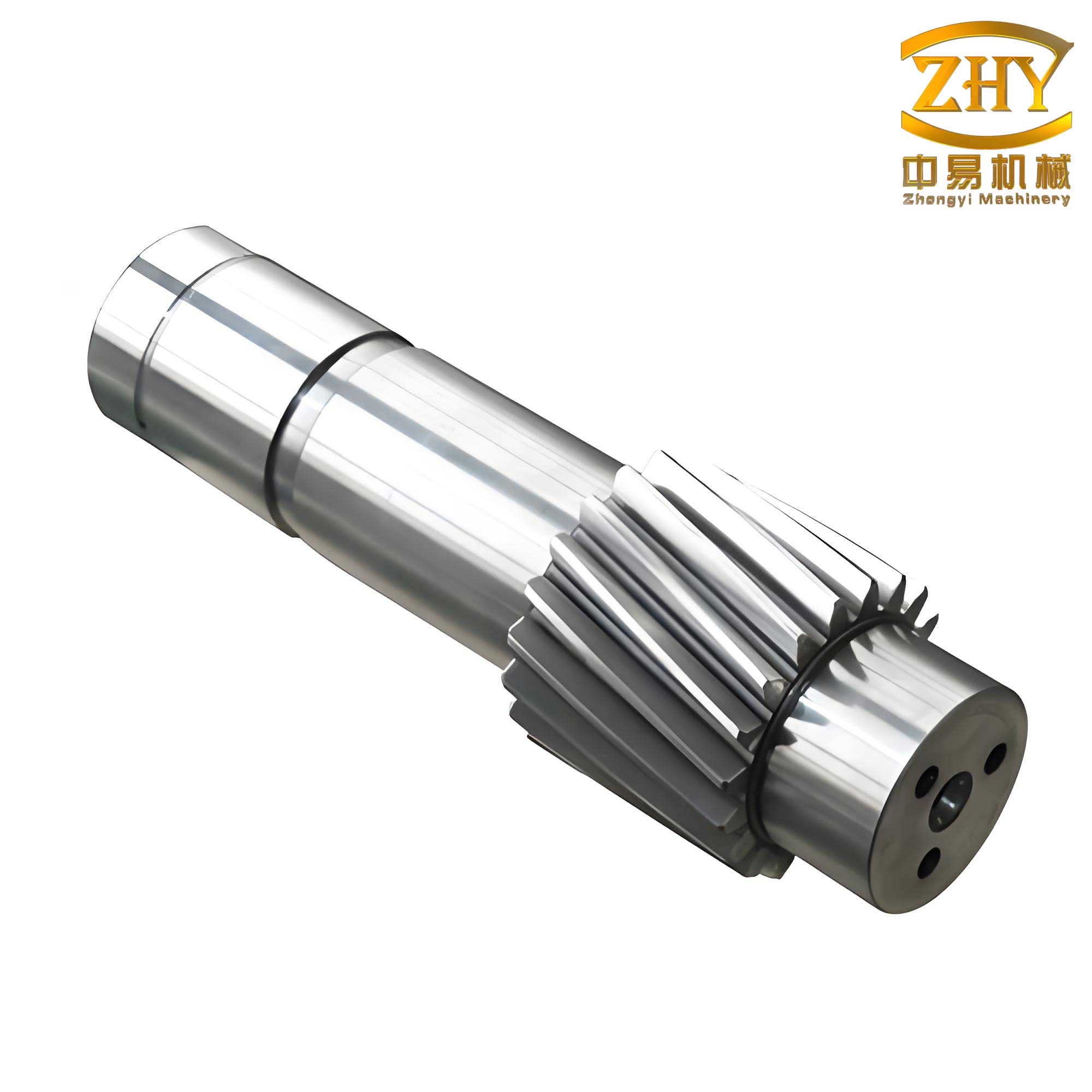
The importance of gear shafts in industrial applications cannot be overstated. They are typically manufactured from alloy steels like 20CrMnTiH, which offers a balance of strength, toughness, and hardenability. However, failures such as brittle fracture and cracking can lead to catastrophic breakdowns. In this analysis, we focus on the specific case of 20CrMnTiH gear shafts that failed during processing. Our approach involves examining both forged fracture surfaces and machined cracks to identify inherent material defects. We will present detailed results, supported by tables and formulas, to elucidate the role of inclusions, microstructure, and oxidation in the failure of these gear shafts.
Our experimental methodology began with sampling from the fractured forged gear shafts and cracked machined components. The samples were carefully sectioned using wire electrical discharge machining to preserve the fracture features. For macro- and micro-examination, we used optical microscopy (OM) after standard grinding, polishing, and etching with 4% nital solution. Scanning electron microscopy (SEM) was employed for high-resolution imaging of fracture surfaces and microstructures, coupled with EDS for elemental analysis. Additionally, electron probe microanalysis (EPMA) was conducted to map elemental distributions around crack regions. All samples were ultrasonically cleaned in alcohol to remove contaminants prior to analysis, ensuring accurate results.
The fracture surface of the forged gear shaft revealed distinct regions under macroscopic observation. As shown in the analysis, the fracture could be divided into three areas: an oxidized flat zone, a brittle propagation zone, and a final rupture zone. SEM examination of the oxidized zone indicated a layer of iron oxide particles, approximately 5 μm in size, covering the surface. EDS spectra confirmed high oxygen and iron content, with weight percentages around 35.28% O and 56.98% Fe, suggesting severe high-temperature oxidation. This implies that the crack initiated prior to or during forging, as the oxide layer formed at elevated temperatures. The brittle zones exhibited cleavage features, indicative of rapid crack propagation, but were also oxidized, possibly due to exposure after fracture or during forging under pressure.
Microstructural analysis near the fracture of the forged gear shaft revealed a ferrite-pearlite matrix. However, the core region showed anisotropy, with alternating layers of ferrite and pearlite, while the surface region had a more homogeneous distribution. This anisotropy can be attributed to non-uniform deformation during forging, which is critical for gear shafts that require consistent mechanical properties. More importantly, numerous inclusions and voids were observed within the microstructure. The inclusions ranged from 1 to 15 μm in size, with some reaching up to 30 μm, and voids measured between 5 and 10 μm. EDS analysis identified these inclusions as sulfides (e.g., MnS), oxides (e.g., MnO2), and mixed compounds, as summarized in Table 1.
| Inclusion Type | Typical Composition | Size Range (μm) | Potential Source |
|---|---|---|---|
| Sulfides | MnS, FeS | 1-10 | Deoxidation residues |
| Oxides | FeO, MnO2, Al2O3 | 2-15 | Oxidation during casting |
| Mixed Inclusions | CaCO3, silicates | 5-30 | Slag entrapment |
| Voids | — | 5-10 | Gas porosity or shrinkage |
The presence of these defects significantly compromises the integrity of gear shafts. Inclusions act as stress concentrators, initiating cracks under applied loads. The stress concentration factor around an elliptical inclusion can be estimated using the formula:
$$K_t = 1 + 2\sqrt{\frac{a}{\rho}}$$
where \(K_t\) is the stress concentration factor, \(a\) is the crack or inclusion length, and \(\rho\) is the radius of curvature at the tip. For typical inclusions in our gear shafts, with \(a = 10 \, \mu m\) and \(\rho = 1 \, \mu m\), \(K_t\) can be as high as 7.33, dramatically reducing the fatigue life of the material. This explains the brittle fracture observed during forging, where localized stresses exceeded the material’s fracture toughness.
Further investigation of the machined gear shaft cracks using SEM and EPMA revealed decarburized layers on both sides of the cracks. The microstructure adjacent to the cracks consisted primarily of ferrite, with an absence of pearlite, indicating carbon loss due to high-temperature exposure. EPMA elemental mapping showed elevated oxygen and carbon levels within the cracks, along with reduced iron content, confirming oxidation. The oxidation kinetics can be described by the parabolic rate law:
$$\frac{dx}{dt} = k e^{-\frac{E_a}{RT}}$$
where \(x\) is the oxide thickness, \(t\) is time, \(k\) is a rate constant, \(E_a\) is the activation energy, \(R\) is the gas constant, and \(T\) is the absolute temperature. This suggests that the cracks formed at high temperatures, likely during prior processing such as continuous casting or rolling, rather than during machining. The decarburization indicates prolonged exposure to oxidizing atmospheres, which weakens the surface of gear shafts and promotes crack propagation.
The combined evidence points to inherent material flaws as the root cause of failure in these gear shafts. The cracks originated from inclusions and voids introduced during steelmaking, continuous casting, or rolling processes. During forging, these defects acted as initiation sites for brittle fracture, exacerbated by high-temperature oxidation. The anisotropic microstructure in the core further contributed to uneven stress distribution, making the gear shafts prone to cracking. To quantify the fracture risk, we can apply linear elastic fracture mechanics. The stress intensity factor for mode I cracking is given by:
$$K_I = \sigma \sqrt{\pi a}$$
where \(K_I\) is the stress intensity factor, \(\sigma\) is the applied stress, and \(a\) is the crack length. For a crack length of 100 μm (typical of observed defects) and an applied stress of 500 MPa (common in forging), \(K_I\) approximates 88.6 MPa√m, which may exceed the fracture toughness of 20CrMnTiH steel (typically 50-80 MPa√m), leading to unstable crack growth. This underscores the criticality of controlling defect sizes in gear shafts.
To prevent such failures in future production of gear shafts, several measures are recommended. First, improving deoxidation practices in steelmaking can reduce inclusion content. Second, implementing full protective casting—from ladle to tundish and tundish to mold—minimizes air exposure and slag entrapment. Third, optimizing heating and rolling parameters can alleviate surface cracks. Fourth, gear shaft design should incorporate fillets and smooth transitions to mitigate stress concentration. These preventive actions are summarized in Table 2, along with their expected impact on gear shaft quality.
| Measure | Implementation Stage | Key Action | Expected Outcome |
|---|---|---|---|
| Enhanced Deoxidation | Steelmaking | Use of aluminum or calcium treatment | Reduction in oxide inclusions by up to 50% |
| Full Protection Casting | Continuous Casting | Shrouded nozzles and argon bubbling | Minimized oxidation and slag inclusion |
| Process Optimization | Rolling | Controlled heating rates and reduction ratios | Elimination of surface cracks and anisotropy |
| Design Modification | Engineering | Stress-relief features and shot peening | Increased fatigue resistance of gear shafts |
| Quality Monitoring | Throughout Production | Non-destructive testing (e.g., ultrasonic) | Early detection of defects in gear shafts |
In addition to process improvements, material selection and heat treatment play vital roles in the performance of gear shafts. For 20CrMnTiH steel, proper carburizing and quenching can enhance surface hardness while maintaining a tough core. However, if inclusions are present, they can serve as nucleation sites for quench cracks. The susceptibility to cracking can be assessed using the quench crack sensitivity index, which relates to hardenability and inclusion content. Empirically, we can express this as:
$$S = \frac{H}{C_i + V_d}$$
where \(S\) is the crack sensitivity index, \(H\) is the hardenability, \(C_i\) is the inclusion concentration, and \(V_d\) is the void density. Lower \(S\) values indicate higher risk, emphasizing the need for clean steel in gear shafts. Our analysis shows that the failed gear shafts had high \(C_i\) and \(V_d\), leading to low \(S\) and thus prone to cracking during heat treatment or service.
Furthermore, the role of non-metallic inclusions in fatigue failure of gear shafts cannot be overlooked. Under cyclic loading, inclusions can debond from the matrix, forming microvoids that coalesce into cracks. The fatigue life \(N_f\) can be estimated using models that incorporate inclusion size. For example, the Murakami model relates the fatigue limit \(\sigma_w\) to the square root of the projected inclusion area \(\sqrt{area}\):
$$\sigma_w = \frac{C}{(H_v + 120)} \left( \frac{\sqrt{area}}{10^{-6}} \right)^{-1/6}$$
where \(C\) is a constant (typically 1.43 for surface defects), \(H_v\) is the Vickers hardness, and \(\sqrt{area}\) is in meters. For our gear shafts with inclusions of \(\sqrt{area} = 10 \, \mu m\) and \(H_v = 300\), the fatigue limit reduces significantly, explaining the premature failures. This highlights the importance of controlling inclusion sizes below critical thresholds, ideally under 5 μm for high-stress applications like gear shafts.
Another aspect to consider is the effect of microstructure anisotropy on the mechanical properties of gear shafts. The banded structure observed in the core region leads to directional strength variations. The anisotropy coefficient \(A\) can be defined as the ratio of longitudinal to transverse tensile strength:
$$A = \frac{\sigma_{L}}{\sigma_{T}}$$
For isotropic materials, \(A \approx 1\), but for the failed gear shafts, \(A\) deviated due to banding, causing uneven load distribution and promoting crack growth along weak interfaces. Homogenization annealing or controlled cooling rates during rolling can alleviate this issue, ensuring uniform properties throughout gear shafts.
Our investigation also underscores the significance of oxidation prevention during high-temperature processing. The formation of iron oxides on fracture surfaces indicates exposure to oxygen, which embrittles the material. The oxide growth can be modeled using the Wagner theory, where the weight gain per unit area \(\Delta W\) follows:
$$\Delta W = k_p \cdot t^{1/2}$$
with \(k_p\) as the parabolic rate constant. For gear shafts processed in oxidizing atmospheres, this leads to scale formation and subsurface decarburization, both detrimental to fatigue strength. Implementing inert gas shielding or vacuum heating can mitigate oxidation, preserving the surface integrity of gear shafts.
In summary, the brittle fracture and cracks in 20CrMnTiH gear shafts stem from a combination of material defects, including inclusions, voids, and anisotropic microstructure, compounded by high-temperature oxidation. These flaws originated in the steelmaking and rolling stages, highlighting the need for stringent quality control. By adopting the preventive measures outlined, manufacturers can produce more reliable gear shafts with enhanced durability. Future work should focus on real-time monitoring of inclusion populations and advanced non-destructive evaluation techniques to ensure the longevity of gear shafts in demanding applications.
To conclude, gear shafts are pivotal components whose failure can have severe repercussions. Our analysis provides a detailed framework for diagnosing and addressing such failures. Through integrated use of analytical techniques, we have identified key factors—from inclusion content to oxidation—that compromise gear shaft performance. By implementing the recommended strategies, the industry can advance toward producing defect-free gear shafts capable of withstanding rigorous operational conditions. This study not only resolves the immediate issue but also contributes to broader knowledge on material failure analysis, benefiting the design and manufacturing of gear shafts across sectors.