
In modern manufacturing, the production of high-precision herringbone gears remains a significant challenge. The gear milling process is highly sensitive to various error sources, among which the clamping pose errors of the workpiece on the machine tool are critical yet often overlooked. These errors, introduced during fixture setup, directly transfer to the machined tooth surfaces, affecting the final gear quality, meshing performance, and service life. This analysis delves deeply into the influence of workpiece clamping eccentricity and inclination errors on the accuracy of herringbone gears produced via flank gear milling. By establishing a comprehensive mathematical model and conducting detailed numerical and experimental investigations, this work aims to elucidate the specific relationships between these pose errors and key gear accuracy parameters, thereby providing a foundation for error identification and compensation strategies.
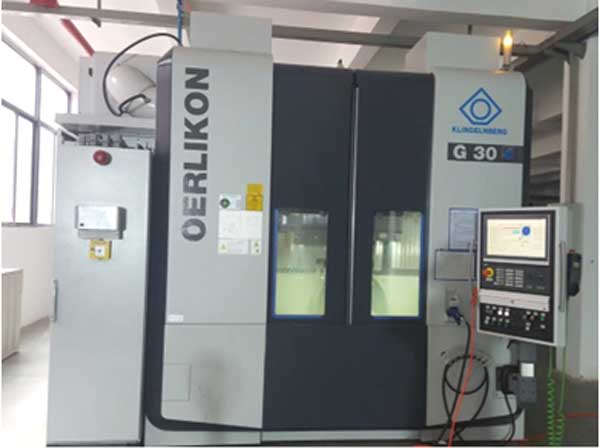
The fundamental principle of herringbone gear milling involves generating the tooth flank as an envelope of the tool path. A standard CNC gear milling machine typically features several linear axes (e.g., radial X, tangential Y, stroke Z) and rotary axes (workpiece rotation C, tool spindle SP). The cutter, often an end mill, rotates about its axis while performing a reciprocating motion along the gear’s axial direction (Z-axis). Simultaneously, the workpiece rotates about the C-axis. The synchronized helical motion of the cutter relative to the workpiece generates the intended involute helix of the herringbone gear. This process is highly efficient for machining large gears but is susceptible to geometric inaccuracies stemming from machine tool errors and workpiece misalignment.
Mathematical Modeling of Gear Milling with Pose Errors
To quantify the impact of clamping errors, a precise mathematical model of the gear milling process incorporating these errors is essential. The model is built upon the theory of gearing and homogeneous coordinate transformations.
In an ideal setup, the right-hand flanks of the herringbone gear teeth can be defined in the workpiece coordinate system S_g (O_g – x_g y_g z_g). The surface equation for the right-hand helical involute flank is given by:
$$
\begin{aligned}
x_g &= r_b \cos(\sigma_0 + u + \theta) + r_b u \sin(\sigma_0 + u + \theta) \\
y_g &= r_b \sin(\sigma_0 + u + \theta) – r_b u \cos(\sigma_0 + u + \theta) \\
z_g &= p \theta
\end{aligned}
$$
where \( r_b \) is the base circle radius, \( \sigma_0 \) is the half-space angle on the base circle, \( u \) is the involute roll angle parameter, \( \theta \) is the parameter of rotation around the z_g axis, and \( p \) is the spiral parameter (\( p = r_b / \tan(\beta_b) \), with \( \beta_b \) as the base helix angle).
Clamping pose errors disrupt the ideal alignment between the workpiece coordinate system S_g and the machine tool’s coordinate system S_c (O_c – x_c y_c z_c) attached to the rotary table. These errors include three translational errors (δ_xg, δ_yg, δ_zg) and three rotational errors (ε_xg, ε_yg, ε_zg). For a cylindrical gear mounted on a rotary table, errors δ_zg and ε_zg primarily affect the initial axial and angular positioning but do not alter the form of the generated surface relative to the workpiece itself. Furthermore, the gear can be treated as a rigid body. A common and significant clamping error is an eccentricity \( e \) in the plane perpendicular to the gear axis. Assuming this eccentricity lies along a direction defined by a phase angle \( \phi \), the translational errors can be expressed as δ_xg = e sin φ and δ_yg = e cos φ. A typical tilt error around the y-axis, ε_yg, is also considered. Therefore, the simplified homogeneous transformation matrix from the ideal frame S_c to the actual workpiece frame S_g, accounting for small angle approximations (sin ε ≈ ε, cos ε ≈ 1), is:
$$
\mathbf{T}_{gc} =
\begin{bmatrix}
1 & 0 & \varepsilon_{yg} & e \sin \phi \\
0 & 1 & 0 & e \cos \phi \\
-\varepsilon_{yg} & 0 & 1 & 0 \\
0 & 0 & 0 & 1
\end{bmatrix}
$$
The coordinates of a point on the actual machined tooth surface, considering clamping pose errors during the gear milling process, are then obtained by transforming the ideal surface coordinates:
$$
\begin{bmatrix}
x’_g \\
y’_g \\
z’_g \\
1
\end{bmatrix}
= \mathbf{T}_{gc} \cdot
\begin{bmatrix}
x_g \\
y_g \\
z_g \\
1
\end{bmatrix}
=
\begin{bmatrix}
x_g + \varepsilon_{yg} z_g + e \sin \phi \\
y_g + e \cos \phi \\
-\varepsilon_{yg} x_g + z_g \\
1
\end{bmatrix}
$$
This equation \( \mathbf{r}’_g(u, \theta) = [x’_g, y’_g, z’_g]^T \) forms the foundation for analyzing the deviations introduced by the clamping errors \( e \) and \( \varepsilon_{yg} \) during gear milling.
Gear Accuracy Evaluation Methodology
The influence of errors is assessed against standardized gear accuracy metrics as per ISO 1328-1. The evaluation focuses on profile, lead, and pitch deviations.
Profile Deviation: For any measured point \( G’ \) on the actual profile in a transverse section, its deviation from the theoretical involute is calculated. The theoretical involute length \( GT \) from the base circle to the point of intersection with a line tangent to the base circle through \( G’ \) is compared to the actual length \( G’T \).
$$
\begin{aligned}
f_{\alpha} &= G’T – GT \\
\text{where } G’T &= \sqrt{(x’_g)^2 + (y’_g)^2 – r_b^2} \\
u &= \arctan(y’_g / x’_g) + \arctan(G’T / r_b) – \sigma_0 \\
GT &= r_b \cdot u
\end{aligned}
$$
The profile slope deviation \( f_{H\alpha} \), profile form deviation \( f_{f\alpha} \), and total profile deviation \( F_{\alpha} \) are then derived from the calculated deviation curve over the evaluation range.
Lead Deviation: Lead errors are evaluated along tooth traces on the cylindrical surface. The lead slope deviation \( f_{H\beta} \) and lead form deviation \( f_{f\beta} \) are determined from the deviations of the actual helix from the theoretical one.
Pitch Deviation: Single pitch deviation \( f_{pt} \) is the algebraic difference between the actual and theoretical pitch. The total cumulative pitch deviation \( F_p \) is the maximum range of cumulative pitch error over any sector of the gear.
Numerical Analysis of Error Influences
A detailed numerical simulation was performed for a herringbone gear with the following parameters: number of teeth z = 78, normal module m_n = 12 mm, normal pressure angle α_n = 20°, helix angle β = 30°, face width b = 200 mm. The nominal clamping errors were set to e = 0.05 mm and ε_yg = 0.05°. The effects of eccentricity error alone, inclination error alone, and their coupled effect were investigated separately.
Influence on Profile Error
The analysis reveals that profile errors are relatively insensitive to clamping pose errors in gear milling. The deviations are minimal and show a consistent, low-amplitude periodic variation across the gear teeth.
| Error Condition | Profile Slope Dev. \( f_{H\alpha} \) (mm) | Profile Form Dev. \( f_{f\alpha} \) (mm) | Sensitivity |
|---|---|---|---|
| Eccentricity only (e=0.05mm) | ~0.007 | ~0.00014 | Low |
| Inclination only (ε=0.05°) | ~0.0123 | ~0.000313 | Low |
| Coupled (e=0.05mm, ε=0.05°) | ~0.0193 | ~0.000453 | Low (Linear Superposition) |
Influence on Lead Error
Lead error exhibits a distinct sensitivity pattern. The inclination error ε_yg has a profound effect on the lead slope deviation, as it introduces a twist in the generated helix. Eccentricity has a negligible effect on lead. The form deviation remains small in all cases.
| Error Condition | Lead Slope Dev. \( f_{H\beta} \) (mm) | Lead Form Dev. \( f_{f\beta} \) (mm) | Sensitivity |
|---|---|---|---|
| Eccentricity only (e=0.05mm) | ~0.0051 | ~0.000081 | Low |
| Inclination only (ε=0.05°) | ~0.0829 | ~0.00313 | **Very High** for \( f_{H\beta} \) |
| Coupled (e=0.05mm, ε=0.05°) | ~0.088 | ~0.00321 | Linear Superposition |
Influence on Pitch Error
Pitch error, particularly the cumulative pitch deviation \( F_p \), is highly sensitive to both types of clamping pose errors in gear milling. The single pitch deviation \( f_{pt} \) is less sensitive. The eccentricity error produces a sinusoidal cumulative error with an amplitude of approximately \( 2e \). The inclination error also significantly impacts \( F_p \).
| Error Condition | Single Pitch Dev. \( \pm f_{pt} \) (mm) | Total Cumulative Dev. \( F_p \) (mm) | Sensitivity |
|---|---|---|---|
| Eccentricity only (e=0.05mm) | ~0.004 | ~0.1 (≈ 2e) | **High** for \( F_p \) |
| Inclination only (ε=0.05°) | ~0.007 | ~0.127 | **High** for \( F_p \) |
| Coupled (e=0.05mm, ε=0.05°) | ~0.011 | ~0.227 | Linear Superposition |
The overall relationship can be summarized for a point \( P \) on the tooth surface. The resultant deviation \( \Delta \mathbf{r} \) due to clamping errors in gear milling is approximately:
$$
\Delta \mathbf{r}(P) \approx \mathbf{J}_e(P) \cdot e + \mathbf{J}_\varepsilon(P) \cdot \varepsilon_{yg}
$$
where \( \mathbf{J}_e \) and \( \mathbf{J}_\varepsilon \) are sensitivity matrices for eccentricity and inclination, respectively. For composite errors like \( F_p \) and \( f_{H\beta} \), the total effect is essentially the linear sum of the individual effects, confirming the principle of superposition for these small geometric errors.
Experimental Verification in Gear Milling
To validate the numerical findings, a practical gear milling experiment was conducted. A herringbone gear with the specified parameters was machined on a CNC gear milling machine. Two setups were used: one with intentionally introduced clamping errors (e ≈ 0.05 mm, ε_yg ≈ 0.05°), and another with errors minimized through careful alignment. The machined gears were inspected on a high-precision coordinate measuring machine (CMM). Four teeth approximately 90° apart were measured for lead and pitch deviations.
The results from the gear milling test with errors confirmed the predictions. The measured lead slope deviation \( f_{H\beta} \) corresponded to ISO grade 8, and the total cumulative pitch deviation \( F_p \) corresponded to ISO grade 9 for one flank, showing significant degradation. The pattern of the cumulative pitch error curve matched the expected sinusoidal form from eccentricity superposed with the trend from inclination.
| Measurement (With Errors) | Upper Flank | Lower Flank | ISO Grade |
|---|---|---|---|
| Lead Slope Dev. \( f_{H\beta} \) | 33.3 µm | 27.2 µm | 8 |
| Pitch Cum. Dev. \( F_p \) | 173.9 µm | 143.7 µm | 9 / 8 |
After correcting the clamping pose errors, the gear was remachined. The subsequent inspection showed marked improvement, confirming that the observed errors were indeed attributable to the clamping pose. The lead accuracy improved by two ISO grades, and the pitch accuracy improved by up to four grades, aligning with the theoretical sensitivity analysis.
| Measurement (Errors Corrected) | Upper Flank | Lower Flank | ISO Grade |
|---|---|---|---|
| Lead Slope Dev. \( f_{H\beta} \) | 17.7 µm | 17.1 µm | 6 |
| Pitch Cum. Dev. \( F_p \) | 34.4 µm | 48.0 µm | 4 / 5 |
Conclusion
This comprehensive analysis establishes clear and quantifiable relationships between workpiece clamping pose errors and the accuracy of herringbone gears produced by gear milling. The key conclusions are:
- Profile Accuracy: Tooth profile deviations ( \( f_{H\alpha}, f_{f\alpha}, F_{\alpha} \) ) are largely insensitive to both eccentricity and inclination clamping errors in gear milling. Their influence is negligible compared to other error sources.
- Lead Accuracy: Lead slope deviation ( \( f_{H\beta} \) ) is extremely sensitive to the workpiece inclination error ( \( \varepsilon_{yg} \) ) because it directly twists the generated helix. It is, however, insensitive to eccentricity error. Lead form deviation ( \( f_{f\beta} \) ) remains relatively unaffected.
- Pitch Accuracy: Single pitch deviation ( \( f_{pt} \) ) is not highly sensitive. In contrast, the total cumulative pitch deviation ( \( F_p \) ) is highly sensitive to both eccentricity and inclination errors. Eccentricity induces a dominant once-per-revolution error with an amplitude of approximately twice the eccentricity value ( \( F_p \approx 2e \) ).
- Coupled Effects: For the small errors considered, the combined effect of eccentricity and inclination on the evaluated gear accuracy parameters in gear milling can be treated as a linear superposition of their individual effects.
The findings underscore that in precision gear milling, meticulous attention to workpiece alignment—specifically minimizing both radial eccentricity and axial tilt—is paramount for controlling lead and cumulative pitch accuracy. The mathematical models and sensitivity data presented provide a direct pathway for implementing error compensation strategies, either through pre-process fixture adjustment or in-process CNC compensation, ultimately leading to higher quality herringbone gear manufacturing.