
In modern transmission systems, the gear shaft plays a critical role in transferring torque and ensuring efficient power delivery under varying operational loads. As a key component, the gear shaft must maintain precise dimensional accuracy and tooth integrity to withstand dynamic stresses. However, heat treatment processes often induce significant deformations in critical dimensions, such as pinion span and tooth profile accuracy, leading to increased scrap rates and production costs. This article delves into the cold and hot fitting test methodology, which involves pre-adjusting machining parameters based on anticipated heat treatment distortions. By analyzing deformation patterns and implementing corrective measures before heat treatment, manufacturers can enhance the conformity of gear shaft specifications, reduce waste, and optimize production efficiency. Through detailed experimental data, mathematical modeling, and practical insights, this study demonstrates how cold and hot fitting tests serve as a proactive approach to addressing thermal deformation challenges in gear shaft manufacturing.
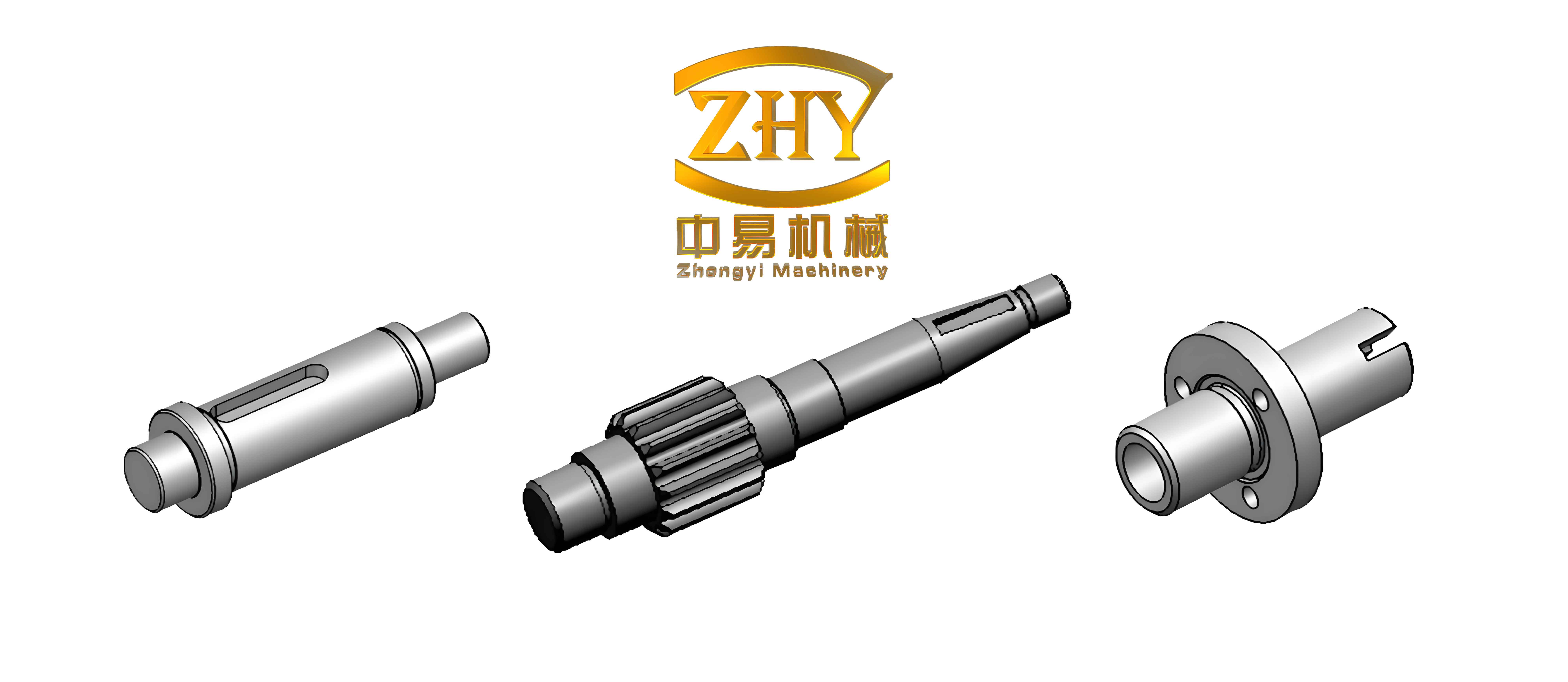
The gear shaft, typically fabricated from materials like 8620RH steel (analogous to 20CrNiMo), undergoes carburizing heat treatment to achieve surface hardness levels of 58–63 HRC, ensuring durability and wear resistance. Despite these benefits, the thermal cycles during heat treatment cause dimensional shifts, particularly in the pinion span of external and internal gears. For instance, external gear pinion spans tend to expand, while internal gear spans contract post-treatment. Traditional machining sequences, where tooth processing is completed before heat treatment, fail to account for these deformations, resulting in non-conforming products. This highlights the necessity of integrating cold and hot fitting tests into the production workflow, enabling data-driven adjustments that compensate for thermal effects and improve overall gear shaft quality.
Traditional manufacturing processes for gear shafts involve sequential steps such as rough turning, finish turning, gear shaping, hobbing, shaving, intermediate inspection, heat treatment, and post-treatment machining. While these methods ensure basic dimensional accuracy, they often overlook the cumulative impact of heat treatment deformation on final product specifications. Key issues include deviations in pinion span and tooth accuracy, which are predominantly influenced by thermal expansion and contraction. For example, the pinion span of an external gear may increase beyond allowable limits after heat treatment, whereas that of an internal gear may decrease, leading to assembly failures or performance issues. Additionally, tooth helix angles can shift directionally—left-hand helical gears tend to tilt leftward, and right-hand gears rightward—due to residual stresses from quenching. These distortions are challenging to predict and correct post-treatment, underscoring the limitations of conventional approaches and the need for advanced strategies like cold and hot fitting tests.
The cold and hot fitting test method revolves around analyzing historical heat treatment data to pre-adjust machining parameters, thereby counteracting anticipated deformations. This involves modifying the pinion span and tooth profile during pre-treatment machining stages. For external gears, the pinion span is machined to values below the specification lower limit, accounting for post-treatment expansion. Conversely, for internal gears, the span is set above the upper limit to accommodate contraction. Moreover, tooth profile corrections, such as helix angle adjustments, are applied to mitigate shifts in tooth orientation. This proactive approach relies on empirical data from small-batch trials, where deformation trends are quantified and used to refine pre-treatment processes. By incorporating these adjustments, manufacturers can achieve tighter tolerances and higher precision in gear shaft production, ultimately reducing scrap rates and enhancing cost-effectiveness.
To illustrate the deformation mechanisms, consider the mathematical modeling of thermal effects on gear shaft dimensions. The change in pinion span due to heat treatment can be expressed using a linear expansion formula:
$$ \Delta M = \alpha \cdot M_0 \cdot \Delta T $$
where $\Delta M$ represents the change in pinion span, $\alpha$ is the coefficient of thermal expansion for the gear shaft material (e.g., approximately $12 \times 10^{-6} \, \text{°C}^{-1}$ for steel), $M_0$ is the initial pinion span, and $\Delta T$ is the temperature variation during heat treatment. For more complex deformations, such as tooth helix angle shifts, a trigonometric relation can be applied:
$$ \Delta \beta = \tan^{-1}\left( \frac{\delta}{L} \right) $$
where $\Delta \beta$ denotes the change in helix angle, $\delta$ is the linear deformation along the tooth width, and $L$ is the characteristic length of the gear shaft. These formulas help quantify expected distortions and guide pre-adjustments in cold and hot fitting tests.
In practice, the cold and hot fitting test for a gear shaft begins with a detailed analysis of heat treatment parameters. The table below summarizes key factors influencing deformation in a typical push-type continuous furnace setup:
| Parameter | Value or Range |
|---|---|
| Material | 8620RH Steel |
| Surface Carbon Content | 0.85% |
| Carbon Potential Allowable Deviation | ±0.05% |
| Heat Treatment Efficiency Zones | Pre-oxidation, Heating I, Heating II, Strong Carburizing I, Strong Carburizing II, High-Temperature Diffusion, Low-Temperature Diffusion |
| Quenching Time | Dependent on gear shaft size and furnace settings |
| Temperature Zones | Cleaning, Rinsing, Drying, Tempering I, Tempering II, Tempering III |
Based on these parameters, pre-adjustments are made to the pinion span and tooth profile. For example, in external gears, the target pinion span is reduced by an amount derived from historical deformation data, while internal gears have their spans increased. Additionally, tooth helix angles are modified to oppose anticipated shifts. The following table presents the product key parameters for a typical gear shaft, highlighting the specifications that require careful management during cold and hot fitting tests:
| Item | Number of Teeth | Module | Pressure Angle (°) | Helix Angle (°) | Tooth Width (mm) | Pinion Span (mm) |
|---|---|---|---|---|---|---|
| External Gear | 34 | 2.345 | 19.5 | 26.993 (Left-Hand) | 30 | 102.60–102.69 (φ6 Gauge Pin) |
| Internal Gear | 21 | 3 | 30 | — | 9.3 | 53.80–53.93 (φ5.6 Gauge Pin) |
Experimental implementation involves machining multiple gear shaft samples with adjusted dimensions before heat treatment. The table below shows the measured pinion spans for five gear shaft samples after pre-adjustment, demonstrating how values are set to compensate for expected deformations:
| Part No. | 1 | 2 | 3 | 4 | 5 |
|---|---|---|---|---|---|
| External Gear (mm) | 102.54, 102.54 | 102.52, 102.53 | 102.56, 102.55 | 102.55, 102.55 | 102.54, 102.55 |
| Internal Gear (mm) | 53.81, 53.83 | 53.81, 53.82 | 53.83, 53.80 | 53.80, 53.81 | 53.80, 53.81 |
After heat treatment, the final pinion spans and tooth accuracies are measured to evaluate the effectiveness of the cold and hot fitting test. The results, summarized in the table below, indicate that pre-adjusted gear shafts consistently fall within specification limits, validating the method’s precision:
| Part No. | 1 | 2 | 3 | 4 | 5 |
|---|---|---|---|---|---|
| External Gear Pinion Span (mm) | 102.65, 102.64 | 102.64, 102.63 | 102.66, 102.64 | 102.64, 102.63 | 102.63, 102.62 |
| Internal Gear Pinion Span (mm) | 53.88, 53.87 | 53.84, 53.86 | 53.82, 53.85 | 53.81, 53.80 | 53.85, 53.86 |
| Tooth Helix Angle Deviation (°) | Within ±0.05 | Within ±0.05 | Within ±0.05 | Within ±0.05 | Within ±0.05 |
Statistical analysis further supports the reliability of cold and hot fitting tests. The standard deviation of pinion span changes can be calculated using:
$$ \sigma = \sqrt{\frac{1}{N-1} \sum_{i=1}^{N} (\Delta M_i – \bar{\Delta M})^2 } $$
where $\sigma$ is the standard deviation, $N$ is the number of gear shaft samples, $\Delta M_i$ is the deformation for each sample, and $\bar{\Delta M}$ is the mean deformation. For the gear shaft samples in this study, $\sigma$ values below 0.02 mm indicate consistent performance, reinforcing the method’s effectiveness in controlling dimensional variations.
In addition to pinion span adjustments, tooth profile corrections are crucial for maintaining gear shaft accuracy. The helix angle correction can be derived from the formula:
$$ \beta_{\text{corrected}} = \beta_{\text{nominal}} + \Delta \beta_{\text{expected}} $$
where $\beta_{\text{corrected}}$ is the machined helix angle before heat treatment, $\beta_{\text{nominal}}$ is the design specification, and $\Delta \beta_{\text{expected}}$ is the anticipated shift based on historical data. For left-hand helical gears, $\Delta \beta_{\text{expected}}$ is positive, while for right-hand gears, it is negative. This pre-emptive shaping ensures that post-treatment helix angles align with requirements, minimizing noise and improving meshing efficiency in the gear shaft assembly.
The economic impact of cold and hot fitting tests cannot be overstated. By reducing scrap rates through precise pre-adjustments, manufacturers can achieve significant cost savings. For instance, in high-volume production of gear shafts, even a 5% reduction in scrap can translate to substantial financial benefits. Moreover, the enhanced consistency in gear shaft dimensions leads to improved product reliability and customer satisfaction, fostering long-term business growth. As industries advance toward smarter manufacturing, integrating data analytics and machine learning with cold and hot fitting tests could further optimize deformation predictions, making gear shaft production more adaptive and efficient.
In conclusion, the cold and hot fitting test method represents a paradigm shift in gear shaft manufacturing, addressing the inherent challenges of heat treatment deformation through proactive dimensional and profile adjustments. By leveraging empirical data, mathematical models, and systematic experimentation, this approach ensures that critical parameters like pinion span and tooth accuracy remain within specified tolerances. The successful application of this method not only minimizes waste and production costs but also elevates the overall quality and performance of gear shafts in demanding applications. As technology evolves, continuous refinement of cold and hot fitting tests will play a pivotal role in advancing gear shaft design and manufacturing, paving the way for more resilient and efficient transmission systems.