
Straight bevel gears are fundamental components in mechanical transmission systems, widely employed in industries such as aerospace, automotive, and marine engineering due to their ability to transmit motion and power between intersecting shafts. The performance and reliability of these gears are critically influenced by the contact stress distribution and root bending stress during operation. Failures like tooth breakage, surface damage, and plastic deformation can lead to catastrophic system failures, underscoring the necessity for accurate stress analysis. In this study, I investigate the contact behavior of straight bevel gears under torque loading using a combined approach of parametric modeling and finite element analysis (FEA). By leveraging Pro/E for geometric modeling and ANSYS for simulation, I aim to elucidate the stress distribution and deformation patterns, which are pivotal for optimizing gear design and enhancing structural integrity.
The parametric modeling of straight bevel gears is essential for creating adaptable and precise geometric representations. I utilize Pro/E, a robust CAD platform, to develop a parameter-driven model where key dimensions are controlled by user-defined parameters and relational equations. The fundamental parameters include module (M), number of teeth (Z), mating gear teeth (Z_m), pressure angle (α), face width (B), addendum coefficient (HAX), dedendum coefficient (CX), and profile shift coefficient (X). From these, derived geometric parameters are computed to define the gear geometry comprehensively. For instance, the pitch diameter (D) is given by $$ D = M \times Z $$, the base diameter (DB) by $$ DB = D \times \cos(\alpha) $$, and the addendum diameter (DA) by $$ DA = D + 2 \times H_A \times \cos(\delta) $$, where δ represents the pitch cone angle. This parametric framework allows for rapid regeneration of the gear model by modifying the basic parameters, facilitating efficient exploration of various design configurations for straight bevel gears.
To perform finite element analysis, the Pro/E model is exported in .IGS format and imported into ANSYS, a powerful FEA software capable of handling complex contact problems. The transition ensures that the geometric integrity is maintained, enabling accurate simulations. The core of this analysis lies in addressing the contact nonlinearities inherent in gear meshing, which involve varying contact areas and pressure distributions. Traditional Hertzian contact theory, which assumes idealized contact geometries, often falls short in capturing real-world scenarios. Therefore, I employ a finite element-based approach to model the contact behavior more realistically. The governing equations for two elastic bodies in contact, denoted as A1 and A2, are derived from elastic theory. The finite element equations for each body are expressed as:
$$ [K_1]\{u_1\} = \{R_1\} + \{P_1\} $$
$$ [K_2]\{u_2\} = \{R_2\} + \{P_2\} $$
where [K1] and [K2] are the stiffness matrices, {u1} and {u2} are the nodal displacement vectors, {R1} and {R2} represent the contact forces, and {P1} and {P2} are the external loads. By solving these equations iteratively, considering contact constraints, I obtain the displacement and stress fields. The flexibility matrix method is employed to handle the contact problem efficiently, where the flexibility coefficients [C_ij] relate unit forces to displacements at contact points. The contact conditions are enforced through equations such as:
$$ \{u_i^2\} = \{u_i^1\} + \{\delta_0\} $$
where {δ0} accounts for initial gaps or interferences. This formulation allows for accurate prediction of contact stresses in straight bevel gears, considering factors like friction and surface nonlinearities.
In ANSYS, I select the Lagrange multiplier method for imposing contact constraints due to its suitability for static analyses. This method avoids the need for penalty parameters and ensures precise satisfaction of contact conditions, albeit with increased computational effort. The contact pairs are defined using CONTA174 and TARGE170 elements, with the gear teeth surfaces designated as contact and target surfaces, respectively. This setup enables the simulation to automatically detect and resolve contact interactions during meshing.
For the application example, I analyze a pair of straight bevel gears from an aerospace transmission system. The key parameters are summarized in Table 1, which provides a clear overview of the gear specifications used in this study.
| Parameter | Value |
|---|---|
| Module (M) | 2.5 mm |
| Number of Teeth (Z) | 20 |
| Pressure Angle (α) | 20° |
| Face Width (B) | 16 mm |
| Addendum Coefficient (HAX) | 1.0 |
| Dedendum Coefficient (CX) | 0.25 |
| Profile Shift Coefficient (X) | 0.0 |
| Elastic Modulus | 2.1 GPa |
| Poisson’s Ratio | 0.3 |
| Applied Torque | 600 N·m |
The finite element model is constructed using SOLID95 elements, which are well-suited for curved geometries and provide high accuracy. The mesh consists of 168,708 elements, ensuring sufficient resolution for stress analysis. To simulate the meshing condition, I consider a two-tooth model, which reduces computational cost while capturing essential contact phenomena. The boundary conditions are applied as follows: the driven gear’s inner ring and side surfaces are fully constrained, while the driving gear is subjected to a torque of 600 N·m. A master node is defined at the pitch cone apex of the driving gear, connected via rigid body elements to apply the torque and constraints, allowing rotation about the axis. This setup mimics real-world operating conditions for straight bevel gears.
The analysis reveals critical insights into the stress distribution and deformation of the straight bevel gears. The overall Von Mises stress distribution shows that the highest stresses are concentrated at the contact regions of the meshing teeth, with values decreasing rapidly away from the engagement zone. The maximum Von Mises stress reaches 479 MPa, located at the contact points and root fillets, indicating potential failure sites. To quantify the root stress behavior, I examine the stress along the tooth root on both sides of the driving gear. The results, presented in Table 2, highlight the asymmetry in stress distribution, with compressive stresses on the non-loaded side and tensile stresses on the loaded side.
| Position Along Root | Compressive Stress (Non-loaded Side) | Tensile Stress (Loaded Side) |
|---|---|---|
| Start | -120 | 40 |
| Midpoint | -150 | 50 |
| End | -100 | 30 |
The contact stress distribution along the tooth profile is crucial for understanding gear performance and informing design modifications like profile corrections. I analyze the stress at the large and small ends of the tooth, as summarized in Table 3. The data shows that stress magnitudes vary significantly along the profile, with higher values at the ends due to edge effects.
| Profile Location | Large End Stress | Small End Stress |
|---|---|---|
| Tip | 300 | 280 |
| Mid-height | 400 | 380 |
| Root | 479 | 460 |
Deformation analysis indicates that the straight bevel gears undergo significant flexural deformation under load, with the contact deformation being secondary. The displacement fields for both gears show that the maximum deformation occurs at the tooth tips, while the gear body experiences minimal displacement. This pattern underscores the importance of considering tooth flexibility in design calculations. The deformation can be described by the equation $$ \delta = \theta \times r \times n $$, where δ is the displacement, θ is the rotation angle, r is the radius, and n is the unit normal vector. This relationship helps in understanding how torque application influences gear deformation.
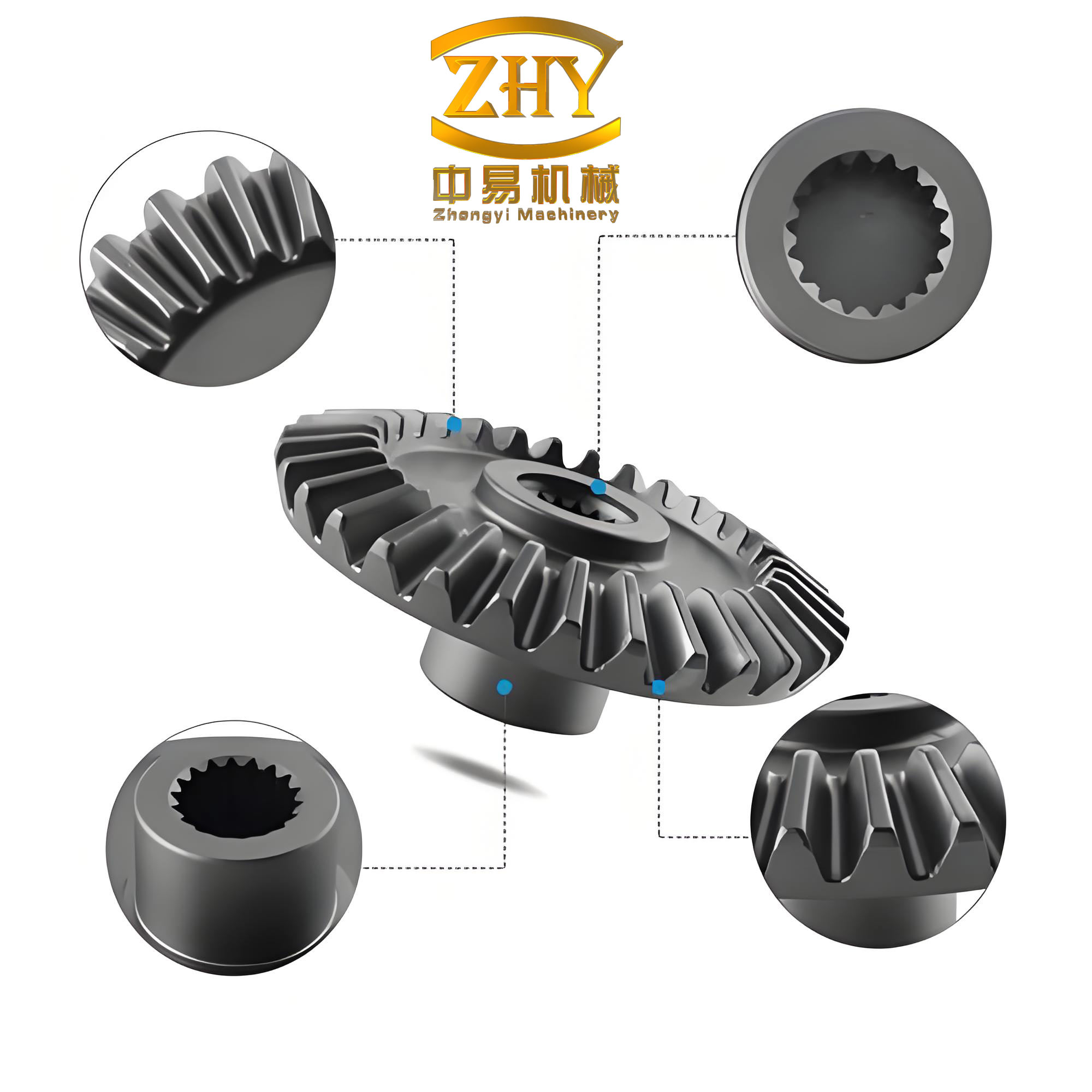
The results demonstrate that the parametric modeling and FEA approach provide a reliable means for analyzing straight bevel gears. The stress concentrations at the contact points and root regions align with typical failure modes observed in practice. For instance, the higher compressive stresses on the non-loaded side of the tooth root suggest a need for material strengthening in those areas. Additionally, the variation in stress along the tooth profile highlights the potential for optimizing tooth geometry to achieve a more uniform stress distribution, thereby enhancing the lifespan of straight bevel gears. The use of the Lagrange multiplier method in ANSYS ensured convergence and accuracy, validating the feasibility of this approach for contact problems in gear systems.
In conclusion, this study successfully analyzes the contact stress distribution in straight bevel gears through an integrated CAD-FEA methodology. The findings reveal that stress is predominantly localized at the meshing teeth, with root stresses exhibiting a mix of compression and tension. Deformation patterns emphasize the dominance of tooth bending over contact effects. These insights are invaluable for designing more reliable straight bevel gears, as they enable precise strength assessments and inform corrective measures such as profile modifications. Future work could explore dynamic loading conditions and thermal effects to further enhance the understanding of straight bevel gear behavior in real-world applications.