
The relentless pursuit of higher power density, increased load capacity, and reduced vibration and noise in mechanical transmission systems has placed stringent demands on gear performance. A critical challenge lies in enhancing system bearing capacity and dynamic smoothness without proportionally increasing weight and inertia. In this context, High Contact Ratio (HCR) spur cylindrical gear pairs, typically defined as having a contact ratio greater than 2, present a compelling solution. By engaging more tooth pairs simultaneously in the load path, HCR gears inherently distribute transmitted forces, leading to higher load-sharing capacity and potentially smoother operation. This article conducts a comprehensive investigation into the coupling dynamic characteristics of HCR spur cylindrical gear systems. Based on the potential energy method, a refined time-varying mesh stiffness (TVMS) model for HCR gears is established and compared against standard contact ratio gears. Subsequently, a fully coupled dynamic model of a cylindrical gear transmission system, incorporating flexible shafts, the gear pair, and bearing supports, is developed using a finite element approach. The dynamic responses, including mesh forces and housing vibrations, of both HCR and standard gear systems are systematically compared under a wide range of rotational speeds to elucidate the performance benefits of the HCR design.
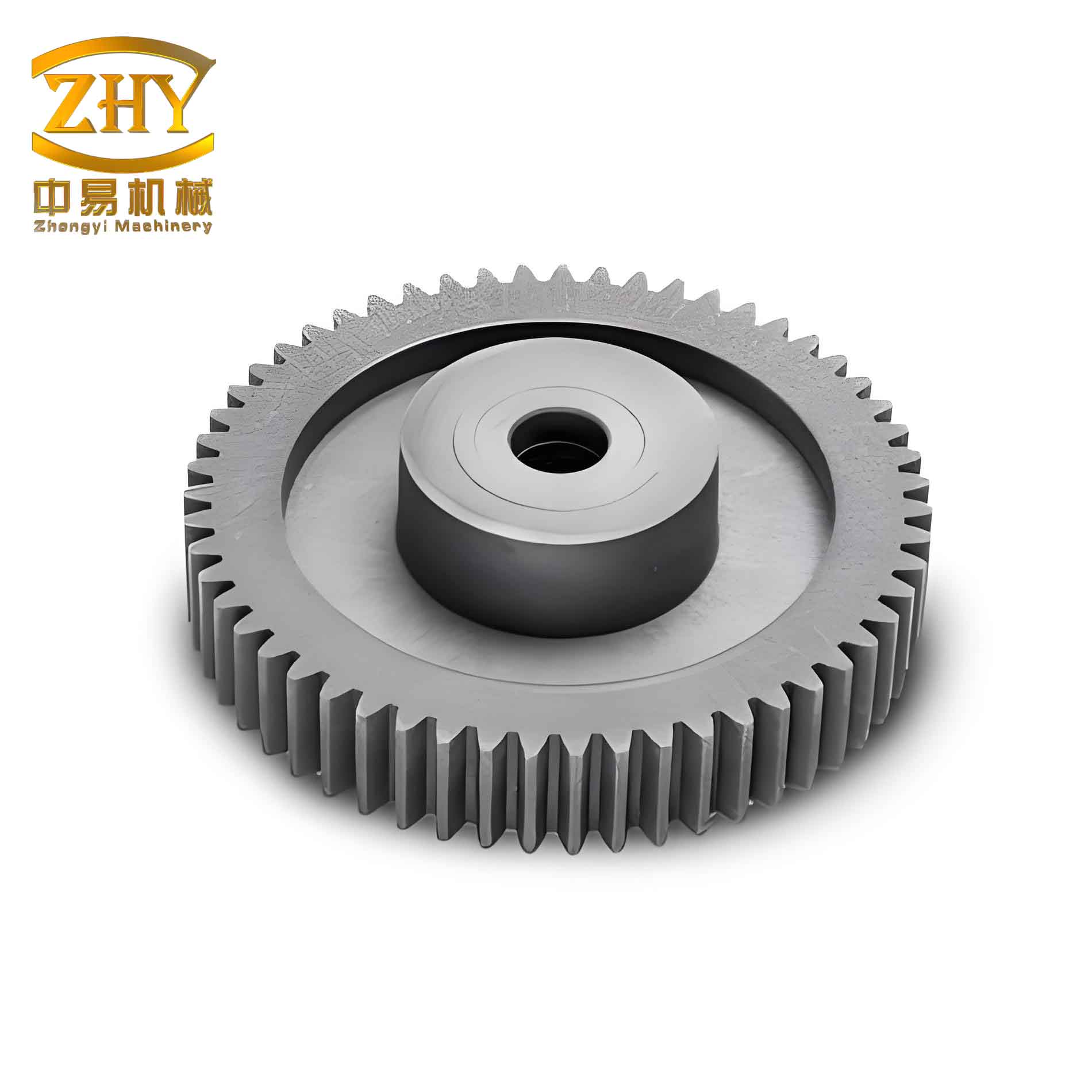
1. Introduction and Background
The evolution of gear technology is inextricably linked to the demands of modern machinery for higher speeds, greater loads, and quieter operation. Traditional spur cylindrical gear designs, with contact ratios typically between 1 and 2, have been the workhorse of industry for decades. However, their performance is fundamentally limited by the periodic fluctuation in the number of teeth in contact, which gives rise to significant time-varying mesh stiffness—a primary internal excitation source for gear vibration and noise. As a single tooth pair approaches the pitch point, its stiffness is highest; as it enters or exits engagement, stiffness drops. This periodic stiffness variation excites the system, leading to dynamic loads that can exceed static loads, increased vibration, and elevated noise levels, ultimately limiting the power density and reliability of the transmission.
The High Contact Ratio (HCR) spur cylindrical gear concept offers a direct approach to mitigating this fundamental issue. By modifying key geometric parameters such as pressure angle and addendum coefficient, the contact ratio is elevated beyond 2, often into the range of 2.0 to 2.5 or even higher for specialized designs. This ensures that at least two, and often three, tooth pairs are in contact simultaneously throughout the meshing cycle. The primary consequences are twofold: first, the load is shared among more teeth, reducing the nominal stress on any individual tooth and thus increasing the potential load capacity for a given gear size and material. Second, and crucially for dynamics, the transition of load from one tooth pair to the next is smoother, and the amplitude of the stiffness variation is significantly reduced. This attenuation of the primary internal excitation source holds the promise of superior dynamic performance, including lower vibration and noise.
Extensive research has been conducted on HCR gears. Early work by Cornell and Westervelt established foundational dynamic models, treating gears as rigid inertias connected by time-varying spring elements representing tooth stiffness, and analyzed the dynamic response considering profile errors and modifications. Later, researchers like Karpat et al. employed finite element methods to accurately compute the TVMS of asymmetric HCR gears and studied their dynamic load characteristics. Huang and colleagues developed nonlinear dynamic models incorporating multiple clearances (backlash, bearing clearance) and investigated the influence of these factors on system dynamics. More recent studies, such as those by Cheng et al., have focused on fault dynamics, examining the response of HCR gear-bearing systems with localized spalling defects. Research by Li Fajia and Li Tongjie explored nonlinear phenomena like bifurcation and parameter stability in HCR systems. A common theme in much of the literature is the focus on the gear pair itself or simplified rotor models, often neglecting the full coupling effects between the flexible shafting, the gear mesh, and the bearing supports within a complete transmission system.
Therefore, while the static and basic dynamic advantages of HCR gears are acknowledged, a clear gap exists in understanding their coupled dynamic behavior in a realistic system context under varying operational conditions, particularly speed. The influence of shaft flexibility and system-level mode shapes can interact with the altered mesh excitation from HCR gears in complex ways. This paper aims to address this gap. We first establish a precise analytical model for the TVMS of HCR spur cylindrical gears using the potential energy method, providing a direct comparison with standard gears. Then, we construct a detailed, coupled finite element dynamics model of a complete gear-shaft-bearing system. Finally, we perform a systematic parametric analysis across a wide speed range to quantitatively compare the dynamic mesh forces and housing vibrations of HCR and standard cylindrical gear systems, providing insights critical for the optimal design and application of HCR technology.
2. Time-Varying Mesh Stiffness Model for HCR Spur Cylindrical Gears
The time-varying mesh stiffness (TVMS) is the most critical internal excitation in geared systems. Accurate modeling of TVMS is paramount for dynamic analysis. For spur cylindrical gears, the potential energy method, which models the tooth as a non-uniform cantilever beam, offers an efficient and accurate analytical solution.
2.1 Single Tooth Pair Mesh Stiffness Model
A spur gear tooth under load can be modeled as a variable-section cantilever beam fixed at the root circle. The total deflection along the line of action under a nominal force \(F\) is comprised of contributions from bending, shear, axial compression, and Hertzian contact deformation, as well as fillet-foundation deflection. The compliance (inverse of stiffness) for each component can be derived by calculating the associated strain energy.
The Hertzian contact stiffness \(K_h\) for two contacting cylinders (simplified tooth surfaces) is given by:
$$ \frac{1}{K_h} = \frac{4(1 – \nu^2)}{\pi E L} $$
where \(\nu\) is Poisson’s ratio, \(E\) is Young’s modulus, and \(L\) is the face width (gear thickness).
The bending stiffness \(K_b\), shear stiffness \(K_s\), and axial compressive stiffness \(K_a\) for a single tooth are obtained by integrating the strain energy along the tooth profile from the root to the load application point. For a load applied at distance \(S\) from the root along the tooth centerline, with an angle \(\alpha_1\) relative to the tooth’s centerline, these are:
$$ \frac{1}{K_b} = \int_{0}^{S} \frac{[x \cos(\alpha_1) – h \sin(\alpha_1)]^2}{E I_x} dx $$
$$ \frac{1}{K_s} = \int_{0}^{S} \frac{1.2 \cos^2(\alpha_1)}{G A_x} dx $$
$$ \frac{1}{K_a} = \int_{0}^{S} \frac{\sin^2(\alpha_1)}{E A_x} dx $$
where \(x\) is the distance from the load point to a cross-section, \(h\) is half the tooth thickness at the load point, \(I_x\) is the area moment of inertia of the cross-section, \(A_x\) is the cross-sectional area, and \(G\) is the shear modulus (\(G = E/[2(1+\nu)]\)).
The fillet-foundation deflection stiffness \(K_f\) accounts for the deformation of the gear body beneath the tooth. It is not derived from beam theory but from empirical or semi-analytical formulas. A commonly used expression from Sainsot et al. is:
$$ \frac{1}{K_f} = \frac{\cos^2(\alpha_m)}{E L} \left[ L^* \left( \frac{u_f}{S_f} \right)^2 + M^* \left( \frac{u_f}{S_f} \right) + P^* (1 + Q^* \tan^2(\alpha_m)) \right] $$
where \(\alpha_m\) is the load angle, \(u_f\) is the distance from the root circle to the gear’s inner rim, \(S_f\) is the tooth thickness at the root, and \(L^*, M^*, P^*, Q^*\) are polynomial coefficients dependent on the gear geometry.
For a mating gear pair, the single tooth pair mesh stiffness \(K_{pair}\) is the series combination of the stiffness components from both the pinion (1) and gear (2):
$$ \frac{1}{K_{pair}} = \frac{1}{K_{h}} + \sum_{i=1}^{2} \left( \frac{1}{K_{b,i}} + \frac{1}{K_{s,i}} + \frac{1}{K_{a,i}} + \frac{1}{K_{f,i}} \right) $$
$$ K_{pair} = \left[ \frac{1}{K_{h}} + \sum_{i=1}^{2} \left( \frac{1}{K_{b,i}} + \frac{1}{K_{s,i}} + \frac{1}{K_{a,i}} + \frac{1}{K_{f,i}} \right) \right]^{-1} $$
2.2 Comprehensive Mesh Stiffness for HCR Gears
The fundamental difference between standard and HCR gears manifests in the superposition of individual tooth pair stiffnesses over the meshing cycle. For a standard spur cylindrical gear with a contact ratio \(1 < \epsilon < 2\), the meshing cycle alternates between single and double tooth contact regions. The total mesh stiffness \(K_{total}(t)\) is the sum of the stiffnesses of all tooth pairs in contact at that instant, modeled as springs in parallel.
Let \(K_p(\theta)\) represent the stiffness of one tooth pair as a function of its angular position within the mesh cycle (from start to end of contact). The base pitch angle is \(\theta_b\). For a standard gear, over one mesh cycle \(T_m\):
$$ K_{total,std}(t) = K_p(\theta) + K_p(\theta – \theta_b) \quad \text{for double contact region} $$
$$ K_{total,std}(t) = K_p(\theta) \quad \text{for single contact region} $$
For an HCR spur cylindrical gear with \(2 < \epsilon < 3\), the meshing cycle alternates between double and triple tooth contact regions. Therefore, the total mesh stiffness is:
$$ K_{total,HCR}(t) = K_p(\theta) + K_p(\theta – \theta_b) + K_p(\theta – 2\theta_b) \quad \text{for triple contact region} $$
$$ K_{total,HCR}(t) = K_p(\theta) + K_p(\theta – \theta_b) \quad \text{for double contact region} $$
This superposition principle is illustrated schematically below. The key outcome is that while the individual tooth pair stiffness \(K_p(\theta)\) for an HCR gear might be slightly lower due to potentially thinner teeth (higher addendum), the superposition of two or three such springs in parallel results in a higher mean mesh stiffness and, more importantly, a significantly reduced amplitude of fluctuation (\(\Delta K = K_{max} – K_{min}\)).
To quantify this, we analyze two gear pairs: a standard design and an HCR design. The HCR gear is achieved primarily by using a lower pressure angle and a higher addendum coefficient. Both pairs have the same module, number of teeth, and face width to ensure a fair comparison of dynamic performance, not static strength. The key parameters are summarized in Table 1.
| Parameter | Symbol | Standard Gear | HCR Gear |
|---|---|---|---|
| Module | \(m_n\) | 2.75 mm | 2.75 mm |
| Pinion Teeth | \(z_1\) | 36 | 36 |
| Gear Teeth | \(z_2\) | 61 | 61 |
| Pressure Angle | \(\alpha\) | 24.0° | 18.0° |
| Addendum Coefficient | \(h_a^*\) | 1.0 | 1.3283 |
| Pinion Profile Shift | \(x_1\) | 0.250 | 0.250 |
| Gear Profile Shift | \(x_2\) | -0.383 | -0.383 |
| Face Width | \(L\) | 33 mm | 33 mm |
| Contact Ratio | \(\epsilon\) | 1.5549 | 2.3719 |
Applying the potential energy method, the single tooth pair stiffness \(K_p(\theta)\) and the total mesh stiffness \(K_{total}(t)\) for both pairs are calculated over one complete mesh cycle. Key results are extracted and presented in Table 2.
| Stiffness Metric | Standard Gear | HCR Gear | Change |
|---|---|---|---|
| Single Pair Stiffness, Max | 615,838 N/mm | 537,620 N/mm | -12.7% |
| Single Pair Stiffness, Min | 328,921 N/mm | 255,063 N/mm | -22.5% |
| Single Pair Stiffness, Mean | 533,933 N/mm | 453,340 N/mm | -15.1% |
| Total Mesh Stiffness, Max (\(K_{max}\)) | 1,037,805 N/mm | 1,286,885 N/mm | +24.0% |
| Total Mesh Stiffness, Min (\(K_{min}\)) | 578,372 N/mm | 920,083 N/mm | +59.1% |
| Total Mesh Stiffness, Mean (\(\bar{K}\)) | 895,805 N/mm | 1,106,679 N/mm | +23.6% |
| Stiffness Fluctuation (\(\Delta K = K_{max}-K_{min}\)) | 459,433 N/mm | 366,802 N/mm | -20.2% |
| Stiffness Variation Coefficient (\(\Delta K / \bar{K}\)) | 0.513 | 0.332 | -35.3% |
The results clearly demonstrate the HCR advantage: 1) The maximum and mean total mesh stiffness are significantly higher (by 24.0% and 23.6%, respectively), indicating a stiffer load path. 2) Most critically, the amplitude of stiffness fluctuation \(\Delta K\) is reduced by 20.2%, and the normalized fluctuation (variation coefficient) is reduced by 35.3%. This substantial reduction in the primary internal excitation source is the key mechanism behind the expected dynamic improvement in HCR spur cylindrical gear systems.
3. Coupled Dynamic Model of the Spur Cylindrical Gear System
To accurately predict the dynamic response, a model must account for the flexibility and coupling of all major system components: shafts, gears, and bearings. A finite element (FE) modeling approach is adopted for its versatility in modeling complex geometries and assembling system matrices.
3.1 System Description and Finite Element Discretization
The system under study is a single-stage parallel-axis spur cylindrical gear reducer. It consists of an input shaft supporting the pinion, an output shaft supporting the gear, and rolling element bearings supporting each shaft at two locations. The housing is considered rigid for bearing reaction analysis but its local compliance at bearing seats can be included in the bearing stiffness. The system is discretized into three primary element types: Shaft Elements, Gear Mesh Elements, and Bearing Support Elements. The nodes connect these elements, with each node having six degrees of freedom (DOFs): three translational (\(x, y, z\)) and three rotational (\(\theta_x, \theta_y, \theta_z\)).
3.2 Shaft Element Model (Timoshenko Beam)
Shaft segments are modeled as Timoshenko beam elements, which account for shear deformation and rotary inertia, making them suitable for shorter, stiffer shafts common in gearboxes. A two-node beam element has 12 DOFs (6 per node). The element consistent mass matrix \(\mathbf{M}_s\), stiffness matrix \(\mathbf{K}_s\), and damping matrix \(\mathbf{C}_s\) are derived from shape functions. The damping matrix is typically formulated as Rayleigh damping: \(\mathbf{C}_s = \alpha \mathbf{M}_s + \beta \mathbf{K}_s\), where \(\alpha\) and \(\beta\) are mass and stiffness proportional coefficients determined from modal damping ratios. The equation of motion for a shaft element is:
$$ \mathbf{M}_s \ddot{\mathbf{u}}_s + \mathbf{C}_s \dot{\mathbf{u}}_s + \mathbf{K}_s \mathbf{u}_s = \mathbf{0} $$
where \(\mathbf{u}_s = [x_i, y_i, z_i, \theta_{xi}, \theta_{yi}, \theta_{zi}, x_j, y_j, z_j, \theta_{xj}, \theta_{yj}, \theta_{zj}]^T\) is the nodal displacement vector for nodes \(i\) and \(j\).
3.3 Gear Mesh Element Model
The gear mesh is modeled as a discrete element connecting the nodes at the centers of the pinion and gear. The force transmitted is a function of the relative displacement along the line of action (LOA). The LOA is defined by the pressure angle \(\alpha\) and the gear centerline orientation \(\gamma\). The dynamic transmission error (DTE) along the LOA, \(\delta(t)\), is the primary coordinate:
$$ \delta(t) = (x_1 – x_2)\sin\varphi + (y_1 – y_2)\cos\varphi + r_1 \theta_{z1} + r_2 \theta_{z2} $$
where subscripts 1 and 2 denote pinion and gear nodes, \(r_{1,2}\) are base circle radii, and \(\varphi = \alpha \pm \gamma\) depending on rotation direction. The governing mesh force \(F_m(t)\) is:
$$ F_m(t) = k_m(t) \delta(t) + c_m \dot{\delta}(t) + F_{static} $$
Here, \(k_m(t)\) is the time-varying mesh stiffness from Section 2 (either \(K_{total,std}(t)\) or \(K_{total,HCR}(t)\)). \(c_m\) is the mesh damping, often taken as a constant percentage (e.g., 1-3%) of critical damping: \(c_m = 2 \zeta \sqrt{k_{mean} m_{eq}}\), where \(m_{eq}\) is the equivalent mass. \(F_{static}\) is the static load from transmitted torque.
This mesh force acts on the pinion and gear nodes through a transformation matrix \(\mathbf{T}_g\) to create the 12-DOF force vector \(\mathbf{F}_g\). The resulting contribution to the system equations from the gear pair is inherently nonlinear if backlash is considered, but for the linearized dynamic analysis of this study focusing on forced response, the mesh stiffness variation is the main excitation.
3.4 Bearing Support Element Model
Bearings are modeled as linear spring-damper elements connecting a shaft node to ground (the rigid housing). For a deep groove ball bearing under moderate load, a simplified diagonal stiffness matrix \(\mathbf{K}_b\) at the support node is often used:
$$ \mathbf{K}_b = \begin{bmatrix}
k_{xx} & 0 & 0 & 0 & 0 & 0 \\
0 & k_{yy} & 0 & 0 & 0 & 0 \\
0 & 0 & k_{zz} & 0 & 0 & 0 \\
0 & 0 & 0 & k_{\theta_x\theta_x} & 0 & 0 \\
0 & 0 & 0 & 0 & k_{\theta_y\theta_y} & 0 \\
0 & 0 & 0 & 0 & 0 & 0
\end{bmatrix} $$
where \(k_{xx} = k_{yy}\) are radial stiffnesses, \(k_{zz}\) is axial stiffness (often high for rigid housing), and \(k_{\theta_x\theta_x}, k_{\theta_y\theta_y}\) are tilt stiffnesses. Damping matrix \(\mathbf{C}_b\) has a similar structure. The bearing force vector is \(\mathbf{F}_b = -\mathbf{K}_b \mathbf{u}_b – \mathbf{C}_b \dot{\mathbf{u}}_b\).
3.5 System Assembly and Equation of Motion
The global mass \(\mathbf{M}\), damping \(\mathbf{C}\), and stiffness \(\mathbf{K}\) matrices are assembled by superimposing the contributions from all shaft, gear mesh, and bearing elements according to the system’s connectivity (node numbering). The global stiffness matrix \(\mathbf{K}(t)\) becomes time-dependent due to the periodic \(k_m(t)\). The assembled linearized equation of motion for the forced response analysis is:
$$ \mathbf{M} \ddot{\mathbf{U}}(t) + \mathbf{C} \dot{\mathbf{U}}(t) + \mathbf{K}(t) \mathbf{U}(t) = \mathbf{F}_{ext}(t) $$
where \(\mathbf{U}(t)\) is the global displacement vector for all nodes, and \(\mathbf{F}_{ext}(t)\) contains static torques applied at input/output nodes and the kinematic excitation from static transmission error if considered. For steady-state response analysis under constant speed, the periodic system can be solved in the frequency domain using Harmonic Balance Method (HBM) or in the time domain using direct numerical integration (e.g., Newmark-β method). In this study, numerical integration is used to capture transient effects and nonlinearities if included in future studies.
4. Dynamic Characteristics Analysis: Results and Discussion
The dynamic model is used to simulate the response of both the standard and HCR spur cylindrical gear systems. A constant input torque is applied, and the rotational speed is varied from 1,000 rpm to 15,000 rpm. Key performance metrics are analyzed: the dynamic mesh force (DMF) and the vibration acceleration at four housing measurement points (M1-M4) located directly above the bearing housings.
4.1 Dynamic Mesh Force (DMF)
The DMF is the oscillatory component superimposed on the static load. Its Root Mean Square (RMS) value indicates the average dynamic load severity, while its peak-to-peak (P-P) value indicates the maximum load fluctuation. Table 3 and the subsequent analysis summarize the results.
| Speed (rpm) | System | DMF RMS (N) | Reduction in RMS | DMF P-P (N) | Reduction in P-P |
|---|---|---|---|---|---|
| 1,000 | Standard | 145.2 | – | 810.5 | – |
| HCR | 131.9 | 9.2% | 612.3 | 24.4% | |
| 3,000 | Standard | 412.7 | – | 2850.1 | – |
| HCR | 328.5 | 20.4% | 694.8 | 75.6% | |
| 5,000 | Standard | 255.1 | – | 1520.4 | – |
| HCR | 215.8 | 15.4% | 1460.2 | 4.0% | |
| 10,000 | Standard | 188.3 | – | 1120.8 | – |
| HCR | 158.6 | 15.8% | 850.9 | 24.1% | |
| 15,000 | Standard | 205.5 | – | 1250.3 | – |
| HCR | 179.2 | 12.8% | 980.6 | 21.6% |
Key Observations:
- Superior Performance of HCR System: Across the entire speed range, the HCR spur cylindrical gear system exhibits lower DMF RMS and P-P values compared to the standard system. This confirms the fundamental benefit of reduced mesh stiffness variation translating into lower dynamic excitation.
- Maximum Benefit at 3,000 rpm: The most significant reduction occurs at 3,000 rpm, where the DMF RMS drops by 20.4% and the P-P value drops dramatically by 75.6%. This speed likely corresponds to a resonance condition for the standard gear system where its larger stiffness fluctuation strongly excites a system mode. The HCR system, with its attenuated excitation, experiences a much lower resonance peak.
- Consistent Attenuation: Even away from severe resonances, the HCR system maintains a 9-16% reduction in DMF RMS, indicating a consistently smoother meshing action.
4.2 Housing Vibration Acceleration
Vibration acceleration at the housing is a direct measure of noise-radiating potential. RMS and P-P values of acceleration in the X (horizontal radial) and Y (vertical radial) directions at points M1 (input bearing) and M4 (output bearing) are analyzed as representative examples. Tables 4 and 5 show detailed data for a subset of speeds.
| Speed (rpm) | System | Accel. RMS (m/s²) | Reduction | Accel. P-P (m/s²) | Reduction |
|---|---|---|---|---|---|
| 1,000 | Standard | 0.85 | – | 5.10 | – |
| HCR | 0.52 | 38.8% | 3.15 | 38.2% | |
| 3,000 | Standard | 9.25 | – | 56.0 | – |
| HCR | 2.26 | 75.6% | 18.4 | 67.1% | |
| 10,000 | Standard | 3.15 | – | 19.8 | – |
| HCR | 1.98 | 37.1% | 12.5 | 36.9% |
| Speed (rpm) | System | Accel. RMS (m/s²) | Reduction | Accel. P-P (m/s²) | Reduction |
|---|---|---|---|---|---|
| 1,000 | Standard | 0.78 | – | 4.65 | – |
| HCR | 0.48 | 38.5% | 2.95 | 36.6% | |
| 3,000 | Standard | 12.45 | – | 78.5 | – |
| HCR | 2.65 | 78.7% | 17.7 | 77.4% | |
| 10,000 | Standard | 2.88 | – | 18.2 | – |
| HCR | 1.75 | 39.2% | 11.1 | 39.0% |
Key Observations:
- Significant Vibration Reduction: The HCR spur cylindrical gear system achieves substantial reductions in housing vibration across all measurement points and directions. This directly correlates with lower noise potential.
- Resonance Suppression: The most dramatic reductions (75-83% in RMS, 67-77% in P-P) occur at 3,000 rpm, aligning with the DMF results. This demonstrates that the HCR design not only lowers the dynamic loads but also drastically reduces the vibration transmitted to the structure at critical speeds.
- Broad-Band Improvement: Even at non-resonant speeds (e.g., 1,000 rpm and 10,000 rpm), vibration levels are reduced by 35-40%. This indicates a consistent benefit in operational smoothness.
- System-Wide Effect: The reduction is evident at both input and output bearing locations (M1 and M4), confirming that the improved dynamics are a system-level characteristic of the HCR gear pair integration.
4.3 Discussion of Mechanisms
The superior dynamic performance of the HCR spur cylindrical gear system can be attributed to two interlinked mechanisms stemming from the higher contact ratio:
1. Reduced Mesh Stiffness Fluctuation Amplitude: As quantified in Section 2.2, the HCR gear pair has a 35.3% lower stiffness variation coefficient (\(\Delta K / \bar{K}\)). The mesh stiffness excitation force is proportional to this fluctuation. A smaller excitation amplitude directly results in lower forced vibration responses, all else being equal.
2. Increased Mean Mesh Stiffness and Altered System Dynamics: The 23.6% higher mean mesh stiffness \(\bar{K}\) of the HCR pair increases the natural frequencies of the torsional and transverse modes involving the gear mesh. This can shift the system’s critical speeds, potentially moving resonances away from operational speeds. More importantly, a stiffer mesh connection can alter the mode shapes, potentially reducing the translational motion of the gear centers and the resulting bearing force transmission to the housing.
The combined effect is a transmission system that is both more robust (higher dynamic load capacity due to lower DMF) and quieter (lower housing vibration). The results validate the premise that adopting HCR spur cylindrical gears is an effective strategy for enhancing the dynamic performance of gear transmission systems without major system redesign.
5. Conclusion
This study presents a comprehensive analysis of the coupling dynamic characteristics of High Contact Ratio (HCR) spur cylindrical gear systems in comparison to standard contact ratio systems. Through detailed analytical modeling of time-varying mesh stiffness and the development of a coupled finite element dynamic model, the following key conclusions are drawn:
- Mesh Stiffness Characteristics: The HCR spur cylindrical gear design fundamentally alters the mesh stiffness profile. While the stiffness of an individual tooth pair may be slightly lower, the superposition of two or three pairs in contact results in a significantly higher mean mesh stiffness (increase of ~24%) and, critically, a substantially reduced amplitude of stiffness fluctuation (reduction of ~20% in absolute terms, ~35% in normalized coefficient). This attenuation of the primary internal excitation source is the root cause of dynamic improvement.
- Dynamic Performance Enhancement: The HCR gear system exhibits consistently superior dynamic performance across a wide speed range (1,000 – 15,000 rpm):
- Dynamic Mesh Force: Both the RMS and peak-to-peak values of the dynamic mesh force are lower for the HCR system. The reduction is most pronounced at specific speeds (e.g., 75.6% lower P-P at 3,000 rpm), indicating effective suppression of resonance peaks.
- System Vibration: Housing vibration acceleration at bearing locations is significantly reduced in both horizontal and vertical directions. Reductions of 35-40% are common at general operating speeds, with extreme reductions of 75-83% observed at resonant conditions, highlighting the HCR system’s ability to dramatically lower noise-radiating vibration.
- Design Implication: The use of HCR spur cylindrical gears presents a highly effective design strategy for improving the load capacity and dynamic smoothness of gear transmissions. It achieves this primarily through geometric modification rather than increasing material usage or system size, aligning with goals of lightweight and high-power-density design.
Future work could extend this analysis to include nonlinear effects such as backlash and tooth separation, investigate the impact of manufacturing errors and profile modifications on HCR gear dynamics, and explore the performance of HCR gears in planetary or multi-stage cylindrical gear systems. Experimental validation would further solidify the findings presented in this numerical study.