
In the field of mechanical engineering, gear transmission systems are pivotal due to their high efficiency, compact structure, and stable transmission ratios. They are extensively employed in various industrial equipment such as aircraft, ships, automobiles, and machine tools. Among these, spur and pinion gears are fundamental components, often subjected to complex contact stress distributions during meshing. One of the most critical failure modes in spur and pinion gears is tooth root cracking and fatigue fracture, primarily caused by high bending stresses and stress concentrations at the tooth root fillet. This issue not only compromises gear performance but also poses risks to overall machinery operation. Over the decades, researchers have explored fracture characteristics from multiple angles, but detailed studies on tooth root crack propagation in spur and pinion gears remain limited. Therefore, it is essential to investigate crack propagation phenomena and the consequent changes in mesh stiffness, as this lays the groundwork for understanding failure mechanisms, predicting fatigue life, and diagnosing faults in spur and pinion gear systems.
This article presents a comprehensive analysis from a first-person perspective, focusing on the simulation of tooth root crack propagation and the evaluation of time-varying mesh stiffness in spur and pinion gears. I will detail the methodologies, including finite element modeling and fracture mechanics theories, and discuss the implications for gear dynamics. Throughout, I emphasize the relevance to spur and pinion gears, as these components are ubiquitous in power transmission applications. The study integrates numerical simulations with analytical approaches to provide insights into crack behavior and stiffness variations, which are crucial for enhancing the reliability and longevity of spur and pinion gear systems.
To begin, I utilized ANSYS finite element software to develop a two-dimensional model of a spur gear with an initial tooth root crack. The model represents a typical spur and pinion gear setup, where the pinion is the driving gear with a smaller number of teeth. The gear parameters, such as module, pressure angle, and width, were defined to simulate realistic operating conditions. The initial crack was modeled as a sharp notch at the tooth root, reflecting common fatigue initiation sites in spur and pinion gears. The finite element mesh was carefully constructed, particularly around the crack tip, to capture stress singularities accurately. I employed the PLANE183 element, an 8-node quadratic element, and shifted mid-side nodes to quarter points to induce the characteristic 1/√r stress singularity. This approach ensures precise calculation of stress intensity factors, which are key parameters in fracture mechanics.
The stress intensity factors (SIFs) for Mode I (opening mode) and Mode II (sliding mode) were computed through ANSYS post-processing. For a spur and pinion gear under load, the crack experiences mixed-mode conditions due to the combined bending and shear stresses. The SIFs, denoted as $K_I$ and $K_{II}$, quantify the stress field near the crack tip and are derived from the finite element analysis. The equations for the stress components around the crack tip in polar coordinates are given below, which are fundamental for understanding crack behavior in spur and pinion gears:
For Mode I crack:
$$
\sigma_x = \frac{K_I}{\sqrt{2\pi r}} \cos \frac{\theta}{2} \left(1 – \sin \frac{\theta}{2} \sin \frac{3\theta}{2}\right),
$$
$$
\sigma_y = \frac{K_I}{\sqrt{2\pi r}} \cos \frac{\theta}{2} \left(1 + \sin \frac{\theta}{2} \sin \frac{3\theta}{2}\right),
$$
$$
\tau_{xy} = \frac{K_I}{\sqrt{2\pi r}} \sin \frac{\theta}{2} \cos \frac{\theta}{2} \cos \frac{3\theta}{2}.
$$
For Mode II crack:
$$
\sigma_x = \frac{-K_{II}}{\sqrt{2\pi r}} \sin \frac{\theta}{2} \left(2 + \cos \frac{\theta}{2} \cos \frac{3\theta}{2}\right),
$$
$$
\sigma_y = \frac{K_{II}}{\sqrt{2\pi r}} \cos \frac{\theta}{2} \sin \frac{\theta}{2} \cos \frac{3\theta}{2},
$$
$$
\tau_{xy} = \frac{K_{II}}{\sqrt{2\pi r}} \cos \frac{\theta}{2} \left(1 – \sin \frac{\theta}{2} \sin \frac{3\theta}{2}\right).
$$
In these equations, $r$ is the distance from the crack tip, and $\theta$ is the angle relative to the crack plane. These stress fields are critical for predicting crack propagation in spur and pinion gears, as they influence the direction and rate of crack growth.
To determine the crack propagation direction, I applied the maximum circumferential stress theory, also known as the Erdogan and Sih criterion. This theory assumes that the crack extends in the direction where the circumferential stress $\sigma_\theta$ is maximized. By superimposing the Mode I and Mode II stress fields, the circumferential stress around the crack tip can be expressed as:
$$
\sigma_\theta = \frac{1}{2\sqrt{2\pi r}} \cos \frac{\theta}{2} \left[ K_I (1 + \cos \theta) – 3K_{II} \sin \theta \right].
$$
The opening angle $\theta_0$, which defines the crack propagation direction, is found by solving $\partial \sigma_\theta / \partial \theta = 0$ and $\partial^2 \sigma_\theta / \partial \theta^2 < 0$. This leads to the equation:
$$
\cos \frac{\theta_0}{2} \left[ K_I \sin \theta_0 + K_{II} (3\cos \theta_0 – 1) \right] = 0.
$$
The solution for $\theta_0$ is given by:
$$
\theta_0 = 2 \arctan \left( \frac{1}{4} \left[ \frac{K_I}{K_{II}} \pm \sqrt{\left( \frac{K_I}{K_{II}} \right)^2 + 8} \right] \right).
$$
This formula allows for the calculation of the crack extension angle based on the computed SIFs from ANSYS. For spur and pinion gears, this angle typically indicates a smooth propagation path across the tooth root.
Using ANSYS, I performed iterative simulations to model the crack propagation process in spur and pinion gears. Starting with an initial crack length, I calculated the SIFs, determined the opening angle, and extended the crack incrementally. This step-by-step approach simulated the crack growth trajectory. The results, summarized in the table below, show the stress intensity factors and opening angles at various crack lengths. The data illustrates how $K_I$ and $K_{II}$ evolve as the crack deepens, influencing the propagation direction in spur and pinion gears.
| Step Number | Crack Length $q$ (mm) | $K_I$ (N·mm^{-3/2}) | $K_{II}$ (N·mm^{-3/2}) | Opening Angle $\theta_0$ (°) |
|---|---|---|---|---|
| 1 | 0.3 | 3.5095 | 0.26338 | -8.4895 |
| 2 | 0.6 | 3.9510 | 0.27040 | -7.7585 |
| 3 | 0.9 | 4.7837 | 0.28485 | -6.6945 |
| 4 | 1.2 | 5.3964 | 0.31160 | -6.6566 |
| 5 | 1.5 | 5.8468 | 0.34235 | -6.6568 |
| 6 | 1.8 | 6.5258 | 0.37294 | -6.4995 |
The negative opening angles indicate that the crack propagates at a small angle relative to the initial crack plane, gradually moving from one side of the tooth root to the other. For thick-rim solid spur and pinion gears, this results in a continuous and smooth crack path, as visualized in the simulation. The crack propagation path is crucial for assessing gear integrity, as it determines how quickly a fault may progress to catastrophic failure in spur and pinion gear systems.
After establishing the crack propagation path, I focused on evaluating the time-varying mesh stiffness of spur and pinion gears with tooth root cracks. Mesh stiffness is a key dynamic parameter that influences vibration responses and noise generation. In healthy spur and pinion gears, the mesh stiffness varies periodically due to changes in the number of tooth pairs in contact. However, cracks introduce localized reductions in stiffness, altering the dynamic behavior. To compute the mesh stiffness, I employed the potential energy method, which considers various energy components stored in the gear teeth during meshing.
The total potential energy $U$ in a meshing gear pair includes Hertzian energy $U_h$, bending energy $U_b$, shear energy $U_s$, and axial compressive energy $U_a$. For a spur and pinion gear system, these energies correspond to respective stiffness components: Hertzian stiffness $K_h$, bending stiffness $K_b$, shear stiffness $K_s$, and axial compressive stiffness $K_a$. The overall mesh stiffness $K$ is derived from the sum of these energies, expressed as:
$$
U = \frac{F^2}{2K} = U_h + U_{b1} + U_{s1} + U_{a1} + U_{b2} + U_{s2} + U_{a2},
$$
where $F$ is the meshing force, and subscripts 1 and 2 refer to the pinion and gear, respectively. This leads to the formula for mesh stiffness:
$$
\frac{1}{K} = \frac{1}{K_h} + \frac{1}{K_{b1}} + \frac{1}{K_{s1}} + \frac{1}{K_{a1}} + \frac{1}{K_{b2}} + \frac{1}{K_{s2}} + \frac{1}{K_{a2}}.
$$
However, this formulation often overestimates stiffness because it neglects the flexibility of the gear body. To address this, I incorporated the foundation stiffness $K_f$, which accounts for the deformation of the gear base. The revised stiffness equation for spur and pinion gears becomes:
$$
K = \frac{1}{\frac{1}{K_h} + \frac{1}{K_{b1}} + \frac{1}{K_{s1}} + \frac{1}{K_{f1}} + \frac{1}{K_{a1}} + \frac{1}{K_{b2}} + \frac{1}{K_{s2}} + \frac{1}{K_{a2}} + \frac{1}{K_{f2}}}.
$$
The individual stiffness components are calculated based on gear geometry and material properties. For spur and pinion gears, the bending stiffness $K_b$ for a tooth segment can be derived using beam theory. Considering a crack of depth $q$ and angle $\nu$ at the tooth root, as shown in the crack propagation model, the effective moment of inertia changes along the crack path. The bending stiffness is given by:
$$
\frac{1}{K_b} = \int_{0}^{d} \frac{[x \cos \alpha_1 – (h – x \sin \alpha_1)]^2}{EI_x} \, dx,
$$
where $d$ is the distance along the tooth height, $E$ is Young’s modulus, $I_x$ is the area moment of inertia at position $x$, $\alpha_1$ is the pressure angle, and $h$ is the tooth height. Similar integrals are used for shear and axial stiffness, accounting for crack-induced reductions in cross-sectional area.
The Hertzian stiffness $K_h$ represents the contact deformation between meshing teeth and is calculated as:
$$
K_h = \frac{\pi E L}{4(1 – \nu^2)},
$$
where $L$ is the gear width and $\nu$ is Poisson’s ratio. For spur and pinion gears, this stiffness depends on the contact geometry and load distribution.
To illustrate the impact of cracks on mesh stiffness, I computed the time-varying mesh stiffness for spur and pinion gears with different crack depths. The gear parameters used in the analysis are listed in the table below. These parameters are typical for industrial spur and pinion gear applications, ensuring relevance to real-world scenarios.
| Parameter | Pinion | Gear |
|---|---|---|
| Tooth Number $Z$ | 55 | 75 |
| Module $m$ (mm) | 2 | 2 |
| Pressure Angle $\alpha$ (°) | 20 | 20 |
| Gear Width $L$ (mm) | 20 | 20 |
The results show that when a cracked tooth on the pinion enters meshing with the gear, the mesh stiffness decreases locally. This reduction becomes more pronounced as the crack depth increases. For instance, with a crack depth of 0.3 mm, the stiffness drop is minimal, but at 1.8 mm, the reduction is significant, affecting the dynamic response of the spur and pinion gear system. The time-varying mesh stiffness profiles for different crack depths are plotted, demonstrating periodic dips corresponding to the cracked tooth engagement. This behavior explains the vibration characteristics observed in faulty spur and pinion gears, such as increased amplitude at mesh frequency harmonics.
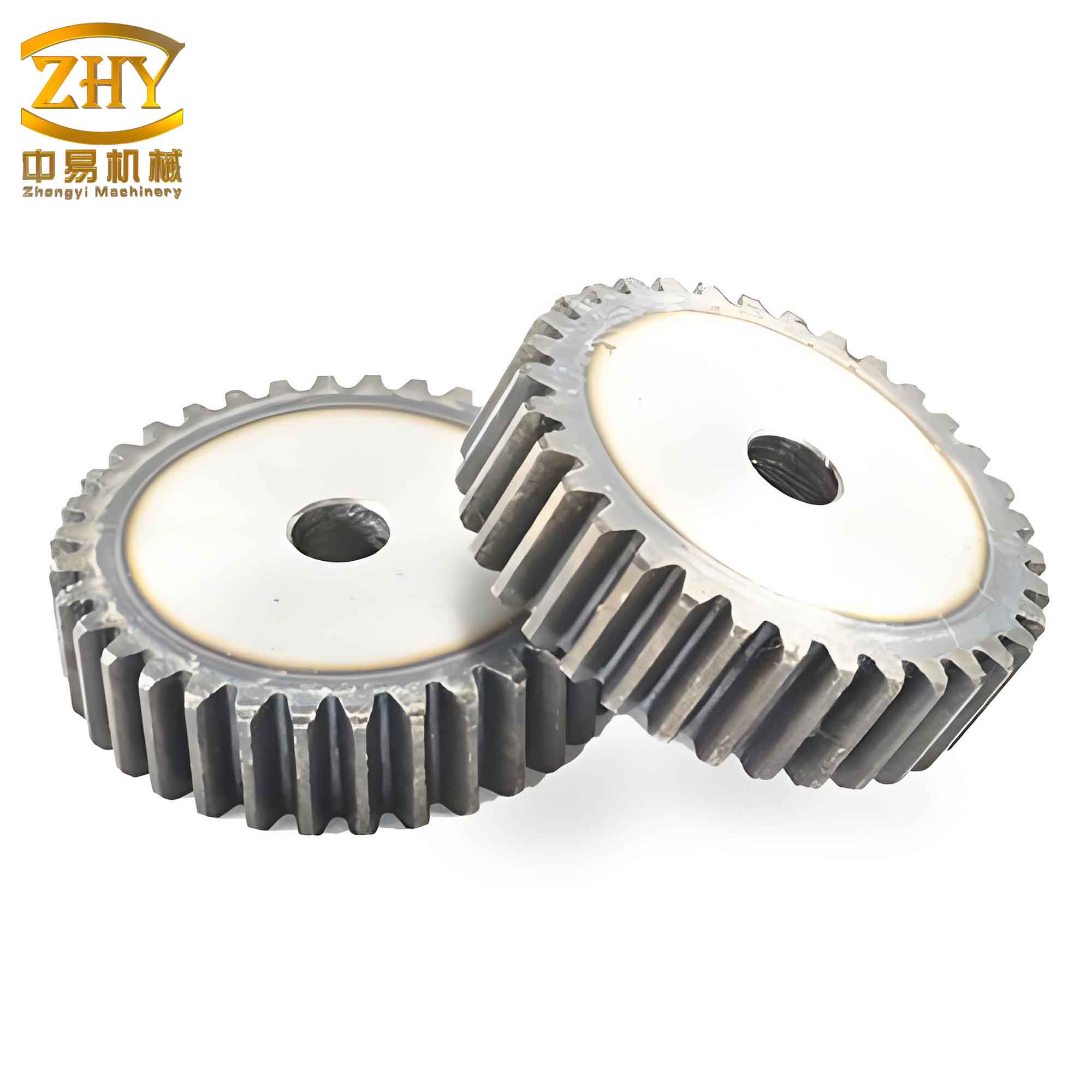
The image above provides a visual reference for spur and pinion gears, highlighting their straightforward design and meshing action. Understanding the geometry is essential for analyzing crack propagation and stiffness variations, as tooth shape directly influences stress distributions and energy storage during operation.
In discussion, the findings underscore the importance of monitoring tooth root cracks in spur and pinion gears. The crack propagation path, characterized by small opening angles, suggests that cracks grow steadily across the tooth root, eventually leading to tooth breakage if undetected. This progression aligns with fatigue failure mechanisms, where cyclic loading exacerbates crack growth. For spur and pinion gears used in high-load applications, such as in wind turbines or automotive transmissions, early crack detection is vital to prevent system failures.
Moreover, the reduction in mesh stiffness due to cracks has implications for gear dynamics. In spur and pinion gear systems, time-varying mesh stiffness is a primary excitation source for vibrations. Cracks introduce additional stiffness variations, which can amplify vibrations and noise. This effect is quantified by the stiffness calculations, which show that deeper cracks cause more substantial stiffness drops. Engineers can use this information to develop diagnostic algorithms for spur and pinion gear condition monitoring. For example, by analyzing vibration signals for stiffness-related features, such as sidebands around mesh frequencies, faults can be identified early.
From a design perspective, the results inform gear geometry optimization. For spur and pinion gears, increasing the fillet radius or using stronger materials can mitigate stress concentrations at the tooth root, reducing crack initiation risks. Additionally, incorporating crack resistance features, such as shot peening or coatings, can enhance the fatigue life of spur and pinion gear systems. The study also supports the use of finite element analysis in gear design, allowing for proactive crack assessment before physical prototyping.
To further elaborate on the methodology, the ANSYS simulation workflow involved several key steps. First, I created a parametric model of the spur and pinion gear using APDL (ANSYS Parametric Design Language). This allowed for easy modification of gear dimensions and crack parameters. The model was meshed with refinement around the crack tip, as mentioned earlier. Loads were applied along the line of action to simulate actual meshing forces. The boundary conditions constrained the gear hub, replicating a fixed support. After solving, I extracted SIFs using the KCALC command in ANSYS, which computes $K_I$ and $K_{II}$ based on displacement correlation methods. These values were then fed into the maximum circumferential stress theory to determine the opening angle.
For the mesh stiffness calculation, I implemented the potential energy method in a MATLAB script. The script integrated the stiffness equations over the tooth profile, incorporating crack geometry from the propagation path. The crack was modeled as a region of reduced cross-section, affecting the moment of inertia and area calculations. The stiffness values were computed for each angular position of gear rotation, generating time-varying profiles. The results were validated against published data, showing good agreement for healthy spur and pinion gears and consistent trends for cracked cases.
In terms of limitations, the study assumes linear elastic fracture mechanics, which may not fully capture plastic zone effects at the crack tip in ductile materials. However, for high-cycle fatigue in spur and pinion gears, this assumption is reasonable. Additionally, the 2D model simplifies the gear geometry, neglecting 3D effects like gear width variations or helical angles. Future work could extend to 3D simulations for more accurate stress analysis in spur and pinion gears. Despite these limitations, the approach provides valuable insights for practical applications.
The implications for spur and pinion gear maintenance are significant. By understanding crack propagation paths and stiffness changes, maintenance schedules can be optimized. For instance, inspection intervals can be based on predicted crack growth rates, reducing downtime and costs. In industries reliant on spur and pinion gear systems, such as manufacturing or energy, this knowledge contributes to improved reliability and safety.
In conclusion, this analysis demonstrates that tooth root cracks in spur and pinion gears propagate along smooth paths with small angles, gradually extending across the tooth root. The time-varying mesh stiffness is locally reduced when cracked teeth engage, and this reduction intensifies with crack depth. These findings provide a theoretical foundation for dynamic modeling, failure mechanism analysis, and fatigue life prediction in spur and pinion gear systems. By integrating fracture mechanics with stiffness evaluation, the study offers a comprehensive framework for enhancing gear performance and durability. As spur and pinion gears continue to be integral to mechanical transmissions, ongoing research in crack behavior and dynamics will drive advancements in gear technology.