
Gear hobbing is a critical manufacturing process for producing high-precision gears, such as cycloidal gears used in RV reducers. The accuracy of the gear tooth profile directly impacts the transmission performance of the reducer. In this study, we investigate the effects of gear hobbing parameters on cutting forces and temperature during the gear hobbing process. We develop geometric models of the cycloidal gear and the corresponding hob cutter using the center-enclosing method and planar engagement principles. Based on these models, we establish a thermo-mechanical coupled finite element model to simulate the gear hobbing process. The analysis focuses on the influence of varying gear hobbing speeds and axial feed rates. Our results indicate that during gear hobbing, axial cutting forces increase rapidly with time, stabilize, and then decrease sharply, while radial cutting forces initially rise quickly and gradually decline. Cutting temperatures surge rapidly before entering a stable phase. Axial feed rates between 0.25 mm/r and 0.75 mm/r lead to slow growth in axial and radial cutting forces and temperature, whereas rates from 0.75 mm/r to 1.00 mm/r cause rapid increases. Gear hobbing speed has a minor impact on axial cutting forces but significantly affects cutting temperature. This research provides insights into optimizing gear hobbing machine parameters for improved machining efficiency and accuracy.
The gear hobbing process involves the interaction between the hob cutter and the workpiece, where the hob’s teeth gradually remove material to form the gear teeth. The geometric modeling of the cycloidal gear and hob is essential for accurate simulation. The tooth profile of the cycloidal gear is derived from the engagement between the gear and the pin wheel. Using homogeneous coordinate transformations and multi-body kinematics, the tooth profile equation of the cycloidal gear can be expressed as:
$$ X_1 = R_2 \sin\left(\frac{e \phi_1}{r_2}\right) – e \sin \phi_1 + \frac{r_z \left[- r_2 \sin \phi_1 – R_2 \sin\left(\frac{e \phi_1}{r_2}\right)\right]}{\sqrt{R_2^2 + r_z^2 – 2 R_2 r_z \cos\left(\phi_1 – \frac{e \phi_1}{r_2}\right)}} $$
$$ Y_1 = R_2 \cos\left(\frac{e \phi_1}{r_2}\right) – e \cos \phi_1 – \frac{r_z \left[R_2 \cos\left(\frac{e \phi_1}{r_2}\right) – r_2 \cos \phi_1\right]}{\sqrt{R_2^2 + r_z^2 – 2 R_2 r_z \cos\left(\phi_1 – \frac{e \phi_1}{r_2}\right)}} $$
where $R_2$ is the radius of the pin wheel, $e$ is the center distance, $r_2$ is the base circle radius of the pin wheel, $r_z$ is the pin tooth radius, and $\phi_1$ is the rotation angle of the center distance. The hob cutter’s tooth profile is derived based on the engagement between the gear and a rack, resulting in the following equation for the hob’s normal tooth profile:
$$ X_{C’} = X_1 \cos \eta – Y_1 \sin \eta + r_1 \eta $$
$$ Y_{C’} = X_1 \sin \eta + Y_1 \cos \eta – r_1 $$
Here, $r_1$ is the base circle radius of the cycloidal gear, and $\eta$ is the rotation angle. The hob cutter parameters include an outer diameter of 75 mm, 12 chip flutes, 3 starts, a length of 110 mm, a helix angle of 3.136°, and a relief value of 5.4 mm. The gear hobbing machine must be precisely controlled to ensure the correct relative motion between the hob and the workpiece.
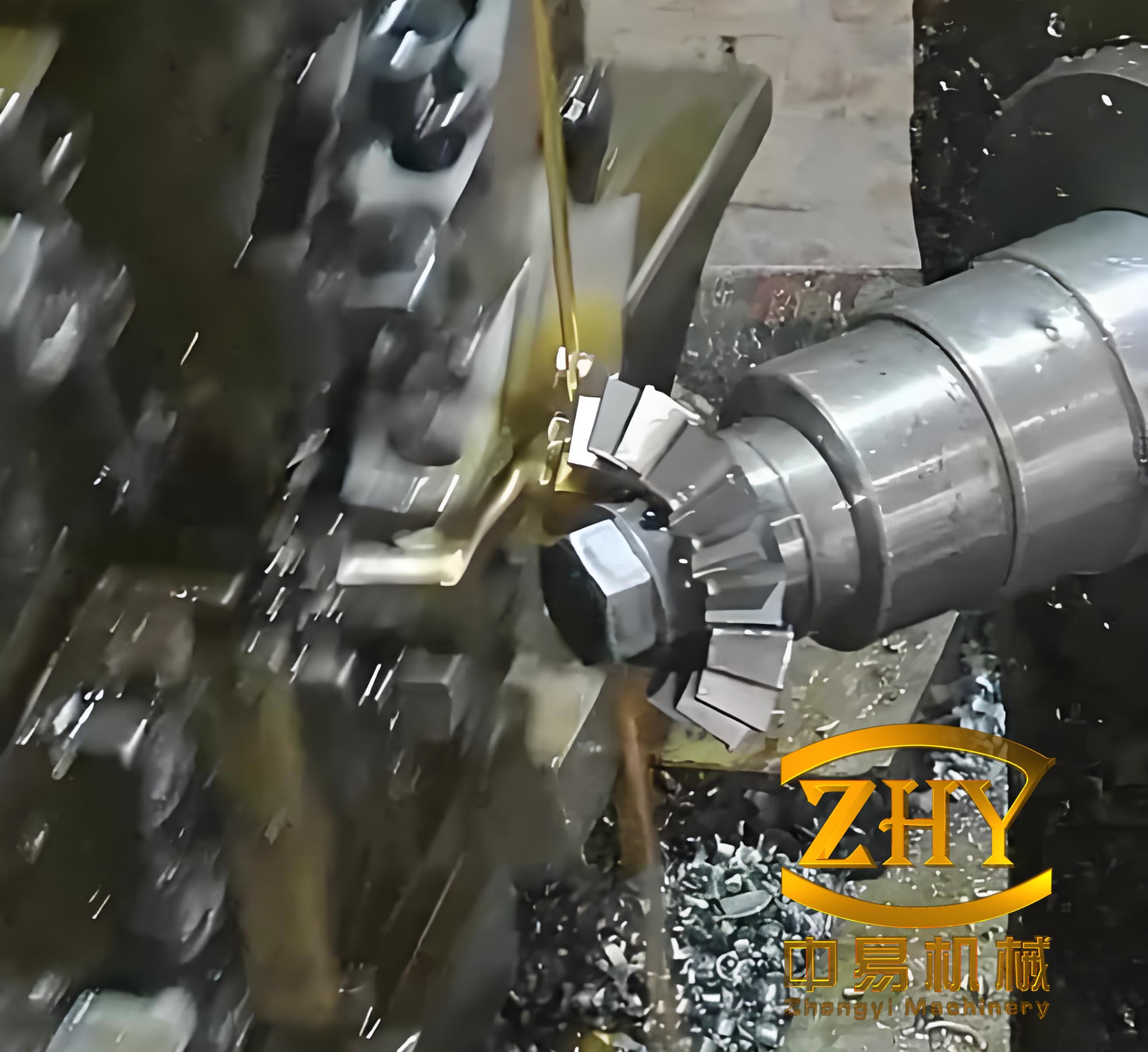
The finite element model for gear hobbing simulation is developed using Deform-3D software. The workpiece material is 25CrMo4, and the hob material is M35. The material properties of 25CrMo4 vary with temperature, as summarized in Table 1. These properties are crucial for accurately modeling the thermo-mechanical behavior during gear hobbing.
| Temperature (°C) | Young’s Modulus (MPa) | Thermal Expansion Coefficient (×10⁻⁵/K) | Thermal Conductivity (W/(m·K)) | Specific Heat Capacity (J/(kg·K)) |
|---|---|---|---|---|
| 20 | 212,000 | 1.19 | 41.7 | 6.6189 |
| 100 | 207,000 | 1.25 | 43.4 | 3.8936 |
| 200 | 199,000 | 1.31 | 41.4 | 4.1841 |
| 300 | 192,000 | 1.36 | 39.1 | 4.4588 |
| 400 | 184,000 | 1.41 | 36.7 | 4.7964 |
| 500 | 175,000 | 1.49 | 34.1 | 5.3145 |
| 600 | 164,000 | 1.49 | 34.1 | 6.1073 |
| 1500 | 69,440 | 1.49 | 34.1 | 6.1073 |
The Johnson-Cook constitutive model is employed to represent the material behavior under high strain rates and large deformations during gear hobbing. The flow stress is given by:
$$ \sigma = \left( A + B \varepsilon^n \right) \left[ 1 + C \ln \left( \frac{\dot{\varepsilon}}{\dot{\varepsilon}_0} \right) \right] \left[ 1 – \left( \frac{T – T_{\text{room}}}{T_{\text{melt}} – T_{\text{room}}} \right)^m \right] $$
where $A$, $B$, $C$, $n$, and $m$ are material constants, $\varepsilon$ is the plastic strain, $\dot{\varepsilon}$ is the strain rate, $\dot{\varepsilon}_0$ is the reference strain rate, $T$ is the temperature, $T_{\text{room}}$ is room temperature, and $T_{\text{melt}}$ is the melting temperature. The fracture strain model is defined as:
$$ \varepsilon_D = \left[ d_1 + d_2 \exp(-d_3 \eta) \right] \left[ 1 + d_4 \ln \left( \frac{\dot{\varepsilon}_{\text{pl}}}{\dot{\varepsilon}_0} \right) \right] (1 + d_5 \hat{\theta}) $$
where $d_1$ to $d_5$ are failure parameters, $\eta$ is the stress triaxiality, $\dot{\varepsilon}_{\text{pl}}$ is the plastic strain rate, and $\hat{\theta}$ is the dimensionless temperature. The parameters used in the simulation are: $d_1 = 0.1$, $d_2 = 0.76$, $d_3 = 1.57$, $d_4 = 0.005$, $d_5 = -0.84$, $n = 0.2$, $C = 0.02$, $T_{\text{room}} = 20^\circ \text{C}$, $T_{\text{melt}} = 1527^\circ \text{C}$, and $m = 0.64$.
The gear hobbing simulation model incorporates the relative motion between the hob and the workpiece. The transformation matrix for the gear hobbing motion is:
$$ \mathbf{R}_{\text{trans}}(\phi) = \mathbf{R}_z(\psi(\phi)) \mathbf{T}_z(\zeta(\phi)) \mathbf{R}_x(\phi) $$
where $\mathbf{R}_x(\phi)$ represents the rotation of the hob, $\mathbf{T}_z(\zeta(\phi))$ denotes the axial feed motion, and $\mathbf{R}_z(\psi(\phi))$ represents the rotation of the workpiece. The axial feed $\zeta(\phi)$ is defined as $\zeta(\phi) = \frac{n f}{2\pi z} \phi$, where $n$ is the number of workpiece revolutions, $f$ is the axial feed per revolution, and $z$ is the number of teeth. The workpiece rotation angle $\psi(\phi)$ is given by $\psi(\phi) = \pm \frac{z_0}{z} \phi$, where $z_0$ is the number of hob starts. The trajectory of the hob teeth in the workpiece coordinate system is described by:
$$ \mathbf{G}_i(t) = \mathbf{R}_{\text{trans}}(\phi) \mathbf{E}(t)_i $$
where $\mathbf{E}(t)_i$ represents the $i$-th hob tooth edge. The gear hobbing machine settings are critical for achieving the desired tooth geometry.
We conducted simulations to analyze the effects of gear hobbing speed and axial feed on cutting forces and temperature. The gear hobbing speeds varied from 300 r/min to 900 r/min, and axial feed rates ranged from 0.25 mm/r to 1.00 mm/r. The results show that axial cutting forces increase rapidly during the initial engagement phase, stabilize, and then decrease during tool exit. Radial cutting forces peak early and gradually decline. Cutting temperatures rise quickly and stabilize due to heat dissipation and cooling. The following equations summarize the relationships observed in the gear hobbing process. The uncut chip geometry, which influences cutting forces, can be expressed as:
$$ G_{i-1 \to i}(t, \phi) = \mathbf{R}_{\text{trans}}(\phi) \mathbf{E}(t)_i – \mathbf{R}_{\text{trans}}(\phi) \mathbf{E}(t)_{i-1} $$
The shear area variation during gear hobbing affects the cutting forces. For axial cutting forces $F_a$ and radial cutting forces $F_r$, the trends are modeled as:
$$ F_a(t) = k_a \cdot A_s(t) \cdot \left[ 1 + \alpha_a \ln \left( \frac{v}{v_0} \right) \right] $$
$$ F_r(t) = k_r \cdot A_s(t) \cdot \left[ 1 + \alpha_r \ln \left( \frac{v}{v_0} \right) \right] $$
where $k_a$ and $k_r$ are force coefficients, $A_s(t)$ is the shear area, $v$ is the gear hobbing speed, $v_0$ is the reference speed, and $\alpha_a$ and $\alpha_r$ are sensitivity coefficients. The cutting temperature $T_c$ is influenced by the gear hobbing parameters:
$$ T_c = T_0 + \beta \cdot v^\gamma \cdot f^\delta $$
where $T_0$ is the initial temperature, $f$ is the axial feed rate, and $\beta$, $\gamma$, $\delta$ are empirical constants. The simulation data are summarized in Table 2, showing the average cutting forces and temperature under different gear hobbing conditions.
| Gear Hobbing Speed (r/min) | Axial Feed (mm/r) | Average Axial Force (N) | Average Radial Force (N) | Average Temperature (°C) |
|---|---|---|---|---|
| 300 | 0.5 | 791 | 324 | 229 |
| 450 | 0.5 | 798 | 335 | 232 |
| 600 | 0.5 | 806 | 345 | 244 |
| 750 | 0.5 | 819 | 360 | 258 |
| 900 | 0.5 | 834 | 375 | 274 |
| 600 | 0.25 | 803 | 324 | 225 |
| 600 | 0.5 | 806 | 345 | 244 |
| 600 | 0.75 | 823 | 407 | 244 |
| 600 | 1.00 | 914 | 554 | 273 |
The analysis reveals that axial feed rate has a more significant impact on cutting forces than gear hobbing speed. For instance, increasing the axial feed from 0.25 mm/r to 1.00 mm/r raises axial forces by 91 N and radial forces by 230 N, whereas increasing the gear hobbing speed from 300 r/min to 900 r/min only increases axial forces by 43 N. This highlights the importance of controlling axial feed in gear hobbing machines to manage cutting forces. Similarly, cutting temperature is more sensitive to gear hobbing speed, with a 45°C increase when speed rises from 300 r/min to 900 r/min, compared to a 29°C increase when axial feed increases from 0.25 mm/r to 1.00 mm/r. These findings emphasize the need for balanced parameter selection in gear hobbing operations to minimize thermal damage and ensure gear accuracy.
In conclusion, gear hobbing is a complex process influenced by multiple parameters. Our study demonstrates that axial feed rates below 0.75 mm/r result in gradual changes in cutting forces and temperature, making them suitable for precision applications. Higher gear hobbing speeds significantly elevate cutting temperatures, requiring efficient cooling systems in gear hobbing machines. The developed finite element model provides a reliable tool for optimizing gear hobbing parameters, enhancing the manufacturing efficiency and quality of cycloidal gears. Future work could explore the effects of tool wear and different cooling strategies on the gear hobbing process.