
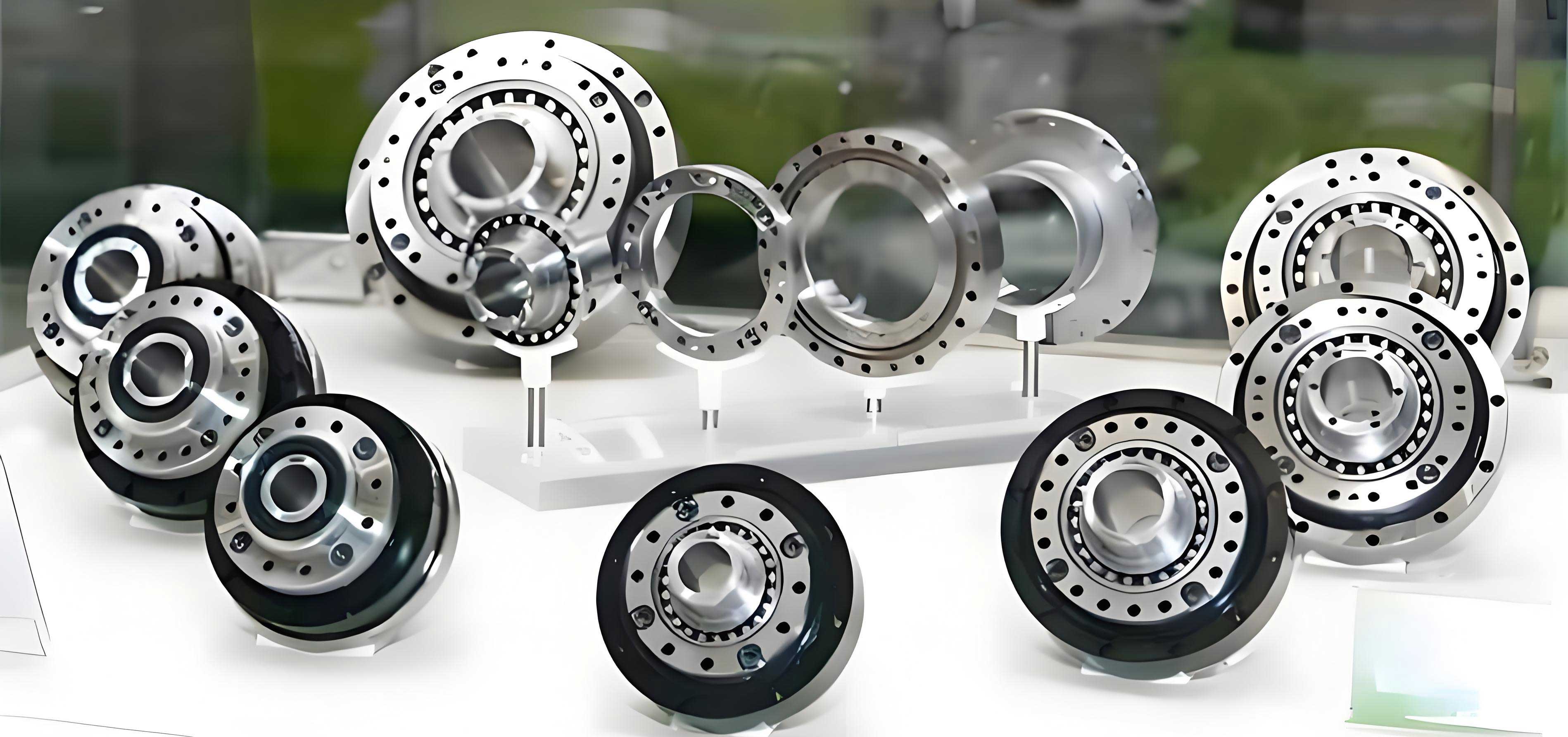
My research focuses on the critical component found within industrial robot joints: the rotary vector reducer. Renowned for its high precision, substantial rigidity, excellent overload capacity, and compact design, the performance and longevity of the rotary vector reducer are paramount. At the heart of its two-stage transmission lies the cycloidal gear, positioned between the output and input planet carriers. This gear’s tooth surfaces are subjected to significant shock loads during operation. Consequently, the surface strength and wear resistance of the cycloidal gear directly dictate the overall lifespan, precision retention, and durability of the entire rotary vector reducer.
Several factors influence the surface longevity of cycloidal gears, including installation accuracy, the effective load-bearing region, material properties, and heat treatment. The contact zones between the needle rollers and the cycloidal tooth surface experience complex coupled deformation and stress concentration under alternating loads. Furthermore, external loads can induce tilt in the rotary vector reducer’s main bearing. This tilt angle alters the relative position between the cycloidal tooth surface and the needle rollers, potentially leading to uneven load distribution across the tooth face, a phenomenon known as bias loading.
While extensive research exists on the dynamic performance of cycloidal gears, studies concerning contact stress have largely been confined to the circumferential direction. A significant gap remains in the theoretical analysis of contact stress distribution along the tooth width (face width) direction of cycloidal gears. Classical Hertzian theory, the foundational method for solving contact stresses, remains dominant but fails to adequately explain edge contact phenomena. The Hertzian line contact solution is based on the assumption of infinite line length. However, in a rotary vector reducer, the needle roller length is typically greater than the cycloidal gear’s face width. The problem becomes non-Hertzian and considerably more complex when the needle roller’s generatrix is not perfectly straight or when installation errors cause misalignment relative to the cycloidal surface.
In this work, I develop and present a numerical analysis method to calculate the effective contact area and the distribution of circumferential loads on the cycloidal gear tooth surface under specified loads, taking into account both elastic deformation and backlash. I then establish a mathematical model for contact stress distribution along the tooth width direction by employing force equilibrium and deformation compatibility equations. This model, formulated as a set of nonlinear equations, allows for the determination of contact stress distribution and contact width across the gear face. I provide a detailed computational procedure and flowchart to solve this system. This methodology is applied to simulate both the ideal state and scenarios with installation alignment errors for a cycloidal gear within a rotary vector reducer. Finally, the correctness and feasibility of the proposed method are validated through a combination of simulation results and physical loading tests.
1. Geometry and Force Analysis of the Cycloidal Gear in a Rotary Vector Reducer
1.1 Tooth Profile Equation and Curvature Radius
Based on the meshing and forming principles of cycloidal gears, tooth profile modification is essential for proper performance. The three primary modification types are: profile shift (move distance), equidistant modification, and rotational angle modification. The comprehensive tooth profile equation incorporating these modifications is given by:
$$x_c = \left[ r_p + \Delta r_p – (r_{rp} + \Delta r_{rp}) S^{-\frac{1}{2}} \right] \cos\left( (1 – i_H) \varphi – \delta_0 \right) – \frac{e}{r_p + \Delta r_p} \left[ r_p + \Delta r_p – z_p (r_{rp} + \Delta r_{rp}) S^{-\frac{1}{2}} \right] \cos\left( i_H \varphi + \delta_0 \right)$$
$$y_c = \left[ r_p + \Delta r_p – (r_{rp} + \Delta r_{rp}) S^{-\frac{1}{2}} \right] \sin\left( (1 – i_H) \varphi – \delta_0 \right) + \frac{e}{r_p + \Delta r_p} \left[ r_p + \Delta r_p – z_p (r_{rp} + \Delta r_{rp}) S^{-\frac{1}{2}} \right] \sin\left( i_H \varphi + \delta_0 \right)$$
Where the auxiliary variables are defined as:
$$S = 1 + K_1^2 – 2 K_1 \cos \varphi, \quad i_H = \frac{z_p}{z_c}, \quad K_1 = \frac{e z_p}{r_p + \Delta r_p}$$
The parameters are defined in the following table:
| Symbol | Description |
|---|---|
| $z_p$ | Number of needle roller pins |
| $z_c$ | Number of cycloidal gear teeth |
| $r_p$ | Radius of the needle pin distribution circle |
| $r_{rp}$ | Radius of the needle roller pin |
| $e$ | Eccentricity |
| $\varphi$ | Rotation angle of the crank arm relative to a needle pin |
| $\delta_0$ | Rotational angle modification amount |
| $\Delta r_p$ | Profile shift modification amount |
| $\Delta r_{rp}$ | Equidistant modification amount |
According to differential geometry, the curvature at any point on the profile is given by:
$$k = \left| \frac{x’_\varphi y”_\varphi – x”_\varphi y’_\varphi}{((x’_\varphi)^2 + (y’_\varphi)^2)^{3/2}} \right|$$
where $x’_\varphi$, $y’_\varphi$ are the first derivatives and $x”_\varphi$, $y”_\varphi$ are the second derivatives of the profile coordinates with respect to $\varphi$. The radius of curvature $\rho$ for the modified cycloidal profile is therefore:
$$\rho = \frac{(r_p + \Delta r_p)(1 + K_1^2 – 2 K_1 \cos \varphi)^{3/2}}{K_1(z_p + 1)\cos \varphi – (1 + z_p K_1^2)} + r_{rp} + \Delta r_{rp}$$
1.2 Tooth Surface Force Analysis
Under an applied torque $T$, the force on the $i$-th needle pin is $F_i$, and the elastic deformation in the direction of the common normal at the meshing point is $\delta_i$. Let the maximum force be $F_{max}$ with a corresponding deformation $\delta_{max}$. The initial backlash at the $i$-th pin, relative to the crank arm angle $\varphi_i$, is $\Delta s(\varphi_i)$. The force relationship can be expressed as:
$$F_i = \frac{\delta_i – \Delta s(\varphi_i)}{\delta_{max}} F_{max}$$
Neglecting non-linear factors, the relationship between the deformation $\delta_i$ at any meshing point and the maximum deformation $\delta_{max}$ can be derived as:
$$\delta_i = \frac{\sin \varphi_i}{\sqrt{1 + K_1^2 – 2 K_1 \cos \varphi_i}} \delta_{max}$$
The initial normal direction backlash $\Delta s(\varphi_i)$ after modification is:
$$\Delta s(\varphi_i) = \Delta r_{rp} \left( 1 – \frac{\sin \varphi_i}{\sqrt{1 + K_1^2 – 2 K_1 \cos \varphi_i}} \right) – \frac{ \Delta r_p \left( 1 – K_1 \cos \varphi_i – \sqrt{1 – K_1^2} \sin \varphi_i \right) }{ \sqrt{1 + K_1^2 – 2 K_1 \cos \varphi_i} }$$
Contact occurs when the elastic deformation exceeds the initial backlash. The region where the deformation is greater than the backlash defines the tooth surface meshing zone. Let the initial contacting pin number be $m$ and the final one be $n$. From the torque equilibrium equation, the maximum force is:
$$F_{max} = \frac{T}{\sum_{i=m}^{n} \left( \frac{l_i}{r’_c} – \frac{\Delta s(\varphi_i)}{\delta_{max}} \right) l_i}$$
where $l_i$ is the distance from the common normal at the $i$-th meshing point to the center of the cycloidal gear, and $r’_c$ is the pitch circle radius of the cycloidal gear. Assuming negligible bending deformation of the needle pins, the relationship between the maximum deformation $\delta_{max}$ and the maximum contact force $F_{max}$ for line contact can be expressed as:
$$\delta_{max} = \frac{2(1-\mu^2) F_{max}}{E \pi b} \left( \frac{2}{3} + \ln \frac{16 r_{rp} |\rho_0|}{c^2} \right)$$
with the contact half-width parameter $c$ given by:
$$c = 4.99 \times 10^{-3} \sqrt{ \frac{2(1-\mu^2) F_{max}}{E \pi b} \cdot \frac{2 |\rho_0| r_{rp}}{|\rho_0| + r_{rp}} }$$
Here, $\rho_0$ is the radius of curvature at $\varphi = \arccos K_1$, $\mu$ is Poisson’s ratio, $E$ is the elastic modulus, and $b$ is the face width of the cycloidal gear. By solving the system of equations formed by the equilibrium and deformation relations, the force $F_i$ on each tooth in the meshing zone can be determined.
2. Mathematical Model for Contact Stress Along the Tooth Width
The contact between the needle roller and the cycloidal gear tooth is a line contact problem. The comprehensive curvature radius $\rho_n$ depends on whether the contact occurs on the concave or convex flank of the cycloidal tooth. For contact on the concave flank, the equivalent curvature is:
$$\frac{1}{\rho_n} = \frac{1}{\rho} – \frac{1}{r_{rp}}$$
For contact on the convex flank, it is:
$$\frac{1}{\rho_n} = \frac{1}{|\rho|} + \frac{1}{r_{rp}}$$
2.1 Numerical Formulation of the Contact Problem
To solve the non-Hertzian contact problem across the tooth width, the contact line is discretized into $N$ elements along the face width direction ($y$-axis). For element $j$, let $p_{0j}$ be the maximum contact stress at its center, $2a_j$ be the contact width, and $2h_j$ be the element height. The pressure distribution within an element is assumed to be semi-elliptical:
$$p_j(x, y) = p_{0j} \sqrt{1 – \left( \frac{x}{a_j} \right)^2}$$
According to the Hertzian relation for the element, we have:
$$a_j E’ = 2 R_j p_{0j}$$
where $R_j$ is the comprehensive radius of curvature for element $j$, and $E’$ is the combined elastic modulus: $1/E’ = (1-\mu_1^2)/E_1 + (1-\mu_2^2)/E_2$. The problem reduces to finding the distribution of $p_{0j}$ along the $y$-axis. Substituting the pressure distribution into the force equilibrium and deformation compatibility integral equations and discretizing yields the following system:
Force Equilibrium:
$$\pi \sum_{j=1}^{N} a_j h_j p_{0j} = P$$
where $P$ is the total normal load on the tooth ($F_i$ from the circumferential analysis).
Deformation Compatibility (for each element $i’$):
$$\frac{1}{\pi E’} \sum_{j=1}^{N} D_{i’j} p_{0j} = \delta – z_{i’}(y_{i’}), \quad i’ = 1, 2, …, N$$
The term $z_{i’}(y_{i’})$ represents the geometric separation of the surfaces at element $i’$ before loading, which includes any installation tilt error $\theta_{err}$ and intentional tooth flank modification (crowning) $z_{bi’}$:
$$z_{i’}(y_{i’}) = y_{i’} \tan \theta_{err} + z_{bi’}$$
The flexibility coefficient $D_{i’j}$ represents the displacement at element $i’$ due to a unit pressure distribution over element $j$ and is calculated by the double integral:
$$D_{i’j} = \int_{-a_j}^{a_j} \int_{y_j – h_j}^{y_j + h_j} \frac{ \sqrt{1 – (x’/a_j)^2} }{ \sqrt{(x’)^2 + (y_{i’} – y_j – y’)^2} } dx’ dy’$$
The system comprising the one equilibrium equation and the $N$ compatibility equations forms a set of $N+1$ equations for the $N+1$ unknowns: $p_{0j}$ ($j=1,…,N$) and the rigid body approach $\delta$. The solution must satisfy the non-negativity constraint $p_{0j} \ge 0$.
2.2 Tooth Flank Modification (Crowning) Design
To mitigate edge stress concentration, the needle roller or cycloidal tooth flank is often crowned. A common profile is a logarithmic curve, symmetric about the center of the face width. The crowning height $z_b$ as a function of the distance $y$ from the center is given by:
$$z_b = 2 k_b \frac{(1-\mu^2)}{\pi E} \frac{F}{l} \ln \frac{1}{1 – (2y/l)^2}$$
where $F$ is the load on the needle roller, $l$ is the total width of the needle roller (or gear face), and $k_b$ is a bias load coefficient that adjusts the amount of crown.
2.3 Computational Procedure Flowchart
The complete numerical procedure for calculating the circumferential load distribution and the resulting tooth-width contact stress in a rotary vector reducer cycloidal gear is executed in two main stages, as summarized in the steps below and illustrated conceptually.
- Input Parameters: Define all geometric ($z_p, z_c, r_p, r_{rp}, e, \Delta r_p, \Delta r_{rp}, b, l$), material ($E_1, E_2, \mu_1, \mu_2$), load ($T$), and numerical ($N$, tolerances $\epsilon, \epsilon_1, \epsilon_2$) parameters.
- Stage 1 – Circumferential Load Distribution:
- Estimate an initial $F_{max}$.
- Calculate $\delta_{max}$ using the deformation formula.
- Compute deformations $\delta_i$ and backlashes $\Delta s(\varphi_i)$ for all potential teeth.
- Identify the meshing zone (teeth where $\delta_i > \Delta s(\varphi_i)$).
- Solve the equilibrium equation iteratively to find the correct $F_{max}$ and the individual tooth loads $F_i$.
- Stage 2 – Tooth-Width Contact Stress for a Selected Tooth:
- For a specific loaded tooth $i$, set $P = F_i$ and calculate its local curvature $R_j$ across the width.
- Initialize $a_j$, $p_{0j}$, and $\delta$ using Hertz formulas for line contact.
- Construct the geometric gap function $z_{i’}$ including tilt and crowning.
- Compute the flexibility matrix $D_{i’j}$.
- Solve the nonlinear system of $N+1$ equations iteratively:
- Solve for new $p_{0j}$ and $\delta$ from the linearized system.
- Update contact half-widths $a_j = 2 p_{0j} R_j / E’$.
- Apply non-negativity constraint (set $p_{0j}=0, a_j=0$ if $p_{0j}<0$).
- Check for convergence in $a_j$ and total force $P$.
- Adjust $\delta$ and iterate until full convergence.
- Output the final distributions of contact stress $p_{0j}$ and contact width $2a_j$ across the tooth face.
3. Case Study: Simulation Results and Discussion
To validate the proposed numerical analysis method, I applied it to a cycloidal gear from a commercial rotary vector reducer. The key parameters are listed in the table below.
| Parameter | Value |
|---|---|
| Eccentricity, $e$ (mm) | 1.3 |
| Needle Pin Radius, $r_{rp}$ (mm) | 3.0 |
| Pin Distribution Radius, $r_p$ (mm) | 64.0 |
| Cycloidal Gear Teeth, $z_c$ | 39 |
| Needle Pin Teeth, $z_p$ | 40 |
| Face Width, $b$ (mm) | 10.0 |
| Equidistant Modification, $\Delta r_{rp}$ (mm) | 0.006 |
| Profile Shift Modification, $\Delta r_p$ (mm) | 0.0 |
| Elastic Modulus, $E$ (GPa) | 206 |
| Poisson’s Ratio, $\mu$ | 0.3 |
| Applied Torque, $T$ (Nm) | 412 |
3.1 Circumferential Load Distribution
For an applied torque of 412 Nm, the analysis reveals the meshing zone where elastic deformation exceeds initial backlash. The results for different torque levels are summarized below:
| Torque, $T$ (Nm) | Meshing Zone (deg) | Number of Teeth in Contact | Min Tooth Force (N) | Max Tooth Force (N) |
|---|---|---|---|---|
| 412 | [6.588, 121.819] | 13 | 50.43 | 588.45 |
| 618 | [5.355, 131.347] | 14 | 69.82 | 824.90 |
| 1030 | [3.981, 142.866] | 15 | 140.22 | 1286.10 |
| 2060 | [2.495, 156.228] | 17 | 94.75 | 2416.80 |
Key observations from the circumferential analysis:
- As the load increases, the number of teeth sharing the load increases, but the fluctuation in force among the engaged teeth becomes more pronounced.
- The maximum force consistently occurs near the tooth flank inflection point (approximately tooth #5 for this geometry).
- A small subset of teeth near the inflection point carries a disproportionately large share of the total load. For instance, at 412 Nm, about 35% of the contacting teeth (teeth #4-#7) carry over 50% of the total load. This concentration becomes slightly more pronounced with higher loads.
3.2 Tooth-Width Contact Stress: Ideal Alignment
Analyzing tooth #5 (near the inflection point) under 412 Nm with perfect alignment ($\theta_{err}=0$) and no crowning ($\delta_a=0$) reveals a characteristic non-Hertzian edge effect. The contact stress distribution is nearly uniform across the central 90% of the face width but shows significant stress spikes at both edges. This simulation provides a theoretical explanation for why fatigue pitting often initiates at the edges of cycloidal gear teeth in rotary vector reducers. The contact width distribution mirrors this, being uniform in the center but flaring out at the edges.
When crowning is applied to the needle roller (with a maximum crown height $\delta_a = 1.5 \mu m$ and $k_b=1.5$), the edge stress concentrations are effectively eliminated. The contact stress in the central region remains largely unchanged, but the stress at the edges now decreases smoothly to zero. This modification significantly alleviates stress concentration, which is expected to prolong the surface fatigue life of the gear in the rotary vector reducer.
3.3 Tooth-Width Contact Stress: Effect of Installation Tilt Error
Introducing a small installation tilt error ($\theta_{err} = 0.01^\circ$) drastically changes the load distribution across the face width. Without crowning, the contact pattern becomes severely biased. One edge experiences a much larger contact width and higher, sharply increasing stress, while the opposite edge has a reduced contact zone. This bias load accelerates fatigue on the heavily loaded edge.
The beneficial effect of crowning is even more critical under misaligned conditions. With the same 1.5 $\mu m$ crown applied, the contact stress distribution under the 0.01° tilt becomes a smooth, sloping distribution across the face width. The severe edge stress peaks are suppressed. Although the effective contact length is reduced, the load is distributed more evenly, and the bias loading is managed more gracefully. This demonstrates that proper flank modification in a rotary vector reducer’s cycloidal drive can provide valuable tolerance to assembly misalignments.
4. Experimental Validation
To verify the numerical findings, a loading test was conducted on a prototype rotary vector reducer. The reducer’s performance metrics (transmission accuracy, backlash, torsional stiffness, efficiency) were first verified to meet design specifications prior to testing.
The test involved mounting the reducer on a dedicated test bench and applying a constant output torque of 615 Nm for an extended run-in period. Upon disassembly and inspection, contact patterns were clearly visible on the cycloidal gear teeth. Notably, not all theoretical teeth showed contact marks, confirming the load-sharing behavior predicted by the circumferential analysis. The most pronounced contact marks were clustered around the flank inflection point region (near tooth #5), with marking intensity diminishing for teeth farther from this region. This observation strongly correlates with the simulation result that a small set of teeth near the inflection point carries the majority of the load.
For tooth #5, the contact pattern exhibited a distinct bias across the face width, with the mark widening towards one side. This visual pattern aligns with the simulated contact width distribution for a scenario with a slight tilt error. While the simulated contact zone was narrower, the actual wear mark was broader, which can be attributed to stress radiation in the surrounding material during long-term operation and potential deviations in the actual tilt angle from the assumed value. Furthermore, the cycloidal gear closer to the output side showed more pronounced wear, indicating a more severe bias load in that stage of the rotary vector reducer, consistent with the model’s predictions under tilt conditions.
5. Conclusion
In this study, I have developed a comprehensive numerical analysis method for evaluating the contact stress in cycloidal gears used in rotary vector reducers. The key contributions and findings are summarized as follows:
- Integrated Analysis Framework: The method integrates a circumferential load distribution model (accounting for elastic deformation and backlash) with a two-dimensional non-Hertzian contact solver for the tooth width direction. This provides a complete picture of the stress state on the cycloidal gear tooth surface.
- Load Distribution Insights: The analysis confirms that the load is not evenly shared among all theoretically engaging teeth. A small subset of teeth near the flank inflection point carries a dominant portion of the total torque in the rotary vector reducer. This concentration becomes more pronounced with increasing load.
- Criticality of Edge Effects and Crowning: Under ideal alignment, classic edge stress concentration is predicted. Intentional flank modification (crowning) is demonstrated to be highly effective in eliminating these edge stresses, promoting a more uniform pressure distribution and enhancing gear life.
- Sensitivity to Misalignment: The model is capable of simulating the detrimental effects of installation tilt errors, which cause severe bias loading across the tooth face. Crowning is shown to be essential in mitigating the impact of such misalignments, making the rotary vector reducer’s cycloidal transmission more robust to assembly variations.
- Experimental Correlation: Physical loading tests on a rotary vector reducer prototype confirmed the predicted trends: concentrated contact near the inflection point and visible bias in the contact pattern across the tooth width. This validates the practical relevance and accuracy of the proposed numerical approach.
This methodology provides a powerful tool for the design and strength evaluation of cycloidal gears in rotary vector reducers. It enables engineers to optimize tooth modifications, assess the impact of manufacturing tolerances and assembly errors, and ultimately predict and improve the fatigue life and reliability of these critical components in robotic and precision motion systems.