
The operational lifespan of forging dies is critically dependent on the thermal loads they experience during the metal forming process. Specifically, the peak temperature attained and the resulting temperature distribution within the die surface layers are paramount factors influencing phenomena such as thermal softening, wear, plastic deformation, and the onset of thermal fatigue cracking. In the context of precision forging for complex components like spiral bevel gears, these thermal challenges are significantly amplified. Unlike simpler geometries, the forming of spiral bevel gears involves a non-linear, extended metal flow path as the material is forced axially into the intricate, curved tooth cavities. This results in intense localized plastic deformation and high frictional work, generating substantial heat at the die-workpiece interface. Furthermore, the ejection process for spiral bevel gears is not a simple axial motion; it often requires a relative rotational movement between the forged gear and the die cavity to overcome undercuts, leading to prolonged contact time and additional frictional heating. This complex thermomechanical interaction severely threatens the service life of the expensive forging die. Therefore, a comprehensive understanding of the die temperature field is essential for optimizing the process, selecting appropriate die materials and heat treatments, and implementing effective cooling strategies. This article presents a detailed numerical investigation into the temperature evolution in the die during the warm forging of spiral bevel gears, analyzing the influence of key process parameters.
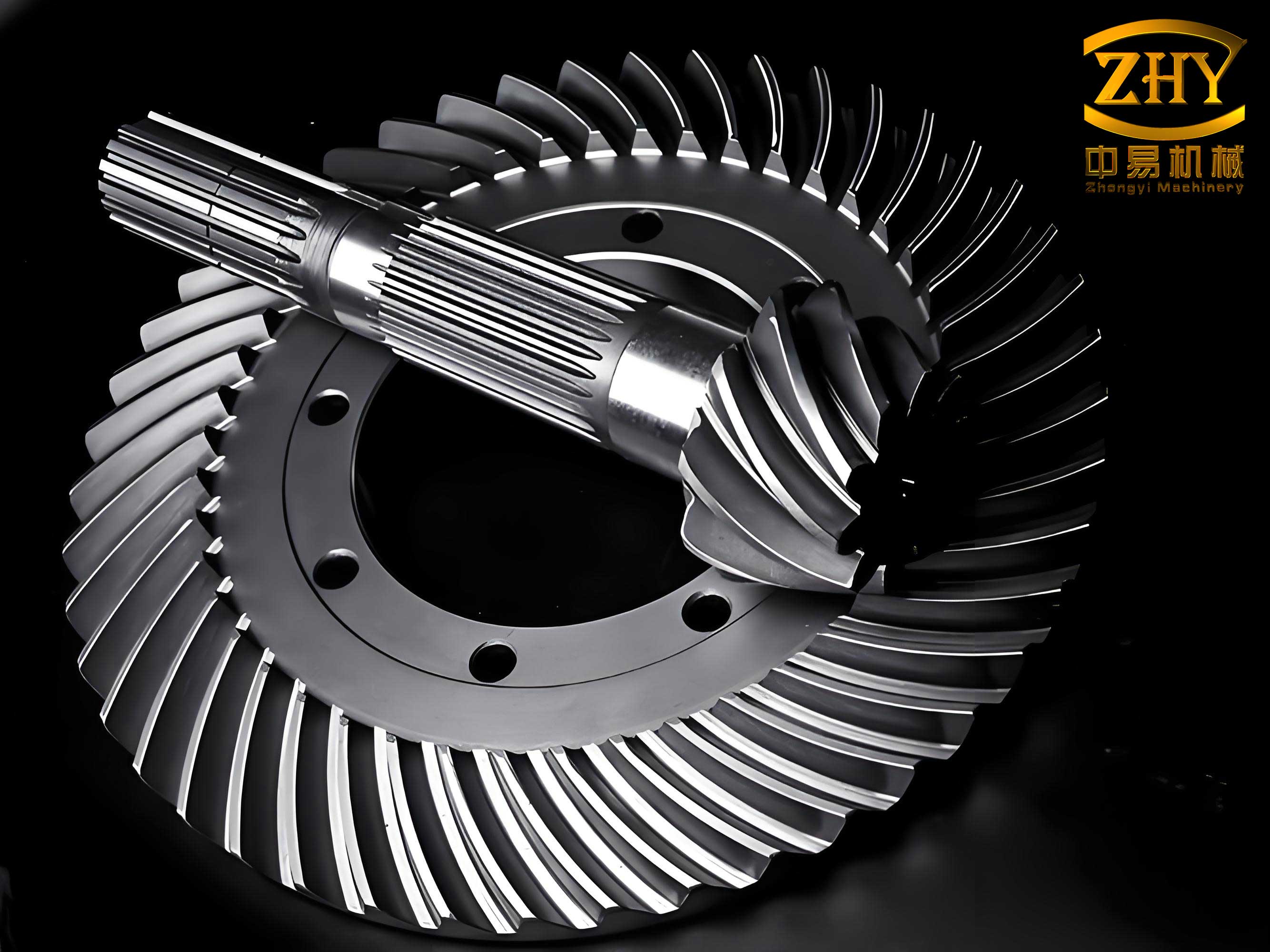
Theoretical Foundation: Thermo-Mechanical Coupling in Warm Forging
The analysis of die temperature during forging is a classic coupled problem, where mechanical deformation generates heat, and the resulting temperature field affects material flow stress and tribological conditions. The governing principles are derived from the laws of thermodynamics and heat transfer.
Governing Equation for Heat Conduction
The spatial and temporal variation of temperature within a solid, such as a forging die, is described by the heat conduction equation. Fourier’s law states that the heat flux vector $\mathbf{q}$ is proportional to the negative gradient of the temperature field $T$:
$$
\mathbf{q} = -k \nabla T
$$
where $k$ is the thermal conductivity tensor. For an isotropic material, $k$ becomes a scalar, and in Cartesian coordinates, the components are:
$$ q_x = -k \frac{\partial T}{\partial x}, \quad q_y = -k \frac{\partial T}{\partial y}, \quad q_z = -k \frac{\partial T}{\partial z} $$
Consider an infinitesimal control volume $dV = dx\,dy\,dz$ within the die material. The conservation of energy principle requires that the net rate of heat entering the volume plus the rate of internal heat generation equals the rate of increase of internal energy. The heat generation term $\dot{Q}$, crucial in forging simulations, includes heat from plastic deformation ($\eta \sigma \dot{\epsilon}$, where $\eta$ is the inelastic heat fraction, $\sigma$ is the flow stress, and $\dot{\epsilon}$ is the strain rate) and frictional dissipation at the interface. Performing an energy balance leads to the transient heat conduction equation:
$$
\rho c_p \frac{\partial T}{\partial t} = \nabla \cdot (k \nabla T) + \dot{Q}
$$
where $\rho$ is the density, $c_p$ is the specific heat capacity, and $t$ is time. For a homogeneous, isotropic material with constant properties, this simplifies to:
$$
\frac{\partial T}{\partial t} = \alpha \nabla^2 T + \frac{\dot{Q}}{\rho c_p}
$$
where $\alpha = k/(\rho c_p)$ is the thermal diffusivity. This partial differential equation requires initial and boundary conditions for a unique solution.
Initial and Boundary Conditions
The initial condition specifies the temperature distribution at time $t=0$:
$$ T(x,y,z,0) = T_0(x,y,z) $$
For a forging die, $T_0$ is typically the uniform preheat temperature. The boundary conditions (BCs) describe the thermal interaction at the die surfaces ($\Gamma$). The primary BCs encountered in die analysis are:
- Dirichlet (Temperature) BC: Prescribed surface temperature.
$$ T(\mathbf{x}, t) = T_s(\mathbf{x}, t) \quad \text{for } \mathbf{x} \in \Gamma_T $$
This is less common for free surfaces but may apply to cooled channels. - Neumann (Heat Flux) BC: Prescribed heat flux normal to the surface.
$$ -k \frac{\partial T}{\partial n} = q_n(\mathbf{x}, t) \quad \text{for } \mathbf{x} \in \Gamma_q $$
This is used for known heat inputs, like from heaters. - Convection BC (Newton’s Law of Cooling): Heat loss to the surrounding air.
$$ -k \frac{\partial T}{\partial n} = h_c (T – T_{\infty}) \quad \text{for } \mathbf{x} \in \Gamma_c $$
where $h_c$ is the convective heat transfer coefficient and $T_{\infty}$ is the ambient temperature. - Radiation BC (Stefan-Boltzmann Law): Heat loss via thermal radiation.
$$ -k \frac{\partial T}{\partial n} = \epsilon \sigma_{SB} (T^4 – T_{\text{surr}}^4) \quad \text{for } \mathbf{x} \in \Gamma_r $$
where $\epsilon$ is the emissivity, $\sigma_{SB}$ is the Stefan-Boltzmann constant, and $T_{\text{surr}}$ is the surrounding temperature. - Contact/Interface BC: The most critical condition for forging analysis. It governs heat partition between the hot workpiece (temp $T_w$) and the cooler die (temp $T_d$). The heat flux into the die is:
$$ q_d = h_{\text{int}} (T_w – T_d) $$
where $h_{\text{int}}$ is the interfacial heat transfer coefficient (IHTC), which depends on contact pressure, surface roughness, and the presence of lubricant/scale.
Finite Element Formulation and Variational Principle
The analytical solution to the coupled, nonlinear thermo-mechanical problem with complex geometry like that of a spiral bevel gear die is intractable. Therefore, numerical methods, primarily the Finite Element Method (FEM), are employed. The FEM formulation often starts from a variational principle. A functional $\Pi(T)$, whose minimum corresponds to the solution of the heat conduction equation with its BCs, can be constructed:
$$
\begin{aligned}
\Pi(T) = & \frac{1}{2} \int_{\Omega} k \left[ \left(\frac{\partial T}{\partial x}\right)^2 + \left(\frac{\partial T}{\partial y}\right)^2 + \left(\frac{\partial T}{\partial z}\right)^2 \right] d\Omega \\
& + \int_{\Omega} \left( \rho c_p \frac{\partial T}{\partial t} – \dot{Q} \right) T \, d\Omega \\
& + \int_{\Gamma_q} q T \, d\Gamma + \int_{\Gamma_c} \frac{h_c}{2} (T^2 – 2 T_{\infty} T) \, d\Gamma \\
& + \int_{\Gamma_r} \frac{\epsilon \sigma_{SB}}{2} (T^4 – 2 T_{\text{surr}}^4 T) \, d\Gamma
\end{aligned}
$$
The domain $\Omega$ (the die and workpiece) is discretized into finite elements. The temperature field within an element is approximated by shape functions $N_i$ and nodal temperatures $T_i$: $T^{(e)} = \sum N_i T_i$. Applying the stationarity condition $\delta \Pi = 0$ to the discretized system leads to a set of algebraic equations in matrix form:
$$
\mathbf{C} \dot{\mathbf{T}} + \mathbf{K} \mathbf{T} = \mathbf{F}
$$
where $\mathbf{C}$ is the heat capacity matrix, $\mathbf{K}$ is the conductivity matrix (including contributions from convection and radiation), $\mathbf{T}$ is the vector of nodal temperatures, $\dot{\mathbf{T}}$ is its time derivative, and $\mathbf{F}$ is the heat flux vector (including internal heat generation $\dot{Q}$, surface fluxes, and boundary conditions). This system is solved using time-integration schemes (e.g., backward Euler) to obtain the temperature history throughout the forging process. Commercial software like DEFORM-3D implements this coupled thermomechanical analysis, where the mechanical solution provides $\dot{Q}$ from plastic and frictional work, and the thermal solution updates material properties for the next mechanical step.
Numerical Simulation Setup for Spiral Bevel Gear Forging
This study focuses on a specific case: the closed-die warm forging of a spiral bevel gear. The gear’s geometric complexity, characterized by its curved teeth and spiral angle, makes it an excellent subject for analyzing non-uniform thermal loading on dies.
Gear Geometry and Finite Element Model
The subject spiral bevel gear has the following primary design parameters, which define its challenging formability characteristics:
| Parameter | Symbol | Value | Unit |
|---|---|---|---|
| Number of Teeth | Z | 25 | – |
| Module | m | 4.3 | mm |
| Pressure Angle | α | 20 | ° |
| Spiral Angle | β | 35 | ° (Right-hand) |
| Pitch Cone Angle | δ | 30 | ° |
| Whole Depth | h | 8.1184 | mm |
The 3D finite element model was constructed to simulate the precision forming process. The model consists of four primary components: the upper punch (acting as the male die/convex tooth form), the lower die body containing the female gear cavity, the lower counter punch (for ejection), and the billet. The billet is modeled as a plastic, deformable body, while the dies are modeled as rigid objects for computational efficiency, which is a standard practice when focusing on die stresses and temperatures. However, their thermal properties (capacity, conductivity) are fully defined to capture heat accumulation. Tetrahedral elements with adaptive remeshing were employed for the billet to handle the large plastic deformation accurately. The model inherently captures the complex curved metal flow into the spiral bevel gear tooth cavities.
Material Properties and Process Parameters
The selection of material properties and process parameters is critical for a realistic simulation. The following tables summarize the baseline data used in this analysis. The friction condition is modeled using the shear friction model, where the frictional stress $\tau_f$ is defined as $\tau_f = m_k \cdot \bar{\sigma} / \sqrt{3}$, with $m_k$ being the friction factor ranging from 0 (perfect lubrication) to 1 (perfect sticking).
| Component | Material | Thermal Conductivity (N/s·°C) | Heat Capacity (N/mm²·°C) | Emissivity | Initial Temperature (°C) |
|---|---|---|---|---|---|
| Billet | 20CrMnTi Steel | 64.6 | 3.602 | 0.3 | 600 – 850 (Variable) |
| Die Set | H13 Tool Steel | 28.6 | 3.574 | 0.3 | 200 (Preheat) |
| Parameter | Symbol / Description | Baseline Value / Range | Unit |
|---|---|---|---|
| Friction Factor | $m_k$ (Shear Model) | 0.1 – 0.5 | – |
| Interfacial Heat Transfer Coefficient (IHTC) | $h_{int}$ | 11.3 | N/(s·mm·°C) |
| Convective Heat Transfer Coefficient | $h_c$ (to air) | 0.02 | N/(s·mm·°C) |
| Forging Speed | $v$ (Punch velocity) | 5 – 50 | mm/s |
Analysis Methodology
A series of coupled thermomechanical simulations were performed using DEFORM-3D. The baseline case used the median values: billet temperature = 750°C, friction factor $m_k$ = 0.3, forging speed = 20 mm/s. To isolate the effect of individual parameters, sensitivity analyses were conducted where one parameter was varied while the others were held constant at their baseline values. The primary output of interest was the temperature history at strategic points on the surface of the female gear cavity die, specifically at the tooth tip (P1), the mid-flank (P3), and the tooth root/fillet region (P5). Monitoring these points reveals the spatial temperature gradient inherent to forming spiral bevel gears.
Results and Discussion: Die Temperature Field Analysis
Baseline Temperature Distribution
The simulated temperature distribution on the die surface at the end of the forging stroke for the baseline parameters reveals a highly non-uniform pattern. The highest temperature, reaching approximately 542°C, is localized at the tips of the gear teeth cavities. The temperature decreases gradually along the tooth flank, with the lowest temperatures, around 200-250°C, found in the deeper recesses of the tooth root and fillet areas. This gradient of several hundred degrees Celsius over a small spatial domain is characteristic of the forging process for spiral bevel gears.
The temperature-time histories for points P1 (tip), P3 (flank), and P5 (root) provide further insight. All curves show a rapid temperature rise during the initial contact and filling phase, followed by a near-plateau or slight increase as deformation completes and the part is held before ejection. The peak temperatures follow the order: $T_{P1} > T_{P3} > T_{P5}$. This can be attributed to several synergistic factors:
- Contact Time and Sequence: The tooth tip region is the first to contact the deforming billet and remains in contact throughout the entire stroke as metal flows around it. In contrast, the tooth root is filled last, experiencing contact for a shorter duration.
- Deformation Intensity: The tip of the die cavity acts as a constraint around which metal must flow and undergo significant shear and bending. This intense localized plastic work generates considerable heat at the interface.
- Heat Dissipation Path: The tooth tip, being a protruding feature into the hot billet, is surrounded by heat on multiple sides and has a relatively longer conduction path to the cooler die body mass. The tooth root, situated closer to the bulk of the lower die, can dissipate heat more efficiently into the massive tooling below.
This non-uniform heating is a primary driver for differential thermal expansion, stress, and accelerated wear in the tooth tip region of dies for spiral bevel gears.
Parametric Sensitivity Analysis
1. Influence of Friction Factor ($m_k$)
Friction at the die-workpiece interface is a major source of heat generation. The relationship between the shear friction factor $m_k$ and the peak die temperature at points P1, P3, and P5 is quantitatively summarized below.
| Friction Factor ($m_k$) | Peak Temp. at P1 (Tip) (°C) | Peak Temp. at P3 (Flank) (°C) | Peak Temp. at P5 (Root) (°C) | $\Delta T_{P1}$ (vs $m_k$=0.1) |
|---|---|---|---|---|
| 0.1 | 524 | 456 | 349 | 0 |
| 0.2 | 528 | 458 | 352 | +4 |
| 0.3 | 532 | 460 | 354 | +8 |
| 0.4 | 534 | 462 | 355 | +10 |
| 0.5 | 535 | 463 | 356 | +11 |
The data shows a clear positive correlation. As $m_k$ increases from 0.1 to 0.5, the temperature rises at all monitored points. However, the magnitude of the increase is not linear and is most pronounced at the tooth tip (P1), with an 11°C rise, compared to a 7°C rise on the flank and a 6°C rise at the root. This indicates that the frictional heating effect is most severe in regions where relative sliding velocity and contact pressure are high—typically the tooth tips of the spiral bevel gear cavity. The results underscore the critical importance of effective lubrication not only to reduce forming load but also to mitigate die temperature rise and prolong die life.
2. Influence of Initial Billet Temperature ($T_{\text{billet}}$)
The initial temperature of the workpiece is a primary driver of the thermal load on the die. The results of varying the billet temperature are presented in the following table and can be modeled by a near-linear relationship in this range.
| Billet Temperature (°C) | Peak Temp. at P1 (Tip) (°C) | Peak Temp. at P3 (Flank) (°C) | Peak Temp. at P5 (Root) (°C) | Gradient $dT_{P1}/dT_{\text{billet}}$ (°C/°C) |
|---|---|---|---|---|
| 600 | 430 | 384 | 307 | – |
| 650 | 465 | 408 | 325 | ~0.35 |
| 700 | 498 | 433 | 340 | ~0.33 |
| 750 | 530 | 459 | 354 | ~0.32 |
| 800 | 557 | 484 | 374 | ~0.27 |
The increase in die temperature is significant. Raising the billet temperature from 600°C to 800°C causes the tooth tip temperature to soar by 127°C. The sensitivity, expressed as the change in die temperature per degree change in billet temperature, is highest for the tooth tip (initially ~0.35) and decreases slightly at higher temperatures, likely due to increased radiation and convection losses from the hotter billet surface prior to contact. Again, the spatial gradient is evident: the temperature increase at the tip (~127°C) is substantially larger than at the root (~67°C). This reinforces the thermal vulnerability of the tooth tip region in spiral bevel gear forging. The choice of warm forging (e.g., 750-850°C) over hot forging (1100-1200°C) for such precision components is partly justified by this need to control die thermal load.
3. Influence of Forging Speed ($v$)
Forging speed, or strain rate, has a complex and often dominant influence on the die temperature. It affects both the heat generation rate and the heat transfer time. The results demonstrate a strong inverse relationship.
| Forging Speed, $v$ (mm/s) | Process Time (s) | Peak Temp. at P1 (Tip) (°C) | Peak Temp. at P3 (Flank) (°C) | Peak Temp. at P5 (Root) (°C) |
|---|---|---|---|---|
| 5 | ~1.5 | 557 | 502 | 393 |
| 10 | ~0.75 | 520 | 470 | 365 |
| 20 | ~0.38 | 497 | 447 | 347 |
| 30 | ~0.25 | 460 | 415 | 320 |
| 50 | ~0.15 | 383 | 336 | 267 |
The effect is profound. Increasing the speed from 5 mm/s to 50 mm/s reduces the peak tooth tip temperature by 174°C—a much larger change than caused by varying friction or billet temperature over the studied ranges. This can be explained by competing mechanisms:
- Adiabatic Heating: At higher strain rates, more of the plastic work of deformation is converted to heat within the workpiece itself (higher $\eta$), raising its temperature. This would tend to increase die temperature.
- Contact Duration: This is the dominant factor for die temperature. A higher forging speed drastically reduces the time $t_c$ the hot billet is in contact with any given point on the die. The heat flux into the die, governed by $q_d = h_{\text{int}} (T_w – T_d)$, operates over a shorter duration. The total energy transferred $Q_d = \int q_d \, dt$ is therefore lower. The die simply does not have time to heat up as much.
- Heat Conduction: During the brief contact at high speed, the generated heat remains concentrated in a very thin surface layer of the die, creating a steep thermal gradient. At lower speeds, heat has time to conduct deeper, raising the average temperature of a larger die volume and reducing the surface gradient.
The net result is that higher forging speeds lead to lower die surface temperatures, even if the workpiece temperature is slightly higher due to adiabatic heating. This provides a powerful lever for controlling die thermal load in the production of spiral bevel gears. However, speed must be balanced against press capacity, risk of incomplete filling, and potential for excessive wear due to high sliding velocities.
Discussion on Implications for Die Life and Process Design
The findings have direct implications for the design and maintenance of dies for manufacturing spiral bevel gears. The consistent localization of the highest temperature at the tooth tip cavity identifies this as the primary failure initiation site. Thermal softening at this location reduces the yield strength and hardness of the die material (e.g., H13 steel), making it more susceptible to plastic deformation under high forming pressures, leading to rounding of sharp edges and loss of dimensional accuracy. Furthermore, the cyclic heating and cooling promote thermal fatigue (heat checking), where networks of fine cracks initiate on the die surface, which can propagate and cause catastrophic failure or degrade the surface finish of forged gears.
The parametric study provides a roadmap for mitigation:
- Optimized Lubrication: Maintaining a low, consistent friction factor ($m_k < 0.2$) is essential. This requires lubricants stable at warm forging temperatures that can form an effective barrier film.
- Controlled Billet Temperature: Operating at the lower end of the warm forging window that still ensures complete filling and low flow stress is beneficial for die life. Precise and uniform billet heating is crucial.
- High-Speed Forging: Where equipment allows, using higher forging speeds is one of the most effective ways to reduce die thermal load. Modern servo presses offer excellent control in this regard.
- Die Material and Cooling: For critical areas like the tooth tips of spiral bevel gear cavities, the use of premium high-temperature die steels or even ceramic inserts could be considered. Implementing conformal cooling channels near these hot spots can help extract heat, though the complex geometry of spiral bevel gear dies makes this challenging.
- Process Simulation: The demonstrated methodology should be an integral part of the die design phase for spiral bevel gears. Simulating multiple cycles (including air cooling time between shots) can predict the steady-state die temperature and the magnitude of thermal cycles, allowing for a more accurate assessment of thermal fatigue life.
The complex geometry of spiral bevel gears inherently creates a severe and non-uniform thermal environment in the forging die. A holistic approach combining parameter optimization, advanced materials, and active thermal management is necessary to achieve economically viable die lifetimes.
Conclusion
This numerical investigation into the warm forging process for spiral bevel gears has yielded critical insights into the die temperature field, a key determinant of tool life. The use of coupled thermomechanical finite element analysis has allowed for a detailed examination of the process. The principal conclusions are:
- The temperature distribution on the surface of a spiral bevel gear forging die is highly non-uniform. The highest temperatures consistently occur at the tips of the gear tooth cavities, with progressively lower temperatures on the tooth flanks and the lowest in the tooth root regions. This gradient is a consequence of differential contact time, deformation intensity, and heat dissipation paths inherent to the geometry of spiral bevel gears.
- The die surface temperature exhibits a positive correlation with both the interfacial friction factor and the initial billet temperature. Increasing the friction factor from 0.1 to 0.5 raised the tooth tip temperature by approximately 11°C, while increasing the billet temperature from 600°C to 800°C caused a dramatic increase of about 127°C at the same location. In both cases, the tooth tip region showed the greatest sensitivity to parameter changes.
- Forging speed has the most pronounced effect on die temperature among the parameters studied. Increasing the speed from 5 mm/s to 50 mm/s reduced the peak tooth tip temperature by 174°C. This strong inverse relationship is primarily due to the reduced contact time between the hot workpiece and the die, which limits the total heat transfer despite potentially higher strain-rate heating in the billet.
The results provide a quantitative foundation for optimizing the warm forging process of spiral bevel gears. To maximize die life, the process should be designed to employ effective lubrication (minimizing friction), the lowest practical billet temperature that ensures formability, and the highest feasible forging speed. Furthermore, die design and material selection should specifically account for the severe thermal loading at the tooth tips. This study underscores the value of numerical simulation as an indispensable tool for understanding complex thermo-mechanical interactions and guiding the development of robust and economical manufacturing processes for high-precision components like spiral bevel gears.