
In modern high-performance mechanical systems, the demand for precision, efficiency, and reliability in linear motion components has driven the adoption of advanced mechanisms. Among these, the planetary roller screw assembly stands out as a critical innovation, replacing traditional ball screws with threaded rollers to achieve superior performance in terms of speed, acceleration, and power density. This assembly is extensively utilized in aerospace, robotics, precision machining, and industrial automation due to its ability to handle high loads and dynamic operating conditions. However, the performance of a planetary roller screw assembly is significantly influenced by frictional losses, which vary with operational parameters such as rotational speed, load, and acceleration. Understanding these frictional dynamics is essential for optimizing design and enhancing operational efficiency. This article delves into a comprehensive analysis of the dynamic friction torque and transmission efficiency of planetary roller screw assemblies, considering factors like lubricant viscosity, spin sliding, and differential sliding at thread contacts. A dynamic model based on the Lagrangian method is developed to simulate non-steady-state operations, and the effects of load and screw acceleration are examined to provide insights for practical applications.
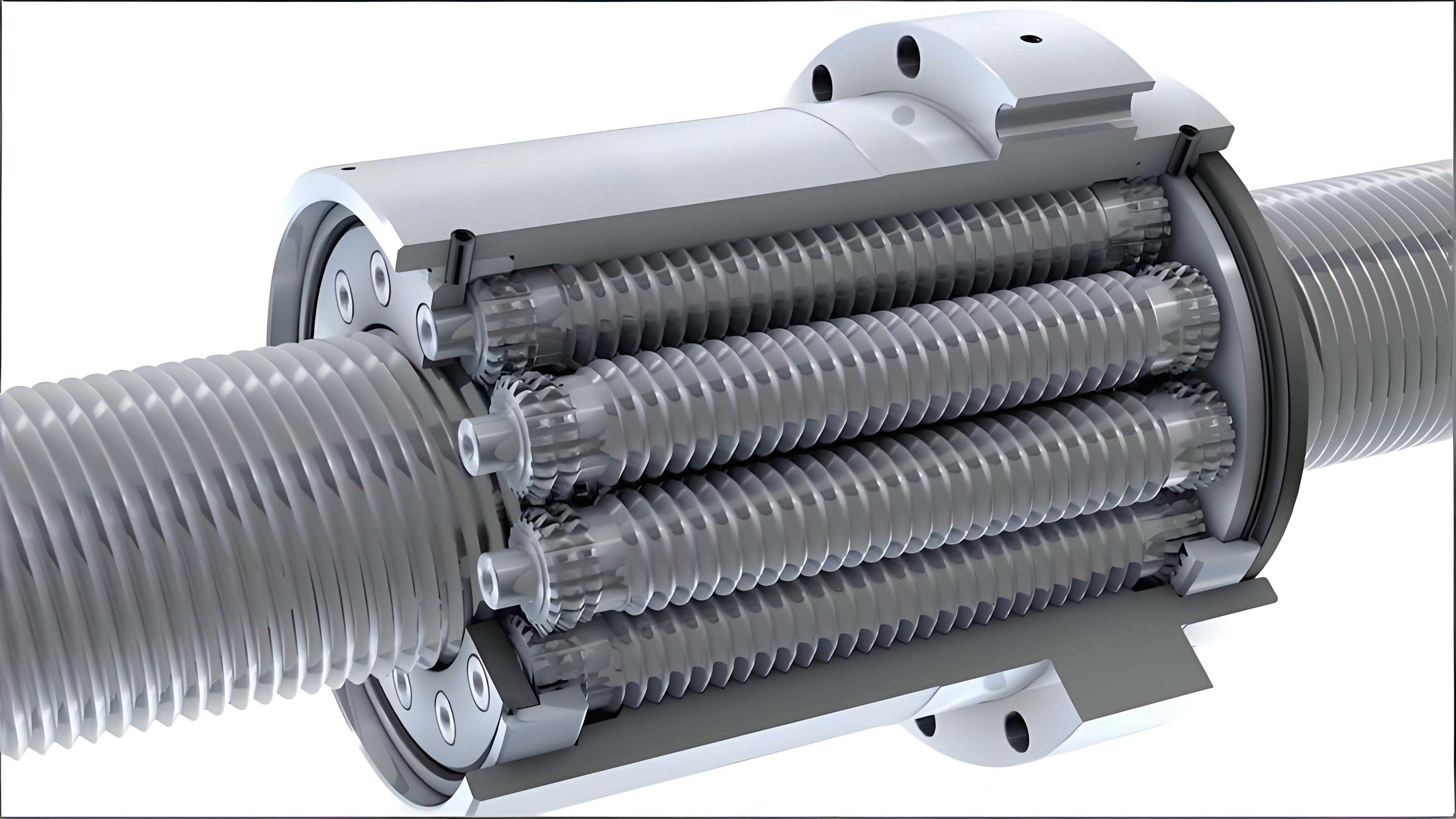
The planetary roller screw assembly consists of several key components: a central screw, multiple threaded rollers, a nut, and an internal gear ring. The screw rotates around its axis, driving the rollers through frictional contact. The rollers, in turn, revolve around the screw axis (planet motion) while rotating about their own axes (spin motion), and they translate axially along with the nut. The engagement between the roller end gears and the internal gear ring ensures pure rolling at the roller-nut interface, but the screw-roller interface exhibits a combination of rolling and sliding motions. This sliding introduces frictional resistance that impacts the overall efficiency and torque requirements, especially during transient phases like acceleration and deceleration. The complexity of the planetary roller screw assembly arises from the kinematic interactions and contact mechanics at the threaded interfaces, which necessitate a detailed analysis to predict dynamic behavior accurately.
To model the dynamics of a planetary roller screw assembly, it is crucial to first establish the kinematic relationships among its components. Consider an inertial coordinate system \( O[0; x, y, z] \) fixed in space, with a moving coordinate system \( O_s[O_s; x_s, y_s, z_s] \) attached to the screw, and another moving system \( O_r[O_r; x_r, y_r, z_r] \) attached to a roller. The screw rotates about the \( z \)-axis by an angle \( \theta_s \), the rollers revolve around the screw axis by an angle \( \theta_R \), and each roller spins about its own axis by an angle \( \theta_r \). Simultaneously, the rollers and nut translate axially by a distance \( L \). The initial contact point between the screw and a roller is denoted as \( P_0 \), which moves to \( P \) after the described motions. The thread leads on the screw and rollers are identical in hand and angle, but due to geometric offsets, the actual contact points deviate from the axial planes, leading to relative sliding velocities that must be quantified.
The relative sliding velocity at the screw-roller thread contact point is derived from the parametric equations of the contact helices. For the screw, with actual contact radius \( r_s \), contact offset angle \( \theta_{sc} \), and helix parameter \( p_s = \frac{p}{2\pi} \) (where \( p \) is the pitch and \( z_s \) is the number of screw threads), the position vector of a point on the screw thread in the inertial frame is given by:
$$ \mathbf{r}_s = \begin{bmatrix} r_s \cos(\theta_R + \theta_{sc}) \\ r_s \sin(\theta_R + \theta_{sc}) \\ p_s \theta_s \end{bmatrix} $$
Differentiating with respect to time \( t \) and substituting \( \dot{\theta}_s \) for the screw angular velocity, the linear velocity of point \( P \) on the screw is:
$$ \mathbf{v}_s = \begin{bmatrix} -r_s \dot{\theta}_s \sin(\theta_R + \theta_{sc}) \\ r_s \dot{\theta}_s \cos(\theta_R + \theta_{sc}) \\ 0 \end{bmatrix} $$
For a roller, with actual contact radius \( r_r \), contact offset angle \( \theta_{rc} \), and helix parameter \( p_r = \frac{p}{2\pi} \) (where \( z_r \) is the number of roller threads), the position vector in the inertial frame is:
$$ \mathbf{r}_r = \begin{bmatrix} r_r \cos(\theta_r + \theta_{rc}) + (r_{s0} + r_{r0}) \cos \theta_R \\ r_r \sin(\theta_r + \theta_{rc}) + (r_{s0} + r_{r0}) \sin \theta_R \\ p_r \theta_r + L \end{bmatrix} $$
where \( r_{s0} \) and \( r_{r0} \) are the nominal contact radii of the screw and roller, respectively, and \( L = -p_s \theta_s \) due to the axial motion relationship. Differentiating and incorporating \( \dot{\theta}_r = G \dot{\theta}_R \) (with \( G = -\frac{r_{n0} – r_{r0}}{r_{r0}} \), where \( r_{n0} \) is the nut thread nominal radius) from the gear engagement condition, the linear velocity of point \( P \) on the roller is:
$$ \mathbf{v}_r = \begin{bmatrix} -r_r G \dot{\theta}_R \sin(\theta_R – \theta_{rc}) – (r_{s0} + r_{r0}) \dot{\theta}_R \sin \theta_R \\ r_r G \dot{\theta}_R \cos(\theta_R – \theta_{rc}) + (r_{s0} + r_{r0}) \dot{\theta}_R \cos \theta_R \\ -p_s \dot{\theta}_s \end{bmatrix} $$
The relative sliding velocity \( \mathbf{v}_{sr} = \mathbf{v}_s – \mathbf{v}_r \) is then expressed as:
$$ \mathbf{v}_{sr} = \begin{bmatrix} -r_s \dot{\theta}_s \sin(\theta_R + \theta_{sc}) – r_r G \dot{\theta}_R \sin(\theta_R – \theta_{rc}) + (r_{s0} + r_{r0}) \dot{\theta}_R \sin \theta_R \\ r_s \dot{\theta}_s \cos(\theta_R + \theta_{sc}) + r_r G \dot{\theta}_R \cos(\theta_R – \theta_{rc}) – (r_{s0} + r_{r0}) \dot{\theta}_R \cos \theta_R \\ p_s \dot{\theta}_s \end{bmatrix} $$
At the initial contact point \( P_0 \) where \( \theta_R = 0 \), this simplifies to:
$$ \mathbf{v}_{sr0} = \begin{bmatrix} -r_s \dot{\theta}_s \sin \theta_{sc} + r_r G \dot{\theta}_R \sin \theta_{rc} \\ r_s \dot{\theta}_s \cos \theta_{sc} + r_r G \dot{\theta}_R \cos \theta_{rc} – (r_{s0} + r_{r0}) \dot{\theta}_R \\ p_s \dot{\theta}_s \end{bmatrix} $$
This relative sliding velocity is fundamental in determining the frictional forces within the planetary roller screw assembly, as it directly influences lubricant shear and sliding friction at the contact interfaces.
The frictional resistance in a planetary roller screw assembly originates from three primary sources: lubricant viscous drag, Coulomb friction due to roller spin sliding, and friction torque from differential sliding caused by surface deformation at thread contacts. Each component contributes uniquely to the overall dynamic friction torque, especially during non-steady-state operations where velocities and loads vary rapidly.
First, the lubricant viscous drag force \( \mathbf{F}_{fs1} \) opposes the relative sliding motion and is proportional to the sliding velocity. For an assembly with \( n_R \) rollers and \( n_t \) thread pitches per roller, this force is modeled as:
$$ \mathbf{F}_{fs1} = \mu_1 n_R n_t \mathbf{v}_{sr0} $$
where \( \mu_1 \) is the viscous friction coefficient. This component is velocity-dependent and becomes significant during high-speed or accelerated motions in the planetary roller screw assembly.
Second, the roller spin sliding induces Coulomb friction due to the misalignment between the roller axis and the thread force direction. The normal force \( F_{nf} \) at a screw-roller contact point can be resolved into axial, radial, and tangential components based on the thread geometry. For a screw with thread flank angle \( \beta_s \) and contact lead angle \( \psi_s \), the forces are:
$$ F_{rf} = F_{nf} \cos \psi_s \sin \beta_s, \quad F_{af} = F_{nf} \cos \psi_s \cos \beta_s, \quad F_{tf} = F_{nf} \sin \psi_s $$
The total axial output force \( F_{out} \) from the nut is related to the sum of axial components from all contact points. Assuming uniformity across rollers and contact points, the normal force per contact point is:
$$ F_n = \frac{F_{out}}{n_R n_t \cos \psi_s \cos \beta_s} $$
The Coulomb friction force due to spin sliding is then:
$$ F_{fs2} = \mu_2 F_n = \mu_2 \frac{F_{out}}{n_R n_t \cos \psi_s \cos \beta_s} $$
where \( \mu_2 \) is the sliding friction coefficient. This force acts tangentially at the contact interface and contributes to the friction torque in the planetary roller screw assembly.
Third, the differential sliding friction torque arises from the elliptical contact patch deformation under normal load, where velocity gradients cause micro-slip. The torque \( M_{fs3} \) is given by:
$$ M_{fs3} = -\frac{3 \pi \mu_3 a}{16} \left( \frac{2}{d_s} + \frac{2}{d_r} \right) (\kappa^2 + 1)^2 F_n $$
Here, \( a \) is the contact ellipse semi-major axis, \( d_s \) and \( d_r \) are the screw and roller thread contact diameters, \( \kappa \) is the ellipticity ratio, and \( \mu_3 \) is a coefficient typically on the order of \( 10^{-6} \, \text{m} \) when forces are in Newtons and torque in Newton-meters. For simplicity, this is often expressed as \( M_{fs3} = -\mu_3 F_n \), where \( \mu_3 \) encapsulates the geometric and material constants. This torque is load-dependent but independent of sliding velocity, making it a constant contributor during loaded operations of the planetary roller screw assembly.
The total friction torque on the screw is the sum of contributions from these sources, projected along the screw axis. The generalized forces are derived for inclusion in the dynamic model, which is essential for predicting the behavior of the planetary roller screw assembly under varying conditions.
To capture the dynamic response of the planetary roller screw assembly, a Lagrangian approach is employed to derive the equations of motion. The system’s kinetic energy is computed considering the screw rotation, roller spin and revolution, nut translation, and carrier motion. Assumptions include identical roller masses and moments of inertia, symmetric loading, and negligible gravitational and elastic potential energy variations. The kinetic energies are as follows:
- Screw (rotation only): \( T_s = \frac{1}{2} I_s \dot{\theta}_s^2 \)
- Nut (translation only): \( T_N = \frac{1}{2} m_N ( -p_s \dot{\theta}_s )^2 \)
- Roller (spin, revolution, and translation): \( T_R = \frac{1}{2} I_r \dot{\theta}_r^2 + \frac{1}{2} m_R \left[ (r_{s0} + r_{r0})^2 \dot{\theta}_R^2 + (-p_s \dot{\theta}_s)^2 \right] \)
- Carrier (revolution and translation): \( T_C = \frac{1}{2} I_c \dot{\theta}_R^2 + \frac{1}{2} m_c (-p_s \dot{\theta}_s)^2 \)
The total kinetic energy \( T_{\text{total}} \) is the sum for all components. With \( n_R \) rollers and two carriers (typical in assemblies), and substituting \( \dot{\theta}_r = G \dot{\theta}_R \), the Lagrangian \( \mathcal{L} = T_{\text{total}} \) (potential energy neglected) is expressed in terms of generalized coordinates \( \theta_s \) and \( \theta_R \):
$$ \mathcal{L} = \frac{1}{2} \left[ I_s + (m_N + n_R m_R + 2 m_c) p_s^2 \right] \dot{\theta}_s^2 + \frac{1}{2} \left[ n_R I_r G^2 + 2 I_c + n_R m_R (r_{s0} + r_{r0})^2 \right] \dot{\theta}_R^2 $$
The generalized forces corresponding to \( \theta_s \) and \( \theta_R \) are derived from the virtual work done by input torque \( T_{in} \) on the screw, output axial force \( F_{out} \) on the nut, and the frictional forces. For a virtual displacement \( \delta \theta_s \), the work is:
$$ \delta W = ( \mathbf{F}_{fs1} + \mathbf{F}_{fs2} ) \cdot \frac{\partial \mathbf{v}_{sr0}}{\partial \dot{\theta}_s} \delta \theta_s + M_{fs3} \delta \theta_s + T_{in} \delta \theta_s – F_{out} p_s \delta \theta_s $$
Thus, the generalized force for \( \theta_s \) is:
$$ Q_s = ( \mathbf{F}_{fs1} + \mathbf{F}_{fs2} ) \cdot \frac{\partial \mathbf{v}_{sr0}}{\partial \dot{\theta}_s} + M_{fs3} + T_{in} – F_{out} p_s $$
Similarly, for \( \theta_R \), considering the roller equilibrium, the generalized force is:
$$ Q_R = ( \mathbf{F}_{fs1} + \mathbf{F}_{fs2} ) \cdot \frac{\partial \mathbf{v}_{sr0}}{\partial \dot{\theta}_R} $$
Applying the Lagrange equations:
$$ \frac{d}{dt} \left( \frac{\partial \mathcal{L}}{\partial \dot{\theta}_s} \right) – \frac{\partial \mathcal{L}}{\partial \theta_s} = Q_s, \quad \frac{d}{dt} \left( \frac{\partial \mathcal{L}}{\partial \dot{\theta}_R} \right) – \frac{\partial \mathcal{L}}{\partial \theta_R} = Q_R $$
yields a set of coupled differential equations that describe the dynamic behavior of the planetary roller screw assembly. These equations can be solved numerically to obtain the time-varying angular velocities, friction torque, and transmission efficiency under specified operating conditions.
The transmission efficiency of the planetary roller screw assembly is a key performance metric. The instantaneous efficiency \( \eta(t) \) at time \( t \) is defined as the ratio of output power to input power:
$$ \eta(t) = \frac{P_{out}(t)}{P_{in}(t)} = \frac{F_{out} \cdot p_s \cdot \dot{\theta}_s(t)}{T_{in}(t) \cdot \dot{\theta}_s(t)} = \frac{F_{out} p_s}{T_{in}(t)} $$
where \( T_{in}(t) \) is the dynamic input torque from the solved model. The overall efficiency \( \eta_{\text{overall}} \) over a time interval \( [t_0, t_1] \) is computed from the total work done:
$$ \eta_{\text{overall}} = \frac{\int_{t_0}^{t_1} P_{out}(t) \, dt}{\int_{t_0}^{t_1} P_{in}(t) \, dt} = \frac{\int_{t_0}^{t_1} F_{out} p_s \dot{\theta}_s(t) \, dt}{\int_{t_0}^{t_1} T_{in}(t) \dot{\theta}_s(t) \, dt} $$
This formulation allows for evaluating the planetary roller screw assembly’s performance under both steady-state and transient conditions, which is crucial for applications involving frequent starts, stops, or load changes.
To validate the dynamic model and analyze the effects of operational parameters, consider a typical planetary roller screw assembly with the following geometric and material properties:
| Parameter | Symbol | Value |
|---|---|---|
| Nominal screw thread radius | \( r_{s0} \) | 10 mm |
| Nominal roller thread radius | \( r_{r0} \) | 5 mm |
| Nominal nut thread radius | \( r_{n0} \) | 15 mm |
| Pitch | \( p \) | 5 mm |
| Number of screw threads | \( z_s \) | 1 |
| Number of rollers | \( n_R \) | 5 |
| Thread rounds per roller | \( n_t \) | 3 |
| Viscous friction coefficient | \( \mu_1 \) | 0.01 N·s/m |
| Sliding friction coefficient | \( \mu_2 \) | 0.1 |
| Rolling friction coefficient | \( \mu_3 \) | 1.5 × 10^{-6} m |
| Nut mass | \( m_N \) | 0.5 kg |
| Roller mass | \( m_R \) | 0.05 kg |
| Carrier mass | \( m_c \) | 0.1 kg |
| Screw mass | \( m_s \) | 0.8 kg |
| Flank angle | \( \beta_s \) | 45° |
Using these parameters, the dynamic model is solved for various scenarios to examine the influence of load and screw acceleration on friction torque and efficiency in the planetary roller screw assembly. The results provide insights into the assembly’s behavior under non-steady-state conditions.
The dynamic friction torque in a planetary roller screw assembly is highly dependent on the relative sliding velocity at thread contacts, which varies with screw speed and roller motions. During non-steady-state operations, such as acceleration phases, the friction torque peaks due to increased sliding velocities and inertial effects. The contributions from lubricant viscosity and spin sliding are particularly pronounced, while differential sliding torque remains relatively constant if the load is steady. For instance, when the screw accelerates from rest to a constant angular velocity, the friction torque exhibits a transient spike before settling to a steady-state value. This behavior underscores the importance of considering dynamic effects in the design and control of planetary roller screw assemblies for applications requiring rapid motion changes.
The load condition significantly impacts the friction dynamics and efficiency of the planetary roller screw assembly. Higher axial loads increase the normal forces at thread contacts, amplifying the Coulomb friction from spin sliding and the differential sliding torque. However, the viscous drag remains largely unaffected by load, as it depends on velocity. To quantify this, simulations are conducted for output axial forces \( F_{out} \) of 500 N, 1000 N, 3000 N, and 5000 N, with the screw accelerating linearly from 0 to 1 rad/s over 0.02 s and then maintaining constant speed. The dynamic friction torque profiles show that during acceleration, the torque rises sharply, with higher loads producing greater torque magnitudes. After acceleration, the torque decays to steady-state values, and the settling time shortens with increased load due to enhanced damping from higher frictional forces. This indicates that a planetary roller screw assembly operating under heavy loads reaches stable motion more quickly, which can be advantageous in high-load applications.
The instantaneous transmission efficiency during these simulations reveals that efficiency drops during acceleration due to elevated friction torque, then recovers as steady-state is approached. The overall efficiency over the entire cycle improves with higher loads, as the output work increases proportionally more than the frictional losses. This suggests that planetary roller screw assemblies are more efficient when operated near their rated load capacity, and light-load conditions should be avoided to maximize energy efficiency. Designers should therefore size the assembly appropriately for the application to ensure optimal performance.
Another critical factor is the screw acceleration time, which affects the inertial forces and transient friction in the planetary roller screw assembly. Shorter acceleration times imply higher angular accelerations, leading to greater relative sliding velocities and thus higher viscous and spin sliding friction. Simulations are performed for a constant load \( F_{out} = 1000 \, \text{N} \) and acceleration times of 0.01 s, 0.03 s, 0.06 s, and 0.09 s to reach 1 rad/s. The results demonstrate that shorter acceleration times yield higher peak friction torques but shorter transient durations. For example, with 0.01 s acceleration, the peak torque may be twice that for 0.09 s acceleration. However, the overall efficiency over the acceleration and steady-state period is higher for shorter acceleration times because the high-friction phase is brief, and the assembly spends more time in efficient steady-state operation. This trade-off between peak torque and efficiency must be balanced based on the drive system’s capability and thermal constraints in the planetary roller screw assembly.
The following table summarizes the effects of load and acceleration time on key performance metrics for the planetary roller screw assembly:
| Condition | Peak Friction Torque (Nm) | Steady-State Torque (Nm) | Instantaneous Min Efficiency (%) | Overall Efficiency (%) |
|---|---|---|---|---|
| \( F_{out} = 500 \, \text{N} \), \( t_{\text{acc}} = 0.02 \, \text{s} \) | 0.15 | 0.08 | 78.5 | 85.2 |
| \( F_{out} = 1000 \, \text{N} \), \( t_{\text{acc}} = 0.02 \, \text{s} \) | 0.25 | 0.12 | 76.8 | 87.1 |
| \( F_{out} = 3000 \, \text{N} \), \( t_{\text{acc}} = 0.02 \, \text{s} \) | 0.55 | 0.25 | 74.3 | 89.5 |
| \( F_{out} = 5000 \, \text{N} \), \( t_{\text{acc}} = 0.02 \, \text{s} \) | 0.85 | 0.40 | 72.1 | 91.0 |
| \( F_{out} = 1000 \, \text{N} \), \( t_{\text{acc}} = 0.01 \, \text{s} \) | 0.40 | 0.12 | 70.5 | 88.9 |
| \( F_{out} = 1000 \, \text{N} \), \( t_{\text{acc}} = 0.03 \, \text{s} \) | 0.20 | 0.12 | 79.2 | 87.5 |
| \( F_{out} = 1000 \, \text{N} \), \( t_{\text{acc}} = 0.06 \, \text{s} \) | 0.15 | 0.12 | 84.1 | 86.8 |
| \( F_{out} = 1000 \, \text{N} \), \( t_{\text{acc}} = 0.09 \, \text{s} \) | 0.13 | 0.12 | 87.8 | 86.2 |
These results highlight that optimizing a planetary roller screw assembly for specific operational scenarios involves balancing load and acceleration parameters to minimize friction losses and maximize efficiency.
In practical applications, the planetary roller screw assembly often undergoes cyclic motions with frequent accelerations and decelerations, such as in robotic arms or aircraft control surfaces. The dynamic model presented here can be extended to include more complex motion profiles and environmental factors like temperature variations, which affect lubricant viscosity and material properties. Additionally, the wear and longevity of the assembly are influenced by the friction dynamics; high transient torques may lead to increased wear at thread contacts, reducing service life. Therefore, incorporating wear models into the dynamic analysis could further enhance the predictive capability for the planetary roller screw assembly’s performance over time.
Future research directions for planetary roller screw assemblies could focus on advanced lubrication strategies, such as solid lubricants or nanofluids, to reduce viscous drag and sliding friction. Moreover, real-time monitoring of friction torque via sensors could enable adaptive control algorithms to optimize efficiency and prevent damage during operation. The integration of smart materials or surface coatings might also mitigate frictional losses in high-speed planetary roller screw assemblies. As these assemblies become more prevalent in precision engineering, continued innovation in modeling and materials will drive their evolution toward higher efficiency and reliability.
In conclusion, the dynamic friction torque and transmission efficiency of a planetary roller screw assembly are governed by a complex interplay of kinematic, load, and acceleration factors. The developed Lagrangian-based dynamic model, incorporating lubricant viscous drag, spin sliding Coulomb friction, and differential sliding torque, provides a robust framework for analyzing non-steady-state behavior. Key findings indicate that friction torque increases with relative sliding velocity, with lubricant viscosity and spin sliding being dominant during transients. Higher loads improve overall efficiency but raise torque demands, while shorter acceleration times enhance efficiency despite higher peak torques. These insights guide the design and operation of planetary roller screw assemblies for optimal performance in demanding applications. Engineers should prioritize load matching and controlled acceleration profiles to harness the full potential of this advanced motion control technology.