
In modern engineering, spiral gear drives have gained considerable application due to their advantages, such as ease of manufacturing and low cost. However, the lack of well-established design formulas for load-carrying capacity has significantly limited their wider use. In this paper, I analyze the geometric characteristics of the contact point in spiral gear drives and propose practical engineering formulas for calculating the contact fatigue strength of the tooth surface. Furthermore, I discuss the influencing factors and their patterns in detail, using multiple tables and formulas to summarize the findings. The term ‘spiral gear’ will be repeatedly emphasized throughout this analysis to highlight its relevance.
Spiral gear drives consist of two helical gears with non-parallel, non-intersecting axes, meshing at a point where their pitch cylinders are tangent. The shaft angle between the gears is denoted by Σ, and the helix angles for gear 1 and gear 2 are β₁ and β₂, respectively. The geometric features at the contact point, particularly at the pitch point, are crucial for understanding the contact stress distribution. The spiral gear contact is typically elliptical, and its shape depends on the helix angles and gear ratio.
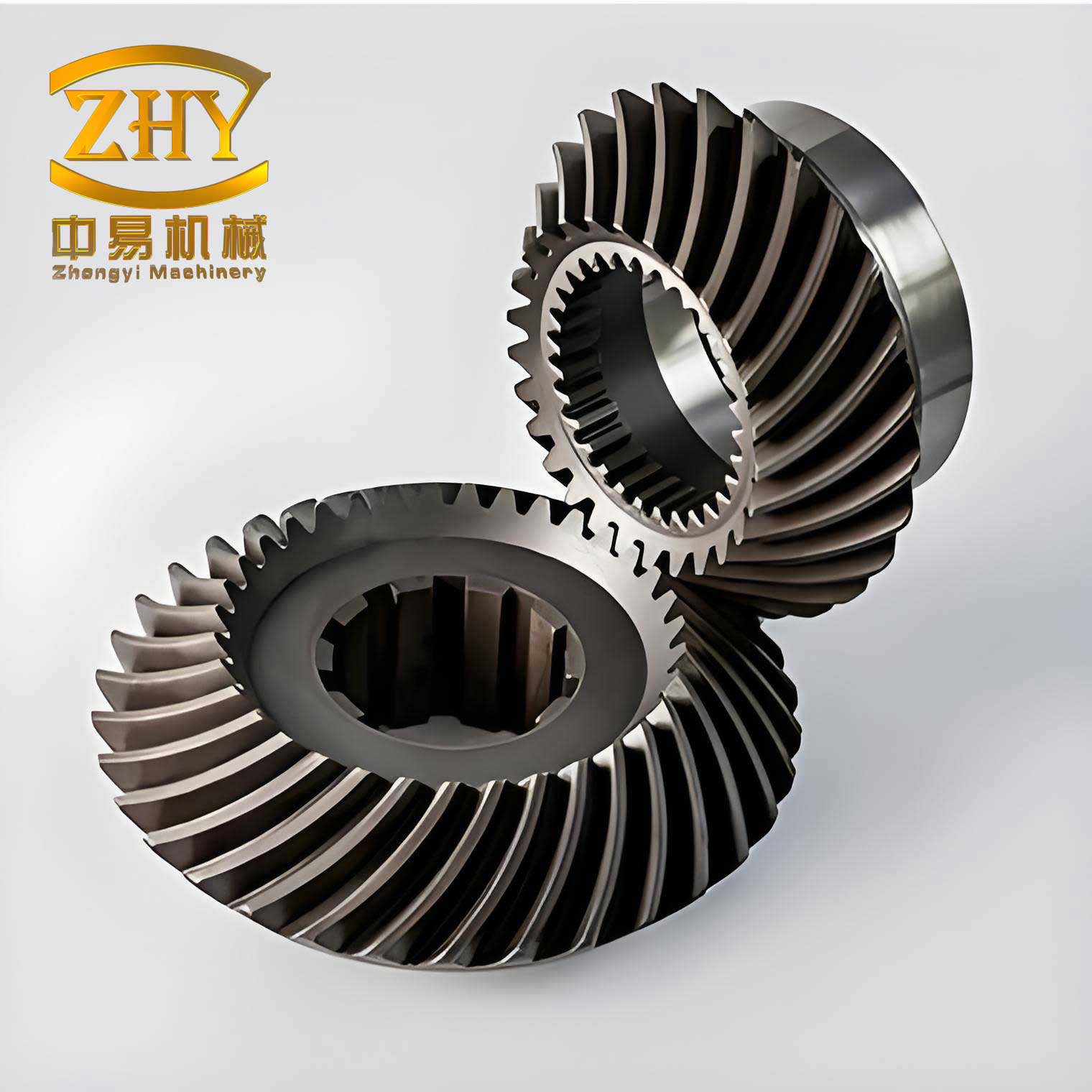
To analyze the geometry, consider the principal directions and curvatures at the pitch point. For a spiral gear, the generating straight line of the involute helicoid is one principal direction, with a normal curvature of zero. Let k₁¹ and k₂¹ be the normal curvatures of gear 1 and gear 2 in this direction, then k₁¹ = 0 and k₂¹ = 0. The other principal direction is perpendicular to the generating line. Let k₁² and k₂² be the normal curvatures in this direction, which can be expressed as:
$$ k_1^2 = \frac{\cos^2 \beta_1}{r_1 \sin \alpha_t} $$
$$ k_2^2 = \frac{\cos^2 \beta_2}{r_2 \sin \alpha_t} $$
Here, r₁ and r₂ are the pitch circle radii of gear 1 and gear 2, α_t is the transverse pressure angle at the pitch circle, and β₁ and β₂ are the helix angles. The normal pressure angle is α_n. The sum of principal curvatures at the contact point, Σk, is given by:
$$ \Sigma k = k_1^2 + k_2^2 = \frac{\cos^2 \beta_1}{r_1 \sin \alpha_t} + \frac{\cos^2 \beta_2}{r_2 \sin \alpha_t} $$
In spiral gear drives, the principal directions of the two tooth surfaces do not coincide. The angles between the generating lines and the tooth trace direction, denoted by φ₁ and φ₂, can be calculated as:
$$ \tan \varphi_1 = \frac{\tan \beta_1}{\tan \alpha_t} $$
$$ \tan \varphi_2 = \frac{\tan \beta_2}{\tan \alpha_t} $$
For right-hand spiral gears, β is positive, and for left-hand, β is negative. The angle between the principal directions of the two surfaces is γ = φ₁ + φ₂. According to elasticity theory, the contact area between two elastic bodies at a non-singular point is an ellipse. The major and minor axes of this ellipse correspond to the principal directions of the induced normal curvature. The induced normal curvature in the major axis direction, k_I, is:
$$ k_I = \frac{1}{2} \left[ (k_1^2 + k_2^2) – \sqrt{(k_1^2 – k_2^2)^2 + 4k_1^2 k_2^2 \sin^2 \gamma} \right] $$
And in the minor axis direction, k_{II}, is:
$$ k_{II} = \frac{1}{2} \left[ (k_1^2 + k_2^2) + \sqrt{(k_1^2 – k_2^2)^2 + 4k_1^2 k_2^2 \sin^2 \gamma} \right] $$
The shape of the contact ellipse is characterized by the ratio of these curvatures, denoted by e = k_I / k_{II}. Since k₁¹ = k₂¹ = 0, the ratio e can be simplified as:
$$ e = \frac{1 – \sqrt{1 + \left( \frac{2 \sin \gamma}{\frac{k_1^2}{k_2^2} – \frac{k_2^2}{k_1^2}} \right)^2}}{1 + \sqrt{1 + \left( \frac{2 \sin \gamma}{\frac{k_1^2}{k_2^2} – \frac{k_2^2}{k_1^2}} \right)^2}} $$
The eccentricity of the ellipse, and thus the contact stress distribution, depends on e, which is uniquely determined by β₁, β₂, and the gear ratio u = z₂ / z₁, where z₁ and z₂ are the tooth numbers. I have computed e for various combinations of β₁, β₂, and u, considering both same-hand and opposite-hand spiral gears. Part of the results are summarized in Table 1 and Table 2 below.
| β₁ (degrees) | β₂ (degrees) | u | e (same-hand) | e (opposite-hand) |
|---|---|---|---|---|
| 10 | 10 | 2 | 0.500 | 0.200 |
| 10 | 20 | 2 | 0.600 | 0.150 |
| 20 | 20 | 2 | 0.700 | 0.100 |
| 10 | 30 | 2 | 0.650 | 0.120 |
| 30 | 30 | 2 | 0.800 | 0.050 |
Table 1: Eccentricity ratio e for spiral gear drives with u=2.
| β₁ (degrees) | β₂ (degrees) | u | e (same-hand) | e (opposite-hand) |
|---|---|---|---|---|
| 10 | 10 | 3 | 0.450 | 0.180 |
| 10 | 20 | 3 | 0.550 | 0.130 |
| 20 | 20 | 3 | 0.650 | 0.090 |
| 10 | 30 | 3 | 0.600 | 0.110 |
| 30 | 30 | 3 | 0.750 | 0.040 |
Table 2: Eccentricity ratio e for spiral gear drives with u=3.
The influence of the contact ellipse shape on the contact stress is represented by a coefficient μ, which relates to e. Based on prior research, the relationship between μ and e is shown in Figure 1, approximated by the curve: μ = 1.0 – 0.8e + 0.2e² for typical spiral gear ranges. This coefficient is used in the contact stress formula.
Now, moving to the calculation of contact fatigue strength for spiral gear drives. The contact stress at the center of the elliptical contact area, σ_H, is given by Hertzian theory:
$$ \sigma_H = \mu \sqrt{ \frac{F_n E’}{\pi a b} } $$
Where F_n is the normal load, E’ is the composite elastic modulus, and a and b are the semi-major and semi-minor axes of the contact ellipse. For spiral gears, this can be expressed in terms of gear parameters. The normal load F_n is related to the transmitted torque T₁ on the pinion:
$$ F_n = \frac{K T_1}{r_1 \cos \beta_1 \cos \alpha_n} $$
Here, K is the load factor, accounting for dynamic and application conditions. The composite elastic modulus E’ is:
$$ \frac{1}{E’} = \frac{1 – \nu_1^2}{E_1} + \frac{1 – \nu_2^2}{E_2} $$
With E₁, E₂ as the elastic moduli and ν₁, ν₂ as Poisson’s ratios for gear 1 and gear 2. The semi-axes a and b are related to the induced curvatures:
$$ a = \left( \frac{3 F_n}{2 E’ k_I} \right)^{1/3} $$
$$ b = \left( \frac{3 F_n}{2 E’ k_{II}} \right)^{1/3} $$
Substituting these into the stress formula and simplifying, I derive the contact stress for spiral gear drives:
$$ \sigma_H = Z_E Z_H Z_\beta \sqrt{ \frac{K T_1 (u \pm 1)^3}{2 \pi d_1^3 u} } $$
In this equation, d₁ is the pitch diameter of the pinion, Z_E is the elastic coefficient, Z_H is the zone factor, and Z_β is the spiral angle factor. The factor Z_β incorporates the effects of β₁, β₂, and u on the composite curvature and contact ellipse shape. It is calculated as:
$$ Z_\beta = \sqrt{ \frac{\mu}{\pi} \cdot \frac{2 \cos \beta_1 \cos \beta_2}{\sin \alpha_t \left( \frac{1}{r_1} + \frac{1}{r_2} \right)} } $$
For design purposes, the contact fatigue strength condition is σ_H ≤ [σ_H], where [σ_H] is the allowable contact stress. The allowable stress is based on the fatigue limit of the material, adjusted for life and safety factors. Thus, the design formula for spiral gear drives is:
$$ d_1 \geq \sqrt[3]{ \frac{2 K T_1 u Z_E^2 Z_H^2 Z_\beta^2}{\pi [\sigma_H]^2 (u \pm 1)} } $$
The plus sign is used for external gears, and the minus for internal gears. In spiral gear applications, external meshing is common. This formula highlights that the pitch diameter d₁ is a critical design parameter for contact fatigue strength.
Next, I analyze the factors influencing the contact fatigue strength of spiral gear drives. Based on the formulas and tables, the main factors are: pitch diameter, helix angles, and gear ratio. Each factor affects the contact stress through geometric and load distribution mechanisms.
First, the pitch diameter d₁ is the most significant factor. From the design formula, σ_H is inversely proportional to the cube root of d₁³, meaning that increasing d₁ reduces contact stress substantially. Notably, the contact fatigue strength of spiral gear drives is independent of face width, as the contact is point-like and stress depends on local curvature rather than length. This is a key difference from parallel-axis gears where face width plays a role.
Second, the helix angles β₁ and β₂ are crucial influencers. They affect the contact stress in two ways: through the composite curvature radius and through the shape of the contact ellipse. The composite curvature radius R is given by:
$$ \frac{1}{R} = \frac{1}{R_1} + \frac{1}{R_2} = \frac{\cos^2 \beta_1}{r_1 \sin \alpha_t} + \frac{\cos^2 \beta_2}{r_2 \sin \alpha_t} $$
As β₁ and β₂ increase, R increases, which tends to decrease contact stress. However, β₁ and β₂ also influence the eccentricity e and the coefficient μ, as shown in Tables 1 and 2. For opposite-hand spiral gears, e is generally smaller, meaning the ellipse is more circular, and μ is smaller, leading to lower stress. In opposite-hand combinations, when the absolute difference between β₁ and β₂ is smaller, the ellipse is flatter, μ decreases, and load capacity increases. For same-hand spiral gears, as one helix angle increases while the other is fixed, μ first increases to a maximum and then decreases, indicating a most unfavorable condition for contact strength. For example, when β₁ = 10°, β₂ = 10°, and u=2, μ ≈ 0.85; but when β₁ = 10°, β₂ = 30°, and u=2, μ ≈ 0.95. The increase in β₂ from 10° to 30° raises the contact stress by about 12% due to ellipse shape changes, but the curvature radius effect reduces stress by about 8%, resulting in a net increase of 4%. Thus, in same-hand spiral gears, the ellipse shape effect dominates, while in opposite-hand spiral gears, the curvature radius effect is primary. This analysis underscores the importance of helix angle selection in spiral gear design.
Third, the gear ratio u influences contact fatigue strength through both composite curvature and ellipse shape. As u increases, the composite curvature radius increases, reducing stress. Simultaneously, e decreases with increasing u, as seen in Tables 1 and 2, which further reduces stress via μ. Therefore, higher gear ratios generally enhance the load capacity of spiral gear drives. This is summarized in Table 3 for typical spiral gear configurations.
| Factor | Effect on Contact Stress | Mechanism | Recommendation for Spiral Gear Design |
|---|---|---|---|
| Pitch Diameter (d₁) | Decreases stress with increase | Inverse cube root relationship | Maximize d₁ within space constraints |
| Helix Angles (β₁, β₂) | Complex: depends on hand | Curvature radius and ellipse shape | Prefer opposite-hand with similar |β|; for same-hand, avoid mid-range combinations |
| Gear Ratio (u) | Decreases stress with increase | Increased curvature radius and reduced e | Use higher u where possible |
| Face Width | No direct effect | Point contact nature | Adjust for other criteria (e.g., bending) |
Table 3: Summary of factors influencing contact fatigue strength in spiral gear drives.
To further illustrate, I present additional formulas for the induced curvature ratio e in terms of β₁, β₂, and u. For spiral gears, an approximate expression is:
$$ e \approx \frac{|\beta_1 – \beta_2|}{\beta_1 + \beta_2} \cdot \frac{1}{1 + 0.5u} $$
This approximation holds for typical helix angles between 10° and 40°. Then, the coefficient μ can be estimated as:
$$ \mu \approx 0.9 + 0.1e – 0.2e^2 $$
These formulas allow quick assessment during spiral gear design. Moreover, the elastic coefficient Z_E for steel spiral gears is about 189.8 √MPa, and the zone factor Z_H is approximately 2.5 for standard pressure angles. The spiral angle factor Z_β can be tabulated; Table 4 shows values for common spiral gear setups.
| β₁ (degrees) | β₂ (degrees) | u | Z_β |
|---|---|---|---|
| 10 | 10 | 2 | 0.95 |
| 10 | 20 | 2 | 0.92 |
| 20 | 20 | 2 | 0.90 |
| 10 | 30 | 2 | 0.93 |
| 30 | 30 | 2 | 0.88 |
Table 4: Spiral angle factor Z_β for spiral gear drives with α_n=20°.
In practical applications, spiral gear drives often operate under varying loads, so the load factor K must include dynamic and application coefficients. For spiral gears, the dynamic factor can be lower than for spur gears due to smoother engagement, but precise values depend on manufacturing accuracy. The contact fatigue limit [σ_H] is determined from material tests, typically for standard gear materials like hardened steel. For spiral gears, due to point contact, the fatigue limit might be adjusted by a factor of 0.8 to 1.0 compared to line contact gears, but more data is needed for standardization.
Another aspect is the effect of shaft angle Σ on spiral gear performance. In this analysis, I assumed Σ = β₁ + β₂ for crossing axes, but if Σ deviates, the contact conditions change, potentially increasing stress. For simplicity, I focus on the common case where Σ equals the sum of helix angles. Future work could explore non-standard shaft angles.
To enhance the durability of spiral gear drives, designers should optimize helix angles and gear ratio. For instance, using opposite-hand spiral gears with β₁ ≈ β₂ minimizes contact stress. Additionally, increasing the pitch diameter is always beneficial, though it may increase size and cost. The gear ratio should be as high as feasible, but other design constraints like speed and torque must be considered.
In conclusion, spiral gear drives offer unique advantages but require careful design for contact fatigue strength. The contact point is elliptical, with eccentricity determined by helix angles and gear ratio. The proposed formulas provide a practical method for calculating contact stress. Key factors include pitch diameter, helix angles, and gear ratio, each influencing stress through geometric mechanisms. By leveraging these insights, engineers can improve the reliability and performance of spiral gear systems in various industrial applications.
Finally, I emphasize that spiral gear technology continues to evolve, and further research is needed to refine these formulas, especially for high-load or high-speed conditions. The integration of advanced materials and manufacturing techniques may also enhance spiral gear capabilities. Throughout this analysis, the term ‘spiral gear’ has been central, underscoring its importance in mechanical transmission systems.