
In modern mechanical engineering, hyperboloid gears play a critical role due to their high load-bearing capacity and ability to transmit power between crossed axes, making them indispensable in automotive, aerospace, and marine applications. Traditional machining methods, such as hobbing or cutting, often fall short in terms of efficiency and material utilization, leading to increased interest in advanced near-net-shape manufacturing techniques. Among these, hot rolling has emerged as a promising green manufacturing process for hyperboloid gears, as it involves plastic deformation to form gear teeth without significant material waste. However, the complex forming mechanism during hot rolling of hyperboloid gears can lead to defects like “lugs,” which adversely affect gear quality and performance. In this study, I delve into a comprehensive analysis of forming defects, particularly lugs, and explore the optimal process settings for hot rolling of hyperboloid gear pinions. Through numerical simulations and experimental validation, I aim to establish guidelines for minimizing defects and enhancing forming quality, with a focus on key parameters such as rotational speed, feed rate, friction coefficient, and temperature. The insights gained here are intended to advance the industrial application of hot rolling for hyperboloid gears, ensuring higher precision and reliability in gear manufacturing.
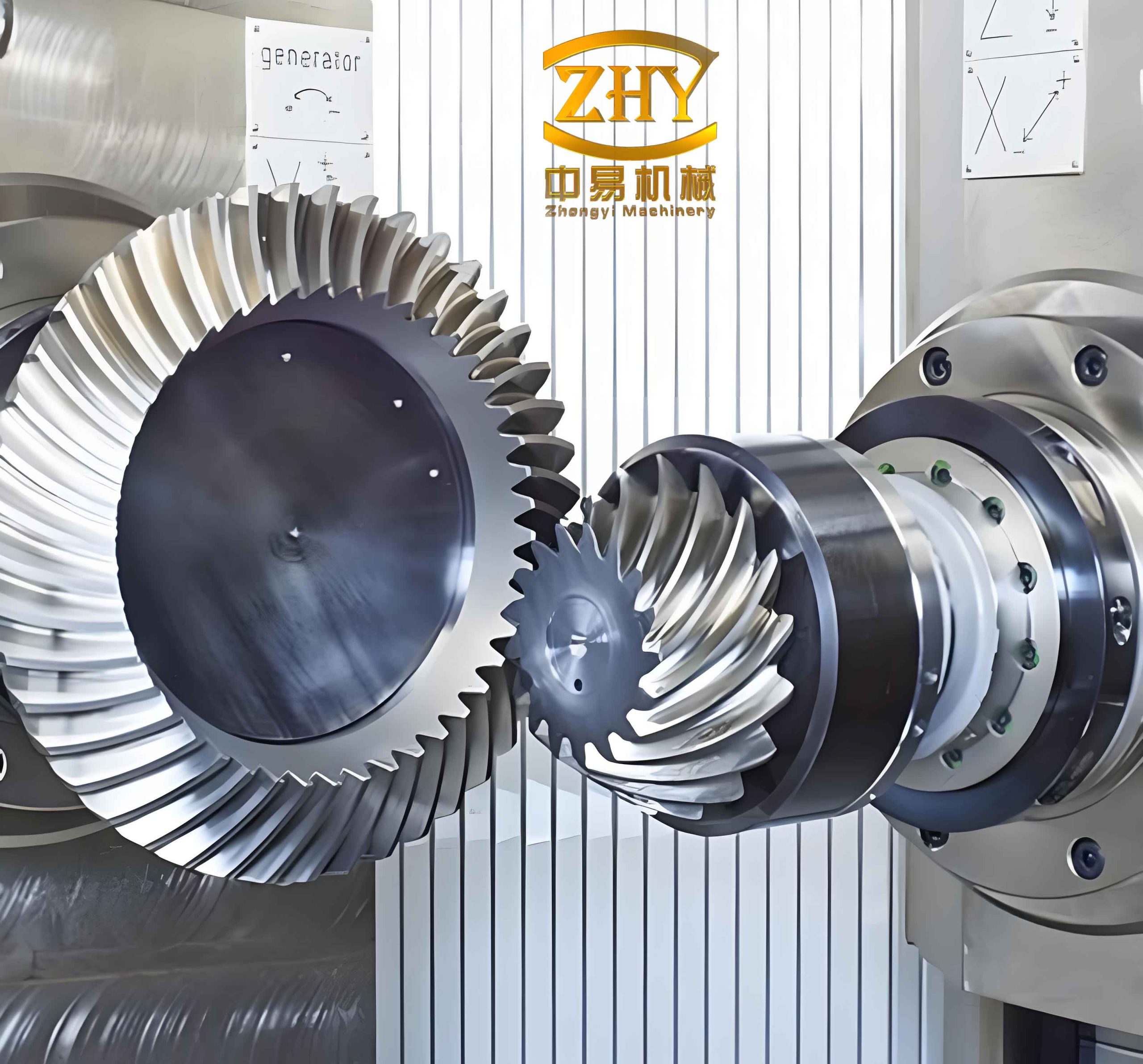
The hot rolling process for hyperboloid gears involves the plastic deformation of a heated gear blank using a rotating mold gear, which progressively impresses the tooth profile onto the blank. This process can be divided into three stages: initial contact, feed-in, and finishing. During the initial stage, minimal metal flow occurs on the blank’s surface. As the mold gear advances, the rolling force increases, and when the stress exceeds the material’s yield limit, protrusions and grooves corresponding to the tooth count form on the blank. In the feed-in stage, metal flow propagates from the surface toward the core, but due to the denser core material, metal from the grooves is forced into the protrusions to form the teeth, eventually filling the entire tooth cavity. The finishing stage involves a full rotation of the mold gear to ensure uniform tooth depth and shape across the hyperboloid gear. Despite this systematic approach, defects like lugs often arise, characterized by uneven material rise on one side of the tooth groove, leading to folding or incomplete filling. These lugs are primarily attributed to improper mold geometry or rotational speed settings, causing asymmetric material flow. To mitigate this, I propose a strategy involving alternating forward and reverse rotations during rolling, which helps balance material redistribution and suppress lug formation. The formation of lugs can be modeled using plasticity theory, where the material flow velocity $v_f$ is expressed as a function of the mold speed $\omega_m$ and feed rate $v_f$:
$$ v_f = k \cdot \omega_m \cdot v_f \cdot \exp\left(-\frac{Q}{RT}\right) $$
Here, $k$ is a material constant, $Q$ is the activation energy for deformation, $R$ is the gas constant, and $T$ is the absolute temperature. This equation highlights how temperature and process parameters influence flow, with imbalances leading to defects. By analyzing the lug formation through finite element simulations, I observed that without reversal, lugs grow continuously, eventually covering the tooth tip and causing folds; with reversal, bilateral lug growth promotes a balanced crown formation, resulting in a defect-free hyperboloid gear tooth profile.
To systematically investigate the hot rolling process for hyperboloid gears, I focus on four key process parameters: mold rotational speed, feed rate, friction coefficient, and initial temperature. Each parameter significantly impacts forming quality, and I employ a control variable method to isolate their effects. Below, I present a detailed breakdown of each parameter’s role, supported by tables and formulas to summarize the findings.
First, the mold rotational speed $\omega_m$ determines the rate at which the mold gear engages with the blank. Higher speeds can enhance productivity but may increase thermal effects and load. I consider speeds of 30, 50, 70, and 90 rpm, with corresponding self-rotation speeds calculated based on gear ratio. The influence on forming targets is quantified through simulations, as shown in Table 1.
| Rotational Speed (rpm) | Forming Load (kN) | Equivalent Strain at Node P1 (mm/mm) | Displacement at Node P1 (mm) | Temperature Drop (°C) |
|---|---|---|---|---|
| 30 | 85.2 | 18.5 | 2.1 | 25 |
| 50 | 92.7 | 20.3 | 2.4 | 30 |
| 70 | 98.5 | 22.1 | 2.7 | 35 |
| 90 | 105.3 | 24.0 | 3.0 | 40 |
The data indicates that as speed increases, forming load, strain, displacement, and temperature drop all rise, with a speed of 70 rpm offering a balance between efficiency and load capacity for hyperboloid gears. The relationship can be expressed as:
$$ F_L = a \cdot \omega_m + b $$
$$ \epsilon_{eq} = c \cdot \omega_m + d $$
where $F_L$ is the forming load, $\epsilon_{eq}$ is the equivalent strain, and $a, b, c, d$ are constants derived from regression analysis.
Second, the feed rate $v_f$, defined as the advance per revolution of the mold, affects the penetration depth and material flow uniformity. I test feed rates of 0.7, 0.8, 0.9, and 1.0 mm/r. Table 2 summarizes the effects on key targets.
| Feed Rate (mm/r) | Forming Load (kN) | Equivalent Strain at Node P1 (mm/mm) | Displacement at Node P1 (mm) | Temperature Fluctuation (°C) |
|---|---|---|---|---|
| 0.7 | 95.0 | 21.0 | 2.5 | 15 |
| 0.8 | 100.2 | 22.5 | 2.8 | 18 |
| 0.9 | 106.5 | 24.2 | 3.1 | 22 |
| 1.0 | 112.8 | 26.0 | 3.4 | 25 |
Higher feed rates increase all metrics, but beyond 0.7 mm/r, strain approaches critical levels where cracking may occur in hyperboloid gears. Thus, a feed rate of 0.7 mm/r is optimal to maintain quality while avoiding defects. The strain relationship is:
$$ \epsilon_{eq} = \alpha \cdot v_f + \beta $$
with $\alpha$ and $\beta$ as material-specific coefficients.
Third, the friction coefficient $\mu$ plays a crucial role in material flow and heat generation, influenced by lubrication conditions. Based on typical hot rolling lubricants, I evaluate $\mu = 0.3$ (5% graphite water), 0.35 (5% soap water), 0.4 (water), and 0.45 (no lubricant). Table 3 outlines the impacts.
| Friction Coefficient | Forming Load (kN) | Equivalent Stress at Node P1 (MPa) | Displacement at Node P1 (mm) | Temperature Amplitude (°C) |
|---|---|---|---|---|
| 0.3 | 96.5 | 250 | 2.6 | 10 |
| 0.35 | 99.8 | 265 | 2.7 | 12 |
| 0.4 | 103.2 | 280 | 2.9 | 15 |
| 0.45 | 107.5 | 300 | 3.0 | 18 |
Lower friction reduces load and stress, with $\mu = 0.3$ providing the best lubrication for hyperboloid gears, minimizing temperature swings and promoting even flow. The frictional force $F_f$ can be modeled as:
$$ F_f = \mu \cdot F_N $$
where $F_N$ is the normal force, and its effect on overall load is additive.
Fourth, the initial heating temperature $T_0$ of the gear blank significantly affects material plasticity and flow stress. I explore temperatures of 950, 1000, 1050, and 1100°C, with results in Table 4.
| Temperature (°C) | Forming Load (kN) | Equivalent Strain at Node P1 (mm/mm) | Displacement at Node P1 (mm) | Temperature Decay (°C) |
|---|---|---|---|---|
| 950 | 98.0 | 21.5 | 2.6 | 30 |
| 1000 | 92.5 | 22.8 | 2.9 | 35 |
| 1050 | 87.0 | 24.2 | 3.2 | 40 |
| 1100 | 81.5 | 25.7 | 3.5 | 45 |
Higher temperatures lower forming load but increase strain and displacement due to enhanced ductility; 950°C is chosen to prevent excessive deformation in hyperboloid gears while maintaining sufficient formability. The temperature dependence of flow stress $\sigma_f$ follows an Arrhenius-type equation:
$$ \sigma_f = C \cdot \exp\left(\frac{Q}{RT}\right) \cdot \epsilon^n $$
where $C$ is a constant, $n$ is the strain-hardening exponent, and $\epsilon$ is the strain rate.
To integrate these parameters, I use a control variable approach, where each factor is varied while others are held constant, as summarized in Table 5, which outlines the experimental design for hyperboloid gear hot rolling.
| Factor | Level 1 | Level 2 | Level 3 | Level 4 |
|---|---|---|---|---|
| Rotational Speed (rpm) | 30 | 50 | 70 | 90 |
| Feed Rate (mm/r) | 0.7 | 0.8 | 0.9 | 1.0 |
| Friction Coefficient | 0.3 | 0.35 | 0.4 | 0.45 |
| Temperature (°C) | 950 | 1000 | 1050 | 1100 |
This method allows for isolating the effects of each parameter on forming targets, such as load, strain, displacement, and temperature. For hyperboloid gears, the interplay between these parameters is complex, and I derive generalized formulas to describe their combined influence. The forming load $F_L$ can be expressed as a multivariate function:
$$ F_L = k_1 \cdot \omega_m + k_2 \cdot v_f + k_3 \cdot \mu + k_4 \cdot \frac{1}{T} + k_5 $$
where $k_1$ to $k_5$ are coefficients determined from simulation data. Similarly, the equivalent strain $\epsilon_{eq}$ at a critical node (e.g., Node P1 at coordinates (27.2552, 99.7478, -0.995086) in the simulation) is given by:
$$ \epsilon_{eq} = m_1 \cdot \omega_m + m_2 \cdot v_f + m_3 \cdot \mu + m_4 \cdot T + m_5 $$
These equations help predict behavior under various settings for hyperboloid gears. The displacement $d$ and temperature change $\Delta T$ follow analogous linear models, validated through numerical simulations using DEFORM software. For instance, the displacement model is:
$$ d = p_1 \cdot \omega_m + p_2 \cdot v_f + p_3 \cdot \mu + p_4 \cdot T + p_5 $$
and the temperature decay during rolling is:
$$ \Delta T = q_1 \cdot \omega_m + q_2 \cdot v_f + q_3 \cdot \mu + q_4 \cdot T_0 + q_5 $$
where $p_i$ and $q_i$ are fitting parameters. These models underscore that higher speeds and feeds increase deformation but also thermal loss, which must be managed for hyperboloid gears to avoid defects like lugs.
Building on this analysis, I conducted experimental hot rolling trials to validate the simulation findings. The test setup involved a dedicated rolling machine capable of precise control over rotational speed, feed, and temperature. The hyperboloid gear pinion blanks were made of 20CrMnTi steel, machined to initial dimensions, and heated in a furnace to the target temperature. The process employed segmented feed with frequent forward-reverse rotations to counteract lug formation. Based on the optimal parameters identified—rotational speed of 70 rpm, feed rate of 0.7 mm/r, friction coefficient of 0.3 (using 5% graphite water lubricant), and temperature of 950°C—I performed multiple rolling passes. The results showed well-formed tooth profiles with minimal surface defects, and cross-sectional analysis via wire cutting revealed no significant folding or cracks, confirming the effectiveness of the parameter set for hyperboloid gears. The gear pitch accumulation error achieved Grade 10 accuracy, meeting industrial standards for hyperboloid gears.
In conclusion, my investigation into hot rolling of hyperboloid gears demonstrates that defects like lugs can be mitigated through optimized process settings. Key findings include: forming load increases with higher rotational speed, feed rate, and friction, but decreases with temperature; equivalent strain and displacement rise with all parameters except temperature, where they increase due to enhanced plasticity; and temperature fluctuations are minimized with lower friction and moderate speeds. For hyperboloid gears, the recommended parameters are 70 rpm rotational speed, 0.7 mm/r feed rate, 0.3 friction coefficient, and 950°C initial temperature, combined with alternating rotations to balance material flow. This approach not only reduces defects but also improves the overall quality and precision of hyperboloid gears, paving the way for broader adoption of hot rolling in gear manufacturing. Future work could explore advanced lubrication techniques or real-time monitoring systems to further refine the process for hyperboloid gears in high-performance applications.