
In the realm of precision manufacturing, the production of spiral bevel gears remains a critical challenge due to their complex geometry and high performance requirements. As a core component in differential systems, spiral bevel gears offer advantages such as high transmission efficiency, strong load-bearing capacity, smooth operation, and space savings. Traditional machining methods, like those employed by Gleason and other specialized companies, rely on dedicated cutting machines, which are often costly and time-consuming. Consequently, precision plastic forming techniques have emerged as a promising alternative, leveraging benefits like continuous metal fiber flow, extended gear life, and high production rates. However, the精密模锻 (precision die forging) of large-diameter spiral bevel gears faces significant hurdles, including excessive forming loads and difficulties in filling corner gaps, prompting exploration into other forming processes.
Rotary forging, also known as swing forging, presents a viable solution due to its localized and continuous deformation characteristics, which reduce forming forces and facilitate circumferential metal flow. This process has garnered attention for gear forming, with studies on straight bevel gears and spur gears demonstrating its potential. For spiral bevel gears, the long and curved tooth lines complicate metal flow during rotary forging, often leading to frequent die fracture failures. Thus, low die life has become a bottleneck in the feasibility of rotary forging for spiral bevel gears. In this analysis, I delve into the fracture mechanisms of the concave die used in rotary forging of spiral bevel gears, employing finite element simulation and stress analysis to identify root causes and propose mitigation strategies.
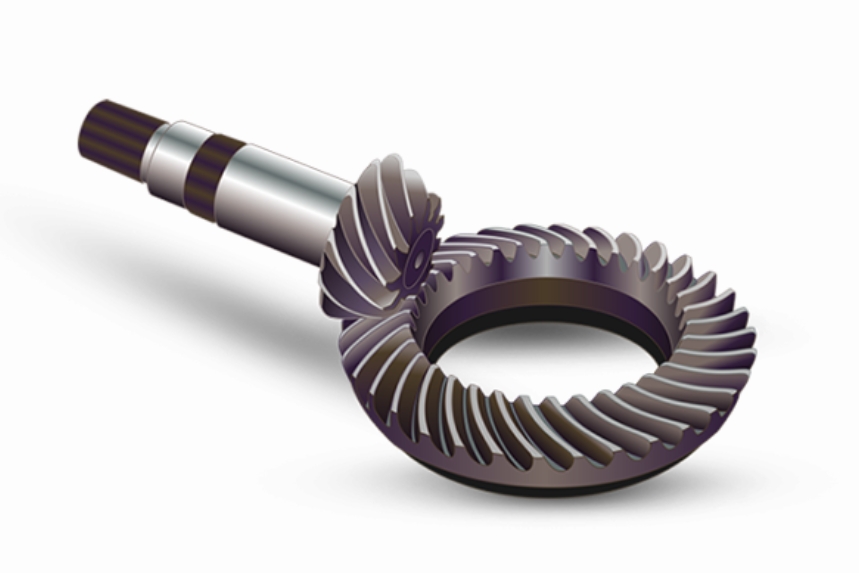
The spiral bevel gear under consideration has 39 teeth, a pressure angle of 22.5°, a spiral angle of 32.22°, a face width of 27 mm, a pitch diameter of 172 mm, and a right-hand spiral direction. To ensure proper forming and ejection, the gear forging and blank are designed with specific dimensions. The finite element model for rotary forging is established using DEFORM software, simulating the relative motion between the swinging head and the blank. The swinging head undergoes a helical feed motion, comprising revolution, rotation, and axial feed, while the blank is fixed centrally on the mandrel of the concave die, constraining internal deformation. The blank’s upper and lower sections experience plastic deformation under the continuous rolling and feeding action of the swinging head. The model incorporates tetrahedral four-node solid elements, with a total of 110,000 elements for the blank, 5,000 for the swinging head, and 50,000 for the concave die.
Material properties are defined as follows: the blank is 45 steel with an elastic modulus of 206,754 MPa, Poisson’s ratio of 0.3, and a flow stress model governed by the von Mises yield criterion. The die material is Cr12MoV with a yield strength of 1,318 MPa, assumed to remain elastic during forging. Friction at interfaces is modeled using a constant friction coefficient of 0.12. Key process parameters are summarized in Table 1.
| Parameter | Value |
|---|---|
| Feed Rate (mm/s) | 1.5 |
| Friction Coefficient | 0.12 |
| Swing Head Inclination Angle (°) | 3 |
| Swing Head Rotation Speed (r/s) | 10 |
During rotary forging of spiral bevel gears, the metal flow is complex, as circumferential movement is hindered by the tooth profile of the concave die, subjecting it to significant shear stresses. Moreover, the curved tooth line of the spiral bevel gear intersects with radial forces at varying angles, increasing from the inner to outer ends, further contributing to shear effects. To analyze die fracture, I focus on circumferential and radial stress components. In cylindrical coordinates $( \rho, \theta, z )$, the stress state at a point includes normal stresses $\sigma_\rho$, $\sigma_\theta$, $\sigma_z$ and shear stresses $\tau_{\rho\theta}$, $\tau_{\theta z}$, $\tau_{z\rho}$, among others, where $\tau_{\rho\theta} = \tau_{\theta\rho}$ due to symmetry. The die tooth profile acts as a cantilever beam, with the root region as a stress concentration zone. Micro-cracks or excessive differential stresses between convex and concave surfaces can lead to shear fracture.
I examine a critical moment during the final forming stage when stresses are highest. Points are tracked along the tooth root on both convex and concave surfaces: points 1–3 on the inner end, 4–5 in the middle, and 6–8 on the outer end for the convex surface, with corresponding points 9–16 for the concave surface. Stress components are extracted, including circumferential normal stress $\sigma_\theta$, circumferential shear stresses $\tau_{\rho\theta}$ and $\tau_{z\theta}$, radial normal stress $\sigma_\rho$, and radial shear stresses $\tau_{z\rho}$ and $\tau_{\theta\rho}$. The results, plotted in Figure 4 (simulated data), reveal that stress magnitudes on the outer convex surface exceed those on the concave surface and other regions, indicating a predisposition to micro-crack initiation. To quantify stress imbalance, I define the unbalanced stress for each segment (inner, middle, outer) as the average absolute difference between corresponding points on convex and concave surfaces. For example, the circumferential normal unbalanced stress at the inner end is calculated as:
$$ \sigma_{\theta,\text{inner}} = \frac{|\sigma_{\theta1} – \sigma_{\theta9}| + |\sigma_{\theta2} – \sigma_{\theta10}| + |\sigma_{\theta3} – \sigma_{\theta11}|}{3} $$
Similar calculations are performed for other stress components, with results summarized in Table 2. The total unbalanced stress for each segment, combining circumferential and radial contributions, is shown in Figure 5. Notably, the outer segment exhibits the highest circumferential unbalanced stress, followed by the middle segment, while radial unbalanced stresses are comparable between outer and middle segments but lower at the inner end. This suggests that the outer and middle regions are most susceptible to fracture, with the outer end being critical.
| Segment | Circumferential Normal Stress $\sigma_\theta$ | Circumferential Shear Stress $\tau_{z\theta}$ | Circumferential Shear Stress $\tau_{\rho\theta}$ | Radial Normal Stress $\sigma_\rho$ | Radial Shear Stress $\tau_{z\rho}$ | Radial Shear Stress $\tau_{\theta\rho}$ |
|---|---|---|---|---|---|---|
| Inner End | 85 | 85 | 18 | 56 | 144 | 18 |
| Middle | 45 | 45 | 168 | 169 | 88 | 168 |
| Outer End | 303 | 455 | 132 | 93 | 177 | 132 |
The fracture patterns observed in practical rotary forging dies for spiral bevel gears align with these findings. Failures often occur at the outer tooth ends, with partial or complete breaks, and sometimes only the convex surface fractures while the concave surface remains intact. This corroborates that high stresses on the outer convex surface and significant unbalanced stresses, particularly in the circumferential direction, are primary drivers of die fracture. The stress analysis underscores that enhancing the strength of the die tooth profile at the outer and middle sections, especially the outer end, can effectively improve die life. This approach mitigates both crack initiation due to high stress magnitudes and propagation due to stress imbalances.
To further elaborate, the von Mises equivalent stress $\sigma_{\text{eq}}$ is often used to assess yield criteria, defined as:
$$ \sigma_{\text{eq}} = \sqrt{\frac{1}{2}\left[ (\sigma_\rho – \sigma_\theta)^2 + (\sigma_\theta – \sigma_z)^2 + (\sigma_z – \sigma_\rho)^2 + 6(\tau_{\rho\theta}^2 + \tau_{\theta z}^2 + \tau_{z\rho}^2) \right]} $$
For the spiral bevel gear die, high $\sigma_{\text{eq}}$ values are concentrated at the tooth root outer convex surface, indicating potential plastic deformation or fatigue initiation. Additionally, the cyclic loading during rotary forging—characterized by repeated contact and release—exacerbates fatigue failure. The stress ratio $R$ and amplitude $\Delta \sigma$ play roles in fatigue life, which can be estimated using models like the Paris law for crack growth:
$$ \frac{da}{dN} = C(\Delta K)^m $$
where $a$ is crack length, $N$ is cycles, $\Delta K$ is the stress intensity factor range, and $C$ and $m$ are material constants. For spiral bevel gear dies, micro-cracks likely initiate at stress concentrations and propagate under unbalanced stresses.
In terms of material selection for spiral bevel gear dies, factors beyond Cr12MoV could be considered. For instance, high-speed steels or powder metallurgy tools offer improved toughness and wear resistance. Surface treatments like nitriding or coating with TiN can enhance hardness and reduce friction, potentially lowering stress levels. Moreover, optimizing process parameters—such as reducing feed rate or adjusting swing angle—might alleviate stress concentrations. However, trade-offs exist with forming quality and efficiency, necessitating a balanced approach.
The finite element simulation also allows for parametric studies. For example, varying the spiral angle of the spiral bevel gear from 30° to 35° could reveal its impact on stress distribution. Similarly, altering the tooth count or pressure angle might influence metal flow and die stresses. I propose a generalized stress model for the die tooth root in rotary forging of spiral bevel gears, incorporating geometry and load factors:
$$ \sigma_{\text{max}} = K_t \cdot \sigma_{\text{nom}} + K_f \cdot \tau_{\text{nom}} $$
where $\sigma_{\text{max}}$ is the maximum stress, $K_t$ and $K_f$ are stress concentration factors for normal and shear stresses, respectively, and $\sigma_{\text{nom}}$ and $\tau_{\text{nom}}$ are nominal stresses derived from forming loads. For spiral bevel gears, $K_t$ and $K_f$ depend on tooth profile curvature and spiral angle, which can be approximated using finite element analysis or analytical methods.
To enhance die life, design modifications are crucial. Increasing the fillet radius at the tooth root can reduce stress concentration. Alternatively, using a segmented die structure might allow for easier replacement of worn or fractured sections. Another strategy involves pre-stressing the die through interference fits or shrink rings, which introduces compressive residual stresses to counteract tensile stresses during forging. For spiral bevel gears, this could be applied selectively to outer tooth regions.
Furthermore, monitoring techniques such as acoustic emission or strain gauges can detect early signs of cracking in spiral bevel gear dies during production. Implementing preventive maintenance schedules based on stress cycle counts could extend service life. From a manufacturing perspective, additive manufacturing of dies with gradient materials or internal cooling channels might offer novel solutions for heat dissipation and stress reduction.
In conclusion, the fracture failure of concave dies in rotary forging of spiral bevel gears stems from complex stress states, with high magnitudes on the outer convex surface and significant unbalanced stresses between convex and concave surfaces. Through finite element simulation and stress analysis, I have identified these factors as critical. Improving die strength at the outer and middle sections, particularly via material upgrades, geometric optimizations, or process adjustments, can substantially enhance durability. This analysis not only addresses spiral bevel gear forming but also provides a framework for other rotary forging applications involving protruding features. Future work could explore dynamic loading effects, thermal stresses, and advanced material models to further refine die design for spiral bevel gears.
To summarize key formulas and data, Table 3 lists stress-related equations relevant to spiral bevel gear die analysis, while Table 4 proposes design improvements. These tables aim to consolidate insights for practitioners working on spiral bevel gear manufacturing.
| Formula | Description |
|---|---|
| $\sigma_{\text{eq}} = \sqrt{\frac{1}{2}\left[ (\sigma_\rho – \sigma_\theta)^2 + (\sigma_\theta – \sigma_z)^2 + (\sigma_z – \sigma_\rho)^2 + 6(\tau_{\rho\theta}^2 + \tau_{\theta z}^2 + \tau_{z\rho}^2) \right]}$ | Von Mises equivalent stress for yield criterion |
| $\Delta K = Y \Delta \sigma \sqrt{\pi a}$ | Stress intensity factor range for crack growth, where $Y$ is geometry factor |
| $\sigma_{\text{max}} = K_t \cdot \sigma_{\text{nom}} + K_f \cdot \tau_{\text{nom}}$ | Maximum stress model with concentration factors |
| $\sigma_{\theta,\text{unbalanced}} = \frac{1}{n} \sum_{i=1}^n |\sigma_{\theta,\text{convex},i} – \sigma_{\theta,\text{concave},i}|$ | Unbalanced circumferential stress calculation |
| Improvement Area | Specific Action | Expected Impact on Spiral Bevel Gear Die Life |
|---|---|---|
| Material Selection | Use high-toughness tool steels (e.g., H13) or carbide inserts | Increase resistance to crack initiation and propagation |
| Geometry Optimization | Enlarge tooth root fillet radius by 20-30% | Reduce stress concentration factors $K_t$ and $K_f$ |
| Surface Treatment | Apply nitriding or TiN coating | Enhance surface hardness and lower friction-induced stresses |
| Process Adjustment | Decrease feed rate to 1.0 mm/s or increase swing head inclination to 4° | Lower forming loads and stress amplitudes |
| Die Structure | Implement segmented die with pre-stressed rings | Introduce compressive residual stresses at critical outer sections |
Ultimately, the successful rotary forging of spiral bevel gears hinges on a deep understanding of die stress behavior. By leveraging simulation tools and stress analysis, manufacturers can proactively address fracture failures, ensuring economical and reliable production of these essential components. The insights derived here emphasize the importance of tailored solutions for spiral bevel gears, given their unique geometric and loading challenges. As technology advances, integrating real-time monitoring and adaptive control could further revolutionize die life management in rotary forging processes for spiral bevel gears.