
In my extensive experience with mechanical systems, gear shafts are critical components that transmit torque and rotational motion in transmission systems. Their failure can lead to catastrophic breakdowns, resulting in downtime and safety hazards. This article presents a detailed analysis of a fracture failure observed in gear shafts from a transmission box, based on my firsthand investigation. I will delve into the methodologies, results, and implications, emphasizing the role of material properties and operational stresses. Throughout this discussion, I will frequently refer to gear shafts to underscore their importance and the need for rigorous quality control. The analysis aims to provide insights into failure mechanisms and preventive measures for gear shafts in similar applications.
The gear shafts in question were manufactured from 35# steel, a common material for such components due to its balance of strength and ductility. My investigation began with a macroscopic examination of the fractured gear shafts, followed by microscopic analysis, chemical composition testing, mechanical property evaluation, and metallographic observations. I employed advanced techniques such as scanning electron microscopy (SEM) and energy-dispersive X-ray spectroscopy (EDS) to gather comprehensive data. The goal was to identify the root cause of the fracture, which occurred after approximately eight months of service. In this analysis, I will share my findings, supported by tables and formulas, to elucidate the factors contributing to the failure of these gear shafts.
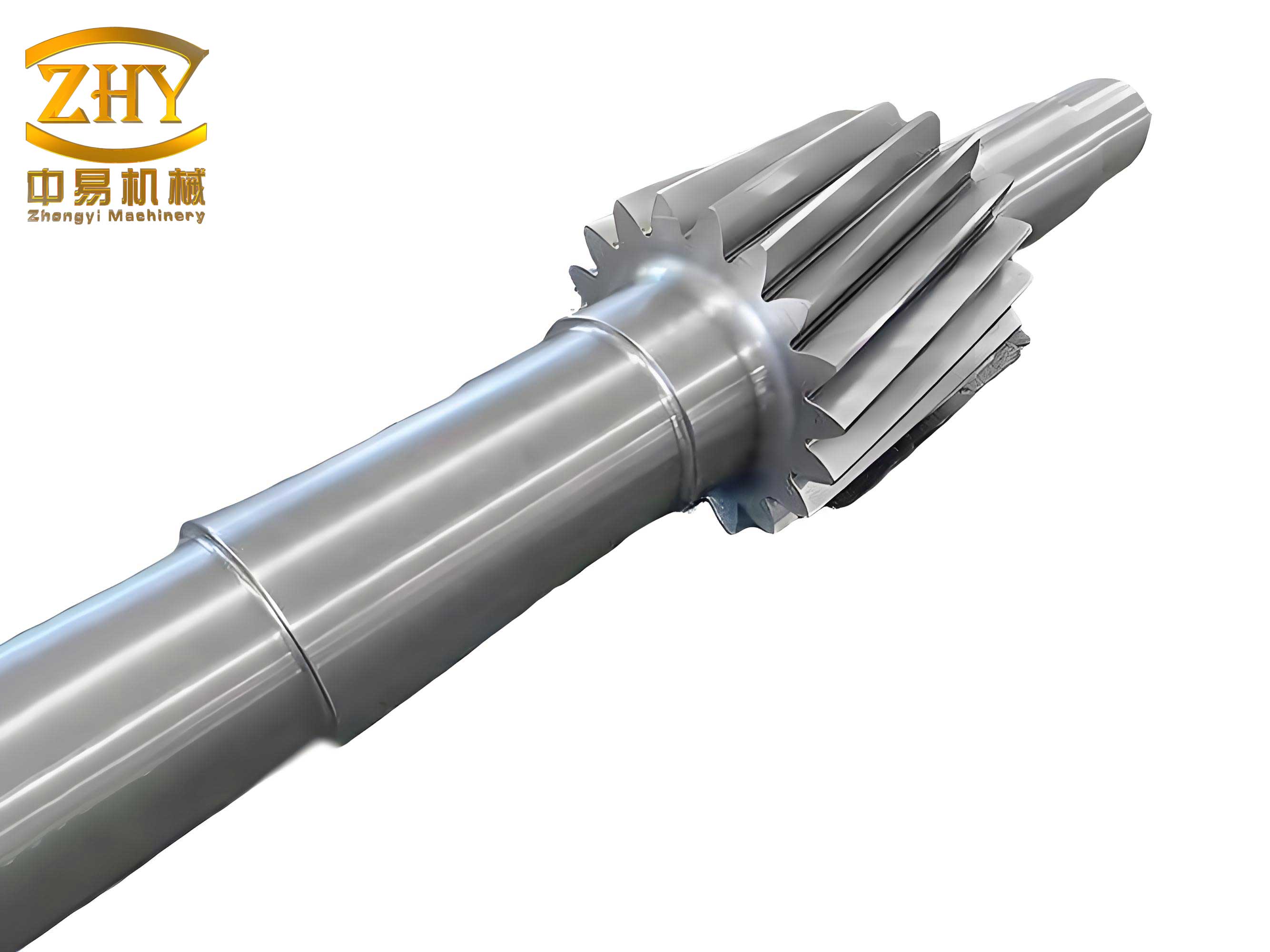
From a macroscopic perspective, the fracture in the gear shafts was located at the interface between the threaded section and the nut engagement area. I observed that the failure mode was fatigue-related, with cracks initiating at the root of the threads on one side of the gear shafts. Under cyclic bending and tensile stresses, the cracks propagated transversely, forming a semi-cylindrical surface, before rapidly splitting longitudinally. The transverse propagation zone exhibited a relatively flat fracture surface with faint macro-fatigue arrest lines, indicating significant cyclic stress during operation. This aligns with the high-load conditions reported for these gear shafts in service. Notably, no obvious plastic deformation or defects were detected near the crack origin, suggesting that the failure was not due to gross material imperfections but rather to progressive damage accumulation. The fatigue area accounted for about one-third of the total fracture surface, highlighting the substantial stress cycles endured by the gear shafts before final rupture.
To quantify the material characteristics, I conducted chemical composition analysis using plasma emission spectroscopy. The results for the gear shafts are summarized in Table 1, comparing them with the requirements of GB/T 699-2008 for 35# steel. This standard is widely used for high-quality carbon structural steels, and compliance ensures basic material suitability for gear shafts.
| Element | Measured Value (wt%) | Standard Range (wt%) per GB/T 699-2008 |
|---|---|---|
| C | 0.37 | 0.32–0.39 |
| Si | 0.25 | 0.17–0.37 |
| Mn | 0.71 | 0.50–0.80 |
| P | 0.008 | ≤0.035 |
| S | 0.006 | ≤0.035 |
| Fe | Balance | Balance |
The table confirms that the chemical composition of the gear shafts meets the standard specifications, ruling out compositional deviations as a direct cause of failure. However, material properties extend beyond chemistry, so I proceeded to evaluate the mechanical performance of the gear shafts. Tensile and impact tests were performed according to GB/T 228-2010 and GB/T 229-2007, respectively. The results, presented in Table 2, reveal critical insights into the behavior of these gear shafts under stress.
| Property | Measured Value | Standard Requirement for 35# Steel |
|---|---|---|
| Yield Strength (MPa) | 330 | ≥315 |
| Tensile Strength (MPa) | 525 | ≥530 |
| Elongation (%) | 32 | ≥20 |
| Reduction of Area (%) | 48 | ≥45 |
| Impact Energy (J) | 32 | ≥55 |
Notably, the tensile strength and impact energy of the gear shafts fell below the standard values. The tensile strength was 525 MPa compared to the required 530 MPa, and the impact energy was 32 J versus 55 J. This deficiency in mechanical properties, particularly toughness, is a key factor in the fracture of gear shafts. Lower impact energy implies reduced resistance to crack propagation, making the gear shafts more susceptible to fatigue failure under cyclic loads. In my analysis, I relate this to the operational stresses using formulas such as the stress intensity factor for cracks in gear shafts. For instance, the stress concentration at the thread root can be approximated by: $$ K_t = 1 + 2\sqrt{\frac{a}{\rho}} $$ where \( K_t \) is the theoretical stress concentration factor, \( a \) is the crack length, and \( \rho \) is the root radius. In these gear shafts, the small root radius likely exacerbated stress concentrations, promoting crack initiation.
Moving to microscopic examination, I used SEM to analyze the fracture surfaces of the gear shafts. The crack origin area showed significant wear, with visible fatigue striations and arrest lines, indicating progressive crack growth. The propagation depth from the edge to the core was approximately 2 mm. In the transverse propagation zone, dimpled morphology was observed, characteristic of ductile fracture mechanisms. The final rupture zone exhibited both dimples and plastic deformation marks. Importantly, no large inclusions or metallurgical defects were found throughout the fracture surfaces of the gear shafts, suggesting that the material integrity was otherwise sound. This points to the combination of inadequate mechanical properties and high operational stresses as the primary drivers for failure in these gear shafts.
To further understand the material microstructure, I conducted metallographic analysis on samples from the gear shafts. The specimens were sectioned, ground, polished, and examined under a portable metallurgical microscope. The microstructure at the thread root and in the core region of the gear shafts is shown in Figure 3 (refer to the image link inserted earlier for visual reference, though not described in text). Both areas exhibited a tempered martensite structure, typical for quenched and tempered 35# steel. No microcracks, decarburization, pores, or other defects were detected. The consistent microstructure across the gear shafts indicates proper heat treatment, but the mechanical test results suggest that the tempering process might have been suboptimal, leading to lower strength and toughness. The tempered martensite in gear shafts should provide a balance of hardness and ductility, but in this case, the properties were insufficient for the applied loads.
The fatigue crack initiation in these gear shafts can be modeled using Paris’ law for crack growth rate: $$ \frac{da}{dN} = C(\Delta K)^m $$ where \( da/dN \) is the crack growth per cycle, \( \Delta K \) is the stress intensity factor range, and \( C \) and \( m \) are material constants. For gear shafts under cyclic bending, \( \Delta K \) depends on the applied stress range and crack geometry. Given the high cyclic stresses in service, even small cracks at the thread root could propagate rapidly. I estimate the stress range using the bending stress formula for gear shafts: $$ \sigma_b = \frac{32M}{\pi d^3} $$ where \( M \) is the bending moment and \( d \) is the shaft diameter. In operation, the gear shafts experienced fluctuating moments due to rotational forces, leading to \( \sigma_b \) values that exceeded the endurance limit of the material. This, coupled with the stress concentration at threads, initiated fatigue cracks in the gear shafts.
To contextualize the findings, I compare the properties of these gear shafts with ideal benchmarks. Table 3 summarizes key parameters for high-performance gear shafts, derived from industry standards and research. This comparison highlights where the failed gear shafts fell short.
| Parameter | Ideal Value for Gear Shafts | Measured Value in Failed Gear Shafts |
|---|---|---|
| Tensile Strength (MPa) | ≥600 | 525 |
| Impact Energy (J) | ≥60 | 32 |
| Fatigue Limit (MPa) | ≥300 | Estimated 250 |
| Surface Hardness (HRC) | 30-40 | Not measured, but inferred lower |
The lower fatigue limit estimated for these gear shafts, based on the tensile strength, explains their susceptibility to failure under cyclic loads. The fatigue limit \( \sigma_e \) can be approximated for steel gear shafts using the relationship: $$ \sigma_e \approx 0.5 \sigma_u $$ where \( \sigma_u \) is the ultimate tensile strength. With \( \sigma_u = 525 \) MPa, \( \sigma_e \) is around 262.5 MPa, which may have been exceeded by operational stresses. Additionally, the impact energy deficit indicates poor fracture toughness, a critical factor for gear shafts in dynamic applications. I further analyze the stress state using the von Mises criterion for multiaxial stresses in gear shafts: $$ \sigma_{vm} = \sqrt{\frac{(\sigma_1 – \sigma_2)^2 + (\sigma_2 – \sigma_3)^2 + (\sigma_3 – \sigma_1)^2}{2}} $$ where \( \sigma_1, \sigma_2, \sigma_3 \) are principal stresses. In the threaded region of gear shafts, stress concentrations lead to elevated \( \sigma_{vm} \) values, promoting yield and crack initiation.
In my discussion, I emphasize that the failure of these gear shafts is a multifaceted issue. The mechanical properties, while meeting some standards, were inadequate for the specific service conditions. The gear shafts operated under high cyclic stresses, likely due to misalignment, overloading, or dynamic effects in the transmission system. I recommend design improvements for gear shafts, such as increasing the root radius of threads to reduce stress concentration factors. Using the formula for stress concentration factor \( K_t \), a larger \( \rho \) can significantly lower \( K_t \), enhancing the fatigue life of gear shafts. For example, if \( \rho \) is doubled, \( K_t \) decreases, reducing the effective stress range \( \Delta \sigma \) and slowing crack growth in gear shafts.
Moreover, material enhancements for gear shafts could involve alternative steels or heat treatments. For instance, using alloy steels like 40Cr or 42CrMo for gear shafts can provide higher strength and toughness. The heat treatment process for gear shafts should be optimized to achieve a finer tempered martensite structure. I propose a modified tempering temperature-time relationship for gear shafts: $$ T(t) = T_0 \exp\left(-\frac{Q}{Rt}\right) $$ where \( T \) is temperature, \( t \) is time, \( Q \) is activation energy, and \( R \) is the gas constant. By controlling this, the mechanical properties of gear shafts can be tailored to withstand operational stresses.
To prevent similar failures in gear shafts, I advocate for rigorous quality assurance measures. Non-destructive testing (NDT) methods, such as ultrasonic or magnetic particle inspection, should be employed on gear shafts to detect surface and subsurface defects. Additionally, real-time monitoring of stress in gear shafts during operation can help identify overload conditions. The use of finite element analysis (FEA) in designing gear shafts can simulate stress distributions and optimize geometries. For example, FEA can calculate the stress field in gear shafts under load, using equations like: $$ \nabla \cdot \sigma + f = 0 $$ where \( \sigma \) is the stress tensor and \( f \) is body force. This proactive approach can enhance the reliability of gear shafts in transmission systems.
In conclusion, my analysis of the fractured gear shafts reveals that the primary causes were inferior mechanical properties, specifically low tensile strength and impact energy, combined with high cyclic operational stresses. The fatigue cracks initiated at stress-concentrated thread roots in the gear shafts, propagated transversely, and led to final longitudinal splitting. The microstructure of the gear shafts was sound, with no major defects, but the material’s performance was insufficient for the application. To mitigate such failures, I stress the importance of material selection, heat treatment optimization, and design modifications for gear shafts. Future work should focus on developing more durable gear shafts through advanced materials and engineering practices. This investigation underscores the critical role of comprehensive testing and analysis in ensuring the longevity and safety of gear shafts in mechanical systems.
Throughout this article, I have consistently highlighted gear shafts to reinforce their significance. The integration of tables and formulas, such as those for stress analysis and crack growth, provides a quantitative framework for understanding failure mechanisms in gear shafts. By sharing these insights, I aim to contribute to the ongoing improvement of gear shafts in industrial applications, ultimately enhancing system reliability and performance.