
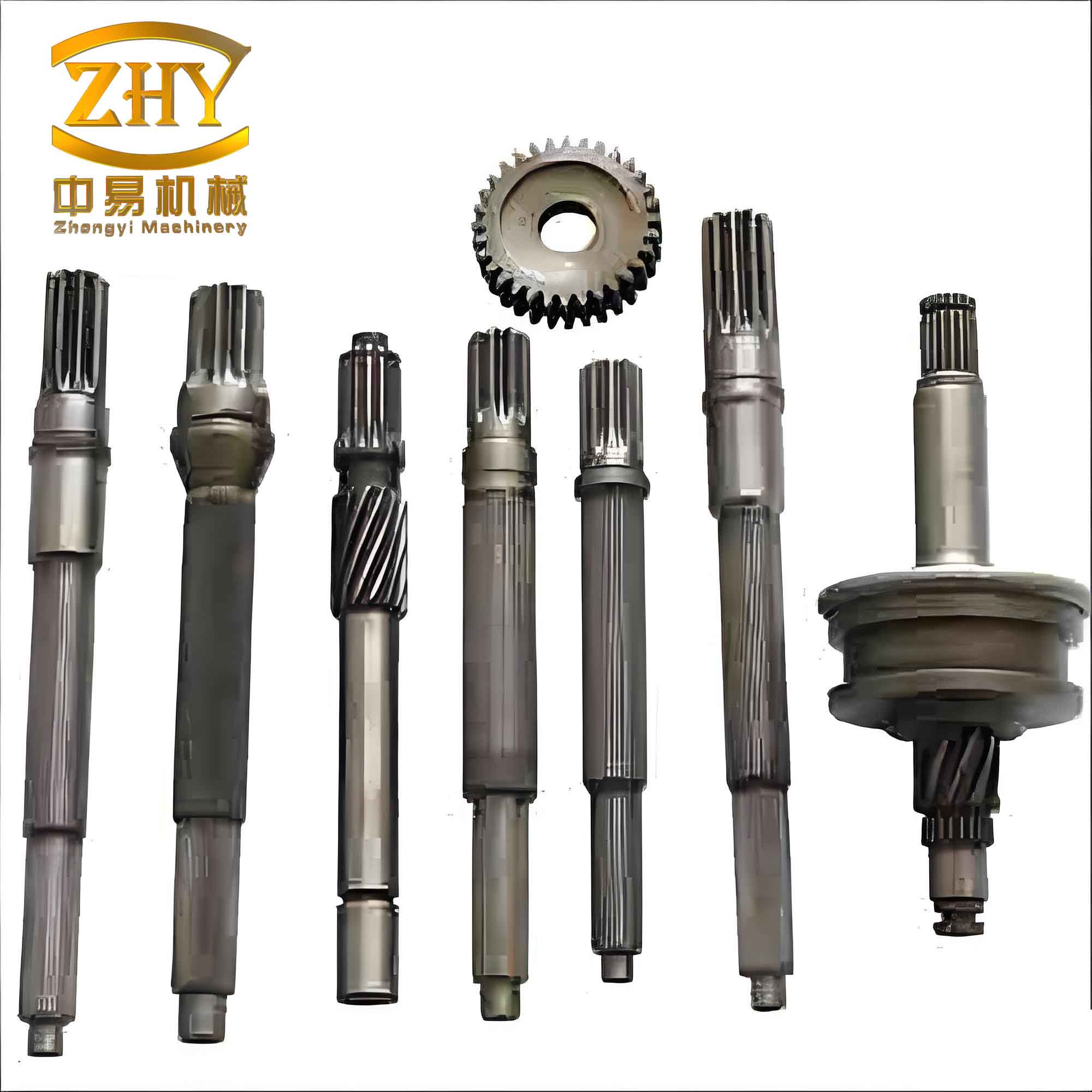
In my investigation of gear shaft failures in industrial reducers, I focused on a case where a gear shaft manufactured from 20CrMnMo steel experienced catastrophic tooth fracture during operation. This gear shaft is critical in transmitting torque and reducing speed in machinery, and its failure led to significant downtime. My analysis aimed to identify the root causes through a comprehensive approach involving chemical composition, metallographic examination, hardness testing, and scanning electron microscopy. The gear shaft was subjected to carburizing and quenching to achieve a surface hardness of HRC 60±2 and a carburized layer depth of 2.1–2.4 mm, but it failed prematurely, highlighting potential issues in material processing and assembly.
Macroscopic examination of the fractured gear shaft revealed multiple teeth with complete or partial breaks. Specifically, two teeth were fully fractured, while others exhibited cracks extending along approximately one-third of their length. The fracture surfaces showed signs of metal spalling and cracking originating from areas about 3 mm below the tooth tip and 26 mm from the tooth end. Wear patterns on the pressure sides of the teeth indicated uneven loading, with spalling pits coalescing into continuous bands that were not parallel to the tooth tip. This suggests misalignment during installation, leading to eccentric loads on the gear shaft. The fracture surfaces displayed brittle zones approximately 2 mm thick, indicative of material embrittlement in the carburized layer.
To understand the material properties, I first conducted chemical composition analysis using optical emission spectroscopy. Samples were taken from the shaft area beneath the tooth roots, and the results were compared to the GB/T 3077-2015 standard for 20CrMnMo steel. The composition was within specified limits, as shown in Table 1, indicating that the base material met requirements and was not a primary factor in the gear shaft failure.
| Element | Content (%) | Standard Range (%) |
|---|---|---|
| C | 0.188 | 0.17–0.23 |
| Si | 0.271 | 0.17–0.37 |
| Mn | 0.895 | 0.90–1.20 |
| P | 0.014 | ≤0.030 |
| S | 0.024 | ≤0.030 |
| Cr | 1.13 | 1.10–1.40 |
| Ni | 0.062 | ≤0.30 |
| Cu | 0.150 | ≤0.30 |
| Mo | 0.214 | 0.20–0.30 |
Metallographic analysis was performed on samples sectioned from the fractured teeth and adjacent areas. I prepared specimens by grinding and polishing, followed by examination under optical and scanning electron microscopes. The non-metallic inclusions were assessed according to GB/T 10561-2015, with results summarized in Table 2. Although inclusions were present, they were within acceptable levels and not the primary cause of failure. However, the microstructure revealed coarse martensite and bainite formations, along with network carbides along grain boundaries, as shown in etched samples using 4% nitric alcohol. This microstructure is typical of overheating during quenching, which weakens the material by reducing toughness and promoting brittleness. Additionally, internal oxidation was observed on the tooth surfaces, with oxide layers extending up to 1 mm deep, exceeding the maximum level of 6 per GB/T 25744-2010. This internal oxidation, characterized by silicon, chromium, manganese, and oxygen-rich phases, further embrittled the gear shaft surface and served as initiation sites for cracks.
| Sample | Type A | Type B | Type C | Type D | Type DS |
|---|---|---|---|---|---|
| 1 | 1.5e | 0.5 | 1.0 | 1.0 | 1.0 |
Hardness testing was critical to evaluate the effectiveness of the carburizing and quenching process. I used Vickers hardness measurements on cross-sections perpendicular to the gear shaft axis, following GB/T 9450-2005. The hardness profiles for the tooth tip and non-pressure side are detailed in Table 3 and Table 4, respectively. The hardened layer depth was calculated mathematically using the hardness gradient method. For the tooth tip, the hardness values at specific distances were used to determine the depth where hardness falls to 550 HV1, as per the standard formula:
$$ CHD = d_1 + (d_2 – d_1) \times \frac{H_1 – H_s}{H_s – H_2} $$
where \( CHD \) is the case hardened depth, \( d_1 \) and \( d_2 \) are distances where hardness values \( H_1 \) and \( H_2 \) are measured, and \( H_s \) is the defined surface hardness. For the tooth tip, with \( d_1 = 1.65 \, \text{mm} \), \( d_2 = 1.85 \, \text{mm} \), \( H_1 = 553 \, \text{HV1} \), \( H_2 = 545 \, \text{HV1} \), and \( H_s = 550 \, \text{HV1} \), the calculation yields:
$$ CHD = 1.65 + (1.85 – 1.65) \times \frac{553 – 550}{550 – 545} = 1.77 \, \text{mm} $$
Similarly, for the non-pressure side, \( CHD = 1.79 \, \text{mm} \). Both values are below the specified range of 2.1–2.4 mm, indicating insufficient carburized layer depth. Moreover, the surface hardness conversions from Vickers to Rockwell C scale, using GB/T 1172-1999, showed values of HRC 56.5 for the tooth tip and HRC 57.0 for the non-pressure side, which are lower than the required HRC 60±2. This deficiency in hardness reduces the gear shaft’s resistance to wear and fatigue, contributing to the failure.
| Purpose | Hardness Values (HV1) | Depth Determination (mm) |
|---|---|---|
| Case Depth | 592, 611, 599, 601, 603, 604, 607, 596, 586, 582, 572, 585, 568, 567, 565, 557, 566, 558, 553, 561, 560, 538, 543, 532, 539, 528, 549, 532, 526, 542, 522, 504, 517, 492, 500 | d1=1.65, d2=1.85 |
| Surface Hardness | 618, 630, 630 (at 0.15 mm) | Converted to HRC 56.5 |
| Purpose | Hardness Values (HV1) | Depth Determination (mm) |
|---|---|---|
| Case Depth | 627, 611, 608, 603, 611, 591, 583, 590, 585, 587, 587, 593, 583, 577, 576, 569, 572, 570, 574, 560, 567, 552, 543, 546, 512, 515, 538, 469, 459 | d1=1.725, d2=1.925 |
| Surface Hardness | 637, 639, 630 (at 0.15 mm) | Converted to HRC 57.0 |
Scanning electron microscopy (SEM) and energy-dispersive X-ray spectroscopy (EDS) provided insights into the fracture mechanisms. The fracture surfaces exhibited a mix of brittle and fatigue zones, with the carburized layer showing a coarse,冰糖-like intergranular fracture morphology. EDS analysis detected elements such as silicon, manganese, sulfur, and oxygen at grain boundaries, confirming the presence of oxides and sulfides that weakened the material. The intergranular cracks and spalling on both pressure and non-pressure sides aligned with the metallographic findings, highlighting how internal oxidation and coarse microstructures led to embrittlement. The formula for evaluating the stress intensity factor in such brittle fractures can be approximated for gear shaft applications as:
$$ K_I = \sigma \sqrt{\pi a} $$
where \( K_I \) is the stress intensity factor, \( \sigma \) is the applied stress, and \( a \) is the crack length. In this gear shaft, the combination of residual stresses from quenching and operational loads likely accelerated crack propagation.
In conclusion, my analysis demonstrates that the gear shaft failure resulted from a combination of material processing defects and mechanical issues. Overheating during quenching caused coarse martensite and network carbides, while severe internal oxidation embrittled the surface, leading to intergranular cracking. The insufficient hardened layer depth and low surface hardness reduced the gear shaft’s load-bearing capacity, and installation misalignment introduced eccentric loads that exacerbated the fractures. This case underscores the importance of严格控制 heat treatment parameters and proper assembly to prevent similar failures in gear shafts used in critical applications.
To further elaborate, the role of carburizing temperature in gear shaft performance can be modeled using diffusion equations. For instance, the carbon concentration profile during carburizing follows Fick’s second law:
$$ \frac{\partial C}{\partial t} = D \frac{\partial^2 C}{\partial x^2} $$
where \( C \) is carbon concentration, \( t \) is time, \( D \) is the diffusion coefficient, and \( x \) is depth. Overheating increases \( D \), leading to excessive carbon uptake and carbide formation, which I observed in this gear shaft. Additionally, the hardness gradient can be correlated to the case depth using empirical relationships, such as:
$$ H = H_0 + k \cdot \sqrt{t} $$
where \( H \) is hardness, \( H_0 \) is base hardness, \( k \) is a material constant, and \( t \) is treatment time. In this gear shaft, the low hardness values indicate that the process parameters were not optimized, resulting in inadequate performance. Future designs should incorporate real-time monitoring of heat treatment to avoid such issues in gear shaft manufacturing.
Overall, this study highlights the critical factors in gear shaft durability and provides a framework for failure analysis through integrated testing methods. By addressing these aspects, manufacturers can enhance the reliability of gear shafts in demanding environments, ensuring longer service life and reduced downtime.