
The pursuit of high-quality gear manufacturing consistently focuses on refining finishing processes. Among these, gear shaving stands out as a highly efficient and precise method for improving the surface finish and profile accuracy of gear teeth after rough hobbing or shaping. The process involves the meshing of a hardened, serrated gear-shaped cutter (the shaving cutter) with a softer work gear. Their axes are crossed, creating a point contact that traverses the tooth flank under pressure, resulting in a fine cutting and burnishing action.
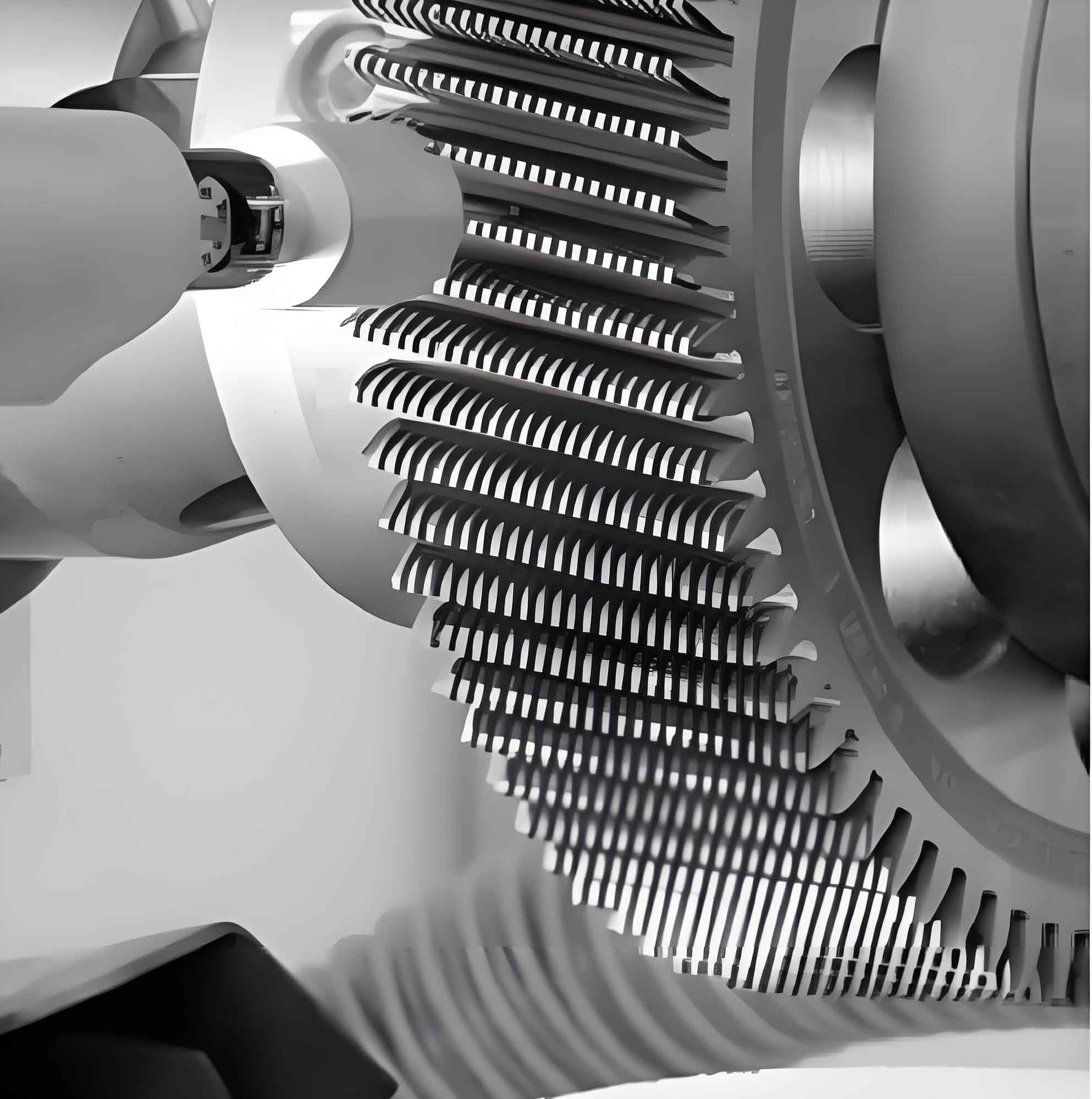
However, a persistent and significant challenge in gear shaving is the formation of a profile error characterized by a concave deviation in the middle region of the tooth flank, commonly referred to as mid-profile concavity or “middle depression” error. The presence of this concave-error detrimentally impacts the final transmission performance, leading to increased vibration, noise, and reduced load-bearing capacity and service life of the gears. Understanding the root cause of this phenomenon is therefore critical for advancing gear shaving technology.
This analysis delves into the fundamental mechanisms behind the formation of concave-errors during gear shaving. It is widely acknowledged that the error is intrinsically linked to the dynamic contact characteristics of the shaving mesh. Specifically, the transition in the number of contacting tooth pairs near the pitch line and the resulting force distribution imbalances are considered primary contributors. This work constructs a comprehensive analytical framework combining elastoplastic theory and Loaded Tooth Contact Analysis (LTCA) to investigate the contact stress, deformation behavior, and load distribution under simulated shaving conditions. The goal is to delineate the regions on the tooth flank susceptible to plastic deformation, which, through cyclic accumulation during the shaving process, manifest as the observed concave-error.
The core of gear shaving involves the complex spatial meshing of two helical surfaces with crossed axes. To analyze this interaction, a simplified yet accurate geometric model is essential. A common and effective simplification treats the process as the meshing between a helical shaving cutter and a spur work gear. The key parameters for such a model are summarized in the table below.
| Parameter | Shaving Cutter | Work Gear |
|---|---|---|
| Number of Teeth | 43 | 12 |
| Module (Normal) | 5.35 mm | 5.35 mm |
| Pressure Angle | 20° | 20° |
| Helix Angle | 11° | — |
| Material | W18Cr4V (Hardened) | 20CrMnTi |
| Young’s Modulus | 218 GPa | 206 GPa |
| Poisson’s Ratio | 0.30 | 0.25 |
| Yield Strength | — | ≥ 835 MPa |
The mathematical description of this meshing process relies on gear meshing theory. The fundamental requirement for continuous contact is expressed by the equation of meshing, which ensures that the relative velocity of the two surfaces at the contact point is perpendicular to their common normal vector. For the crossed-axis helical gear pair in gear shaving, this leads to a relationship involving the surface parameters and kinematics. The derived meshing condition can be expressed in a functional form:
$$ f(u, \theta, \phi_1) = 0 $$
where \(u\) and \(\theta\) are the surface parameters of the shaving cutter flank, and \(\phi_1\) is the rotational angle of the shaving cutter. Solving this equation for a given \(\phi_1\) yields a series of points forming the line of contact on the cutter tooth. The corresponding points on the work gear flank are obtained through coordinate transformation.
A critical aspect in gear shaving analysis is the contact condition. Under ideal settings and without modifications, the meshing is typically a point contact. However, by carefully adjusting the machine kinematics, it is possible to achieve a localized line contact, which can improve load distribution. The condition for this transformation from point to line contact is given by a specific ratio of transmission parameters, which can be expressed as:
$$ \frac{i_{21}}{i”} = \frac{p_1}{\cos\Sigma} $$
where \(i_{21}\) is the gear ratio (\(z_1/z_2\)), \(i”\) is the differential ratio provided by the machine, \(p_1\) is the helix parameter of the shaving cutter, and \(\Sigma\) is the shaft crossing angle. Satisfying this condition leads to a more stable and uniform contact pattern during the gear shaving process.
To understand the forces involved, a mechanical model based on Loaded Tooth Contact Analysis (LTCA) is developed. This model accounts for the actual load sharing between multiple pairs of teeth in contact simultaneously. The radial infeed force \(F_r\) during gear shaving, which typically ranges from 700 N to 2000 N, is the primary external load. For a right-hand work gear flank, the meshing sequence involves alternating states of four-point, three-point, and two-point contact along the path of contact. A schematic force diagram for the four-point contact state is most illustrative, as it presents a statically indeterminate system. Equilibrium equations for force and moment are insufficient to solve for the four unknown normal contact forces \(F_1, F_2, F_3, F_4\). An additional compatibility equation is required, which states that the sum of elastic approach (deformation) along the left and right lines of contact must be equal for geometric consistency.
The elastic deformation \(\delta_e\) at a contact point under a normal load \(P\) can be estimated using Hertzian contact theory for cylinders:
$$ \delta_e = \frac{4(1-\nu^2)P}{E\pi} \left( \ln\frac{2}{b} + \ln L \right) $$
where \(\nu\) is Poisson’s ratio, \(E\) is the equivalent Young’s modulus, \(b\) is the semi-width of the contact ellipse, and \(L\) is a length related to the contacting bodies. Using LTCA, the normal force \(F_n\) at each instantaneous contact point can be determined for different loading conditions (e.g., \(F_r = 700, 1100, 1500, 2000\) N). Subsequently, the contact stress \(\sigma_H\) can be calculated using a standardized formula such as the AGMA equation for helical gears:
$$ \sigma_H = Z_H Z_E Z_\epsilon Z_\beta \sqrt{ \frac{F_n \cos\alpha_t \cos\beta}{d_1 b} \cdot \frac{u+1}{u} \cdot K_H } $$
where \(Z_H\), \(Z_E\), \(Z_\epsilon\), \(Z_\beta\) are the zone, elasticity, contact ratio, and helix angle factors, \(\alpha_t\) and \(\beta\) are the transverse pressure angle and helix angle, \(d_1\) is the pinion pitch diameter, \(b\) is the face width, \(u\) is the gear ratio, and \(K_H\) is the load factor. Calculating these values for the entire tooth profile under different \(F_r\) yields the contact characteristic curves.
The analysis reveals consistent trends. The contact stress and calculated elastic deformation increase with the applied radial force \(F_r\). More importantly, their distribution along the tooth profile is non-uniform. The root region generally experiences higher stress and deformation than the tip region. Crucially, distinct peaks in stress and deformation occur in the vicinity of the pitch point. These peaks coincide with transitions in the number of contacting teeth, particularly during the three-point contact phase following a two-point contact phase. This region near the pitch line is therefore identified as the most critically loaded zone during gear shaving.
| Radial Force \(F_r\) (N) | Max Contact Stress (Theory) (MPa) | Location of Peak | Primary Contact State at Peak |
|---|---|---|---|
| 700 | ~600 | Pitch region | 3-point |
| 1100 | ~850 | Pitch region | 3-point |
| 1500 | ~1050 | Pitch region / Lower flank | 3-point / 2-point |
| 2000 | ~1250 | Lower flank / Pitch region | 2-point / 3-point |
The calculated contact stress provides the key to understanding permanent deformation. When the contact stress \(\sigma_H\) at a point on the work gear’s softer material exceeds its yield strength \(\sigma_s\) (835 MPa for 20CrMnTi), the material undergoes plastic deformation. Elastic deformation recovers when the load passes, but plastic deformation is permanent. By using the contact stress as a criterion, the tooth profile can be partitioned into regions of purely elastic deformation (\(\sigma_H < \sigma_s\)), elastoplastic transition, and plastic deformation (\(\sigma_H \geq \sigma_s\)) for each loading condition.
This partitioning analysis yields critical insights into the mechanism of concave-error formation in gear shaving. Under light loads (e.g., \(F_r = 700\) N), most of the profile remains elastic. As the radial force increases, the plastic deformation region initiates and grows non-linearly. It first appears prominently in the high-stress zone around the pitch line and in the two-point contact region. With further load increase (e.g., \(F_r = 1500\) or 2000 N), this plastic zone expands towards the root and, to a lesser extent, the tip. The cyclic nature of gear shaving means that every tooth on the work gear undergoes this loading sequence hundreds of times. The small, incremental plastic deformation in the pitch region accumulates with each shaving cycle. This accumulated, irreversible material removal or displacement in a localized area results in a deviation from the ideal involute profile, manifesting as the characteristic concave-error. The imbalance of forces during the three-point contact phase near the pitch line exacerbates this effect, making it the epicenter of error generation.
To validate the theoretical LTCA and stress analysis, a Finite Element Method (FEM) simulation is performed. A three-dimensional model of a segment containing five teeth from both the shaving cutter and the work gear is constructed. Boundary conditions representing the crossed-axis rotation and radial infeed are applied. The simulation is run for the same set of radial forces (\(F_r\)). The FEM directly computes the contact stress distribution and the resulting deformations, including plastic strain if the material’s plastic properties are defined.
The results from the FEM simulation show strong qualitative agreement with the theoretical LTCA predictions. The stress distribution pattern along the flank is similar, with maximum stresses occurring in the pitch region and root. The expansion of the high-stress (and thus high plastic strain potential) zone with increasing load is clearly observed in the FEM results. Quantitative comparison reveals a reasonable correlation, with deviations typically within 10-20%. These deviations are expected and attributable to several factors: the AGMA formula is an empirical standard, while FEM solves the continuum mechanics equations numerically; dynamic effects and system errors (like alignment errors) present in real gear shaving are simplified in the static/quasi-static models; and the definition of the exact yield point and material hardening behavior influences the plastic zone prediction. Notably, the FEM confirms that the plastic deformation initiates in the mid-to-lower flank area, validating the proposed mechanism.
| Aspect | Theoretical (LTCA + AGMA) | FEM Simulation | Agreement & Notes |
|---|---|---|---|
| Stress Pattern | Peak near pitch line/root; varies with contact state. | Peak near pitch line/root; smoother transitions. | Very good qualitative agreement. FEM shows smoother gradients. |
| Plastic Zone Initiation | Begins at ~1100 N near pitch line. | Plastic strain appears at similar load level in the same region. | Good agreement on critical load and location. |
| Plastic Zone Growth | Expands non-linearly towards root with load. | Shows similar non-linear expansion pattern. | Good agreement on trend. |
| Max Stress Value @1500N | ~1050 MPa | ~900-950 MPa (Mises Stress) | Fair agreement. Difference due to model assumptions and formula approximations. |
Finally, experimental verification is crucial. Gear shaving tests are conducted on a shaving machine (e.g., YW4232 type) using work gears with the specified parameters. Different radial infeed rates are applied to approximate the different radial forces \(F_r\). After the gear shaving process, the profile of the finished gears is meticulously measured using a precision gear measuring instrument (e.g., GM3040a).
The measured profile charts consistently show the presence of a concave deviation in the pitch region for all tested loads, confirming the practical reality of the error. Furthermore, the magnitude of this concave-error generally increases with the radial infeed (and thus \(F_r\)), aligning with the theoretical prediction that higher loads cause larger plastic deformation zones. However, the relationship is not perfectly monotonic; at very high infeed rates, error magnitude can fluctuate. This is attributed to the complex interaction between aggressive cutting, potential chatter, and the existing pre-shave errors, factors not fully captured in the idealized model. The experimental results thus substantiate the core conclusion: the dynamic contact stress during gear shaving, particularly its peak in the pitch region, induces localized plastic deformation whose accumulation is a primary root cause of the mid-profile concave-error.
In conclusion, this integrated analysis provides a clear elucidation of the formation mechanism for concave-errors in gear shaving. The process is fundamentally governed by the loaded contact characteristics between the shaving cutter and the work gear. The application of elastoplastic theory and LTCA reveals that the contact stress peaks in a specific zone around the pitch line due to the dynamics of multiple tooth pair contact. When this stress surpasses the material’s yield point, plastic deformation occurs. The cyclical nature of gear shaving causes this micro-plastic strain to accumulate iteratively, resulting in a measurable and detrimental deviation from the ideal involute profile—the concave-error. This understanding, validated by FEM simulations and physical gear shaving experiments, points directly towards potential solutions. Mitigating the concave-error requires strategies to reduce the peak contact stress in the critical zone. This can be achieved through process parameter optimization (e.g., optimal crossed-axis angle, speed), shaving cutter design modifications (e.g., profile modifications, groove pattern), or pre-shave gear profile corrections that compensate for the anticipated plastic flow. Therefore, a deep understanding of the contact mechanics and plastic deformation behavior is not merely academic but essential for advancing the precision and reliability of the gear shaving process.