
In the realm of advanced aviation, tiltrotor aircraft represent a significant technological leap, combining the vertical takeoff and hovering capabilities of helicopters with the high-speed cruise performance of turboprop airplanes. The传动系统 of such aircraft, particularly the tilting mechanism, is highly complex, with counter-rotating bevel gears serving as critical components for power transmission to the rotors. During the transition mode, where the aircraft shifts between helicopter and airplane configurations, the lubrication of these bevel gears becomes a paramount concern. Grease lubrication is often preferred due to its ability to adhere to gear surfaces under extreme orientations, ensuring stable lubrication during tilting maneuvers. This article delves into the grease lubrication characteristics of counter-rotating bevel gears under tilting conditions, employing a thermal elastohydrodynamic lubrication (TEHL) model based on the Ostwald rheological model. The influence of tilting speed, manifested as differential speeds between the pinions, is incorporated into the input parameter calculations for the elastohydrodynamic analysis. By examining various differential speeds and rotational speeds, this study aims to provide insights into the lubrication performance of bevel gears during the transition phase of tiltrotor operation.
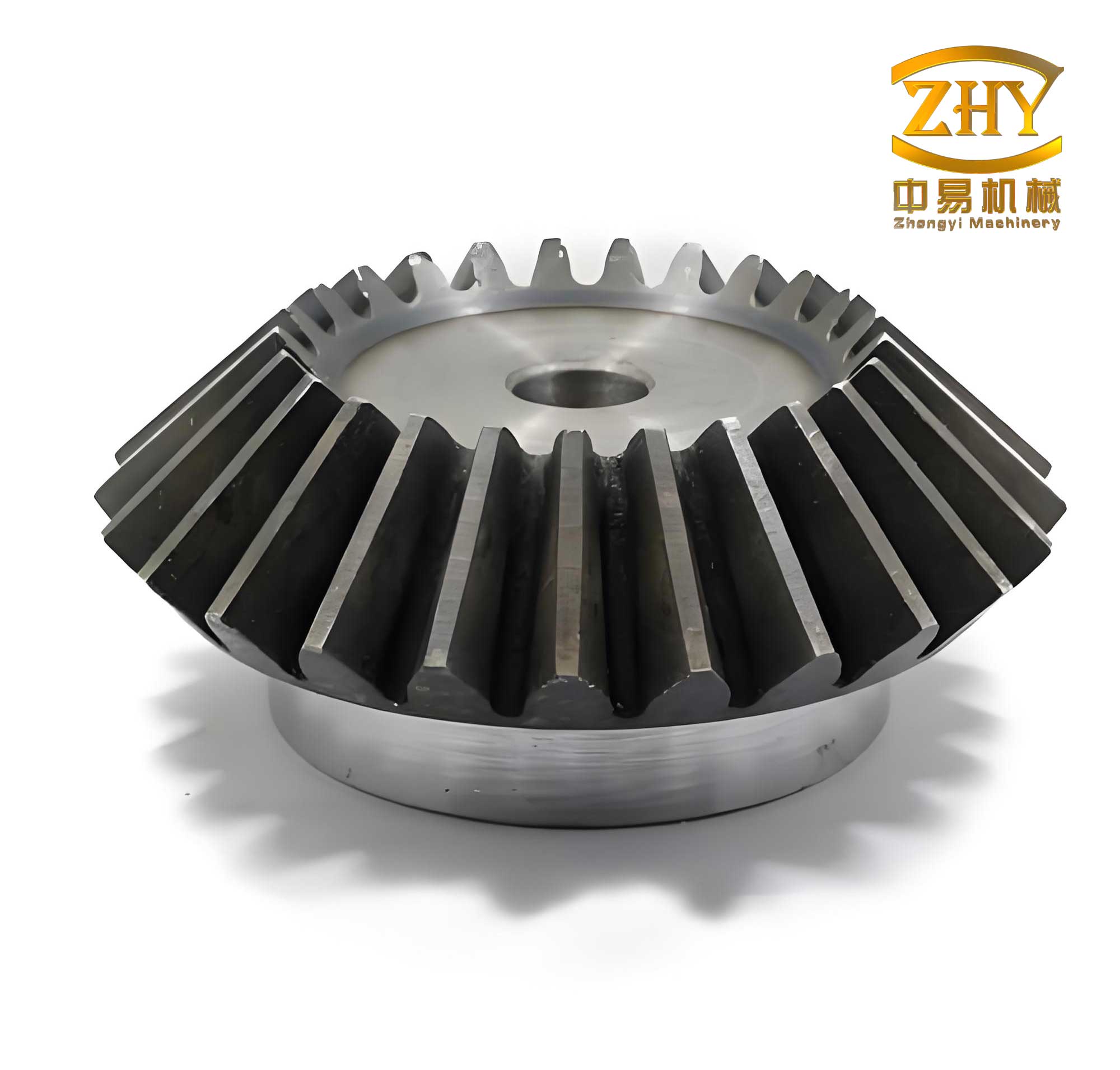
The counter-rotating bevel gear system in a tiltrotor typically involves two pinions driving a central gear. In standard operation with equal pinion speeds, the system behaves as a fixed-axis transmission. However, during tilting, differential speeds between the pinions introduce a公转 speed to the central gear, altering the kinematic conditions at the gear mesh. This directly impacts the lubrication regime, making it essential to analyze the TEHL behavior under these transient conditions. The bevel gears considered here are of the Gleason spiral bevel type, modeled using齿面 equations that simulate the manufacturing process. The geometry of these bevel gears is critical for determining contact parameters, which are extracted via loaded tooth contact analysis (LTCA) using finite element software. The subsequent sections detail the methodology, input parameter derivation, results, and conclusions from this comprehensive analysis.
To model the grease lubrication, the Ostwald rheological model is adopted, which describes the shear stress $\tau$ as a function of shear rate $\dot{\gamma}$:
$$\tau = \eta \dot{\gamma}^n$$
Here, $\eta$ is the grease viscosity, and $n$ is the flow behavior index. This model is chosen for its simplicity and effectiveness, especially when shear stresses exceed the yield point, where it aligns with more complex models like Herschel-Bulkley. The governing equations for the TEHL analysis include the Reynolds equation, film thickness equation, viscosity-pressure-temperature relation, load balance equation, and energy equations. For point contact conditions relevant to bevel gear teeth, the Reynolds equation accounting for entrainment angle is expressed as:
$$\frac{\partial}{\partial x} \left( \frac{\rho h^{2+1/n}}{2^{1+1/n} \eta^{1/n}} \frac{\partial p}{\partial x} \right) + \frac{\partial}{\partial y} \left( \frac{\rho h^{2+1/n}}{2^{1+1/n} \eta^{1/n}} \frac{\partial p}{\partial y} \right) = \frac{\partial}{\partial x} \left( \frac{\rho h u_s \cos \theta_e}{2} \right) + \frac{\partial}{\partial y} \left( \frac{\rho h u_s \sin \theta_e}{2} \right)$$
where $p$ is pressure, $h$ is film thickness, $\rho$ is density, $u_s$ is sliding speed, and $\theta_e$ is the entrainment angle. The film thickness equation incorporates elastic deformation:
$$h = h_0 + \frac{x^2}{2R_x} + \frac{y^2}{2R_y} + \frac{2}{\pi E’} \iint_{\Omega} \frac{p(s,t)}{\sqrt{(x-s)^2 + (y-t)^2}} ds dt$$
with $h_0$ as central film thickness, $R_x$ and $R_y$ as effective radii of curvature, and $E’$ as equivalent elastic modulus. The viscosity-pressure-temperature relation follows the Roelands equation:
$$\eta = \eta_0 \exp \left( \ln(\eta_0) + 9.67 \right) \left[ -1 + (1 + 5.1 \times 10^{-9} p)^{z_0} \left( \frac{T – 138}{T_0 – 138} \right)^{-s_0} \right]$$
where $\eta_0$ is ambient viscosity, $z_0$ and $s_0$ are pressure-viscosity and temperature-viscosity indices, respectively. The density-pressure-temperature equation is:
$$\rho = \rho_0 \left( 1 + \frac{0.6 \times 10^{-9} p}{1 + 1.7 \times 10^{-9} p} + D_0 (T – T_0) \right)$$
Load balance ensures that the integrated pressure equals the applied load from LTCA:
$$\iint_{\Omega} p(x,y) dxdy = F_{ext}$$
The energy equations for the grease film and gear solids are solved to obtain temperature distributions, considering conduction and convection. The numerical solution involves discretizing the domain into a 129×129 grid, using the DC-FFT method for elastic deformation and Gauss-Seidel iteration for pressure. Convergence criteria are set for pressure, load, and temperature.
The calculation of input parameters, particularly velocities, is crucial for accurately capturing the tilting state effects. For counter-rotating bevel gears with differential pinion speeds, the surface velocities at the contact point M are derived. Let $\omega_G$ be the rotational speed of the central gear, $\omega_{Pr}$ and $\omega_{Pl}$ be the rotational speeds of the right and left pinions (with $\omega_{Pr} > 0$, $\omega_{Pl} < 0$), and $\omega_{rot}$ be the公转 speed of the central gear. The velocities are:
$$\mathbf{v}_G = (\omega_G \mathbf{z}_G \times \mathbf{R}_G^{(M)}) + (\omega_{rot} \mathbf{z}_P \times \mathbf{R}_P^{(M)})$$
$$\mathbf{v}_P = \omega_P \mathbf{z}_P \times \mathbf{R}_P^{(M)}$$
where $\mathbf{z}$ are unit vectors along axes, and $\mathbf{R}$ are position vectors. The entrainment velocity $U_e$ and sliding velocity $U_s$ are then computed from the tangential components of these velocities. For instance, the entrainment velocity components are:
$$U_e^x = \frac{1}{2} (v_G^{t,x} + v_P^{t,x}), \quad U_e^y = \frac{1}{2} (v_G^{t,y} + v_P^{t,y})$$
$$U_e = \sqrt{(U_e^x)^2 + (U_e^y)^2}, \quad \theta_e = \arctan\left( \frac{U_e^y}{U_e^x} \right)$$
Similarly, sliding velocity components are:
$$U_s^x = v_P^{t,x} – v_G^{t,x}, \quad U_s^y = v_P^{t,y} – v_G^{t,y}$$
$$U_s = \sqrt{(U_s^x)^2 + (U_s^y)^2}, \quad \theta_s = \arctan\left( \frac{U_s^y}{U_s^x} \right)$$
These velocities are key inputs for the TEHL model. The differential speed $\Delta n$ between pinions defines the tilting state; for example, $\Delta n = 1.5$ or $5$ rpm corresponds to different tilting durations. The rotational speeds of the pinions are set as $n$ and $n + \Delta n$, with $n$ ranging from 8500 to 10000 rpm to simulate various flight modes: vertical ($n=8500$ rpm, tilt angle $90^\circ$), tilting ($n=9000$ or $9500$ rpm, tilt angles $45^\circ$ or $60^\circ$), and horizontal ($n=10000$ rpm, tilt angle $0^\circ$). The gear parameters used in this analysis are summarized in Table 1, while material and grease properties are in Tables 2 and 3.
| Parameter | Pinion | Gear |
|---|---|---|
| Number of teeth | 30 | 41 |
| Module (mm) | 9.3 | 9.3 |
| Pressure angle (°) | 25 | 25 |
| Shaft angle (°) | 90 | 90 |
| Face width (mm) | 80 | 80 |
| Outer cone distance (mm) | 236.24 | 236.24 |
| Addendum (mm) | 9.59 | 6.22 |
| Dedendum (mm) | 7.97 | 11.34 |
| Pitch cone angle (°) | 36.2 | 53.8 |
| Face cone angle (°) | 38.93 | 55.73 |
| Root cone angle (°) | 34.27 | 51.07 |
| Parameter | Value |
|---|---|
| Equivalent elastic modulus, $E’$ (GPa) | 207 |
| Poisson’s ratio | 0.3 |
| Density, $\rho$ (kg/m³) | 7850 |
| Specific heat capacity, $c$ (J/(kg·K)) | 470 |
| Thermal conductivity, $k$ (W/(m·K)) | 46 |
| Parameter | Value |
|---|---|
| Pressure-viscosity coefficient, $\alpha$ (Pa⁻¹) | 2.3 × 10⁻⁸ |
| Initial dynamic viscosity, $\eta_0$ (Pa·s) | 0.336 |
| Rheological coefficient, $n$ | 0.822 |
| Temperature-viscosity coefficient, $\beta_T$ (K⁻¹) | 0.0409 |
| Ambient density, $\rho_0$ (kg/m³) | 980 |
| Thermal conductivity, $k_f$ (W/(m·K)) | 0.14 |
| Specific heat capacity, $c_f$ (J/(kg·K)) | 2000 |
The analysis focuses on five classic meshing positions throughout the gear engagement cycle. For each position, the TEHL equations are solved to obtain film thickness, pressure, temperature, and friction coefficient distributions. The results are examined for two scenarios: first, varying differential speeds at a constant rotational speed (e.g., 9000 rpm), and second, varying rotational speeds at a constant differential speed (e.g., $\Delta n = 5$ rpm). The term “acceleration side” refers to where the公转 speed aligns with the pinion speed, increasing the central gear’s surface velocity, while “deceleration side” refers to the opposite case.
For the constant rotational speed case (9000 rpm), differential speeds of $\Delta n = 1.5$ and $5$ rpm are considered for both acceleration and deceleration sides. The entrainment and sliding velocities show systematic changes: on the acceleration side, entrainment speed increases, while on the deceleration side, it decreases. The differences are more pronounced with higher $\Delta n$. Similarly, sliding speed increases on both sides, but more so on the deceleration side. These velocity alterations influence the TEHL outcomes. Figure 1 illustrates the entrainment speed and angle variations compared to the non-tilting case. The results for film thickness, pressure, and temperature along the X-direction (at Y=0) are plotted for the five meshing moments. In general, the changes in lubricant film thickness are most significant in the central region (X ∈ [-1, 1]), pressure changes concentrate near the pressure spike (X ∈ [0, 1]), and temperature changes span a wider region (X ∈ [-1, 1.5]). Notably, for the deceleration side with $\Delta n = 5$ rpm, temperature rises are the highest, followed by $\Delta n = 1.5$ rpm on the deceleration side, while acceleration side cases show minimal changes.
The comprehensive lubrication characteristics, including average film thickness $h_{ave}$, maximum pressure $p_{max}$, maximum average temperature $T_{max}$, and friction coefficient $f$, are summarized for the five meshing moments under different differential speeds. Table 4 presents the differences relative to the non-tilting case ($\Delta n = 0$). The data indicate that, apart from $T_{max}$, which exhibits a consistent trend (higher temperatures on the deceleration side with larger $\Delta n$), other parameters like $h_{ave}$, $p_{max}$, and $f$ do not show strong systematic variations. The magnitude of changes is relatively small; for instance, film thickness differences are on the order of $10^{-3}$ μm, pressure differences around $10^{-1}$ MPa, and temperature differences up to $0.1^\circ$C. This suggests that for the given bevel gear system with high rotational speeds (9000 rpm), differential speeds of a few rpm have negligible impact on lubrication performance, except for a slight temperature increase on the deceleration side.
| Meshing Moment | Case ($\Delta n$) | $\Delta h_{ave}$ (μm) | $\Delta p_{max}$ (MPa) | $\Delta T_{max}$ (°C) | $\Delta f$ |
|---|---|---|---|---|---|
| 1 | 1.5 rpm (+) | 0.0012 | -0.15 | 0.02 | 1.5e-6 |
| 5 rpm (+) | 0.0025 | -0.30 | 0.03 | 2.8e-6 | |
| 1.5 rpm (-) | -0.0010 | 0.12 | 0.05 | -1.2e-6 | |
| 5 rpm (-) | -0.0028 | 0.25 | 0.10 | -2.5e-6 | |
| 2 | 1.5 rpm (+) | 0.0008 | -0.10 | 0.01 | 1.0e-6 |
| 5 rpm (+) | 0.0018 | -0.22 | 0.02 | 2.0e-6 | |
| 1.5 rpm (-) | -0.0007 | 0.08 | 0.04 | -0.8e-6 | |
| 5 rpm (-) | -0.0020 | 0.18 | 0.08 | -1.8e-6 | |
| 3 | 1.5 rpm (+) | 0.0005 | -0.05 | 0.01 | 0.5e-6 |
| 5 rpm (+) | 0.0012 | -0.12 | 0.01 | 1.2e-6 | |
| 1.5 rpm (-) | -0.0004 | 0.04 | 0.03 | -0.4e-6 | |
| 5 rpm (-) | -0.0015 | 0.10 | 0.06 | -1.0e-6 | |
| 4 | 1.5 rpm (+) | 0.0003 | -0.03 | 0.00 | 0.3e-6 |
| 5 rpm (+) | 0.0008 | -0.08 | 0.01 | 0.8e-6 | |
| 1.5 rpm (-) | -0.0002 | 0.02 | 0.02 | -0.2e-6 | |
| 5 rpm (-) | -0.0010 | 0.06 | 0.04 | -0.6e-6 | |
| 5 | 1.5 rpm (+) | 0.0001 | -0.01 | 0.00 | 0.1e-6 |
| 5 rpm (+) | 0.0005 | -0.05 | 0.00 | 0.5e-6 | |
| 1.5 rpm (-) | -0.0001 | 0.01 | 0.01 | -0.1e-6 | |
| 5 rpm (-) | -0.0008 | 0.04 | 0.03 | -0.4e-6 |
In the second scenario, with a constant differential speed of $\Delta n = 5$ rpm, the rotational speed is varied from 8500 rpm to 10000 rpm to simulate the transition from vertical to horizontal flight. The results are compared relative to the 8500 rpm case. As rotational speed increases, the changes in lubrication parameters become more pronounced. For example, film thickness differences grow from about 0.1 μm at 9000 rpm to 0.6 μm at 10000 rpm on the acceleration side. Pressure and temperature differences also amplify with speed. Figure 2 shows the X-direction film thickness, pressure, and temperature differences for the five meshing moments at different speeds. The acceleration and deceleration sides exhibit similar trends, but with slightly larger magnitudes on the acceleration side. The average film thickness and friction coefficient generally increase with rotational speed, as higher speeds enhance entrainment and reduce boundary lubrication effects. However, maximum pressure and maximum average temperature show more complex behavior: they increase at meshing-in and meshing-out moments but decrease during the middle of engagement. This is attributed to the shifting contact conditions and pressure distributions.
The lubrication characteristics for varying rotational speeds are summarized in Table 5. The data confirm that $h_{ave}$ and $f$ rise monotonically with speed across all meshing moments. For $p_{max}$, at moments 1 and 5 (meshing-in/out), the difference increases from 5 MPa at 9000 rpm to 20 MPa at 10000 rpm, but at moments 2-4, the difference decreases or changes sign. Similarly, $T_{max}$ increases at moments 1 and 5 but decreases at moments 2-4. These patterns highlight the dynamic nature of bevel gear lubrication during tilting transitions, where speed variations significantly alter the TEHL regime.
| Meshing Moment | Rotational Speed (rpm) | $\Delta h_{ave}$ (μm) | $\Delta p_{max}$ (MPa) | $\Delta T_{max}$ (°C) | $\Delta f$ |
|---|---|---|---|---|---|
| 1 | 9000 | 0.12 | 5.0 | 0.5 | 1.2e-5 |
| 9500 | 0.35 | 12.0 | 1.2 | 3.5e-5 | |
| 10000 | 0.60 | 20.0 | 2.0 | 6.0e-5 | |
| 2 | 9000 | 0.10 | 3.0 | 0.3 | 1.0e-5 |
| 9500 | 0.28 | 7.0 | 0.7 | 2.8e-5 | |
| 10000 | 0.50 | 10.0 | 1.0 | 5.0e-5 | |
| 3 | 9000 | 0.08 | 1.5 | 0.2 | 0.8e-5 |
| 9500 | 0.22 | 3.5 | 0.4 | 2.2e-5 | |
| 10000 | 0.40 | 5.0 | 0.6 | 4.0e-5 | |
| 4 | 9000 | 0.06 | 0.5 | 0.1 | 0.6e-5 |
| 9500 | 0.18 | 1.2 | 0.2 | 1.8e-5 | |
| 10000 | 0.30 | 2.0 | 0.3 | 3.0e-5 | |
| 5 | 9000 | 0.04 | 0.2 | 0.05 | 0.4e-5 |
| 9500 | 0.12 | 0.8 | 0.1 | 1.2e-5 | |
| 10000 | 0.20 | 1.5 | 0.2 | 2.0e-5 |
The numerical methods employed ensure accurate solutions. The Reynolds equation is discretized using finite differences, with pressure updated via relaxation. The elastic deformation is computed efficiently using the DC-FFT algorithm. The energy equations are solved column by column with a tridiagonal matrix algorithm. Convergence is achieved when relative errors for pressure, load, and temperature fall below $10^{-4}$, $10^{-3}$, and $10^{-4}$, respectively. The computational domain is normalized to $X \in [-2.5, 1.5]$ and $Y \in [-2, 2]$, with a grid spacing sufficient to capture pressure spikes and thermal gradients. The grease model’s non-Newtonian behavior is integrated through the flow index $n$, affecting the pressure diffusion terms.
In conclusion, this analysis provides a detailed examination of grease lubrication characteristics for counter-rotating bevel gears in tiltrotor aircraft during tilting states. The key findings are: (1) For a given rotational speed, differential speeds up to 5 rpm have minimal impact on lubrication, except for a systematic increase in maximum average temperature on the deceleration side. Other parameters like film thickness, pressure, and friction coefficient show no strong correlations with differential speed. (2) For a given differential speed, increasing rotational speed significantly affects lubrication. Average film thickness and friction coefficient rise with speed, while maximum pressure and maximum average temperature increase at meshing-in and meshing-out moments but decrease during mid-engagement. (3) The proposed TEHL model, incorporating tilting speed effects via kinematic calculations, offers a viable approach for assessing bevel gear lubrication under transition conditions. The bevel gear system’s performance remains robust across the tilting range, with grease lubrication maintaining adequate film thickness and moderate temperature rises. Future work could extend this model to include surface roughness effects, transient dynamics, and more complex grease rheology to further refine the analysis for extreme operational scenarios.
The implications for tiltrotor design are positive: the counter-rotating bevel gears can sustain effective grease lubrication during tilting transitions, provided rotational speeds are within typical ranges. However, designers should monitor temperature increases on the deceleration side during high differential speed operations. This study underscores the importance of integrated kinematic and TEHL analyses for advanced传动 systems, ensuring reliability and efficiency in demanding aviation applications. The methods developed here can be applied to other geared systems experiencing类似 transient conditions, contributing to broader tribological knowledge.