
In modern mechanical transmissions, helical gears are widely utilized due to their high efficiency, precise transmission ratios, and smooth operation. However, during assembly, axis alignment errors inevitably occur due to manufacturing tolerances in gearbox housings, leading to edge contact and potential noise, vibration, and impact. Traditional methods often rely on gear modification to compensate, but understanding the specific effects of axis misalignments can provide a rational basis for tolerance design in gearbox systems. In this study, I employ Tooth Contact Analysis (TCA) to investigate the meshing behavior of helical gears under axis alignment errors, focusing on contact trace determination and transmission ratio fluctuations. The goal is to develop a comprehensive model that accounts for various contact scenarios, including edge contact, and to analyze the coupling effects of different alignment errors.
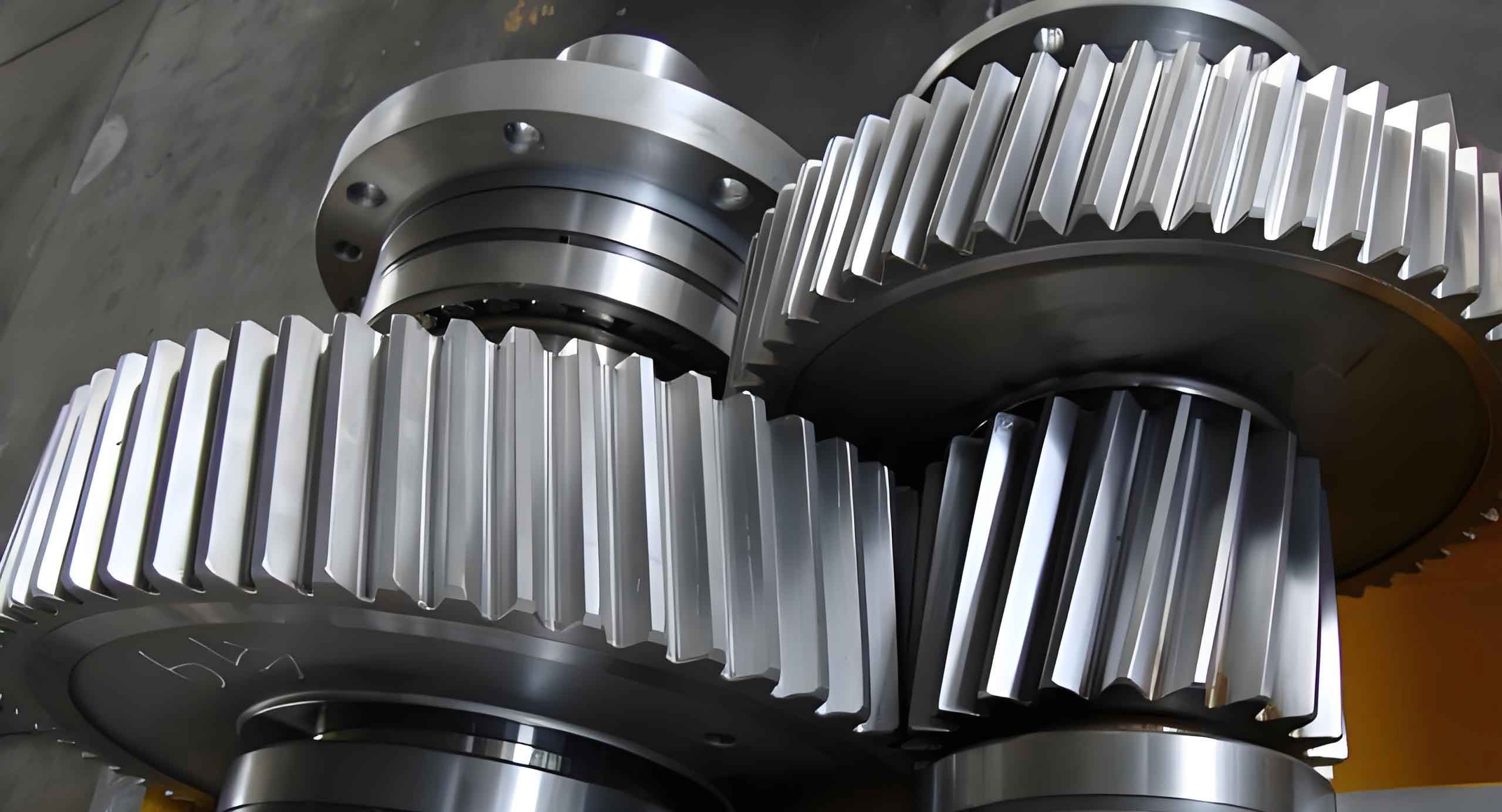
The mathematical foundation for analyzing helical gears with axis misalignments begins with the generation of the involute helical surface. For a planar involute curve, as illustrated in the reference, the equation in parametric form can be expressed as:
$$ \vec{r}_0(\mu) = x_0(\mu) \vec{i} + y_0(\mu) \vec{j} $$
$$ x_0(\mu) = r_b \cos(\sigma_0 + \mu) + r_b \mu \sin(\sigma_0 + \mu) $$
$$ y_0(\mu) = r_b \sin(\sigma_0 + \mu) – r_b \mu \cos(\sigma_0 + \mu) $$
Here, \( r_b \) is the base radius, \( \sigma_0 \) is the initial angle of the involute, and \( \mu \) is the generating angle. By performing a helical motion around the z-axis, the involute helical surface \( \Sigma \) is derived, with its equation given by:
$$ \vec{r}(\mu, \theta) = x(\mu, \theta) \vec{i} + y(\mu, \theta) \vec{j} + z(\mu, \theta) \vec{k} $$
$$ x(\mu, \theta) = r_b \cos(\sigma_0 + \mu + \theta) + r_b \mu \sin(\sigma_0 + \mu + \theta) $$
$$ y(\mu, \theta) = r_b \sin(\sigma_0 + \mu + \theta) – r_b \mu \cos(\sigma_0 + \mu + \theta) $$
$$ z(\mu, \theta) = p \theta $$
where \( p \) is the helix parameter. The normal vector at any point on this helical gear surface is:
$$ \vec{n}(\mu, \theta) = n_x(\mu, \theta) \vec{i} + n_y(\mu, \theta) \vec{j} + n_z(\mu, \theta) \vec{k} $$
$$ n_x(\mu, \theta) = p r_b \mu \sin(\sigma_0 + \mu + \theta) $$
$$ n_y(\mu, \theta) = -p r_b \mu \cos(\sigma_0 + \mu + \theta) $$
$$ n_z(\mu, \theta) = r_b^2 \mu $$
To model the meshing of helical gears with axis alignment errors, a coordinate transformation system is established. Consider two helical gears: Gear 1 is right-handed and Gear 2 is left-handed, with their respective coordinate systems. The transformations involve rotations and translations to account for misalignments, specifically the stagger angle error \( \gamma_x \) (in plane A) and the intersectant angle error \( \gamma_y \) (in plane B). The transformation matrices are defined as follows, where \( \phi_1 \) and \( \phi_2 \) are rotation angles of Gear 1 and Gear 2, respectively, and \( (a_x, a_y, a_z) \) represent translational shifts:
$$ M_{o1} = \begin{bmatrix}
\cos \phi_1 & -\sin \phi_1 & 0 & 0 \\
\sin \phi_1 & \cos \phi_1 & 0 & 0 \\
0 & 0 & 1 & 0 \\
0 & 0 & 0 & 1
\end{bmatrix} $$
$$ M_{p2} = \begin{bmatrix}
\cos \phi_2 & -\sin \phi_2 & 0 & 0 \\
\sin \phi_2 & \cos \phi_2 & 0 & 0 \\
0 & 0 & 1 & 0 \\
0 & 0 & 0 & 1
\end{bmatrix} $$
$$ M_{op} = \begin{bmatrix}
\cos \gamma_y \cos \gamma_z & \cos \gamma_z \sin \gamma_x \sin \gamma_y – \sin \gamma_z \cos \gamma_x & \cos \gamma_z \sin \gamma_y \cos \gamma_x + \sin \gamma_x \sin \gamma_z & a_x \\
\sin \gamma_z \cos \gamma_y & \sin \gamma_z \sin \gamma_x \sin \gamma_y + \cos \gamma_x \cos \gamma_z & \sin \gamma_z \sin \gamma_y \cos \gamma_x – \sin \gamma_x \cos \gamma_z & a_y \\
-\sin \gamma_y & \sin \gamma_x \cos \gamma_y & \cos \gamma_y \cos \gamma_x & a_z \\
0 & 0 & 0 & 1
\end{bmatrix} $$
In this analysis, I focus on axis angle errors, as center distance deviations do not significantly affect transmission ratio or cause edge contact in helical gears. The contact conditions between helical gear surfaces must be categorized to accurately determine the meshing trace. For helical gears with axis misalignments, contact can occur in various forms: surface-to-surface contact, line-to-surface contact, point-to-surface contact, and line-to-line contact, with the latter three being edge contact scenarios. The mathematical conditions for each are summarized below:
| Contact Type | Conditions | Mathematical Expressions |
|---|---|---|
| Surface-to-Surface | Position and normal vector alignment | $$ \vec{r}_1 = \vec{r}_2, \quad \vec{n}_1 = k \cdot \vec{n}_2 $$ |
| Line-to-Surface | Position and tangency condition | $$ \vec{r}_1 = \vec{r}_2, \quad \vec{t} \cdot \vec{n} = 0 $$ |
| Point-to-Surface | Position equality only | $$ \vec{r}_1 = \vec{r}_2 $$ |
| Line-to-Line | Position equality only | $$ \vec{r}_1 = \vec{r}_2 $$ |
To solve for the contact points, I apply these conditions to the transformed coordinates of the helical gear surfaces. For instance, for surface-to-surface contact, given the rotation angle \( \phi_1 \) of Gear 1, the system of equations is solved for parameters \( \mu_1, \theta_1, \mu_2, \theta_2, \phi_2 \). The general form for a point \( M_1 \) on Gear 1 transformed to the global coordinate system is \( (X_1(\mu_1, \theta_1, \phi_1), Y_1(\mu_1, \theta_1, \phi_1), Z_1(\mu_1, \theta_1, \phi_1)) \) with normal vector \( (NX_1, NY_1, NZ_1) \), and similarly for Gear 2. The contact equations become:
$$ X_1(\mu_1, \theta_1, \phi_1) = X_2(\mu_2, \theta_2, \phi_2) $$
$$ Y_1(\mu_1, \theta_1, \phi_1) = Y_2(\mu_2, \theta_2, \phi_2) $$
$$ Z_1(\mu_1, \theta_1, \phi_1) = Z_2(\mu_2, \theta_2, \phi_2) $$
$$ \frac{NX_1(\mu_1, \theta_1, \phi_1)}{NX_2(\mu_2, \theta_2, \phi_2)} = \frac{NY_1(\mu_1, \theta_1, \phi_1)}{NY_2(\mu_2, \theta_2, \phi_2)} $$
$$ \frac{NY_1(\mu_1, \theta_1, \phi_1)}{NY_2(\mu_2, \theta_2, \phi_2)} = \frac{NZ_1(\mu_1, \theta_1, \phi_1)}{NZ_2(\mu_2, \theta_2, \phi_2)} $$
The algorithm for determining the complete meshing trace of helical gears with axis errors involves evaluating all possible contact forms and selecting the dominant one at each instant. First, potential contact trajectories are computed for each contact type over specified angular ranges:
$$ \phi_2 = f_a(\phi_1), \quad \phi_1 \in (\theta_{1a}, \theta_{2a}) $$
$$ \phi_2 = f_b(\phi_1), \quad \phi_1 \in (\theta_{1b}, \theta_{2b}) $$
$$ \phi_2 = f_c(\phi_1), \quad \phi_1 \in (\theta_{1c}, \theta_{2c}) $$
$$ \ldots $$
Then, for overlapping intervals, the maximum \( \phi_2 \) value is taken to avoid interference, resulting in the integrated trace:
$$ \phi_2 = \max(f_a(\phi_1), f_b(\phi_1), f_c(\phi_1), \ldots), \quad \phi_1 \in (\theta_1, \theta_2) $$
$$ \text{where } \theta_1 = \min(\theta_{1a}, \theta_{1b}, \theta_{1c}, \ldots), \quad \theta_2 = \max(\theta_{2a}, \theta_{2b}, \theta_{2c}, \ldots) $$
However, this approach does not account for multi-tooth contact effects in helical gears, where subsequent teeth can influence the meshing of preceding ones due to varying transmission ratios. To address this, I consider an ideal gear pair without errors, with rotation angle \( \phi_2′ \), and define the deviation \( \Delta \phi_2 = \phi_2 – \phi_2′ \). By shifting the \( \Delta \phi_2 \) vs. \( \phi_1 \) curve by one tooth angle, overlapping regions are identified, and the actual meshing segment is determined by taking the larger \( \Delta \phi_2 \) values, effectively shortening the contact length compared to single-tooth analysis.
To illustrate the application of this model, I present a case study on a helical gear pair with the following parameters, summarized in the table below:
| Parameter | Gear 1 | Gear 2 |
|---|---|---|
| Number of Teeth, \( z \) | 28 | 35 |
| Normal Module, \( m_n \) (mm) | 4 | |
| Normal Pressure Angle, \( \alpha_n \) (°) | 23 | |
| Helix Angle, \( \beta \) (°) | 24 | |
| Face Width, \( B \) (mm) | 10 | |
First, I analyze the individual effects of stagger angle error \( \gamma_x \) and intersectant angle error \( \gamma_y \) on the helical gear meshing trace. For a stagger angle error of 3 arcminutes (3′), the contact trace reveals edge contact, primarily occurring at the end faces and root regions of Gear 1 and the end faces and tip edges of Gear 2. The contact forms include point-to-surface and line-to-surface interactions. The transmission ratio, defined as \( \phi_2 / \phi_1 \), fluctuates around the ideal value of 0.8, with periodic jumps during tooth transitions. The magnitude of these jumps is approximately \( 1.8 \times 10^{-3} \), indicating significant impact and noise potential. This behavior underscores the sensitivity of helical gears to axis misalignments.
For an intersectant angle error of 3′, similar edge contact patterns are observed in the helical gear pair, but the transmission ratio jumps are smaller, around \( 0.8 \times 10^{-3} \). This suggests that stagger angle errors have a more pronounced effect on transmission ratio fluctuations compared to intersectant angle errors for helical gears. The contact traces consistently show concentration at gear edges, highlighting the need for precise alignment in helical gear applications to avoid premature wear and failure.
To quantify these effects, the transmission ratio deviation \( \Delta i \) can be expressed as a function of the alignment errors. For small errors, a linear approximation may be derived:
$$ \Delta i \approx k_x \gamma_x + k_y \gamma_y $$
where \( k_x \) and \( k_y \) are coefficients dependent on helical gear geometry. From the analysis, \( |k_x| > |k_y| \), confirming the greater influence of stagger angles.
Next, I investigate the coupling effects of stagger and intersectant angle errors in helical gears. By varying both errors across seven levels from -3′ to 3′, a total of 49 combinations are analyzed to compute the transmission ratio jump magnitude. The results are interpolated and summarized in the following table, which shows the jump magnitude for selected error pairs:
| Stagger Angle \( \gamma_x \) (′) | Intersectant Angle \( \gamma_y \) (′) | Transmission Ratio Jump Magnitude (×10^{-3}) |
|---|---|---|
| -3 | -3 | 2.5 |
| -3 | 0 | 1.8 |
| -3 | 3 | 0.9 |
| 0 | -3 | 0.8 |
| 0 | 0 | 0.0 |
| 0 | 3 | 0.8 |
| 3 | -3 | 0.9 |
| 3 | 0 | 1.8 |
| 3 | 3 | 2.5 |
The data reveals a clear coupling pattern: when stagger and intersectant angle errors have opposite signs (e.g., negative stagger with positive intersectant, or vice versa), the transmission ratio jumps are reduced, indicating a compensatory effect. Conversely, when both errors have the same sign, the jumps are amplified. This can be visualized as a distribution map where the jump magnitude contours approximate straight lines with a slope of about -2, meaning that along the line \( \gamma_y = -2 \gamma_x \), the jumps are minimized. This linear relationship highlights the predictable interaction between alignment errors in helical gears, which can guide tolerance allocation in design.
The underlying mechanism for this coupling in helical gears relates to the geometric interplay of misalignments. The total effective error \( \gamma_{\text{eff}} \) might be modeled as:
$$ \gamma_{\text{eff}} = \sqrt{ \gamma_x^2 + c \gamma_y^2 + 2d \gamma_x \gamma_y } $$
where \( c \) and \( d \) are constants derived from helical gear parameters. For the studied helical gear pair, \( d \) is negative, leading to reduced effects when errors oppose each other. This emphasizes the importance of considering combined errors in helical gear systems, as real-world installations often involve multiple misalignment sources.
Furthermore, the contact stress distribution in helical gears under axis errors can be estimated using Hertzian contact theory, modified for edge contact scenarios. The maximum contact pressure \( p_{\text{max}} \) for a point contact on a helical gear tooth is given by:
$$ p_{\text{max}} = \frac{3F}{2\pi a b} $$
where \( F \) is the normal load, and \( a \) and \( b \) are the semi-axes of the contact ellipse, which depend on the local curvatures of the helical gear surfaces. Under edge contact, the curvatures change abruptly, leading to stress concentrations. For a helical gear with alignment errors, the effective radius of curvature \( R’ \) can be expressed as:
$$ \frac{1}{R’} = \frac{1}{R_1} + \frac{1}{R_2} + \Delta(\gamma_x, \gamma_y) $$
Here, \( R_1 \) and \( R_2 \) are the principal radii of curvature of the helical gear teeth, and \( \Delta \) is a correction term due to misalignments. This stresses the need for accurate TCA in helical gear design to predict fatigue life and failure modes.
In summary, this study provides a comprehensive analysis of helical gear meshing under axis alignment errors using TCA. The key findings are: First, axis angle errors cause edge contact in helical gears, concentrating contact regions at tooth edges such as tips, roots, and end faces. Second, these errors induce periodic jumps in the transmission ratio of helical gears, with stagger angle errors having a larger impact than intersectant angle errors. Third, the coupling effects between stagger and intersectant angles follow a linear pattern, where errors of opposite signs partially cancel out, reducing transmission ratio fluctuations. These insights can inform tolerance design for helical gearboxes, potentially reducing the need for extensive gear modification and improving reliability. Future work could extend this model to dynamic analyses or include thermal effects for a more holistic understanding of helical gear performance in practical applications.