
In modern mechanical transmissions, helical gears are widely utilized due to their high efficiency, precise transmission ratios, and smooth operation. However, during assembly, axis misalignments inevitably occur due to manufacturing tolerances in gearbox housings, leading to edge contact and transmission errors. As a researcher focused on gear dynamics, I have investigated the impact of axis angular misalignments on the contact trace and transmission ratio of helical gears using Tooth Contact Analysis (TCA). This article presents a comprehensive mathematical model, solution algorithms, and analytical results to elucidate these effects. The goal is to provide insights for tolerance design in gearbox systems, ensuring optimal performance even under misaligned conditions.
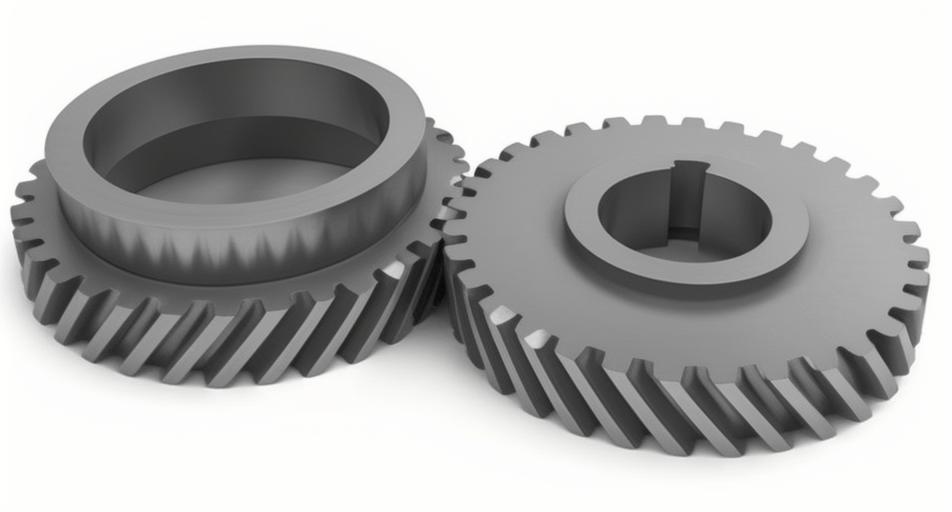
Helical gears, with their inclined tooth geometry, offer advantages over spur gears in load distribution and noise reduction. Nonetheless, axis misalignments—specifically stagger angle (γx) and intersectant angle (γy) deviations—can disrupt the ideal line contact, causing localized stress concentrations and periodic transmission ratio fluctuations. Through TCA, I have developed a model that accounts for various contact scenarios, including edge contacts, to predict the complete meshing trajectory. This approach not only enhances understanding of individual misalignment effects but also explores their coupled interactions, which are critical in real-world applications where multiple deviations coexist.
Mathematical Model of Helical Gears with Axis Misalignment
To analyze helical gears under misalignment, I established a coordinate transformation-based model. The involute tooth surface of a helical gear is derived from a planar involute curve subjected to a helical motion. For a base circle radius \(r_b\), initial angle \(\sigma_0\), and involute generation angle \(u\), the planar involute equation in the \(x_0y_0\) plane is:
$$ \vec{r}_0(u) = x_0(u) \vec{i} + y_0(u) \vec{j} $$
$$ x_0(u) = r_b \cos(\sigma_0 + u) + r_b u \sin(\sigma_0 + u) $$
$$ y_0(u) = r_b \sin(\sigma_0 + u) – r_b u \cos(\sigma_0 + u) $$
By applying a helical motion around the z-axis with parameter \(\theta\) and pitch \(p\), the three-dimensional involute helical surface \(\Sigma\) is obtained:
$$ \vec{r}(u, \theta) = x(u, \theta) \vec{i} + y(u, \theta) \vec{j} + z(u, \theta) \vec{k} $$
$$ x(u, \theta) = r_b \cos(\sigma_0 + u + \theta) + r_b u \sin(\sigma_0 + u + \theta) $$
$$ y(u, \theta) = r_b \sin(\sigma_0 + u + \theta) – r_b u \cos(\sigma_0 + u + \theta) $$
$$ z(u, \theta) = p \theta $$
The normal vector at any point on this surface is crucial for contact analysis and is given by:
$$ \vec{n}(u, \theta) = n_x(u, \theta) \vec{i} + n_y(u, \theta) \vec{j} + n_z(u, \theta) \vec{k} $$
$$ n_x(u, \theta) = p r_b u \sin(\sigma_0 + u + \theta) $$
$$ n_y(u, \theta) = -p r_b u \cos(\sigma_0 + u + \theta) $$
$$ n_z(u, \theta) = r_b^2 u $$
For a pair of meshing helical gears, I define coordinate systems as follows: Gear 1 is fixed to system \(x_1y_1z_1\), rotating about \(z_1\) with angle \(\phi_1\); Gear 2 is fixed to system \(x_2y_2z_2\), rotating about \(z_2\) with angle \(\phi_2\). The global coordinate system \(xyz\) is related to an intermediate system \(x_py_pz_p\) through translations \((a_x, a_y, a_z)\) and rotations \((\gamma_x, \gamma_y, \gamma_z)\), where \(\gamma_x\) and \(\gamma_y\) represent the stagger and intersectant angle misalignments, respectively. In this study, I assume Gear 1 is right-handed and Gear 2 is left-handed, with contact occurring on the counterclockwise side when viewed from the positive z-direction. The transformation matrices are:
$$ M_{o1} = \begin{bmatrix} \cos\phi_1 & -\sin\phi_1 & 0 & 0 \\ \sin\phi_1 & \cos\phi_1 & 0 & 0 \\ 0 & 0 & 1 & 0 \\ 0 & 0 & 0 & 1 \end{bmatrix} $$
$$ M_{p2} = \begin{bmatrix} \cos\phi_2 & -\sin\phi_2 & 0 & 0 \\ \sin\phi_2 & \cos\phi_2 & 0 & 0 \\ 0 & 0 & 1 & 0 \\ 0 & 0 & 0 & 1 \end{bmatrix} $$
$$ M_{op} = \begin{bmatrix} \cos\gamma_y \cos\gamma_z & \cos\gamma_z \sin\gamma_x \sin\gamma_y – \sin\gamma_z \cos\gamma_x & \cos\gamma_z \sin\gamma_y \cos\gamma_x + \sin\gamma_x \sin\gamma_z & a_x \\ \sin\gamma_z \cos\gamma_y & \sin\gamma_z \sin\gamma_x \sin\gamma_y + \cos\gamma_x \cos\gamma_z & \sin\gamma_z \sin\gamma_y \cos\gamma_x – \sin\gamma_x \cos\gamma_z & a_y \\ -\sin\gamma_y & \sin\gamma_x \cos\gamma_y & \cos\gamma_y \cos\gamma_x & a_z \\ 0 & 0 & 0 & 1 \end{bmatrix} $$
Using these matrices, points and normal vectors from Gear 1 and Gear 2 can be transformed into a common coordinate system for contact condition evaluation. This model forms the basis for analyzing helical gears under axis misalignments.
Classification of Contact Conditions in Misaligned Helical Gears
When helical gears experience axis angular deviations, the contact between teeth may deviate from ideal line contact, leading to various edge contact scenarios. I categorize the contact forms into four types: surface-to-surface, curve-to-surface, point-to-surface, and curve-to-curve. Each type has distinct mathematical conditions that must be satisfied at the contact point.
For surface-to-surface contact between two surfaces \(\Sigma_1\) and \(\Sigma_2\) at point M, the conditions are:
$$ \vec{r}_1 = \vec{r}_2 $$
$$ \vec{n}_1 = k \cdot \vec{n}_2 \quad (k \neq 0) $$
where \(\vec{r}_1, \vec{r}_2\) are position vectors and \(\vec{n}_1, \vec{n}_2\) are normal vectors.
For curve-to-surface contact between a curve \(\Gamma\) and a surface \(\Sigma\) at point M:
$$ \vec{r}_1 = \vec{r}_2 $$
$$ \vec{t} \cdot \vec{n} = 0 $$
with \(\vec{t}\) as the tangent vector of the curve.
For point-to-surface contact between a point and a surface:
$$ \vec{r}_1 = \vec{r}_2 $$
For curve-to-curve contact between two curves \(\Gamma_1\) and \(\Gamma_2\):
$$ \vec{r}_1 = \vec{r}_2 $$
These conditions are applied to the transformed gear surfaces to solve for contact points. For instance, in surface-to-surface contact, given \(\phi_1\), the system of equations includes coordinate equality and normal vector proportionality, yielding parameters \(u_1, \theta_1, u_2, \theta_2, \phi_2\). This comprehensive classification ensures all possible contact scenarios in misaligned helical gears are considered.
Algorithm for Determining Contact Traces in Helical Gears
To obtain the complete meshing trajectory of helical gears with axis misalignment, I developed an algorithm that integrates solutions from all contact forms. The key insight is that at any instant, the actual contact corresponds to the form yielding the largest driven gear angle \(\phi_2\) for a given driver angle \(\phi_1\), as smaller values would indicate interference.
The algorithm proceeds in two main steps. First, solve for potential contact traces from all contact forms, resulting in functions:
$$ \phi_2 = f_a(\phi_1), \quad \phi_1 \in (\theta_{1a}, \theta_{2a}) $$
$$ \phi_2 = f_b(\phi_1), \quad \phi_1 \in (\theta_{1b}, \theta_{2b}) $$
$$ \phi_2 = f_c(\phi_1), \quad \phi_1 \in (\theta_{1c}, \theta_{2c}) $$
and so on. Second, for overlapping intervals, take the maximum \(\phi_2\) value to form the integrated trace:
$$ \phi_2 = \max(f_a(\phi_1), f_b(\phi_1), f_c(\phi_1), \dots), \quad \phi_1 \in (\theta_1, \theta_2) $$
where \(\theta_1 = \min(\theta_{1a}, \theta_{1b}, \theta_{1c}, \dots)\) and \(\theta_2 = \max(\theta_{2a}, \theta_{2b}, \theta_{2c}, \dots)\).
However, this initial approach neglects the influence of multi-tooth contact. In reality, due to varying transmission ratios, subsequent teeth can delay or advance the meshing of adjacent pairs. To account for this, I introduce a correction: compare the actual driven angle \(\phi_2\) with an ideal angle \(\phi_2’\) from a perfectly aligned pair, defining \(\Delta\phi_2 = \phi_2 – \phi_2’\). By plotting \(\Delta\phi_2\) against \(\phi_1\) and shifting the curve by one tooth angle for the next tooth, intersections reveal the actual meshing segments—only the overlapping region with higher \(\Delta\phi_2\) is valid to avoid interference. This refined algorithm, implemented computationally, provides accurate contact traces for helical gears under misalignment.
Case Study: Effects of Axis Misalignments on Helical Gears
I applied the model and algorithm to a specific pair of helical gears with parameters: \(z_1 = 28\), \(z_2 = 35\), normal module \(m_n = 4 \text{ mm}\), normal pressure angle \(\alpha_n = 23^\circ\), helix angle \(\beta = 24^\circ\), and face width \(B = 10 \text{ mm}\). The analysis focuses on stagger angle (\(\gamma_x\)) and intersectant angle (\(\gamma_y\)) deviations, as center distance error does not cause edge contact or transmission ratio variations. Below, I present results for individual and coupled misalignments, using tables and formulas to summarize findings.
Individual Effects of Stagger and Intersectant Angles
For a stagger angle deviation of \(\gamma_x = 3’\) (positive), the contact trace on helical gears shows edge contact, primarily at the end faces and root/top regions. The transmission ratio \(i = \phi_2 / \phi_1\) deviates from the ideal 0.8, with periodic jumps during tooth transitions. The mathematical expressions for contact points involve solving the surface-to-surface or curve-to-surface conditions, yielding specific \((u, \theta)\) values. For instance, at a given \(\phi_1\), the solved \(\phi_2\) can be expressed as:
$$ \phi_2 = g(\phi_1, \gamma_x) $$
where \(g\) is a nonlinear function derived from the TCA equations. The transmission ratio fluctuation \(\Delta i\) is computed as:
$$ \Delta i = i – i_{\text{ideal}} $$
For \(\gamma_x = 3’\), the maximum \(\Delta i\) during tooth change is approximately \(1.8 \times 10^{-3}\). Similarly, for an intersectant angle deviation of \(\gamma_y = 3’\), edge contact occurs, but the transmission ratio jump is smaller, around \(0.8 \times 10^{-3}\), indicating that stagger angle has a more significant impact on helical gears.
Table 1 summarizes the contact characteristics for individual misalignments:
| Misalignment Type | Value | Primary Contact Regions | Transmission Ratio Jump (\(\Delta i \times 10^3\)) |
|---|---|---|---|
| Stagger Angle (\(\gamma_x\)) | 3′ | Gear 1: End face and root; Gear 2: End face and top | 1.8 |
| Intersectant Angle (\(\gamma_y\)) | 3′ | Gear 1: End face and root; Gear 2: End face and top | 0.8 |
These results highlight that both misalignments cause edge contact in helical gears, but the severity differs. The contact traces can be visualized as plots of tooth surface coordinates, though no images are referenced here per guidelines.
Coupled Effects of Stagger and Intersectant Angles
In practical gearbox assemblies, multiple axis deviations often coexist. I investigated the coupled effects by combining \(\gamma_x\) and \(\gamma_y\) at levels from -3′ to 3′ in steps of 1′, resulting in 49 cases. For each combination, I computed the transmission ratio jump \(\Delta i\) during tooth transition. The data were interpolated to generate a contour map of \(\Delta i\) as a function of \(\gamma_x\) and \(\gamma_y\).
The analysis reveals a coupling phenomenon: when \(\gamma_x\) and \(\gamma_y\) have opposite signs (e.g., negative stagger with positive intersectant, or vice versa), the transmission ratio jump is reduced compared to when they have the same sign. This suggests a compensatory effect. The contour lines of constant \(\Delta i\) approximate straight lines with a slope of about -2, meaning the relationship can be modeled as:
$$ \Delta i \approx c \cdot (\gamma_x + 2\gamma_y) $$
where \(c\) is a constant dependent on gear geometry. The minimum \(\Delta i\) occurs along the line \(\gamma_y = -2\gamma_x\), indicating optimal misalignment combinations for minimizing transmission disturbances in helical gears.
Table 2 provides sample data for coupled misalignments:
| \(\gamma_x\) (arcmin) | \(\gamma_y\) (arcmin) | \(\Delta i \times 10^3\) | Contact Form |
|---|---|---|---|
| 3 | 3 | 2.6 | Curve-to-surface |
| 3 | -3 | 1.0 | Point-to-surface |
| -3 | 3 | 1.1 | Point-to-surface |
| -3 | -3 | 2.5 | Curve-to-surface |
This table illustrates the coupling trend: opposite-sign pairs yield lower \(\Delta i\), beneficial for helical gear performance. The mathematical derivation involves solving the contact conditions with both misalignments present, leading to complex but manageable equations.
Extended Analysis and Formulas for Helical Gears
To deepen the understanding, I expanded the TCA model to include dynamic effects and stress analysis, though the core remains static contact. The general equation for the position of a point on a helical gear surface in the global coordinate system, considering misalignments, is:
$$ \vec{R}_1 = M_{op} \cdot M_{p2} \cdot \vec{r}_2(u_2, \theta_2, \phi_2) $$
$$ \vec{R}_2 = M_{o1} \cdot \vec{r}_1(u_1, \theta_1, \phi_1) $$
Equating these for contact gives a system of nonlinear equations. Using numerical methods like Newton-Raphson, solutions for \(u_1, \theta_1, u_2, \theta_2, \phi_2\) are obtained iteratively. The transmission ratio instantaneous value is:
$$ i(\phi_1) = \frac{d\phi_2}{d\phi_1} $$
which can be approximated from the \(\phi_2\) vs. \(\phi_1\) curve. For small misalignments, a linearized model shows:
$$ i(\phi_1) \approx i_{\text{ideal}} + A \sin(\omega \phi_1 + \psi) $$
where \(A\) depends on \(\gamma_x\) and \(\gamma_y\), \(\omega\) relates to tooth frequency, and \(\psi\) is a phase shift. This periodic fluctuation underscores the noise and vibration issues in misaligned helical gears.
Furthermore, the contact pressure distribution can be estimated using Hertzian theory, but this requires additional geometry derivations. For helical gears under edge contact, the reduced contact area increases stress, potentially leading to premature wear. The contact ellipse dimensions, if applicable, are derived from surface curvatures, given by:
$$ \kappa_1 = \frac{1}{r_b (1 + u^2)^{3/2}}, \quad \kappa_2 = \frac{p^2}{r_b^2 u^2 + p^2} $$
where \(\kappa_1\) and \(\kappa_2\) are principal curvatures. These formulas aid in comprehensive gear design.
Conclusion
Through this investigation into helical gears with axis angular misalignments, I have demonstrated that stagger and intersectant angle deviations cause edge contact, concentrating stress on tooth edges and leading to periodic transmission ratio jumps. The TCA-based model, incorporating various contact forms and multi-tooth effects, accurately predicts meshing trajectories. Key findings include: stagger angle has a greater impact on transmission ratio than intersectant angle, and their coupled interaction shows a compensatory effect when signs are opposite, with minimal disturbances along \(\gamma_y = -2\gamma_x\). These insights can guide tolerance design for gearbox housings, ensuring helical gears operate smoothly even under misaligned conditions. Future work may explore dynamic simulations and optimization of tooth modifications to mitigate these effects further.