
In the field of mechanical transmission, spur gears are fundamental components widely used in aerospace, automotive, and industrial machinery due to their simplicity and efficiency in power transmission. Traditional manufacturing methods for spur gears, such as cutting and machining, often lead to material waste, disrupted fiber continuity, and reduced mechanical properties, which can compromise the longevity and performance of these critical parts. To address these limitations, precision forging techniques, including hot orbital forging, have emerged as promising alternatives. Hot orbital forging, a localized plastic forming process, offers advantages such as reduced forming loads, minimized vibration and noise, and improved microstructural characteristics, making it suitable for producing high-performance spur gears. In this article, I explore the hot orbital forging process for aerospace cylindrical spur gears through finite element simulation and experimental validation, focusing on metal deformation patterns, tooth filling behavior, and process optimization. The insights gained aim to advance the understanding of this innovative forming technology for spur gears.
The hot orbital forging process involves a swinging die (orbital die) that rotates and oscillates against a workpiece, while a gear cavity die moves upward to facilitate gradual plastic deformation. This method reduces the required forming force to approximately 10–20% of conventional forging, as deformation occurs in localized zones. For aerospace applications, where spur gears must withstand high loads and extreme conditions, achieving precise tooth profiles with enhanced mechanical properties is crucial. My analysis leverages a three-dimensional rigid-plastic finite element model developed in DEFORM-3D software to simulate the hot orbital forging of a cylindrical spur gear made from 20CrMnTi alloy. The simulation parameters are summarized in Table 1, which outlines key geometric and process variables. The gear geometry, with parameters such as module, pressure angle, and tooth width, is designed to meet aerospace standards, ensuring that the spur gears exhibit optimal performance.
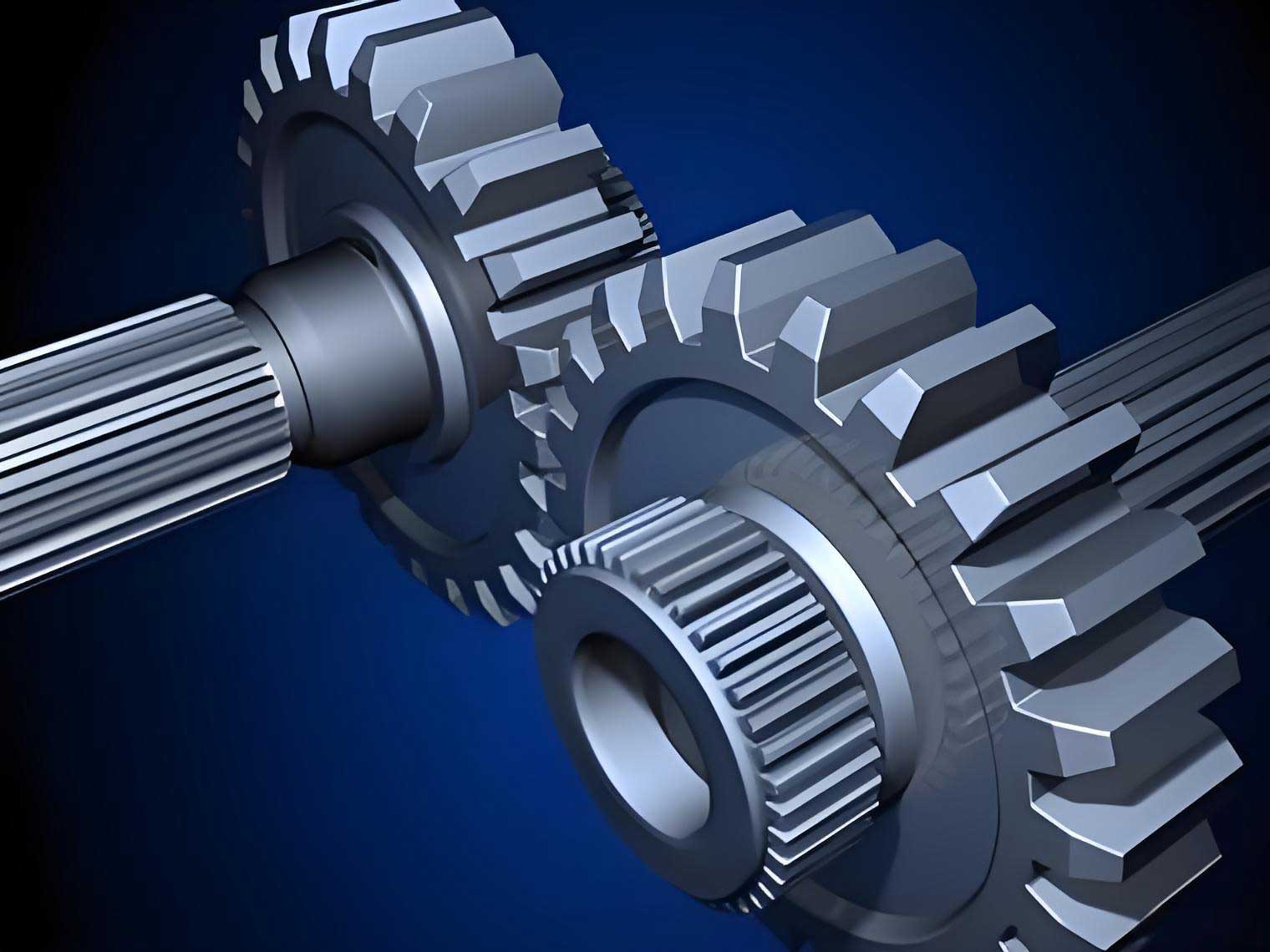
To establish the finite element model, I first created a three-dimensional representation of the spur gear based on standard geometric parameters. The gear has 16 teeth, a module of 4.5 mm, a pressure angle of 20°, and a tooth width of 11 mm. The blank is designed as a cylindrical billet with a diameter slightly smaller than the gear’s hub diameter, following volume conservation principles. The orbital die and gear cavity die are modeled as rigid bodies, while the blank is treated as a plastic body with material properties corresponding to 20CrMnTi steel. The interfacial friction is described using a shear model with a coefficient of 0.25, and thermal conductivity between the dies and blank is set to 11 N·s⁻¹·mm⁻¹·°C⁻¹. The process conditions include a blank temperature of 1000°C, die temperatures of 300°C, a feed rate of 11.5 mm/s for the gear cavity, an orbital die rotational speed of 4 r/s, an orbital angle of 2°, and a total forming time of 2.5 seconds (including 0.5 seconds of finishing). The mesh is refined in the tooth region to capture detailed deformation behavior, with approximately 100,000 elements. This setup allows for a comprehensive analysis of the hot orbital forging process for spur gears.
| Parameter | Value |
|---|---|
| Number of Teeth | 16 |
| Module (mm) | 4.5 |
| Pressure Angle (°) | 20 |
| Addendum Coefficient | 1 |
| Clearance Coefficient | 0.25 |
| Tooth Width (mm) | 11 |
| Blank Diameter (mm) | Calculated based on volume |
| Orbital Angle (°) | 2 |
| Feed Rate (mm/s) | 11.5 |
| Rotational Speed (r/s) | 4 |
| Blank Temperature (°C) | 1000 |
| Die Temperature (°C) | 300 |
The deformation during hot orbital forging of spur gears can be divided into distinct stages: initial contact, intermediate forming, final filling, and finishing. In the initial stage, the orbital die contacts the blank’s upper surface, causing localized plastic deformation that forms the hub regions. As the process progresses, the blank undergoes upsetting, with its height decreasing and diameter increasing, leading to a mushroom-shaped profile. The tooth filling begins from the top and moves downward, with metal flowing radially in the active deformation zone (directly under the orbital die) and axially in the passive zone. This asymmetric flow is critical for achieving complete tooth profiles in spur gears. The velocity field analysis reveals that metal flow speeds are highest in the active deformation zone, exceeding 10 mm/s, while the passive zone experiences slower flow, around 2–5 mm/s. This differential flow ensures that tooth roots are filled first, followed by tooth tips, minimizing defects such as underfilling or flash formation. The periodic motion of the orbital die causes cyclical variations in metal flow, which I characterize using the following equation for velocity components in cylindrical coordinates:
$$v_r = f(r, \theta, t) \quad \text{and} \quad v_z = g(r, z, t)$$
where \( v_r \) is the radial velocity, \( v_z \) is the axial velocity, \( r \) is the radial distance, \( \theta \) is the angular position, \( z \) is