
In modern automotive engineering, the adoption of hypoid gears in drive axles has expanded from passenger cars and light vehicles to medium- and heavy-duty trucks. This shift is driven by advancements in manufacturing processes and the increased availability of specialized hypoid gear oils. However, due to their unique operating conditions and characteristics, users often encounter issues related to hypoid gear damage. In this article, I will comprehensively analyze the failure modes of hypoid gears, focusing on single-reduction hypoid gear reducers used in heavy-duty trucks. I will explore key factors such as operational parameters, material properties, lubrication quality, and maintenance practices, supported by tables and formulas to provide a detailed understanding. Throughout, I will emphasize the importance of proper design and maintenance for hypoid gears, a critical component in modern drivetrains.
The hypoid gear, a type of spiral bevel gear with offset axes, offers significant advantages in terms of strength, noise reduction, and compact design. Its geometry allows for larger pinion diameters, enhancing bending strength and durability. However, the complex contact conditions and high sliding velocities inherent to hypoid gears make them susceptible to various damage mechanisms if not properly managed. I will begin by comparing hypoid gears with traditional spiral bevel gears to establish a foundational understanding.
| Characteristic | Hypoid Gear | Spiral Bevel Gear |
|---|---|---|
| Operational Smoothness | Excellent | Good |
| Bending Strength | Increased by 20-30% | Relatively Lower |
| Anti-Scoring Ability | High | High |
| Contact Strength | High | Moderate |
| Transmission Efficiency | Approximately 96-98% | Approximately 95-97% |
| Sensitivity to Installation Errors | Depends on Support Stiffness and Cutter Diameter | Depends on Support Stiffness and Cutter Diameter |
| Bearing Load | Higher Axial Force on Pinion | Lower Axial Force on Pinion |
| Lubricant Requirement | Specialized Oil with Anti-Scuff Additives | General Gear Oil |
This table highlights the superior performance of hypoid gears in many aspects, but also underscores their need for specific lubrication and careful handling. The higher axial forces on the pinion in hypoid gears necessitate robust bearing designs, while the specialized lubrication requirements are crucial to prevent damage. To delve deeper, I will analyze the relationship between hypoid gear damage and operational factors.
Damage Analysis in Relation to Operating Speed and Torque
Hypoid gears in heavy-duty trucks operate under varying conditions of speed and torque. The damage patterns are closely linked to these parameters. Based on field studies, I have observed the following correlations:
- Repeated Rapid Acceleration and Deceleration: This cyclic loading induces high contact stresses and sliding velocities, leading to scuffing or adhesion on both the drive and coast sides of the gear teeth. The contact stress can be modeled using the Hertzian contact formula for hypoid gears:
$$ \sigma_H = \sqrt{ \frac{F_t}{b d_1} \cdot \frac{u + 1}{u} \cdot \frac{Z_E Z_H Z_\epsilon}{\cos^2 \alpha} } $$
where \( \sigma_H \) is the contact stress, \( F_t \) is the tangential force, \( b \) is the face width, \( d_1 \) is the pinion reference diameter, \( u \) is the gear ratio, \( Z_E \) is the elasticity factor, \( Z_H \) is the zone factor, \( Z_\epsilon \) is the contact ratio factor, and \( \alpha \) is the pressure angle. For hypoid gears, the offset introduces additional complexity, but this formula provides a baseline. Under rapid transients, \( F_t \) fluctuates sharply, causing \( \sigma_H \) to exceed the material’s endurance limit, promoting surface damage. - Prolonged High-Speed Operation: When vehicles operate at high speeds for extended periods, the hypoid gears experience elevated temperatures and reduced oil film thickness. This can result in scuffing and increased noise. The sliding velocity \( v_g \) in hypoid gears is critical and can be approximated by:
$$ v_g = v \cdot \sin \beta \cdot \frac{\sqrt{R_a^2 – R_b^2}}{R_a} $$
where \( v \) is the pitch line velocity, \( \beta \) is the spiral angle, \( R_a \) is the outer cone distance, and \( R_b \) is the offset distance. High \( v_g \) values exacerbate wear if lubrication is inadequate. - Overload at Low Speed and High Torque: In scenarios such as climbing steep grades or hauling excessive loads, hypoid gears are subjected to low speeds but high torque. This leads to extreme contact pressures, causing plastic deformation, rippling, and pitting on the tooth surfaces. The bending stress \( \sigma_F \) at the root of the hypoid gear tooth can be expressed as:
$$ \sigma_F = \frac{F_t}{b m_n} Y_F Y_S Y_\beta K_A K_V K_{F\beta} K_{F\alpha} $$
where \( m_n \) is the normal module, \( Y_F \) is the form factor, \( Y_S \) is the stress correction factor, \( Y_\beta \) is the helix angle factor, and \( K_A \), \( K_V \), \( K_{F\beta} \), \( K_{F\alpha} \) are application, dynamic, face load, and transverse load factors, respectively. Under high torque, \( F_t \) increases, raising \( \sigma_F \) and potentially leading to fatigue cracks.
To quantify the impact, I have compiled data from various hypoid gear failures, summarized in the table below:
| Operating Condition | Primary Damage Mode | Typical Stress Values | Preventive Measures |
|---|---|---|---|
| Rapid Acceleration/Deceleration | Scuffing, Adhesion | \(\sigma_H > 1500 \, \text{MPa}\) | Use of anti-wear additives, smoother driving |
| Prolonged High Speed | Scuffing, Noise | \(v_g > 8 \, \text{m/s}\), Temperature > 120°C | Improved cooling, high-temperature oils |
| Low Speed, High Torque | Plastic Deformation, Pitting | \(\sigma_F > 500 \, \text{MPa}\), Contact pressure > 2 GPa | Proper load management, robust material |
These conditions underscore the need for balanced operation and design optimization for hypoid gears. The hypoid gear’s geometry, while beneficial, requires careful consideration of load cycles and thermal management.
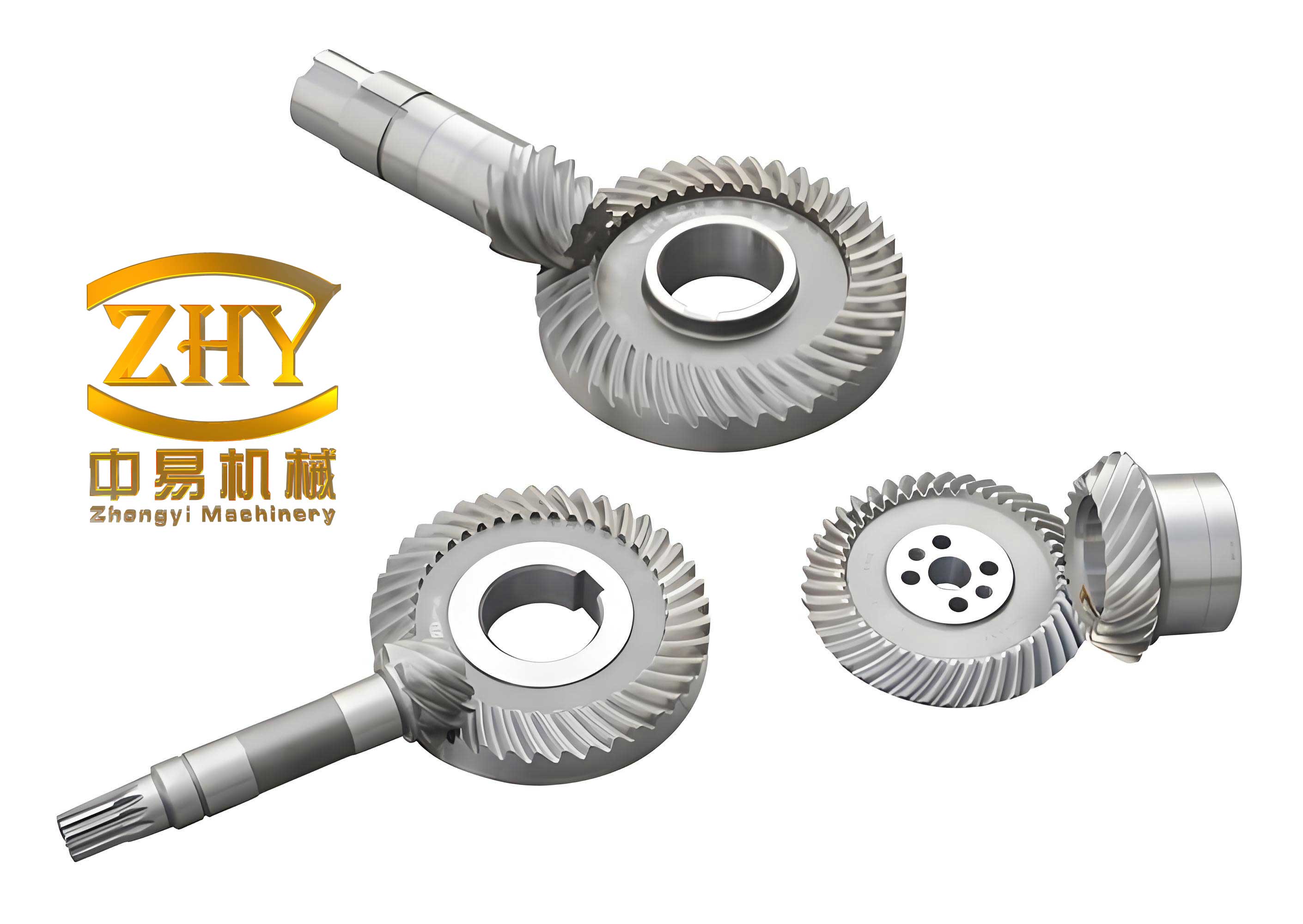
Relationship Between Gear Hardness and Damage
Hypoid gears are typically manufactured from carburized alloy steels, such as AISI 8620 or similar grades, to achieve a hard surface layer with a tough core. This combination provides excellent wear resistance and compressive strength, while maintaining good fracture toughness. However, improper hardness profiles or material defects can lead to specific damage modes. I will analyze this in detail.
The surface hardness of hypoid gears is usually in the range of 58-62 HRC, with a case depth of 0.8-1.5 mm, depending on the module and application. The core hardness is typically 28-35 HRC. The hardness gradient is crucial for performance. The effective case depth \( \delta_c \) can be defined as the distance from the surface to the point where hardness drops to 550 HV, and it influences the gear’s load-bearing capacity. The relationship between hardness \( H \) and yield strength \( \sigma_y \) for steel can be approximated by:
$$ \sigma_y \approx 3.45 \times H \quad (\text{in MPa for HV hardness}) $$
For hypoid gears, this translates to high surface strength but also sensitivity to subsurface stresses.
- Plastic Deformation under Overload: If the hypoid gear is subjected to excessive loads beyond its design limits, the softer core beneath the hardened case may yield, causing plastic deformation. This can manifest as tooth flank wear or even spalling. The critical load \( P_{cr} \) for plastic deformation can be estimated using:
$$ P_{cr} = \frac{\sigma_y \cdot b \cdot m_n}{Y_F \cdot S_F} $$
where \( S_F \) is the safety factor. When operational loads exceed \( P_{cr} \), damage ensues. - Case Crushing due to Carbon Gradient: If there is a significant difference in carbon content between the case and core, leading to a steep hardness gradient, the hypoid gear may experience case crushing or spalling. This occurs when the hardened layer detaches from the substrate. The carbon concentration \( C(x) \) as a function of depth \( x \) can be modeled by Fick’s law:
$$ \frac{\partial C}{\partial t} = D \frac{\partial^2 C}{\partial x^2} $$
where \( D \) is the diffusion coefficient. Improper carburizing can result in a brittle interface, reducing fatigue life. - Oxidative Wear and Hardness: The formation of an oxide layer on hypoid gear surfaces during operation acts as a protective film. The adhesion of this film to the base metal depends on the hardness difference \( \Delta H \) between the film and substrate. A smaller \( \Delta H \) enhances bonding, reducing oxidative wear. The wear rate \( W \) can be expressed as:
$$ W = k \cdot \frac{P}{H} \cdot v $$
where \( k \) is a wear coefficient, \( P \) is the load, and \( v \) is the sliding velocity. Higher surface hardness \( H \) decreases \( W \), emphasizing the importance of proper heat treatment for hypoid gears.
To illustrate, I present a table summarizing hardness-related failures in hypoid gears:
| Hardness Problem | Damage Type | Typical Hardness Values | Remedial Action |
|---|---|---|---|
| Insufficient Case Depth | Subsurface Fatigue, Pitting | Case depth < 0.8 mm | Optimize carburizing process |
| Excessive Core Hardness | Brittle Fracture | Core hardness > 40 HRC | Adjust alloy composition |
| Steep Hardness Gradient | Spalling, Case Crushing | Gradient > 100 HV/mm | Controlled cooling, tempering |
These factors highlight that the material properties of hypoid gears are pivotal to their longevity. Regular hardness testing and microstructure analysis are recommended for quality assurance.
Influence of Gear Oil Quality on Hypoid Gear Damage
Hypoid gears operate under extreme pressures, often exceeding 3000 MPa, and sliding velocities above 10 m/s, with oil temperatures reaching 150-160°C. Therefore, the quality of gear oil is paramount in preventing damage. I will examine how oil properties affect hypoid gear performance.
Specialized hypoid gear oils contain extreme pressure (EP) additives, such as sulfur-phosphorus compounds, to form protective films on tooth surfaces. The viscosity \( \eta \) of the oil plays a critical role in maintaining an elastohydrodynamic (EHD) film. The film thickness \( h \) can be calculated using the Dowson-Higginson equation:
$$ h = 2.65 \frac{R^{0.43} (\eta_0 u)^{0.7} \alpha^{0.54}}{E’^{0.03} W^{0.13}} $$
where \( R \) is the effective radius, \( \eta_0 \) is the dynamic viscosity at inlet temperature, \( u \) is the entraining velocity, \( \alpha \) is the pressure-viscosity coefficient, \( E’ \) is the reduced modulus of elasticity, and \( W \) is the load per unit width. For hypoid gears, maintaining \( h \) above the composite surface roughness is essential to prevent metal-to-metal contact.
- High-Temperature Operation and Oil Starvation: Prolonged operation at high temperatures can cause oil degradation and thinning, leading to insufficient film thickness and scuffing. The viscosity-temperature relationship is given by the Vogel equation:
$$ \eta = \eta_0 \exp\left( \frac{B}{T + C} \right) $$
where \( T \) is temperature, and \( B, C \) are constants. As \( T \) increases, \( \eta \) drops exponentially, compromising lubrication. - Low-Speed, High-Torque Conditions: Under these conditions, the oil’s viscosity must be high enough to withstand extreme pressures without being squeezed out. If the oil is too thin, it can lead to pressure-induced隆起 (bulging) or rippling on hypoid gear surfaces. The pressure-viscosity coefficient \( \alpha \) is key here, and oils with higher \( \alpha \) values perform better.
- Oil Oxidation and Additive Depletion: Over time, gear oil oxidizes, forming sludge and acids, while EP additives are consumed. This reduces the oil’s protective ability, leading to increased wear and fatigue. The oxidation rate can be modeled as:
$$ \frac{d[O]}{dt} = k \cdot [O] \cdot \exp\left( -\frac{E_a}{RT} \right) $$
where \( [O] \) is the oxidant concentration, \( k \) is a rate constant, \( E_a \) is activation energy, \( R \) is the gas constant, and \( T \) is temperature. Regular oil analysis is crucial for hypoid gear systems. - Impact on Bearings: Hypoid gear assemblies include supporting bearings that are lubricated by the same oil. Oil quality directly affects bearing fatigue life, with pitting and spalling being common issues. The bearing life \( L_{10} \) can be estimated by:
$$ L_{10} = \left( \frac{C}{P} \right)^p $$
where \( C \) is the dynamic load rating, \( P \) is the equivalent load, and \( p \) is 3 for ball bearings or 10/3 for roller bearings. Contaminated or degraded oil increases \( P \), reducing \( L_{10} \).
Based on field experience, I recommend using API GL-5 or higher grade oils for hypoid gears in heavy-duty trucks. In colder regions, multi-grade oils like 75W-90 are advisable to ensure flowability. The table below summarizes oil-related factors:
| Oil Property | Ideal Range for Hypoid Gears | Consequence of Deviation | Recommendation |
|---|---|---|---|
| Viscosity at 100°C | 14-18 cSt | Too low: increased wear; Too high: power loss | Use SAE 85W-140 or similar |
| EP Additive Level | High sulfur-phosphorus content | Insufficient: scuffing; Excessive: corrosion | API GL-5 compliant oils |
| Oxidation Stability | ASTM D2893 > 1000 hours | Poor stability: sludge formation | Regular oil changes every 50,000 km |
| Foam Resistance | ASTM D892 < 50 ml | High foam: poor lubrication | Add anti-foam agents |
This underscores that selecting the right gear oil is non-negotiable for hypoid gear durability. The hypoid gear’s high-sliding action demands oils with robust film strength and thermal stability.
Effects of Oil Quantity and Change Intervals on Hypoid Gear Damage
Proper maintenance of oil levels and timely changes are often overlooked but critical aspects of hypoid gear system health. I will analyze how these factors contribute to damage.
- Oil Overfilling: If the hypoid gear housing is overfilled with oil, the rotating gears churn the excess, increasing fluid friction and reducing transmission efficiency. This can lead to higher operating temperatures and accelerated oil oxidation. The churning loss power \( P_c \) can be estimated by:
$$ P_c = C_d \cdot \rho \cdot \omega^3 \cdot d^5 $$
where \( C_d \) is a drag coefficient, \( \rho \) is oil density, \( \omega \) is angular velocity, and \( d \) is gear diameter. Excessive oil raises \( P_c \), wasting energy and generating heat. - Oil Underfilling: Conversely, insufficient oil levels compromise lubrication and cooling. Under high loads, this can cause localized overheating, oil film breakdown, and severe damage like scoring or welding on hypoid gear teeth. The heat generation \( Q \) in a hypoid gear set is given by:
$$ Q = \mu \cdot F_t \cdot v_g $$
where \( \mu \) is the coefficient of friction. Without adequate oil to dissipate \( Q \), temperatures soar, leading to thermal distress. - Oil Change Intervals: Gear oil degrades over time due to oxidation, additive depletion, and contamination by wear particles. Extended change intervals allow viscosity breakdown and loss of EP properties, increasing the risk of hypoid gear failure. The remaining useful life (RUL) of oil can be modeled using:
$$ \text{RUL} = t_0 \cdot \exp\left( -\frac{T}{T_{ref}} \cdot \frac{N}{N_{ref}} \right) $$
where \( t_0 \) is the initial life, \( T \) is operating temperature, \( T_{ref} \) is reference temperature, \( N \) is operating hours, and \( N_{ref} \) is reference hours. Regular oil analysis helps determine optimal change intervals. - Contamination Effects: Wear debris from hypoid gears and bearings acts as abrasives, accelerating surface wear. Water ingress can cause corrosion and reduce oil film strength. The contamination level \( C \) can be monitored via particle counts, with ISO cleanliness codes providing guidelines. For hypoid gears, maintaining ISO 18/16/13 or better is advisable.
To synthesize, I propose a maintenance schedule for hypoid gear systems in heavy-duty trucks:
| Maintenance Action | Frequency | Key Parameters to Check | Impact on Hypoid Gear Life |
|---|---|---|---|
| Oil Level Inspection | Weekly or before long trips | Oil level at dipstick mark | Prevents over/underfilling issues |
| Oil Change | Every 50,000 km or 1 year | Viscosity, TBN, wear metals | Restores lubrication properties |
| Oil Analysis | Every 25,000 km | Particle count, water content | Early detection of problems |
| Gear Inspection | Every 100,000 km | Tooth wear patterns, backlash | Identifies damage before failure |
By adhering to such practices, the longevity of hypoid gears can be significantly extended. The hypoid gear’s performance is inherently tied to consistent and proper lubrication management.
Advanced Considerations for Hypoid Gear Design and Failure Prevention
Beyond the factors discussed, modern engineering approaches offer further insights into enhancing hypoid gear reliability. I will explore topics like finite element analysis (FEA), surface treatments, and system integration.
Hypoid gear design involves complex geometry optimization. The tooth profile is often generated using specialized software that considers conjugate action and contact patterns. The equation of motion for a hypoid gear pair can be described by:
$$ \frac{d^2 \theta}{dt^2} = \frac{T}{I} – \frac{c}{I} \frac{d\theta}{dt} – \frac{k}{I} \theta $$
where \( \theta \) is angular displacement, \( T \) is torque, \( I \) is moment of inertia, \( c \) is damping coefficient, and \( k \) is stiffness. Dynamic analysis helps predict vibrational modes that could lead to noise or fatigue.
- Finite Element Analysis (FEA): FEA allows for detailed stress and thermal simulations of hypoid gears under load. By modeling the exact geometry, engineers can identify high-stress regions and optimize tooth flank modifications. For instance, tip and root relief can be applied to reduce stress concentration. The von Mises stress \( \sigma_{vm} \) is commonly used:
$$ \sigma_{vm} = \sqrt{ \frac{(\sigma_1 – \sigma_2)^2 + (\sigma_2 – \sigma_3)^2 + (\sigma_3 – \sigma_1)^2}{2} } $$
where \( \sigma_1, \sigma_2, \sigma_3 \) are principal stresses. Keeping \( \sigma_{vm} \) below the material yield strength ensures safety. - Surface Enhancements: Techniques like shot peening or nitriding can improve the fatigue resistance of hypoid gears by inducing compressive residual stresses. The residual stress \( \sigma_r \) profile can be modeled as:
$$ \sigma_r(x) = \sigma_0 \cdot \exp(-x / \lambda) $$
where \( \sigma_0 \) is surface stress, \( x \) is depth, and \( \lambda \) is a decay constant. Compressive \( \sigma_r \) retards crack initiation. - Thermal Management: Since hypoid gears generate significant heat, efficient cooling systems are vital. Oil coolers or advanced housing designs can maintain optimal temperatures. The heat transfer rate \( \dot{Q} \) can be expressed as:
$$ \dot{Q} = h A (T_{gear} – T_{oil}) $$
where \( h \) is heat transfer coefficient, \( A \) is surface area, and \( T_{gear} \) and \( T_{oil} \) are gear and oil temperatures, respectively. Enhancing \( \dot{Q} \) prevents thermal overload. - System Integration: Hypoid gears are part of a larger drivetrain that includes differentials, axles, and suspensions. Misalignments from system deflections can alter gear meshing, leading to edge loading. The alignment error \( \Delta \gamma \) should be minimized, and its effect on contact pressure can be assessed using:
$$ \Delta p = \frac{E’}{R} \cdot \Delta \gamma $$
where \( \Delta p \) is pressure change. Proper system design ensures hypoid gears operate within intended tolerances.
To encapsulate these advanced aspects, I present a formula for overall hypoid gear life prediction, incorporating multiple factors:
$$ L = L_0 \cdot f_{load} \cdot f_{material} \cdot f_{lubrication} \cdot f_{maintenance} $$
where \( L_0 \) is baseline life, and \( f \) factors represent influences from load cycles, material properties, lubrication quality, and maintenance practices. This holistic approach underscores the interdependence of variables in hypoid gear performance.
Conclusion
In summary, hypoid gears are a sophisticated and highly effective solution for heavy-duty truck drive axles, offering superior strength and smoothness. However, their performance is contingent upon a multitude of factors, including operational speeds and torques, material hardness, gear oil quality, and maintenance rigor. Through this analysis, I have highlighted how damage mechanisms like scuffing, pitting, and plastic deformation arise from deviations in these parameters. The use of specialized lubricants, regular oil changes, and proper load management are essential to mitigate such issues. Moreover, advanced design tools and surface treatments can further enhance durability. As the automotive industry continues to evolve, the hypoid gear remains a critical component, and understanding its failure modes is key to ensuring reliable and efficient drivetrain operation. By applying the insights and recommendations presented here, engineers and users can optimize the lifespan and performance of hypoid gears in demanding applications.