
The transmission of power and motion in modern machinery heavily relies on gear systems. Among these, the cylindrical gear remains a fundamental component. As manufacturing technology advances towards greater precision and efficiency, the demand for high-performance cylindrical gears operating under severe conditions such as high speed and heavy load has intensified. In such demanding applications, the dynamic behavior of the gear pair, particularly its transmission stability, becomes paramount. Excessive vibration and noise, often stemming from speed fluctuations during meshing, can lead to premature failure, reduced efficiency, and unacceptable operational performance. Therefore, a deep understanding and control of the factors influencing speed fluctuation are critical for the design and application of advanced cylindrical gear geometries.
This article focuses on a specific variant: the cylindrical gear with an oval arc tooth line. This design features a tooth trace that is part of an elliptical arc, theoretically enabling full line contact across the tooth width, which promises improved load distribution and strength compared to standard spur cylindrical gears. However, its dynamic transmission characteristics, especially the inherent speed fluctuation during operation, require thorough investigation to unlock its full potential. Speed fluctuation refers to the periodic variation in the output angular velocity of a gear pair even under a constant input speed, quantified by the speed fluctuation coefficient, $\delta$. The coefficient $\delta$ is defined as the ratio of the difference between the maximum ($\omega_{\text{max}}$) and minimum ($\omega_{\text{min}}$) angular velocities to the average angular velocity ($\omega_{\text{m}}$) during stable operation:
$$
\delta = \frac{\omega_{\text{max}} – \omega_{\text{min}}}{\omega_{\text{m}}}
$$
A lower $\delta$ indicates smoother transmission and better dynamic performance for the cylindrical gear pair.
To analyze this phenomenon, we employ dynamic simulation techniques to model the oval arc tooth line cylindrical gear pair. The primary objective is to systematically evaluate how three key parameters—the radius of the cutting tool (which defines the arc tooth line’s minor axis), the face width of the cylindrical gear, and the operational rotational speed—affect the speed fluctuation coefficient. By identifying optimal ranges for these parameters, this study aims to provide practical guidance for the geometric design and selection of processing parameters for involute cylindrical gears with oval arc tooth lines, thereby enhancing their transmission stability and operational reliability.
Geometric Concept of the Oval Arc Tooth Line Cylindrical Gear
The cylindrical gear with an oval arc tooth line possesses distinct geometric characteristics that differentiate it from conventional spur or helical cylindrical gears. The fundamental concept lies in the path described by the tooth across its width, known as the tooth line. In this design, the tooth line is not straight but follows a specific elliptical arc path on the developed surface of the pitch cylinder.
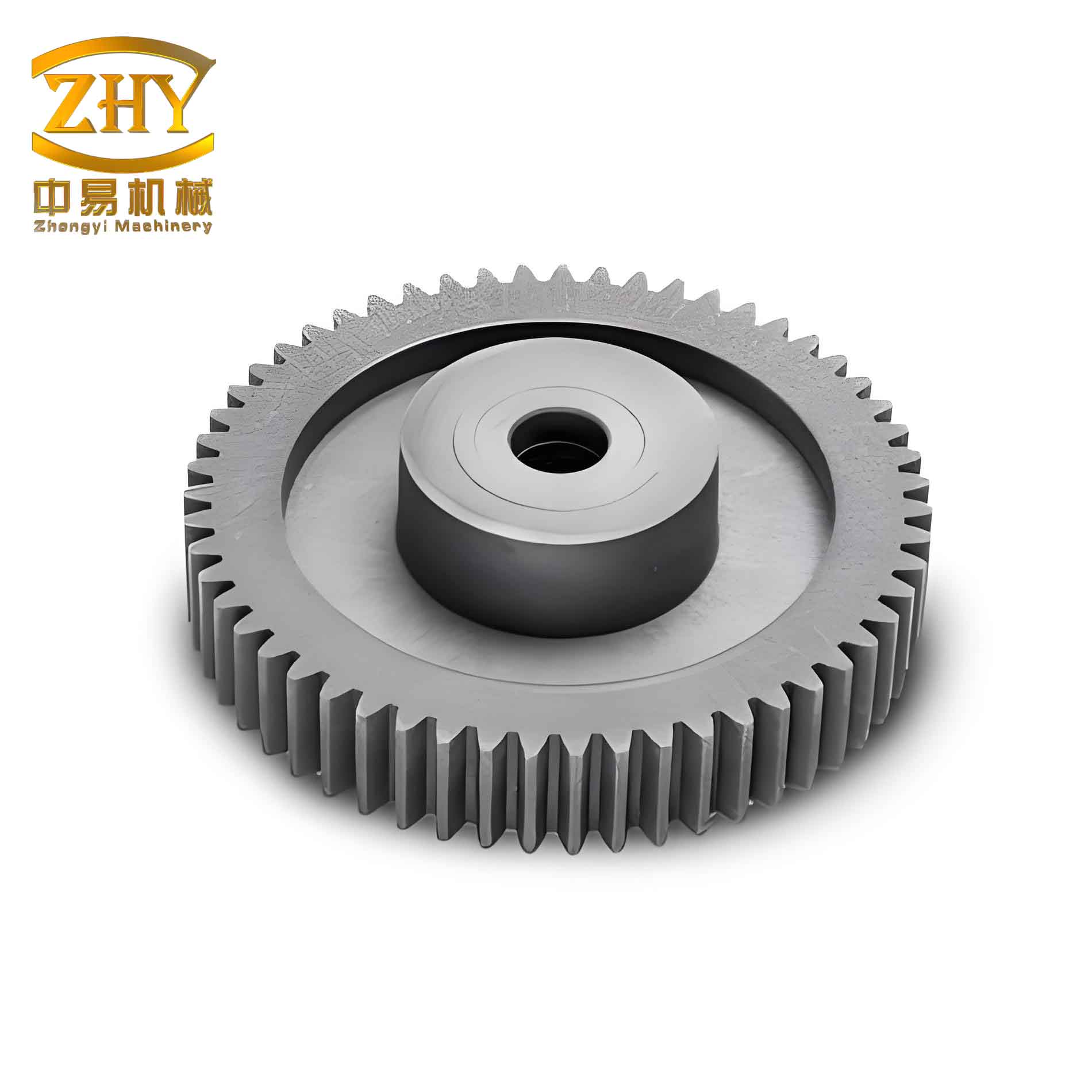
The tooth profile in any transverse section (a plane perpendicular to the gear axis) remains a standard involute curve. The defining feature is that all these parallel involute profiles are rotated relative to each other about the gear axis, such that the tooth line connecting corresponding points on these profiles forms an arc of an ellipse. This ellipse has a major axis of length $2a$ and a minor axis of length $2b$ on the developed pitch surface, where $b = a \cos \alpha$, and $\alpha$ is the standard pressure angle at the pitch circle of the cylindrical gear. Consequently, at the pitch line, the tooth thickness $S_c$ and the space width $P_c$ are equal in any transverse section and are constant along the tooth’s length, each being half of the circular pitch $P$: $S_c = P_c = P/2$. This unique geometry aims to achieve a favorable localized contact pattern. However, the shape of this elliptical arc, controlled by the effective tool radius during manufacturing and the chosen face width of the cylindrical gear, directly influences the tooth’s stiffness distribution and its meshing dynamics, which in turn governs the speed fluctuation during operation.
Influence of the Cutting Tool (Arc Tooth Line) Radius on Speed Fluctuation
The radius of the cutting tool, denoted as $R_T$, fundamentally defines the curvature of the oval arc tooth line on the cylindrical gear; specifically, it corresponds to the minor axis of the elliptical arc ($b = R_T$). To isolate its effect, a series of 18 cylindrical gear pairs were modeled with identical core parameters (module $m=4$ mm, pinion teeth $z_1=32$, gear teeth $z_2=80$, face width $b_w=60$ mm, pressure angle $\alpha=20^\circ$) but varying tool radii from 30 mm to 200 mm. A representative model for $R_T=50$ mm is analyzed. Dynamic simulations were conducted using multi-body dynamics software. A constant rotational velocity of 3500 °/s was applied to the pinion (the driving cylindrical gear), and a constant resistive torque of 15,000 N·mm was applied to the driven cylindrical gear. The output angular velocity of the driven cylindrical gear was recorded after the system reached steady-state operation.
The theoretical output speed for the driven cylindrical gear, based on the gear ratio, is 1400 °/s. The simulation results showed periodic fluctuations around this mean value. Key metrics—maximum speed ($\omega_{\text{max}}$), minimum speed ($\omega_{\text{min}}$), and the average speed ($\omega_{\text{m}}$)—were extracted from the stable phase of the simulation for each cylindrical gear pair. The speed fluctuation coefficient $\delta$ was then calculated. The data is summarized comprehensively in the table below.
| Model ID | Tool Radius, $R_T$ (mm) | Max Speed, $\omega_{\text{max}}$ (°/s) | Min Speed, $\omega_{\text{min}}$ (°/s) | Avg Speed, $\omega_{\text{m}}$ (°/s) | Fluctuation Coeff., $\delta$ |
|---|---|---|---|---|---|
| 1 | 30 | 1415.21 | 1386.84 | 1401.03 | 0.02025 |
| 2 | 40 | 1416.26 | 1386.39 | 1401.33 | 0.02132 |
| 3 | 50 | 1416.37 | 1385.72 | 1401.04 | 0.02187 |
| 4 | 60 | 1413.77 | 1390.54 | 1402.15 | 0.01656 |
| 5 | 70 | 1410.33 | 1396.52 | 1403.43 | 0.00984 |
| 6 | 80 | 1405.93 | 1395.79 | 1400.86 | 0.00724 |
| 7 | 90 | 1404.63 | 1394.85 | 1399.74 | 0.00699 |
| 8 | 100 | 1404.56 | 1396.62 | 1400.59 | 0.00567 |
| 9 | 110 | 1406.53 | 1397.39 | 1401.96 | 0.00652 |
| 10 | 120 | 1404.68 | 1395.93 | 1400.31 | 0.00625 |
| 11 | 130 | 1409.56 | 1399.26 | 1404.41 | 0.00734 |
| 12 | 140 | 1407.76 | 1395.66 | 1401.71 | 0.00863 |
| 13 | 150 | 1415.73 | 1393.67 | 1404.70 | 0.01570 |
| 14 | 160 | 1413.52 | 1389.25 | 1401.38 | 0.01732 |
| 15 | 170 | 1417.17 | 1393.00 | 1405.09 | 0.01720 |
| 16 | 180 | 1417.45 | 1390.14 | 1403.80 | 0.01946 |
| 17 | 190 | 1418.49 | 1386.99 | 1402.74 | 0.02246 |
| 18 | 200 | 1419.99 | 1389.01 | 1404.50 | 0.02205 |
The relationship between the tool radius $R_T$ and the calculated speed fluctuation coefficient $\delta$ reveals a clear, non-linear trend. The coefficient initially increases slightly for very small $R_T$, then decreases sharply to a minimum region, remains relatively low and stable for a range of $R_T$ values, and finally increases again for larger $R_T$. The optimal performance, where the cylindrical gear pair exhibits the smoothest transmission (lowest $\delta$), is observed when the tool radius falls within a specific range relative to the face width $b_w$. This optimal interval can be expressed as:
$$
1.34b_w \leq R_T \leq 2.34b_w
$$
For the simulated cylindrical gear with $b_w=60$ mm, this corresponds to $R_T$ between approximately 80 mm and 140 mm. Outside this range, the speed fluctuation becomes more pronounced. When $R_T$ is too small, the elliptical arc is very pronounced, leading to a significant reduction in the normal tooth thickness at the ends of the cylindrical gear compared to the middle. This creates a non-uniform stiffness distribution along the tooth, with weaker ends that deflect more easily during meshing, inducing larger dynamic variations and thus a higher $\delta$. Conversely, when $R_T$ is excessively large, the oval arc tooth line flattens and approaches a straight line. In this case, the cylindrical gear’s behavior becomes similar to that of a standard spur cylindrical gear, losing the potential dynamic benefits of the arc design and potentially leading to different excitation patterns that increase speed fluctuation.
Influence of the Cylindrical Gear Face Width on Speed Fluctuation
The face width, $b_w$, of the cylindrical gear is another critical geometric parameter that interacts with the tool radius $R_T$ to define the effective tooth line geometry. To investigate its isolated effect, a tool radius of $R_T = 100$ mm was selected (as it yielded excellent stability in the previous analysis), and seven cylindrical gear pairs with face widths ranging from 40 mm to 100 mm were modeled, keeping all other parameters constant. The same dynamic simulation procedure was followed.
The output speed curves for the driven cylindrical gear again showed periodic oscillations. The extracted performance data for each face width configuration is presented in the table below.
| Face Width, $b_w$ (mm) | Max Speed, $\omega_{\text{max}}$ (°/s) | Min Speed, $\omega_{\text{min}}$ (°/s) | Avg Speed, $\omega_{\text{m}}$ (°/s) | Fluctuation Coeff., $\delta$ |
|---|---|---|---|---|
| 40 | 1409.13 | 1391.60 | 1400.37 | 0.01252 |
| 50 | 1407.52 | 1395.30 | 1401.41 | 0.00872 |
| 60 | 1402.50 | 1398.31 | 1400.41 | 0.00299 |
| 70 | 1401.43 | 1398.70 | 1400.06 | 0.00195 |
| 80 | 1402.26 | 1398.71 | 1400.48 | 0.00253 |
| 90 | 1407.75 | 1395.38 | 1401.57 | 0.00882 |
| 100 | 1408.27 | 1394.40 | 1401.33 | 0.00990 |
The analysis of the speed fluctuation coefficient $\delta$ against the face width $b_w$ uncovers a pronounced trend. The coefficient first decreases significantly as the face width increases from 40 mm, reaches a clear minimum plateau, and then increases sharply for larger face widths. The most stable operation for this specific cylindrical gear pair (with $R_T=100$ mm) occurs when the face width is between 60 mm and 80 mm. Expressing this optimal range in terms of the tool radius provides a more general design guideline:
$$
0.6R_T \leq b_w \leq 0.8R_T
$$
This relationship highlights the importance of the proportional design between $b_w$ and $R_T$ for the oval arc tooth line cylindrical gear. If $b_w$ is too small relative to $R_T$ (e.g., $b_w=40$ mm, $R_T=100$ mm), the elliptical arc tooth line is not fully utilized across the gear’s width. The tooth behavior becomes similar to a narrow spur cylindrical gear, and the potential dynamic advantages of the arc design are not realized, leading to higher $\delta$. On the other hand, if $b_w$ is too large relative to $R_T$ (e.g., $b_w=100$ mm, $R_T=100$ mm), the arc becomes overly pronounced over the extended width. This exaggerates the stiffness imbalance between the central and end regions of the cylindrical gear tooth, making the ends excessively flexible. This increased compliance leads to greater dynamic deflections during meshing, resulting in larger speed oscillations and a higher fluctuation coefficient, undermining the transmission stability the design aims to achieve.
Influence of Operational Rotational Speed on Speed Fluctuation
Modern applications increasingly demand cylindrical gears to operate at high rotational speeds. It is therefore essential to evaluate how the speed fluctuation characteristics of the oval arc tooth line cylindrical gear scale with the operational input speed. A cylindrical gear pair with fixed geometry ($R_T=100$ mm, $b_w=60$ mm, $m=4$ mm, $z_1=32$, $z_2=80$, $\alpha=20^\circ$) was simulated under six different constant input speeds applied to the driving cylindrical gear: 2500, 3500, 4500, 5500, 6500, and 7500 °/s. The corresponding theoretical output speeds for the driven cylindrical gear are 1000, 1400, 1800, 2200, 2600, and 3000 °/s, respectively.
The simulation results consistently showed that the actual output speed fluctuated around these theoretical values. The key metrics for each speed level are consolidated in the following table.
| Input Speed (°/s) | Theoretical Output (°/s) | Max Speed, $\omega_{\text{max}}$ (°/s) | Min Speed, $\omega_{\text{min}}$ (°/s) | Avg Speed, $\omega_{\text{m}}$ (°/s) | Fluctuation Coeff., $\delta$ |
|---|---|---|---|---|---|
| 2500 | 1000 | 1013.65 | 1000.17 | 1000.02 | 0.01348 |
| 3500 | 1400 | 1409.00 | 1399.60 | 1400.00 | 0.00672 |
| 4500 | 1800 | 1809.28 | 1798.20 | 1800.01 | 0.00615 |
| 5500 | 2200 | 2209.83 | 2196.90 | 2200.01 | 0.00588 |
| 6500 | 2600 | 2610.17 | 2596.00 | 2599.33 | 0.00545 |
| 7500 | 3000 | 3004.76 | 2992.65 | 3000.00 | 0.00403 |
The data reveals a significant and advantageous trend: the speed fluctuation coefficient $\delta$ decreases monotonically as the operational speed of the cylindrical gear pair increases. Starting from a relatively higher value at 2500 °/s input, $\delta$ drops sharply and then continues to decline gradually at higher speeds. This relationship can be approximated by a decaying function, indicating that the transmission becomes progressively smoother. This behavior suggests that the dynamic meshing action of the oval arc tooth line cylindrical gear pair is favorably influenced by higher rotational speeds. Potential reasons include more consistent fluid film formation in lubricated contacts, reduced relative impact of manufacturing imperfections at higher frequencies, or a shift in the system’s dynamic response away from critical resonant frequencies. This finding is particularly encouraging, as it indicates that this type of cylindrical gear is well-suited for high-speed applications where transmission smoothness is crucial.
Experimental Validation of Speed Fluctuation Characteristics
To substantiate the findings from the dynamic simulations, particularly the trend related to operational speed, an experimental test was conducted on a physically manufactured oval arc tooth line cylindrical gear pair. The gears were machined on a dedicated CNC machine. The experimental setup consisted of a drive motor, the test cylindrical gear pair mounted on precision shafts and bearings, and a non-contact Hall-effect speed sensor attached to the output shaft to measure the rotational speed of the driven cylindrical gear. Data acquisition was performed to record the instantaneous speed under various load conditions at different output speed setpoints.
The experimental speed profiles for the driven cylindrical gear at four different average output speeds showed the characteristic periodic fluctuation. The key results from the experiment are summarized below and compared with the general trend observed in simulation.
| Theoretical Output Speed (°/s) | Exp. Max Speed, $\omega_{\text{max}}$ (°/s) | Exp. Min Speed, $\omega_{\text{min}}$ (°/s) | Exp. Avg Speed, $\omega_{\text{m}}$ (°/s) | Exp. Fluctuation Coeff., $\delta$ |
|---|---|---|---|---|
| 857 | 859.76 | 853.16 | 856.25 | 0.00771 |
| 1106 | 1110.97 | 1104.80 | 1105.46 | 0.00559 |
| 1556 | 1559.38 | 1553.50 | 1556.00 | 0.00378 |
| 2123 | 2127.47 | 2120.50 | 2123.00 | 0.00328 |
The experimental data clearly demonstrates the same fundamental trend predicted by the simulation: the speed fluctuation coefficient $\delta$ decreases as the operational speed of the cylindrical gear pair increases. The absolute values of $\delta$ differ from the simulation due to real-world factors such as manufacturing tolerances, assembly errors, bearing friction, and varying load conditions not fully captured in the ideal model. However, the consistent downward trend validates the core dynamic characteristic. This confirmation reinforces the conclusion that the oval arc tooth line cylindrical gear exhibits improved transmission stability at higher rotational speeds, making it a viable candidate for advanced high-speed power transmission systems.
Conclusion
A comprehensive investigation into the factors influencing the transmission speed fluctuation of cylindrical gears with oval arc tooth lines has been conducted through dynamic simulation and experimental validation. The speed fluctuation coefficient $\delta$ serves as the key metric for evaluating transmission smoothness. The analysis leads to the following principal conclusions regarding the design and operation of this specific type of cylindrical gear:
1. Cutting Tool (Arc) Radius ($R_T$): The tool radius, which defines the curvature of the oval arc tooth line, has a non-linear, U-shaped relationship with the speed fluctuation coefficient. Optimal transmission stability for the cylindrical gear pair is achieved when $R_T$ is selected within a specific proportion of the face width $b_w$. The recommended design range is:
$$
1.34b_w \leq R_T \leq 2.34b_w
$$
Values outside this range lead to increased $\delta$, either due to excessive tooth end flexibility (small $R_T$) or loss of the beneficial arc geometry (large $R_T$).
2. Cylindrical Gear Face Width ($b_w$): The face width must be chosen in proportion to the selected tool radius to optimize dynamic performance. The speed fluctuation coefficient is minimized when the face width satisfies the relation:
$$
0.6R_T \leq b_w \leq 0.8R_T
$$
This proportional balance ensures the elliptical arc tooth line is effectively utilized without creating excessive stiffness variation along the tooth of the cylindrical gear, which would otherwise degrade transmission smoothness.
3. Operational Rotational Speed ($\omega$): A highly favorable characteristic of the oval arc tooth line cylindrical gear is that its transmission smoothness improves with increasing speed. The speed fluctuation coefficient $\delta$ exhibits a monotonic decreasing trend as the input rotational speed rises. This indicates that this cylindrical gear design is inherently well-suited for high-speed applications, where maintaining low vibration and noise is critical.
The insights derived from this study provide valuable practical guidelines for the geometric parameter selection and machining parameter determination of involute cylindrical gears with oval arc tooth lines. By adhering to the identified proportional relationships between $R_T$ and $b_w$, designers can significantly enhance the inherent transmission stability of this cylindrical gear type. Furthermore, the validated positive response to high-speed operation confirms its potential for use in demanding mechanical transmission systems where performance and reliability are paramount.