
In this study, I focus on investigating the influence of key design parameters on the contact performance and load-bearing capacity of a planar enveloping internal-meshing worm gear drive. This type of worm gear drive is a novel transmission mechanism that combines the advantages of planar enveloping worm gears with internal meshing, enabling features such as multi-load output and power splitting. Based on gear meshing theory, I derive the spatial tooth contact line equations for this worm gear drive and use numerical methods to obtain the contact lines, which are then mapped onto the worm wheel tooth surface. By analyzing how different parameters—including center distance, transmission ratio, inclination angle of the generating plane, axial crossing angle between the worm and worm wheel, worm wheel rotation angle, worm pitch circle coefficient, and main base circle coefficient—affect the distribution of the contact zone on the worm tooth surface, I aim to identify a reasonable range for design parameters. Additionally, based on preliminary analysis results, I select a set of appropriate parameters to generate a three-dimensional model of the planar enveloping internal-meshing worm gear drive. My research shows that the transmission ratio, inclination angle of the generating plane, and worm wheel rotation angle have significant impacts on the contact zone. When the inclination angle of the generating plane is between 18° and 36°, the axial crossing angle between the worm and worm wheel is between 30° and 54°, and the worm wheel rotation angle is between 90° and 138°, the planar enveloping internal-meshing worm gear drive exhibits better contact characteristics. These findings provide a theoretical foundation for further research on this worm gear drive.
The worm gear drive is a crucial component in many mechanical systems due to its ability to provide high reduction ratios, compact size, and high torque transmission. In recent years, there has been growing interest in developing advanced worm gear drives that offer improved performance, such as zero-backlash, high precision, and multi-output capabilities. The planar enveloping internal-meshing worm gear drive is one such innovation, which utilizes an internal meshing configuration with a planar enveloping worm. This design allows for multiple worm wheels to engage with a single worm, enabling power splitting and redundancy, which is particularly useful in applications like helicopters and robotics. However, the contact performance of this worm gear drive is highly dependent on its geometric parameters. Therefore, in this article, I conduct a detailed analysis to understand how key parameters affect the contact zone, which directly influences the transmission efficiency, load capacity, and durability of the worm gear drive.
To begin, I establish the coordinate systems for the planar enveloping internal-meshing worm gear drive based on gear meshing principles. Let me define the stationary coordinate system fixed to the worm as \( S_1(O_1; i_1, j_1, k_1) \), and the moving coordinate system fixed to the worm as \( S_1′(O_1′; i_1′, j_1′, k_1′) \), where the worm rotates about the \( k_1′ \) axis with angular velocity \( \omega_1 \). Similarly, for the worm wheel, the stationary coordinate system is \( S_2(O_2; i_2, j_2, k_2) \), and the moving coordinate system is \( S_2′(O_2′; i_2′, j_2′, k_2′) \), with the worm wheel rotating about the \( k_2′ \) axis with angular velocity \( \omega_2 \). On the generating plane \( \Sigma \), I set a moving coordinate system \( S_0(O_0; i_0, j_0, k_0) \), where the \( j_0 \) and \( k_0 \) axes lie on the plane \( \Sigma \) and the origin \( O_0 \) is located on the main base circle. The coordinates of \( O_0 \) in \( S_2′ \) are \( \mathbf{r}_0 = (0, r, 0) \). At the contact point \( p \), I define a moving coordinate system \( S_p(O_p; e_1, e_2, \mathbf{n}) \), where \( e_1 \) and \( e_2 \) are on the plane \( \Sigma \) with \( e_1 \) parallel to \( k_0 \) and \( e_2 \) parallel to \( j_0 \). The coordinates of \( p \) in \( S_0 \) are \( \mathbf{r}_p = (0, u, v) \). The rotation angles of the worm and worm wheel at a given instant are \( \phi_1 \) and \( \phi_2 \), respectively, with the transmission ratio \( i_{12} = 1 / i_{21} = z_1 / z_2 \), where \( z_1 \) and \( z_2 \) are the number of teeth on the worm and worm wheel. The inclination angle of the generating plane is \( \beta \), the center distance is \( A \), and the axial crossing angle (installation angle) of the worm wheel is \( \delta_F \).
The transformation matrix from the worm wheel moving coordinate system \( S_2′ \) to the worm moving coordinate system \( S_1′ \) is derived as follows:
$$ \mathbf{M}_{2’1′} = \mathbf{M}_{1’1} \cdot \mathbf{M}_{12} \cdot \mathbf{M}_{22′} = \begin{pmatrix} f_{11} & f_{12} & f_{13} & f_{14} \\ f_{21} & f_{22} & f_{23} & f_{24} \\ f_{31} & f_{32} & f_{33} & f_{34} \\ f_{41} & f_{42} & f_{43} & f_{44} \end{pmatrix} $$
where the elements are:
$$ f_{11} = \cos \phi_1 \cos \phi_2 + \sin \phi_1 \sin \phi_2 \sin \delta_F $$
$$ f_{12} = \sin \delta_F \cos \phi_2 \sin \phi_1 – \cos \phi_1 \sin \phi_2 $$
$$ f_{13} = -\cos \delta_F \sin \phi_1 $$
$$ f_{14} = A \cos \phi_1 $$
$$ f_{21} = -\sin \delta_F \cos \phi_1 \sin \phi_2 + \sin \phi_1 \cos \phi_2 $$
$$ f_{22} = \sin \phi_1 \sin \phi_2 + \sin \delta_F \cos \phi_1 \cos \phi_2 $$
$$ f_{23} = -\cos \delta_F \cos \phi_1 $$
$$ f_{24} = -A \sin \phi_1 $$
$$ f_{31} = \cos \delta_F \sin \phi_2 $$
$$ f_{32} = \cos \delta_F \cos \phi_2 $$
$$ f_{33} = \sin \delta_F $$
$$ f_{34} = 0 $$
$$ f_{41} = f_{42} = f_{43} = 0, \quad f_{44} = 1 $$
The meshing equation for the planar enveloping internal-meshing worm gear drive must satisfy the condition that the relative velocity at the contact point is perpendicular to the common normal vector. This is expressed as:
$$ \Phi = \mathbf{v}_{1’2′} \cdot \mathbf{n} = 0 $$
where \( \mathbf{v}_{1’2′} \) is the relative velocity vector between the worm and worm wheel at the contact point. In the coordinate system \( S_0 \), the components of \( \mathbf{v}_{1’2′} \) are derived as:
$$ v_{x0} = \sin \beta \left[ \cos \delta_F \cos \phi_2 (A + u \cos \phi_2) + \cos \delta_F \sin \phi_2 (A \sin \phi_2 – r + v \sin \beta) \right] + \cos \beta \left[ (A + u \cos \phi_2) (i_{12} \sin \delta_F – \sin \phi_2) + \cos \phi_2 \cos \delta_F (i_{12} A \cos \phi_2 + v \cos \beta \sin \phi_2) \right] $$
$$ v_{y0} = \sin \phi_2 (A i_{12} \sin \delta_F – A \sin \phi_2 – i_{12} v \cos \beta \cos \delta_F) + \cos \phi_2 \cos \delta_F (A \sin \phi_2 – r + v \sin \beta) $$
$$ v_{z0} = \cos \beta \left[ (A + u \cos \phi_2) (i_{12} \sin \delta_F – \sin \phi_2) + \cos \phi_2 \cos \delta_F (i_{12} A \cos \phi_2 + v \cos \beta \sin \phi_2) \right] + \sin \beta \left[ \cos \delta_F \cos \phi_2 (A + u \cos \phi_2) + \cos \delta_F \sin \phi_2 (A \sin \phi_2 – r + v \sin \beta) \right] $$
The tooth surface equation of the worm is formed by the locus of contact points during meshing. The worm tooth surface equation can be written as:
$$ \mathbf{r}_1′ = \mathbf{M}_{2’1′} \cdot \mathbf{r}_0^p, \quad \text{with} \quad \Phi(u, v, \phi_2) = 0, \quad \phi_1 = i_{12} \phi_2, \quad 0 < \phi_2 < 2\pi $$
Similarly, the worm wheel tooth surface equation is obtained by transforming the contact point coordinates to the worm wheel coordinate system:
$$ \mathbf{r}_2′ = x_{2′} \mathbf{i}_{2′} + y_{2′} \mathbf{j}_{2′} + z_{2′} \mathbf{k}_{2′} $$
$$ x_{2′} = u $$
$$ y_{2′} = r – v \sin \beta $$
$$ z_{2′} = v \cos \beta $$
$$ \Phi = 0 $$
To analyze the contact zone, I map the spatial contact lines onto the worm wheel tooth surface using the following relations:
$$ r_{2′} = \sqrt{x_{2′}^2 + y_{2′}^2} $$
$$ z_{2′} = v \cos \beta $$
The tooth width of the worm wheel, based on mechanical design handbooks, is given by:
$$ b = d_{f1} – h_f – c = k_1 A – h_f – c $$
where \( h_f = 0.8m \), \( m = (2A – d_{f1}) / 2 \) is the module, \( c = 0.2m \) is the clearance, \( d_{f1} = k_1 A \) is the worm root circle diameter, and \( k_1 \) is the worm pitch circle coefficient. The mapped tooth width on the worm wheel is:
$$ B = b \cos \beta $$
Using these equations, I perform numerical calculations in MATLAB to analyze the effects of various parameters on the contact zone. The parameters considered are center distance \( A \), transmission ratio \( i_{12} \), inclination angle of the generating plane \( \beta \), worm wheel rotation angle \( \phi_2 \), axial crossing angle \( \delta_F \), worm pitch circle coefficient \( k_1 \), and main base circle coefficient \( k_b \).
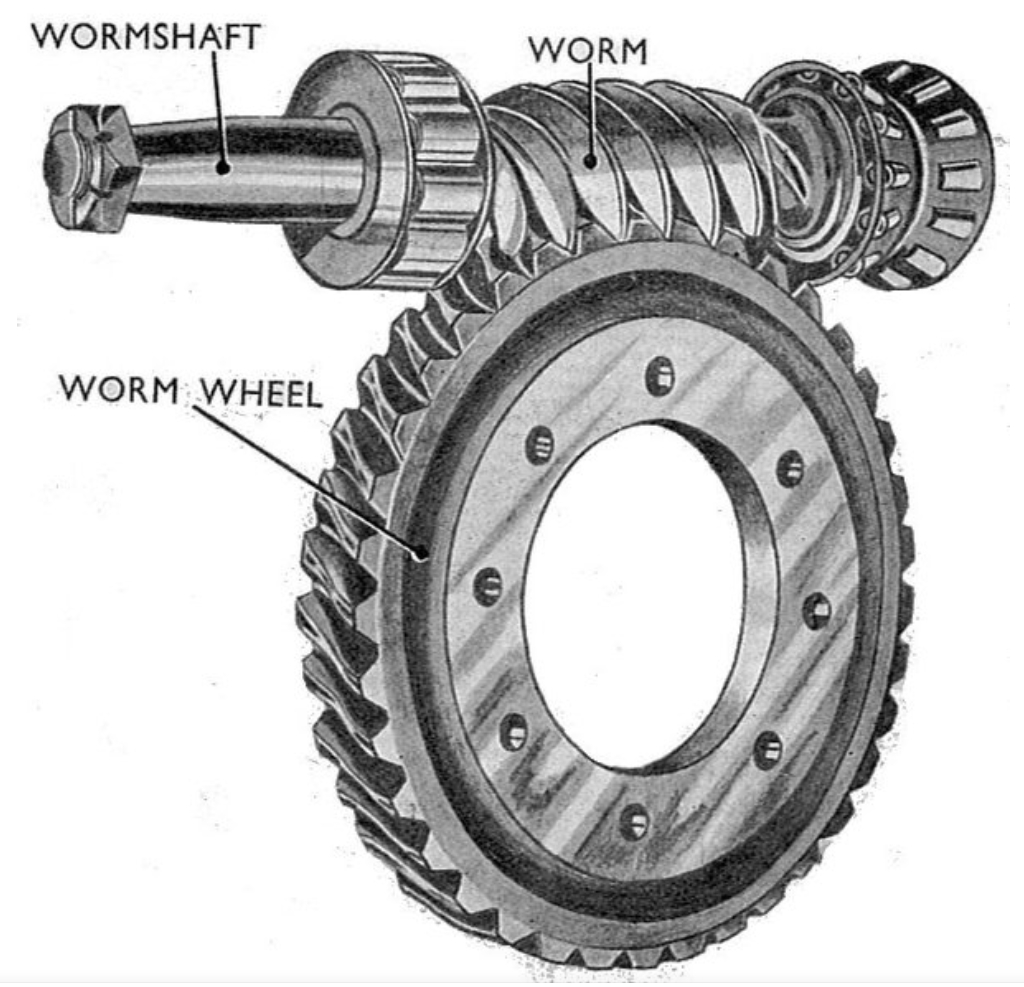
Now, let me discuss the influence of each parameter on the contact zone in detail. For this analysis, I vary one parameter at a time while keeping others constant, as summarized in tables below. The contact lines are plotted on the worm wheel tooth surface, and the distribution is observed to assess the contact performance.
1. Effect of Center Distance
The center distance \( A \) is varied from 100 mm to 400 mm. Other parameters are fixed as shown in Table 1.
| Parameter | Value 1 | Value 2 | Value 3 | Value 4 |
|---|---|---|---|---|
| Center distance \( A \) (mm) | 100 | 200 | 300 | 400 |
| Transmission ratio \( i_{12} \) | 1/40 | 1/40 | 1/40 | 1/40 |
| Inclination angle \( \beta \) (°) | 24 | 24 | 24 | 24 |
| Worm wheel angle \( \phi_2 \) (°) | 90 | 90 | 90 | 90 |
| Axial crossing angle \( \delta_F \) (°) | 35 | 35 | 35 | 35 |
| Pitch circle coefficient \( k_1 \) | 0.38 | 0.38 | 0.38 | 0.38 |
| Main base circle coefficient \( k_b \) | 0.56 | 0.56 | 0.56 | 0.56 |
From the analysis, I observe that as the center distance increases, the contact lines on the worm wheel tooth surface distribute from the root towards the top, with the longest contact line occurring in the middle of the tooth. The contact zone expands with increasing center distance, but the overall pattern remains similar. This suggests that the center distance has a moderate effect on the contact zone, primarily scaling the gear size without drastically altering the meshing characteristics. However, for larger center distances, the worm gear drive may require careful design to maintain stiffness and avoid excessive deflection.
2. Effect of Transmission Ratio
The transmission ratio \( i_{12} \) is varied as 1/10, 1/20, 1/30, and 1/40. Other parameters are fixed as in Table 2.
| Parameter | Value 1 | Value 2 | Value 3 | Value 4 |
|---|---|---|---|---|
| Center distance \( A \) (mm) | 100 | 100 | 100 | 100 |
| Transmission ratio \( i_{12} \) | 1/10 | 1/20 | 1/30 | 1/40 |
| Inclination angle \( \beta \) (°) | 24 | 24 | 24 | 24 |
| Worm wheel angle \( \phi_2 \) (°) | 90 | 90 | 90 | 90 |
| Axial crossing angle \( \delta_F \) (°) | 35 | 35 | 35 | 35 |
| Pitch circle coefficient \( k_1 \) | 0.38 | 0.38 | 0.38 | 0.38 |
| Main base circle coefficient \( k_b \) | 0.56 | 0.56 | 0.56 | 0.56 |
The results indicate that a larger transmission ratio (i.e., a smaller \( i_{12} \) value) leads to longer and more uniformly distributed contact lines on the tooth surface. For instance, at \( i_{12} = 1/10 \), the contact lines span almost the entire tooth height, whereas at \( i_{12} = 1/40 \), the contact lines are shorter and concentrated in a smaller region. This implies that worm gear drives with higher reduction ratios tend to have better load distribution and higher load-bearing capacity. Therefore, when designing a planar enveloping internal-meshing worm gear drive for heavy-duty applications, opting for a larger transmission ratio can enhance the contact performance.
3. Effect of Inclination Angle of the Generating Plane
The inclination angle \( \beta \) is varied as 10°, 20°, 30°, and 40°. Other parameters are fixed as in Table 3.
| Parameter | Value 1 | Value 2 | Value 3 | Value 4 |
|---|---|---|---|---|
| Center distance \( A \) (mm) | 100 | 100 | 100 | 100 |
| Transmission ratio \( i_{12} \) | 1/40 | 1/40 | 1/40 | 1/40 |
| Inclination angle \( \beta \) (°) | 10 | 20 | 30 | 40 |
| Worm wheel angle \( \phi_2 \) (°) | 90 | 90 | 90 | 90 |
| Axial crossing angle \( \delta_F \) (°) | 35 | 35 | 35 | 35 |
| Pitch circle coefficient \( k_1 \) | 0.38 | 0.38 | 0.38 | 0.38 |
| Main base circle coefficient \( k_b \) | 0.56 | 0.56 | 0.56 | 0.56 |
When \( \beta \) is less than 40°, the contact lines are well-distributed across the tooth surface. However, at \( \beta = 40° \), the contact zone shifts significantly towards the upper-left corner of the tooth, leaving the right side with little to no contact. This uneven distribution can lead to stress concentration and reduced load capacity. Based on my analysis, I recommend that \( \beta \) be kept between 18° and 36° to ensure optimal contact characteristics. This range ensures that the contact lines cover a broad area of the tooth, promoting even wear and high efficiency in the worm gear drive.
4. Effect of Worm Wheel Rotation Angle
The worm wheel rotation angle \( \phi_2 \) determines the starting point of meshing for the internal-meshing worm gear drive. I vary \( \phi_2 \) as 70°, 80°, 90°, and 100°. Other parameters are fixed as in Table 4.
| Parameter | Value 1 | Value 2 | Value 3 | Value 4 |
|---|---|---|---|---|
| Center distance \( A \) (mm) | 100 | 100 | 100 | 100 |
| Transmission ratio \( i_{12} \) | 1/40 | 1/40 | 1/40 | 1/40 |
| Inclination angle \( \beta \) (°) | 24 | 24 | 24 | 24 |
| Worm wheel angle \( \phi_2 \) (°) | 70 | 80 | 90 | 100 |
| Axial crossing angle \( \delta_F \) (°) | 35 | 35 | 35 | 35 |
| Pitch circle coefficient \( k_1 \) | 0.38 | 0.38 | 0.38 | 0.38 |
| Main base circle coefficient \( k_b \) | 0.56 | 0.56 | 0.56 | 0.56 |
At \( \phi_2 = 70° \) and \( 80° \), the contact lines do not fully project onto the worm wheel tooth, meaning that only part of the tooth is engaged in meshing. This can reduce the effective contact area and load capacity. At \( \phi_2 = 90° \) and above, the contact lines cover the entire tooth surface, indicating full engagement. For the planar enveloping internal-meshing worm gear drive to function properly with the worm enveloping the worm wheel internally, \( \phi_2 \) should be between 90° and 138°. Values beyond 138° may cause the worm gear drive to degenerate into a face-meshing type, losing the internal meshing advantage. Thus, I suggest selecting \( \phi_2 \) in the range of 90° to 138° for optimal design.
5. Effect of Axial Crossing Angle
The axial crossing angle \( \delta_F \) is varied as 10°, 20°, 30°, and 40°. Other parameters are fixed as in Table 5.
| Parameter | Value 1 | Value 2 | Value 3 | Value 4 |
|---|---|---|---|---|
| Center distance \( A \) (mm) | 100 | 100 | 100 | 100 |
| Transmission ratio \( i_{12} \) | 1/40 | 1/40 | 1/40 | 1/40 |
| Inclination angle \( \beta \) (°) | 24 | 24 | 24 | 24 |
| Worm wheel angle \( \phi_2 \) (°) | 90 | 90 | 90 | 90 |
| Axial crossing angle \( \delta_F \) (°) | 10 | 20 | 30 | 40 |
| Pitch circle coefficient \( k_1 \) | 0.38 | 0.38 | 0.38 | 0.38 |
| Main base circle coefficient \( k_b \) | 0.56 | 0.56 | 0.56 | 0.56 |
For \( \delta_F < 30° \), the contact lines are concentrated in the upper-left part of the tooth, leading to poor contact distribution. When \( \delta_F \) exceeds 54°, interference may occur between the worm wheel axis and the worm tooth profile, unless the worm wheel axis is placed inside the worm body. Practically, it is challenging to install the worm wheel at very low \( \delta_F \) angles. Therefore, I recommend that \( \delta_F \) be set between 30° and 54° to achieve a well-distributed contact zone and avoid interference. This range ensures that the worm gear drive operates smoothly with efficient power transmission.
6. Effect of Worm Pitch Circle Coefficient
The worm pitch circle coefficient \( k_1 \) is varied from 0.33 to 0.38. Other parameters are fixed as in Table 6.
| Parameter | Value 1 | Value 2 | Value 3 | Value 4 |
|---|---|---|---|---|
| Center distance \( A \) (mm) | 100 | 100 | 100 | 100 |
| Transmission ratio \( i_{12} \) | 1/40 | 1/40 | 1/40 | 1/40 |
| Inclination angle \( \beta \) (°) | 24 | 24 | 24 | 24 |
| Worm wheel angle \( \phi_2 \) (°) | 90 | 90 | 90 | 90 |
| Axial crossing angle \( \delta_F \) (°) | 35 | 35 | 35 | 35 |
| Pitch circle coefficient \( k_1 \) | 0.33 | 0.3467 | 0.3634 | 0.38 |
| Main base circle coefficient \( k_b \) | 0.56 | 0.56 | 0.56 | 0.56 |
The analysis shows that \( k_1 \) has minimal impact on the contact zone distribution. The contact lines remain largely unchanged across different values of \( k_1 \). This suggests that the worm pitch circle coefficient is not a critical parameter for optimizing contact performance in the planar enveloping internal-meshing worm gear drive. However, \( k_1 \) may affect other aspects such as tooth strength and manufacturing, so it should still be chosen based on standard design practices.
7. Effect of Main Base Circle Coefficient
The main base circle coefficient \( k_b \) is varied from 0.5 to 0.67. Other parameters are fixed as in Table 7.
| Parameter | Value 1 | Value 2 | Value 3 | Value 4 |
|---|---|---|---|---|
| Center distance \( A \) (mm) | 100 | 100 | 100 | 100 |
| Transmission ratio \( i_{12} \) | 1/40 | 1/40 | 1/40 | 1/40 |
| Inclination angle \( \beta \) (°) | 24 | 24 | 24 | 24 |
| Worm wheel angle \( \phi_2 \) (°) | 90 | 90 | 90 | 90 |
| Axial crossing angle \( \delta_F \) (°) | 35 | 35 | 35 | 35 |
| Pitch circle coefficient \( k_1 \) | 0.38 | 0.38 | 0.38 | 0.38 |
| Main base circle coefficient \( k_b \) | 0.5 | 0.56 | 0.62 | 0.67 |
Similar to \( k_1 \), the main base circle coefficient \( k_b \) does not significantly alter the contact zone. The contact lines maintain their distribution pattern regardless of \( k_b \) values. Thus, \( k_b \) can be selected based on other design constraints without worrying about adverse effects on contact performance.
Based on the above analysis, I select a set of parameters that yield favorable contact characteristics: \( A = 100 \, \text{mm} \), \( i_{12} = 1/40 \), \( \beta = 24° \), \( \phi_2 = 90° \), \( \delta_F = 35° \), \( k_1 = 0.38 \), and \( k_b = 0.56 \). Using these parameters, I generate a three-dimensional model of the planar enveloping internal-meshing worm gear drive. The model confirms that the contact lines are well-distributed across the worm wheel tooth surface, indicating good meshing performance. Furthermore, to achieve zero-backlash and load sharing, I design the worm gear drive with multiple worm wheels. For instance, with two or more worm wheels arranged symmetrically, the backlash can be eliminated by engaging the left and right tooth surfaces differently. This multi-wheel configuration also allows for power splitting, making the worm gear drive suitable for applications requiring high reliability and redundancy.
In conclusion, my study demonstrates that key parameters such as transmission ratio, inclination angle of the generating plane, and worm wheel rotation angle have substantial effects on the contact zone of the planar enveloping internal-meshing worm gear drive. For optimal design, I recommend the following ranges: \( \beta = 18° \text{ to } 36° \), \( \delta_F = 30° \text{ to } 54° \), and \( \phi_2 = 90° \text{ to } 138° \). The transmission ratio should be chosen as large as possible to enhance load distribution. Parameters like center distance, worm pitch circle coefficient, and main base circle coefficient have lesser impacts and can be determined based on practical considerations. This research provides a theoretical foundation for the development of high-performance planar enveloping internal-meshing worm gear drives, which can be applied in robotics, aerospace, and other precision transmission systems. Future work may involve experimental validation, dynamic analysis, and optimization of these worm gear drives for specific applications.