
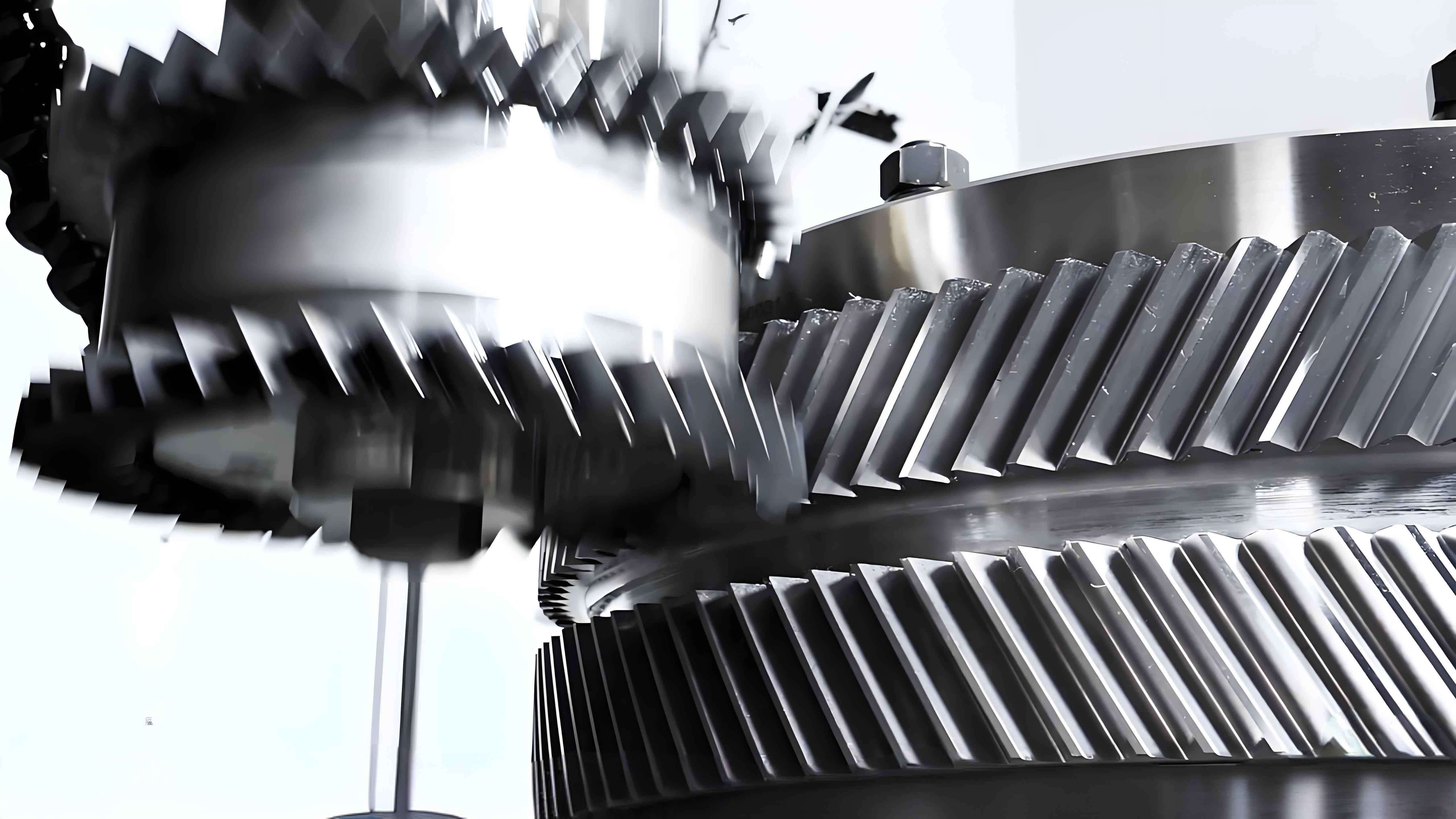
In modern mechanical transmission systems, herringbone gears are widely adopted due to their high load-bearing capacity, large contact ratio, and balanced axial forces. However, manufacturing and assembly errors inevitably introduce asymmetries, particularly in tooth pitch deviations, which can significantly affect the dynamic performance of herringbone gear transmissions. In this study, we investigate the large-period three-dimensional vibration characteristics of herringbone gears under asymmetric tooth pitch deviations. We develop a comprehensive analytical framework that integrates large-period load-bearing contact analysis and dynamic modeling to quantify the effects on mesh stiffness, axial displacement, mesh error, and impact forces. Through numerical simulations, we analyze the vibration responses under varying loads and rotational speeds, providing insights into the unique dynamic behavior of herringbone gear systems.
The inherent asymmetry in herringbone gears arises from separate manufacturing processes for the left and right helical sections, leading to cumulative pitch deviations that differ between sides. This asymmetry results in a large-period variation in mesh conditions, distinct from the short-period fluctuations typically studied. We define the large period based on the least common multiple of the pinion and gear tooth numbers, as shown in the following relationship for the relative pitch deviation along the normal mesh line:
$$ \lambda = (F_{pt1} – F_{pt2}) \cos \beta_b \cos \alpha_t $$
where \( F_{pt1} \) and \( F_{pt2} \) represent the cumulative pitch deviations of the pinion and gear, respectively, \( \beta_b \) is the base circle helix angle, and \( \alpha_t \) is the transverse pressure angle. The large period \( T_l \) is given by:
$$ T_l = T_m \cdot \text{lcm}(Z_1, Z_2) $$
with \( T_m = 60 / (n_1 Z_1) \) as the mesh period, \( n_1 \) the pinion speed, and \( Z_1, Z_2 \) the tooth numbers. For a herringbone gear pair with 17 and 44 teeth, the large period encompasses 748 mesh cycles, during which the asymmetric pitch deviation manifests distinctly between the left and right sides.
To model the large-period behavior, we propose a load-bearing contact analysis method that accounts for asymmetric tooth pitch deviation. The displacement compatibility condition for a single mesh cycle is expressed as:
$$ -\mathbf{F}_k \mathbf{p}_k + \mathbf{e} Z + \mathbf{I} \mathbf{d}_k + \mathbf{A} \delta_p = \mathbf{w}_k + \boldsymbol{\lambda}_k $$
Here, \( \mathbf{F}_k \) is the normal compliance matrix, \( \mathbf{p}_k \) the normal load vector, \( Z \) the normal line displacement, \( \mathbf{d}_k \) the tooth surface gap after deformation, \( \delta_p \) the axial displacement, \( \mathbf{w}_k \) the initial surface gap from geometric contact analysis, and \( \boldsymbol{\lambda}_k \) the mesh gap due to relative pitch deviation. The matrix \( \mathbf{A} \) relates axial displacement to normal gap changes. Solving this using an improved simplex method yields the comprehensive mesh stiffness \( k_m \), axial displacement \( \delta_p \), and composite mesh error for each mesh cycle over the large period.
The mesh stiffness for the left and right herringbone gear sides is calculated as:
$$ k_{m1} = \frac{T}{r_{p2} \cos \alpha_n \cos \beta (Z – \delta_{TE1})}, \quad k_{m2} = \frac{T}{r_{p2} \cos \alpha_n \cos \beta (Z – \delta_{TE2})} $$
where \( T \) is the load torque, \( r_{p2} \) the gear pitch radius, \( \alpha_n \) the normal pressure angle, and \( \delta_{TE1}, \delta_{TE2} \) the composite mesh errors. Additionally, the meshing impact force \( f_s \) at the initial contact point is derived from:
$$ f_s = \left( \frac{c+1}{2} \frac{I_1 I_2}{I_1 r_{b2}^2 + I_2 r_{b1}^2} v_s^2 k_s \right)^{c/(c+1)} $$
with \( I_1, I_2 \) as moments of inertia, \( r_{b1}, r_{b2} \) base radii, \( v_s \) the relative velocity, \( k_s \) the local mesh stiffness, and \( c \) a deformation coefficient. This impact force varies asymmetrically between sides over the large period.
We establish a dynamic model for the herringbone gear transmission system using a lumped-mass approach. The system includes left and right helical gear pairs, denoted as 1L, 2L and 1R, 2R, with support stiffness, damping, and a central gap stiffness to account for the herringbone structure. The equations of motion for the pinion left side (1L) are:
$$ m_{1L} \ddot{x}_{1L} + c_{x1L} \dot{x}_{1L} + k_{x1L} x_{1L} + c_{b1} (\dot{x}_{1L} – \dot{x}_{1R}) + k_{b1} (x_{1L} – x_{1R}) + F_{nLx} + f_{s1}(t) \cos \beta_{bL} \sin \psi_{12L} = 0 $$
$$ m_{1L} \ddot{y}_{1L} + c_{y1L} \dot{y}_{1L} + k_{y1L} y_{1L} + c_{b1} (\dot{y}_{1L} – \dot{y}_{1R}) + k_{b1} (y_{1L} – y_{1R}) + F_{nLy} + f_{s1}(t) \cos \beta_{bL} \cos \psi_{12L} = 0 $$
$$ m_{1L} \ddot{z}_{1L} + c_{z1L} \dot{z}_{1L} + k_{z1L} z_{1L} + c_{p1} (\dot{z}_{1L} – \dot{z}_{1R}) + k_{p1} (z_{1L} – z_{1R}) – F_{nLz} – f_{s1}(t) \sin \beta_{bL} = 0 $$
$$ I_{1L} \ddot{\theta}_{1L} + c_{t1} (\dot{\theta}_{1L} – \dot{\theta}_{1R}) + k_{t1} (\theta_{1L} – \theta_{1R}) + (F_{nL} + f_{s1}(t)) r_{b1L} \cos \beta_{bL} = T_{1L} $$
Similar equations apply to the other components. The relative vibration displacement along the normal mesh line for the left side is:
$$ \lambda_{12L} = [(x_{1L} – x_{2L}) \sin \psi_{12L} + (y_{1L} – y_{2L}) \cos \psi_{12L} + (r_{b1L} \theta_{1L} + r_{b2L} \theta_{2L})] \cos \beta_{bL} + (-z_{1L} + z_{2L}) \sin \beta_{bL} – \delta_p \sin \beta_{bL} – e_{TE1} $$
and analogously for the right side. The three-dimensional vibration characteristics are assessed through the transverse vibration acceleration \( a_{12} \) and axial vibration acceleration, derived from these displacements.
To quantify the system parameters, we present key data in the following tables. Table 1 summarizes the basic geometric parameters of the herringbone gear pair used in our analysis.
| Parameter | Pinion | Gear |
|---|---|---|
| Number of Teeth | 17 | 44 |
| Normal Module (mm) | 6 | 6 |
| Normal Pressure Angle (°) | 20 | 20 |
| Helix Angle (°) | 24.43 | -24.43 |
| Face Width (mm) | 55 | 55 |
| Central Gap Width (mm) | 58 | 58 |
| Central Gap Diameter (mm) | 92 | 260 |
Table 2 lists the dynamic parameters of the herringbone gear transmission system, including masses, inertias, and stiffness values.
| Parameter | Pinion | Gear |
|---|---|---|
| Mass (kg) | 7.11 | 64.75 |
| Moment of Inertia (kg·m²) | 0.012 | 0.7279 |
| Support Stiffness \( k_x \) (N/m) | 2.42 × 10⁸ | 3.83 × 10⁸ |
| Support Stiffness \( k_y \) (N/m) | 2.42 × 10⁸ | 3.83 × 10⁸ |
| Support Stiffness \( k_z \) (N/m) | — | 2.96 × 10⁸ |
| Central Gap Bending Stiffness \( k_b \) (N/m) | 1.11 × 10¹⁰ | 7.11 × 10¹¹ |
| Central Gap Axial Stiffness \( k_p \) (N/m) | 2.36 × 10¹⁰ | 1.89 × 10¹¹ |
| Central Gap Torsional Stiffness \( k_t \) (N·m/rad) | 9.61 × 10⁶ | 6.13 × 10⁸ |
We conducted numerical simulations using the Runge-Kutta method to solve the dynamic equations under various operating conditions. The three-dimensional vibration responses—comprising transverse and axial components—were analyzed in both time and frequency domains. First, we examined the effects of load variation at a constant pinion speed of 2000 rpm. The root mean square (RMS) values of vibration accelerations are summarized in Table 3 for different torque loads.
| Load Torque (N·m) | Transverse Vibration Acceleration RMS (m/s²) | Axial Vibration Acceleration RMS (m/s²) |
|---|---|---|
| 828 | 67.84 | 111.53 |
| 2000 | 167.51 | 85.68 |
| 5000 | 1014.73 | 90.34 |
The frequency spectra of three-dimensional vibration displacement and acceleration reveal distinct characteristics. For displacement spectra, shaft frequency components (e.g., pinion frequency \( f_1 = 33.33 \) Hz and gear frequency \( f_2 = 12.88 \) Hz at 2000 rpm) are predominant, while mesh frequency \( f_m = 566.67 \) Hz and its harmonics are relatively minor. In contrast, acceleration spectra show prominent mesh frequency and harmonics, flanked by sidebands due to modulation effects. As load increases from 828 N·m to 5000 N·m, the amplitudes of mesh frequency components grow, whereas sideband amplitudes diminish, indicating that elastic deformation gradually outweighs the influence of asymmetric pitch deviation in herringbone gears.
Next, we varied the pinion speed while maintaining a load of 5000 N·m. The large-period response demonstrates speed-dependent behavior. The transverse vibration acceleration RMS rises sharply with speed, peaking near half the resonance speed \( N_r/2 \) and the resonance speed \( N_r \), as described by:
$$ a_{\text{transverse}} \propto \frac{n_1^2}{1 – (n_1 / N_r)^2} $$
for a simplified linear approximation. Conversely, axial vibration acceleration RMS increases moderately with speed but exhibits erratic peaks not aligned with resonance conditions. Table 4 compares the RMS values at selected speeds.
| Pinion Speed (rpm) | Transverse Vibration Acceleration RMS (m/s²) | Axial Vibration Acceleration RMS (m/s²) |
|---|---|---|
| 2000 | 1014.73 | 90.34 |
| 4000 | 167.51 | 85.68 |
| 8000 | 111.53 | 176.33 |
| 17200 | 2379.46 | 183.21 |
The asymmetric meshing impact forces become increasingly dominant at speeds exceeding the resonance speed. For instance, at 2000 rpm, the left and right herringbone gear sides show similar dynamic load factors (1.1267 vs. 1.1445), but at 17200 rpm, the difference widens (1.4161 vs. 1.4597), highlighting the growing influence of asymmetric impacts. This is captured by the dynamic load factor \( K_v \):
$$ K_v = 1 + \frac{f_s}{F_n} $$
where \( f_s \) is the impact force and \( F_n \) the static mesh force. The divergence underscores the need to account for large-period asymmetry in high-speed herringbone gear designs.
Further analysis of the frequency spectra under speed variation reveals that transverse acceleration spectra are rich in mesh harmonics, while axial spectra display complex sideband structures. The sidebands are spaced at shaft frequency intervals, given by:
$$ f_{\text{sideband}} = k f_m \pm m f_1 \pm n f_2 $$
with \( k, m, n \) as integers. For example, at 4000 rpm, sidebands appear at \( 2f_m – 5f_1 \) and \( 2f_m – 2f_1 \), reflecting modulation from rotational motions. These features are critical for condition monitoring in herringbone gear systems.
To generalize the findings, we formulate the large-period vibration response as a function of asymmetric pitch deviation \( \lambda \), load \( T \), and speed \( n_1 \). The comprehensive mesh error \( e_{TE} \) can be approximated as:
$$ e_{TE} = e_0 + \sum_{i=1}^{N} \lambda_i \sin(2\pi i t / T_l + \phi_i) $$
where \( e_0 \) is the nominal error, \( \lambda_i \) the deviation amplitudes, and \( \phi_i \) phase angles. This error excites the dynamic system, leading to the three-dimensional vibrations characterized by the equations of motion. The axial displacement \( \delta_p \), unique to herringbone gears, acts as an additional excitation source and is computed from the contact analysis as:
$$ \delta_p = \frac{\sum_{j=1}^m p_{jL} \cos \gamma_{jL} – \sum_{j=1}^q p_{jR} \cos \gamma_{jR}}{k_p} $$
with \( p_{jL}, p_{jR} \) as contact loads and \( \gamma \) pressure angles. This displacement mitigates load imbalance but introduces axial vibrations.
In summary, our study demonstrates that asymmetric tooth pitch deviation in herringbone gears induces large-period variations in mesh stiffness, axial displacement, and impact forces. These variations significantly influence three-dimensional vibration characteristics, with load and speed playing crucial roles. The dynamic model developed here provides a tool for optimizing herringbone gear design to minimize vibration and enhance durability. Future work could explore the effects of other asymmetries, such as helix angle errors, and validate the findings through experimental tests on herringbone gear transmissions.
The methodology and results underscore the importance of considering large-period dynamics in herringbone gear analysis. By integrating load-bearing contact and dynamic models, we offer a comprehensive approach to predict and control vibration in these complex systems. This contributes to advancing the reliability and performance of herringbone gears in high-power applications, from marine propulsion to industrial machinery.