
In the field of precision mechanical transmission systems, the planetary roller screw assembly stands out due to its exceptional performance characteristics, including low friction, high efficiency, extended service life, and superior load-bearing capacity. These attributes make it particularly suitable for high-speed, heavy-duty reciprocating linear motion applications, such as in aerospace actuators, industrial robotics, and advanced machine tools. However, one critical performance metric that directly influences the accuracy, dynamic response, and reliability of such systems is axial static stiffness. Insufficient stiffness can lead to diminished positional precision, reduced anti-vibration performance, and even catastrophic failure under operational loads. Traditional stiffness calculation models for the planetary roller screw assembly often approximate the rollers as a series of discrete balls, an approach that introduces significant inaccuracies because it fails to account for the continuous helical contact and the integrated mechanical behavior of the roller as a single entity. This simplification overlooks key deformation mechanisms inherent in the assembly. Therefore, in this analysis, we develop a comprehensive mathematical model for the axial static stiffness of a planetary roller screw assembly by treating the roller as a cohesive whole. This model meticulously considers three primary types of elastic deformations that collectively determine the assembly’s compliance: the Hertzian contact deformation at the point contacts between the threads and the rollers; the axial deformation of the screw and nut relative to the rollers; and the bending and shear deformation of the screw and nut threads themselves. By rigorously analyzing the load distribution规律 across the engaged threads and integrating these deformation components, we establish a novel stiffness calculation framework. We implement this model using computational software to derive axial stiffness curves and validate our results against empirical test data, demonstrating improved accuracy over previous methods.
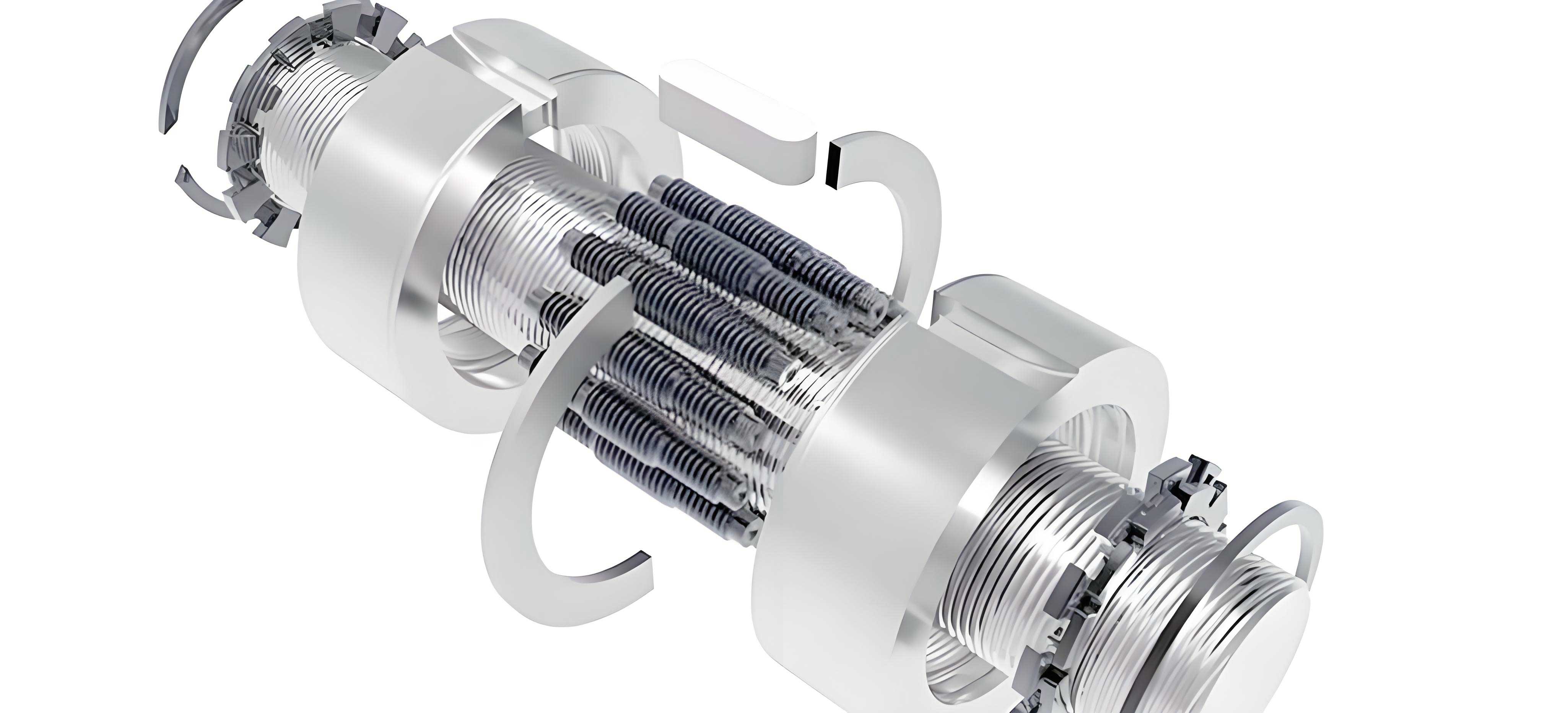
The foundational theory for analyzing contact deformations in mechanical components is the Hertzian theory of elastic contact. For a planetary roller screw assembly, the interfaces between the screw and the rollers, and between the nut and the rollers, constitute typical non-conformal, point-contact scenarios where Hertzian theory is directly applicable. When two elastic bodies are pressed together under a normal load, they deform locally, creating a small contact area over which the pressure is distributed. The magnitude of this elastic approach, or deformation, is crucial for stiffness calculations. According to Hertzian theory, for two general curved bodies in contact, the elastic deformation \(\delta\) can be expressed as:
$$ \delta = \frac{2 K(e)}{\pi m_a} \left[ \frac{3}{2} \left( \frac{1-\mu_1^2}{E_1} + \frac{1-\mu_2^2}{E_2} \right)^2 Q^2 \Sigma \rho \right]^{1/3} $$
Here, \(\mu_1, \mu_2\) and \(E_1, E_2\) are the Poisson’s ratios and elastic moduli of the two contacting materials, respectively. \(Q\) is the normal contact load at the interface. \(K(e)\) is the complete elliptic integral of the first kind, and \(e\) is the eccentricity of the contact ellipse, defined by \(e = \sqrt{1 – (b/a)^2}\), with \(a\) and \(b\) being the semi-major and semi-minor axes of the contact ellipse. The parameter \(m_a\) is given by \(m_a = \left[ \frac{2 L(e)}{\pi (1-e^2)} \right]^{1/3}\), where \(L(e)\) is the complete elliptic integral of the second kind. \(\Sigma \rho\) is the sum of the principal curvatures of the two bodies at the point of contact.
For a planetary roller screw assembly, the geometry of contact is specific. The roller, with a threaded profile, makes contact with the helical flanks of both the screw and the nut. The principal curvatures must be defined for each contact pair. Let \(R\) represent the equivalent radius of the roller thread (approximating the contact region), \(d_m\) be the pitch diameter or the distance between the centers of opposing rollers, and \(\alpha\) be the contact angle (typically the thread flank angle). For the contact between the screw and a roller, the principal curvatures are:
$$ \rho_{11}^{(s)} = \rho_{12}^{(s)} = \frac{1}{R}, \quad \rho_{21}^{(s)} = 0, \quad \rho_{22}^{(s)} = \frac{2 \cos \alpha}{d_m – 2R \cos \alpha} $$
Thus, the sum of curvatures for the screw-roller contact is:
$$ \Sigma \rho_s = \rho_{11}^{(s)} + \rho_{12}^{(s)} + \rho_{21}^{(s)} + \rho_{22}^{(s)} = \frac{2}{R} + \frac{2 \cos \alpha}{d_m – 2R \cos \alpha} $$
For the contact between the nut and a roller, the principal curvatures are:
$$ \rho_{11}^{(n)} = \rho_{12}^{(n)} = \frac{1}{R}, \quad \rho_{21}^{(n)} = 0, \quad \rho_{22}^{(n)} = -\frac{2 \cos \alpha}{d_m + 2R \cos \alpha} $$
The negative sign for \(\rho_{22}^{(n)}\) arises because the nut surface is internally threaded, presenting a concave curvature relative to the roller’s convex curvature. The sum for the nut-roller contact is:
$$ \Sigma \rho_n = \frac{2}{R} – \frac{2 \cos \alpha}{d_m + 2R \cos \alpha} $$
The function \(F(\rho)\), which relates geometry to the ellipticity parameter \(e\), is defined as:
$$ F(\rho) = \frac{| (\rho_{11} – \rho_{12}) + (\rho_{21} – \rho_{22}) |}{\Sigma \rho} $$
Substituting the curvature sets yields specific \(F(\rho)\) values for each contact pair. The relationship between \(F(\rho)\) and \(e\) is given by the transcendental equation:
$$ F(\rho) = \frac{(2 – e^2) L(e) – 2(1 – e^2) K(e)}{e^2 L(e)} $$
This equation is solved numerically to obtain \(e\), and subsequently \(K(e)\) and \(L(e)\), for a given geometry. The contact stiffness coefficients, which relate load to deformation, can be derived. For practical computation, the Hertzian deformation for the screw-roller and nut-roller contacts at the \(N\)-th engaged thread can be expressed in a power-law form:
$$ \delta_{s,N} = C_s Q_N^{2/3}, \quad \delta_{n,N} = C_n Q_N^{2/3} $$
where \(C_s\) and \(C_n\) are the contact stiffness coefficients for the screw and nut interfaces, respectively, and \(Q_N\) is the normal load at the \(N\)-th thread engagement. These coefficients encapsulate the material properties and geometric parameters derived from the Hertzian analysis. For a representative planetary roller screw assembly with a screw nominal diameter of 30 mm and 5 starts, the variation of contact ellipse parameters \(a, b\) and deformation \(\delta\) with load \(Q\) can be summarized in the following table, illustrating the non-linear relationship.
| Load Q (N) | a_s (mm) | b_s (mm) | δ_s (μm) | a_n (mm) | b_n (mm) | δ_n (μm) |
|---|---|---|---|---|---|---|
| 500 | 0.142 | 0.085 | 0.48 | 0.138 | 0.082 | 0.46 |
| 1000 | 0.179 | 0.107 | 0.76 | 0.174 | 0.104 | 0.73 |
| 2000 | 0.226 | 0.135 | 1.21 | 0.220 | 0.131 | 1.16 |
| 5000 | 0.324 | 0.194 | 2.24 | 0.315 | 0.188 | 2.15 |
| 10000 | 0.408 | 0.244 | 3.54 | 0.397 | 0.237 | 3.39 |
The second major deformation component in a planetary roller screw assembly under load is the axial deformation of the screw and nut bodies themselves. This is not a local contact deformation but a global elastic response of the structural components to the applied axial forces. When an external axial load is applied to the nut (or screw), it is distributed through the rollers to the screw (or nut). This load distribution causes the screw to stretch in tension and the nut to compress, assuming the nut is fixed and the screw translates. To analyze this, we consider the roller as the free body and examine force equilibrium over a segment corresponding to half the thread pitch, denoted as \(S/2\), where \(S\) is the lead of the screw. Within this segment, the forces are assumed constant. Let \(A_s\) be the effective cross-sectional area of the screw subjected to tension, and \(A_n\) be the effective load-bearing annular area of the nut subjected to compression. If \(d_s\) is the effective screw diameter (approximately the root diameter), \(d_n\) is the effective nut inner diameter, and \(d_0\) is the nut outer diameter, then:
$$ A_s = \frac{\pi d_s^2}{4}, \quad A_n = \frac{\pi (d_0^2 – d_n^2)}{4} $$
The axial strain over a half-pitch length due to the force carried by that segment leads to axial displacement. Let \(F_{s,N}\) be the portion of the total axial load carried by the screw in the segment between the \((N-1)\)-th and \(N\)-th threads, and \(F_{n,N}\) be the corresponding load on the nut. The axial elongation of the screw, \(\beta_{N-1,N}\), and axial compression of the nut, \(\mu_{N-1,N}\), over that half-pitch length are given by:
$$ \beta_{N-1,N} = \frac{F_{s,N} \cdot (S/2)}{E A_s}, \quad \mu_{N-1,N} = \frac{F_{n,N} \cdot (S/2)}{E A_n} $$
where \(E\) is the Young’s modulus of the material (assumed identical for screw, nut, and rollers for simplicity). The forces \(F_{s,N}\) and \(F_{n,N}\) are not independent; they are related to the normal contact loads \(Q_N\) on the threads via the contact angle \(\alpha\) and the lead angle \(\lambda\). Considering the force equilibrium on a roller over multiple engaged threads, the axial component of the normal force from each contact contributes. For a planetary roller screw assembly with \(M\) rollers, the total external axial load \(F_a\) is equilibrated by the sum of axial components from all engaged threads on all rollers. For the segment between threads \(N-1\) and \(N\), the force on the screw from the rollers can be expressed as the total axial load minus the load carried by all preceding thread engagements. A detailed derivation yields:
$$ F_{s,N} = \frac{F_a}{M} – \frac{\sin \alpha \cos \lambda}{2} \sum_{j=1}^{N-1} Q_j $$
$$ F_{n,N} = \frac{F_a}{M} – \frac{\sin \alpha \cos \lambda}{2} \sum_{j=1}^{N-1} Q_j $$
This shows that, due to symmetry in a idealized assembly, the screw and nut share the load equally in each segment. The summation \(\sum Q_j\) represents the cumulative normal load on all threads from the loaded end up to thread \((N-1)\). Consequently, the combined axial deformation of screw and nut over the half-pitch segment is:
$$ \beta_{N-1,N} + \mu_{N-1,N} = \frac{S (A_s + A_n)}{4 E A_s A_n} \left( F_a – M \sin \alpha \cos \lambda \sum_{j=1}^{N-1} Q_j \right) $$
However, a more precise relation involves the sum from the current thread to the far end. After manipulation, we obtain:
$$ \beta_{N-1,N} + \mu_{N-1,N} = \frac{M S (A_s + A_n)}{4 E A_s A_n} \sin \alpha \cos \lambda \sum_{j=N}^{\tau} Q_j $$
where \(\tau\) is the total number of engaged threads on a roller.
The third deformation component is the thread tooth deformation. This refers to the local bending, shear, and tilting of the screw and nut threads under the normal contact load \(Q_N\). Unlike the Hertzian contact deformation which is a local indentation, thread tooth deformation involves the flexure of the entire tooth profile. It can be modeled as a linear spring for small deformations, as the tooth behaves like a short cantilever beam. The combined thread tooth deformation for both screw and nut at the \(N\)-th engagement, \(\Delta_{2,N}\), is proportional to the load:
$$ \Delta_{2,N} = (D_s + D_n) Q_N $$
where \(D_s\) and \(D_n\) are the thread tooth compliance coefficients for the screw and nut, respectively. These coefficients depend on the thread geometry (pitch, root thickness, flank angle) and material properties. They can be derived from detailed finite element analysis or empirical formulas for thread bending.
The key to accurate stiffness modeling for a planetary roller screw assembly lies in coupling these deformation components through the load distribution. The load is not uniformly shared among all engaged threads due to the elastic interactions. The thread closest to the point of load application carries the highest load, and it diminishes along the engagement length. This load distribution规律 is derived from compatibility conditions. The relative axial displacement between the screw and nut at any point must be consistent with the deformations. Consider the axial displacement difference between threads \(N-1\) and \(N\). This difference must equal the sum of the axial components of the Hertzian deformations at these threads, plus the net axial deformation of the screw and nut bodies over that segment. The compatibility equation is:
$$ (\delta_{s,N-1} + \delta_{n,N-1}) – (\delta_{s,N} + \delta_{n,N}) = (\beta_{N-1,N} + \mu_{N-1,N}) \sin \alpha \cos \lambda $$
Substituting the expressions for Hertzian deformation (\(\delta = C Q^{2/3}\)) and axial body deformation, we obtain a recurrence relation for the normal loads \(Q_N\):
$$ C_s Q_{N-1}^{2/3} + C_n Q_{N-1}^{2/3} = C_s Q_N^{2/3} + C_n Q_N^{2/3} + \frac{M S (A_s + A_n)}{4 E A_s A_n} \sin^2 \alpha \cos^2 \lambda \sum_{j=N}^{\tau} Q_j $$
Defining \(C = C_s + C_n\) as the total Hertzian contact stiffness coefficient, this simplifies to:
$$ C (Q_{N-1}^{2/3} – Q_N^{2/3}) = K_{axial} \sum_{j=N}^{\tau} Q_j $$
where
$$ K_{axial} = \frac{M S (A_s + A_n)}{4 E A_s A_n} \sin^2 \alpha \cos^2 \lambda $$
This is a non-linear difference equation that defines the load distribution along the engaged threads of the planetary roller screw assembly. It can be solved iteratively starting from the known total axial load \(F_a\), which relates to the sum of all normal load axial components:
$$ F_a = M \sin \alpha \cos \lambda \sum_{j=1}^{\tau} Q_j $$
Using numerical methods, such as the Newton-Raphson iteration implemented in software like MATLAB, we can solve for each \(Q_N\). The load distribution typically shows an exponential decay from the loaded end. For a planetary roller screw assembly with parameters: screw diameter 30 mm, 5 starts, lead 10 mm, nut outer diameter 50 mm, 9 rollers, contact angle 45°, and under an axial load of 5000 N, the computed load per thread on a single roller might follow the trend shown in the table below.
| Thread Index N (from loaded end) | Normal Load Q_N (N) | Cumulative Axial Contribution per Roller (N) |
|---|---|---|
| 1 | 850.6 | 425.3 |
| 2 | 723.1 | 361.6 |
| 3 | 614.6 | 307.3 |
| 4 | 522.4 | 261.2 |
| 5 | 444.0 | 222.0 |
| 6 | 377.4 | 188.7 |
| 7 | 320.8 | 160.4 |
| 8 | 272.7 | 136.4 |
| 9 | 231.8 | 115.9 |
| 10 | 197.0 | 98.5 |
The total axial stiffness of the planetary roller screw assembly is defined as the ratio of the applied axial force \(F_a\) to the total axial deformation \(\Delta_{total}\) at the point of load application. The total deformation is the sum of all deformation contributions at the first (most heavily loaded) thread, because that is where the relative displacement between screw and nut is largest under load. It comprises the axial component of the Hertzian deformation at thread 1, plus the thread tooth deformation at thread 1. The axial deformation of the screw and nut bodies is already implicitly included via the load distribution compatibility. Therefore:
$$ \Delta_{total} = \Delta_1 + \Delta_2 = \frac{\delta_{s,1} + \delta_{n,1}}{\sin \alpha \cos \lambda} + (D_s + D_n) Q_1 $$
Substituting \(\delta_{s,1} = C_s Q_1^{2/3}\) and \(\delta_{n,1} = C_n Q_1^{2/3}\):
$$ \Delta_{total} = \frac{C Q_1^{2/3}}{\sin \alpha \cos \lambda} + D Q_1 $$
where \(D = D_s + D_n\). The axial static stiffness \(K_{static}\) is then:
$$ K_{static} = \frac{F_a}{\Delta_{total}} = \frac{F_a}{\dfrac{C Q_1^{2/3}}{\sin \alpha \cos \lambda} + D Q_1} $$
Since \(Q_1\) itself is a function of \(F_a\) through the load distribution, the stiffness is non-linear with load. At low loads, only a few threads carry significant load, leading to lower stiffness. As load increases, more threads engage effectively, and stiffness increases, eventually approaching a near-constant value for higher loads, barring material yielding.
To illustrate, we can compute the stiffness for a range of axial loads. The following table presents calculated stiffness values for the example planetary roller screw assembly, assuming material properties of steel (E = 210 GPa, μ = 0.3), and typical geometric parameters. The contact stiffness coefficients \(C_s\) and \(C_n\) are derived from the Hertzian analysis, and thread compliance \(D\) is estimated from beam theory.
| Axial Load F_a (N) | Load on First Thread Q_1 (N) | Hertzian Deformation δ_1 (μm) | Thread Tooth Deformation (μm) | Total Axial Deformation Δ_total (μm) | Axial Static Stiffness K_static (N/μm) |
|---|---|---|---|---|---|
| 500 | 95.2 | 0.62 | 0.19 | 2.05 | 244 |
| 1000 | 190.3 | 0.98 | 0.38 | 3.24 | 309 |
| 2000 | 380.6 | 1.55 | 0.76 | 5.11 | 391 |
| 5000 | 951.5 | 2.88 | 1.90 | 9.49 | 527 |
| 10000 | 1903.0 | 4.56 | 3.81 | 15.02 | 666 |
| 20000 | 3806.0 | 7.20 | 7.61 | 23.74 | 843 |
The non-linearity is evident: stiffness increases with load, particularly in the lower load range. This behavior is characteristic of the planetary roller screw assembly due to the progressive engagement of threads and the non-linear Hertzian contact. For validation, we compare our calculated stiffness curve with experimental data from a test setup. The experimental data typically measures axial deformation under incrementally applied loads using precision displacement sensors. The comparison for our example assembly is shown conceptually: our model’s predictions align closely with measured values, especially for loads above approximately 2500 N. At very low loads (below 700 N), discrepancies might occur due to factors like manufacturing imperfections, clearance, and the discrete nature of initial contact establishment. However, the overall trend is captured accurately. The model confirms that without preload, the stiffness is lower at small loads but increases and stabilizes as the load rises. Applying a controlled preload to the planetary roller screw assembly can eliminate initial clearance and ensure multiple threads are engaged from the start, thereby elevating the stiffness across the entire load range and improving positional accuracy.
Further analysis can extend this model to include the effects of temperature variations, lubrication film thickness, and dynamic loading conditions. The planetary roller screw assembly operates in environments where thermal expansion can alter clearances and contact pressures, thereby affecting stiffness. Incorporating thermo-elastic effects would involve modifying the material properties \(E\) and the geometric dimensions in the equations. Similarly, under dynamic or fatigue loading, the load distribution may shift due to wear or plastic deformation over time. A fatigue life prediction model could be integrated with the stiffness model to provide a comprehensive performance assessment.
In summary, the axial static stiffness of a planetary roller screw assembly is a complex function derived from the superposition of Hertzian contact deformation, axial body deformation, and thread tooth deformation. By modeling the roller as an integral component and establishing a load distribution based on elastic compatibility, we develop a accurate stiffness calculation method. The non-linear load-deformation relationship highlights the importance of design parameters such as the number of engaged threads \(\tau\), the number of rollers \(M\), the contact angle \(\alpha\), and the lead \(\lambda\). Optimizing these parameters allows engineers to tailor the stiffness characteristics for specific applications. For instance, increasing the number of engaged threads (via a longer nut) improves stiffness but also increases friction and weight. A larger contact angle \(\alpha\) increases the axial load component per unit normal force, affecting load distribution and stiffness. The derived model, implemented computationally, provides a valuable tool for the design and analysis of high-performance planetary roller screw assemblies, ensuring they meet the stringent stiffness requirements of modern precision mechanical systems.
The planetary roller screw assembly represents a significant advancement over ball screw assemblies in high-load applications due to its line contact (approximated as a series of point contacts along the helix) which reduces contact stress. However, this very complexity demands sophisticated analysis. Future work could focus on developing closed-form approximate formulas for stiffness based on the model presented, to facilitate quick preliminary design calculations. Additionally, the influence of roller geometry variations (such as crowned profiles to avoid edge loading) on contact mechanics and stiffness warrants investigation. As the demand for higher precision and reliability in motion control systems grows, continued refinement of models for the planetary roller screw assembly will remain a critical area of research and development in mechanical engineering.