
In the field of heavy-duty transmission systems, the hyperboloid gear stands as a critical and demanding component. Its unique geometry, characterized by offset axes, enables compact design and high torque transmission but simultaneously introduces severe interfacial conditions. During operation, the tooth interfaces of hyperboloid gears experience exceptionally high contact pressures combined with significant sliding velocities, creating a lubrication regime that is both complex and critical for longevity. The performance and durability of these gears are fundamentally tied to the integrity of the elastohydrodynamic lubrication (EHL) film separating the contacting surfaces. However, practical engineering scenarios often deviate from ideal laboratory conditions. A prevalent and challenging issue is oil starvation, where an insufficient supply of lubricant to the contact inlet leads to a degraded or incomplete lubricant film. This condition can precipitate lubrication failure, drastically accelerating surface fatigue, wear, and ultimately, catastrophic gear failure. Therefore, a deep and fundamental understanding of the lubrication behavior of hyperboloid gear contacts under starved conditions is not merely academic but is essential for the design and reliability enhancement of drivetrains in applications like heavy-duty trucks and aerospace gearboxes.
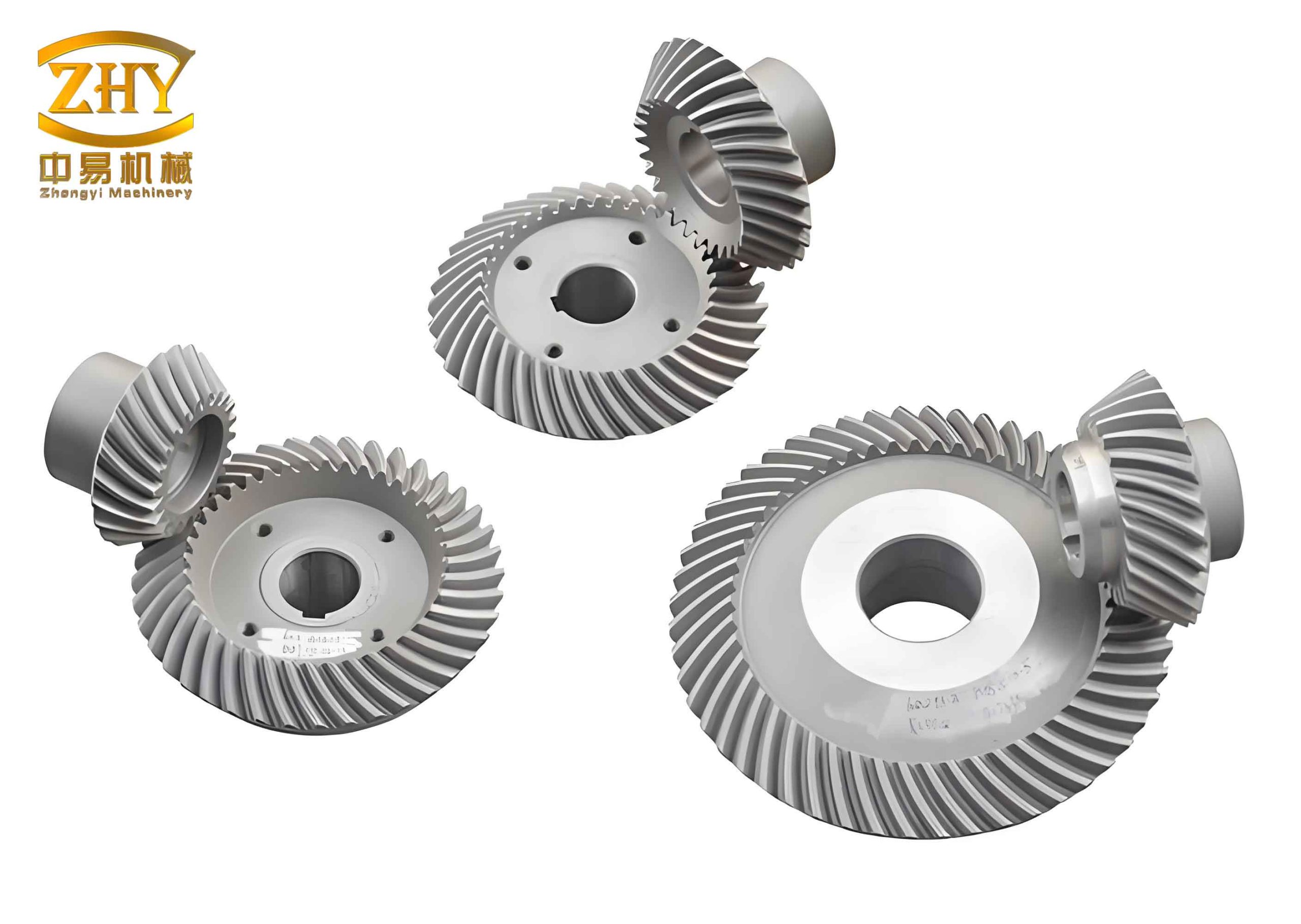
Traditional analyses of hyperboloid gear lubrication often simplify the problem by assuming a fully flooded inlet, where lubricant is abundantly available. Furthermore, many classical EHL models assume the entrainment velocity vector is aligned with one of the principal axes of the contact ellipse. For the complex meshing action of a hyperboloid gear pair, these assumptions are significant oversimplifications. The entrainment velocity vector at any point along the path of contact has an arbitrary direction relative to the Hertzian contact ellipse. The degree of oil starvation, often quantified by the oil layer thickness available at the inlet meniscus, is a critical variable in real-world operation. This work, therefore, aims to bridge this gap by developing and validating a comprehensive starved EHL model specifically for hyperboloid gears. The model integrally considers the transient contact geometry, arbitrary entrainment velocity vector, surface roughness effects, and most importantly, a controlled inlet oil supply condition. The primary objectives are to establish a validated numerical framework and to systematically investigate how diminishing oil supply and operational speed influence the film thickness at critical meshing points of a hyperboloid gear pair.
Mathematical Modeling of Starved Lubrication with Arbitrary Velocity
The lubrication contact between the teeth of a hyperboloid gear pair can be effectively modeled as a transient elliptical point contact. The key complexity arises from the fact that the entrainment velocity vector, $\vec{u_e}$, is generally not aligned with the major or minor axis of the contact ellipse. As illustrated in the conceptual figure, the contact ellipse has semi-axes $a$ and $b$ (where $a > b$). The surface velocities of the two gears are $\vec{u_1}$ and $\vec{u_2}$. The entrainment velocity is defined as $\vec{u_e} = (\vec{u_1} + \vec{u_2})/2$, and the sliding velocity is $\vec{u_s} = \vec{u_1} – \vec{u_2}$. The angle between $\vec{u_e}$ and the x-axis (aligned with the major axis $a$) is denoted as $\theta$. This arbitrary orientation is crucial for accurate modeling of the hyperboloid gear contact.
Under starved conditions, the lubricant does not fully fill the gap in the inlet region, leading to a meniscus and subsequent cavitation in the divergent outlet region. The classical Reynolds equation is inadequate to handle this partial filling. To model starvation, the mass-conserving algorithm based on the concept of a fractional film content, $\phi$, is employed. The variable $\phi$ represents the ratio of the lubricant film height $h_{oil}$ to the total gap height $h$ at any point ($\phi = h_{oil}/h$). The modified, steady-state Reynolds equation for point contact with arbitrary entrainment velocity under starved conditions is given by:
$$
\frac{\partial}{\partial x}\left(\frac{\rho h^3}{12 \eta} \frac{\partial p}{\partial x}\right) + \frac{\partial}{\partial y}\left(\frac{\rho h^3}{12 \eta} \frac{\partial p}{\partial y}\right) = u_e \cos\theta \frac{\partial (\phi \rho h)}{\partial x} + u_e \sin\theta \frac{\partial (\phi \rho h)}{\partial y}
$$
Here, $p$ is pressure, $\rho$ is density, $\eta$ is viscosity, and $h$ is the total film thickness. The solution must satisfy the following complementarity conditions, which distinguish full-film regions from starved/cavitated regions:
$$
\begin{cases}
0 \leq \phi < 1, & p = 0 \\
\phi = 1, & p > 0
\end{cases}
$$
The film thickness equation accounts for the geometric gap and elastic deformation $V$:
$$
h(x,y) = h_0 + \frac{x^2}{2R_x} + \frac{y^2}{2R_y} + V(x,y)
$$
The elastic deformation is calculated using the Boussinesq integral over the computational domain $\Omega$:
$$
V(x,y) = \frac{2}{\pi E’} \iint_{\Omega} \frac{p(\xi, \zeta)}{\sqrt{(x-\xi)^2 + (y-\zeta)^2}} d\xi d\zeta
$$
where $E’$ is the reduced modulus of elasticity. The pressure-density and pressure-viscosity relationships are described by the commonly used Dowson-Higginson and Roelands equations, respectively:
$$
\rho(p) = \rho_0 \left(1 + \frac{0.6 \times 10^{-9} p}{1 + 1.7 \times 10^{-9} p}\right)
$$
$$
\eta(p) = \eta_0 \exp\left\{ (\ln(\eta_0) + 9.67) \left[ (1 + 5.1 \times 10^{-9} p)^{Z} – 1 \right] \right\}
$$
The final equation ensures global force equilibrium, where the integrated pressure balances the applied load $W$:
$$
W = \iint_{\Omega} p(x,y) \, dx \, dy
$$
This system of equations forms the core of the starved EHL model for analyzing the hyperboloid gear contact problem.
Numerical Solution Methodology
The numerical solution of the starved EHL problem follows a robust multi-grid approach but requires specific handling of the fractional film content $\phi$. The governing equations are discretized using finite differences. The Reynolds equation is solved using a distributive relaxation scheme, while the elastic deformation is computed efficiently using the Discrete Convolution Fast Fourier Transform (DC-FFT) technique. The load balance equation is satisfied by adjusting the rigid body separation $h_0$.
The algorithm for handling starvation and cavitation is critical. In the iterative process, after solving for pressure $P_{i,j}$ at a grid point $(i,j)$, the complementarity condition is checked. If $P_{i,j} > 0$, then $\phi_{i,j}$ is set to 1. If $P_{i,j} \leq 0$, then $P_{i,j}$ is set to 0, and $\phi_{i,j}$ becomes an additional unknown at that node. The value of $\phi_{i,j}$ in the cavitated region is then calculated directly from the discretized form of the Reynolds equation rearranged for $\phi$. The discrete form can be represented as:
$$
\begin{aligned}
&\frac{1}{\Delta X^2} \left[ \epsilon^x_{i+1/2,j} P_{i+1,j} – (\epsilon^x_{i+1/2,j} + \epsilon^x_{i-1/2,j}) P_{i,j} + \epsilon^x_{i-1/2,j} P_{i-1,j} \right] + \\
&\frac{1}{\Delta Y^2} \left[ \epsilon^y_{i,j+1/2} P_{i,j+1} – (\epsilon^y_{i,j+1/2} + \epsilon^y_{i,j-1/2}) P_{i,j} + \epsilon^y_{i,j-1/2} P_{i,j-1} \right] = \\
&\frac{\cos\theta}{\Delta X} \left( 1.5 \phi_{i,j} \bar{\rho}_{i,j} H_{i,j} – 2 \phi_{i-1,j} \bar{\rho}_{i-1,j} H_{i-1,j} + 0.5 \phi_{i-2,j} \bar{\rho}_{i-2,j} H_{i-2,j} \right) + \\
&\frac{\sin\theta}{k \Delta Y} \left( 1.5 \phi_{i,j} \bar{\rho}_{i,j} H_{i,j} – 2 \phi_{i,j-1} \bar{\rho}_{i,j-1} H_{i,j-1} + 0.5 \phi_{i,j-2} \bar{\rho}_{i,j-2} H_{i,j-2} \right)
\end{aligned}
$$
When $P_{i,j}=0$, this equation is solved for $\phi_{i,j}$. After obtaining $\phi_{i,j}$, a final check is performed: if $\phi_{i,j} > 1$, it is truncated to 1; if $\phi_{i,j} < 0$, it is set to 0. This iterative procedure, combined with multi-grid techniques, ensures stable and efficient convergence to the final solution for the starved hyperboloid gear contact. The convergence criterion is typically set on the relative error in pressure and film thickness updates, e.g., $\varepsilon < 10^{-6}$.
Model Validation against Experimental Data
Prior to applying the model to the complex case of a hyperboloid gear, its validity was established by comparing predictions with published experimental data from a controlled ball-on-disk study of starved lubrication. The experimental setup utilized a secondary roller-disk contact to precisely control the oil layer thickness ($h_{oil}$) entering the primary ball-disk test contact. This allowed for the creation of repeatable starved conditions. The input parameters for the simulation were matched exactly to the experimental conditions.
| Parameter | Value |
|---|---|
| Load, $W$ | 25 N |
| Ball Radius | 38 mm |
| Lubricant Viscosity, $\eta_0$ | 0.69 Pa·s |
| Pressure-Viscosity Coefficient, $\alpha$ | 23 GPa⁻¹ |
| Young’s Modulus (Steel Disk), $E_1$ | 212 GPa |
| Young’s Modulus (Glass Disk), $E_2$ | 81 GPa |
The comparison between the simulated central film thickness ($h_c$) and the experimental data is plotted as the ratio $h_c / h_{cff2}$ against $h_{oil} / h_{cff2}$, where $h_{cff2}$ is the central film thickness under fully flooded conditions. The results demonstrate excellent agreement across a wide range of inlet oil supply conditions. The model accurately captures the transition from the starved regime, where film thickness is linearly dependent on inlet oil layer thickness ($h_c \approx h_{oil}$), to the fully flooded regime, where film thickness plateaus and becomes independent of further increases in $h_{oil}$. This successful validation confirms the model’s capability to simulate starved EHL contacts with high fidelity, providing a solid foundation for its application to the hyperboloid gear problem.
Analysis of Starved Lubrication in a Hyperboloid Gear Pair
With the validated model, a comprehensive numerical investigation was conducted for a specific hyperboloid gear pair. The geometric and kinematic parameters (path of contact, radii of curvature, entrainment, and sliding velocities) for various meshing points were derived from established gear calculation methods. The analysis focused on three critical points along the path of contact: the engaging-in point, the pitch (mid) point, and the engaging-out point. A constant input torque of 120 N·m was applied. The lubricant properties were $\eta_0 = 0.15$ Pa·s and $\alpha = 12.5$ GPa⁻¹. Both smooth surfaces and rough surfaces with an arithmetic average roughness $R_a = 0.5 \mu m$ were considered.
Effect of Inlet Oil Supply on Film Thickness
The primary variable of interest is the inlet oil layer thickness, $h_{oil}$, which was varied over a wide range from 0.1 $\mu m$ (severely starved) to 30 $\mu m$ (fully flooded). The pinion speed was held constant at 300 rpm. The two-dimensional film thickness profiles at the engaging-in point for different $h_{oil}$ values reveal significant insights. Under fully flooded conditions, the profile shows a characteristic horseshoe shape with a constriction at the outlet. As $h_{oil}$ decreases to 1000 nm, a distinct step or dimple appears in the inlet region, indicating the meniscus where the oil film begins. With further reduction in supply (e.g., 300 nm and 100 nm), this inlet dimple becomes less pronounced and the overall film thickness diminishes substantially. The central film thickness ($h_c$) for smooth surfaces and the average film thickness ($h_a$) for rough surfaces at the three meshing points were extracted and analyzed.
| $h_{oil}$ (nm) | Engaging-in Point | Pitch Point | Engaging-out Point |
|---|---|---|---|
| 100 | 78 | 82 | 85 |
| 300 | 185 | 210 | 232 |
| 600 | 305 | 372 | 420 |
| 1000 | 390 | 495 | 560 |
| Fully Flooded | 425 | 545 | 615 |
The data leads to several key conclusions regarding the hyperboloid gear lubrication under starved conditions. First, the inlet oil supply has a profound effect on film formation. Film thickness increases monotonically with $h_{oil}$ until it saturates at the fully flooded value. Second, under fully flooded conditions, there is a notable difference in film thickness among the three meshing points due to variations in local curvature and slide-to-roll ratio. Typically, the engaging-in point exhibits the lowest film thickness. Third, and most importantly, as starvation intensifies (i.e., $h_{oil}$ decreases), the differences in film thickness among the three points progressively diminish. When $h_{oil}$ is reduced to approximately 100 nm, the film thickness values at all three points converge to nearly the same low level. This indicates that under severe starvation, the localized geometric and kinematic advantages at certain points are negated by the overarching limitation of lubricant supply. The influence of meshing position on film thickness is thus weakened as the oil starvation becomes more severe. The trend for rough surfaces, analyzed via average film thickness, follows the same pattern, confirming the robustness of this finding.
Effect of Rotational Speed under Different Supply Conditions
The interaction between operational speed and inlet oil supply is another critical aspect for hyperboloid gear performance. Simulations were run for the engaging-in point across a wide speed range (100 to 3000 rpm) under three distinct lubrication regimes: fully flooded, moderately starved ($h_{oil}=600$ nm), and severely starved ($h_{oil}=300$ nm).
| Speed (rpm) | Fully Flooded | $h_{oil}=600$ nm | $h_{oil}=300$ nm |
|---|---|---|---|
| 100 | 142 | 135 | 98 |
| 300 | 425 | 305 | 185 |
| 600 | 780 | 415 | 245 |
| 1000 | 1150 | 428 | 252 |
| 2000 | 1980 | 430 | 253 |
| 3000 | 2750 | 431 | 254 |
The results reveal a significant interaction. As expected, under fully flooded conditions, the central film thickness increases continuously with speed, following a power-law relationship typical of EHL. However, under starved conditions, the behavior is markedly different. While film thickness initially rises with speed, it eventually reaches a plateau. For the $h_{oil}=600$ nm case, the plateau begins around 1000 rpm, and for the $h_{oil}=300$ nm case, it begins at an even lower speed. Beyond these critical speeds, increasing the rotational speed provides no further benefit to film thickness; it is strictly limited by the fixed amount of oil available at the inlet ($h_{oil}$). This plateau represents a fundamental limit imposed by starvation. In contrast, the fully flooded film thickness continues to grow. This has major implications for hyperboloid gear design and operation: at high speeds, a gear system operating under even mild starved conditions may have a film thickness orders of magnitude smaller than expected from fully flooded theory, dramatically increasing the risk of asperity contact and wear.
Consideration of Surface Roughness
The analysis was extended to incorporate surface roughness with $R_a = 0.5 \mu m$. The overall trends for average film thickness ($h_a$) versus $h_{oil}$ and speed were consistent with those observed for central film thickness on smooth surfaces. However, one notable difference emerged at very low speeds. Under severe starvation and very low speed (e.g., 10 rpm), the smooth surface model predicted a near-zero film. The rough surface model, however, predicted a finite average film thickness in the range of 120-140 nm. This can be attributed to the micro-reservoir effect of surface roughness: the valleys in the rough surface can trap and retain small amounts of lubricant, which can then be drawn into the contact even when the macroscopic inlet supply is very low. This highlights the protective role of surface topography in boundary and mixed lubrication regimes, which are often entered by hyperboloid gears under starved, low-speed, or high-load conditions.
Conclusion
This investigation successfully developed and applied a comprehensive starved elastohydrodynamic lubrication model to analyze the complex interfacial behavior of hyperboloid gears. The model’s validity was firmly established through favorable comparisons with independent experimental data. The systematic numerical study yielded several critical insights for the performance and design of hyperboloid gear transmissions operating with limited lubricant supply.
Firstly, the degree of oil starvation, quantified by the inlet oil layer thickness $h_{oil}$, is a dominant factor controlling film thickness. As $h_{oil}$ decreases, the lubricant film at all critical meshing points (engaging-in, pitch, and engaging-out) diminishes. Notably, the inherent differences in film thickness between these points, caused by varying contact geometry and kinematics, progressively vanish under severe starvation. When $h_{oil}$ is reduced to a critical low level, the film thickness becomes nearly uniform across the path of contact, indicating that the global oil supply constraint overrides local favorable conditions.
Secondly, the interaction between rotational speed and oil supply reveals a fundamental limitation in starved operation. While speed enhances film formation under fully flooded conditions, its benefit under starved conditions is capped. After a certain critical speed, the film thickness plateaus and becomes independent of further speed increases, being solely determined by the fixed inlet oil availability. This plateau effect means that high-speed operation does not necessarily mitigate the risks associated with starvation for a hyperboloid gear; in fact, the relative deficiency compared to the expected flooded film becomes more severe.
Finally, surface roughness introduces a mitigating factor at extreme conditions. The micro-texture can act as a lubricant reservoir, sustaining a finite separating film even under very low inlet supply and speed, where a smooth surface model would predict complete film collapse.
In summary, the reliable operation of hyperboloid gears in practical applications requires careful consideration of lubricant supply adequacy. Design calculations based on fully flooded assumptions may be non-conservative. The findings underscore the importance of ensuring efficient oil delivery to the meshing zone and suggest that performance gains from increasing speed may be illusory if the inlet is starved. This analysis provides a foundational framework for predicting film thickness, assessing lubrication safety margins, and informing the design of lubrication systems for hyperboloid gear drives in demanding applications.