
In the development of high-speed, high-torque transmission systems for new energy electric vehicles, I have encountered significant challenges in maintaining gear accuracy after implementing a compression welding process for gear-shaft assemblies. This study focuses on the analysis of machining errors that arise between the welding and gear grinding stages, particularly emphasizing the impact on gear parameters such as tooth profile errors, cumulative pitch deviations, and cross-bar distances. Through experimental investigations, I aimed to identify the primary sources of error, including positioning inaccuracies, heat treatment distortions, and welding-induced deformations, and their effects on the final gear grinding outcomes. The integration of gear grinding processes is critical to achieving the required ISO grade 6 precision, but issues like grinding cracks and inconsistent tooth profiles often emerge due to pre-grinding errors. By systematically evaluating these factors, I seek to establish guidelines for minimizing errors and enhancing the reliability of gear profile grinding in automotive applications.
The growing demand for efficient power transmission in electric vehicles has led to the adoption of innovative manufacturing techniques, such as gear-shaft welding, which offers advantages in material savings and structural integrity. However, this process introduces complexities in subsequent gear grinding operations, where errors can propagate and result in defects like grinding cracks or deviations in tooth geometry. In my research, I conducted a series of tests on disk gears and shafts, measuring key parameters before and after heat treatment and welding to quantify their influence. The use of gear profile grinding is essential for correcting these errors, but it requires precise control over the initial gear blank conditions. Below, I present a detailed examination of the error sources, supported by empirical data, formulas, and tables, to provide insights into optimizing the manufacturing workflow for high-precision gears.
To begin, I defined the manufacturing workflow for the gear-shaft assembly, which involves separate processing of the shaft and disk gears, followed by compression welding and final gear grinding. The shaft manufacturing includes initial machining and grinding of shaft teeth, while the disk gears undergo rolling, heat treatment, and hard turning before assembly. During the gear grinding phase, I observed that variations in tooth flank grinding—such as excessive material removal on one side—led to failures in meeting specifications for parameters like the start of active profile (SAP) point, tooth profile angle deviation (fHα), profile form deviation (ffα), and total profile deviation (Fα). These issues were traced back to pre-grinding errors, prompting a focused analysis on positioning, heat treatment, and welding effects.
The positioning errors primarily stem from misalignments during the assembly and clamping stages. For instance, the axial locating surface of the shaft, which is machined intermittently post-heat treatment, can develop taper due to tool wear, affecting the compression fit accuracy. Additionally, radial run-out errors in the mating surfaces between the shaft and gear bore lead to non-uniform interference fits. When clamping the disk gears for hard turning, the use of standard three-jaw chucks on non-machined locating surfaces—prone to burrs or deformations—can cause significant run-out, altering the relative position between the teeth and the bore. To quantify this, I measured the run-out errors under controlled conditions, finding that normal operational controls can limit positioning errors to within 20 μm, but deviations beyond this threshold exacerbate gear grinding challenges. The relationship between positioning error (δ_p) and resultant tooth misalignment can be expressed using a simplified geometric model: $$ \delta_p = \sqrt{(\Delta_x)^2 + (\Delta_y)^2} $$ where Δ_x and Δ_y represent deviations in the horizontal and vertical axes, respectively. This error propagates through the gear grinding process, increasing the risk of grinding cracks if not mitigated.
Heat treatment deformation emerged as the most substantial contributor to pre-grinding errors. Given the structural characteristics of the disk gears—large outer diameters relative to their widths and the presence of lightening holes—they are highly susceptible to thermal distortions. I conducted experiments comparing two placement methods during heat treatment: hanging and flat placement with specialized support fixtures. The results, summarized in Table 1, clearly demonstrate that flat placement with balanced support minimizes cumulative pitch error (Fp) variations. For example, the average change in Fp was 24.62 μm for flat placement compared to 42.26 μm for hanging, indicating better stability. Moreover, the tooth trace error (fHβ) patterns consistently showed an approximate “Λ” shape under flat placement, which is more predictable and easier to compensate for during gear grinding. In contrast, hanging placement resulted in erratic fHβ trends and larger single-flank variations (Vβf), complicating subsequent corrections. The deformation due to heat treatment can be modeled using a thermal expansion formula: $$ \Delta L = \alpha \cdot L \cdot \Delta T $$ where α is the coefficient of thermal expansion, L is the characteristic dimension, and ΔT is the temperature change. However, for complex gear geometries, finite element analysis is often required to predict distortions accurately. Excessive deformation here not only affects gear grinding efficiency but also predisposes the gear to grinding cracks if the material integrity is compromised.
| Placement Method | Sample ID | Fp Before Heat Treatment (μm) | Fp After Heat Treatment (μm) | Change in Fp (μm) |
|---|---|---|---|---|
| Flat Placement | 0 | 8.80 | 45.30 | 36.50 |
| 1 | 17.40 | 37.80 | 20.40 | |
| 2 | 12.40 | 34.50 | 22.10 | |
| 3 | 12.00 | 29.80 | 17.80 | |
| 4 | 18.10 | 41.60 | 23.50 | |
| 5 | 15.20 | 43.30 | 28.10 | |
| 6 | 15.40 | 39.30 | 24.80 | |
| Average | 14.18 | 38.80 | 24.62 | |
| Hanging Placement | 7 | 16.20 | 42.50 | 26.30 |
| 8 | 11.70 | 41.50 | 29.80 | |
| 9 | 20.10 | 44.90 | 24.80 | |
| 10 | 16.90 | 62.40 | 45.50 | |
| 11 | 14.50 | 74.60 | 60.10 | |
| 12 | 14.40 | 56.80 | 42.40 | |
| 14 | 10.40 | 68.00 | 57.60 | |
| 15 | 9.70 | 51.30 | 41.60 | |
| Average | 14.24 | 56.50 | 42.26 |
Welding deformation, though less significant than heat treatment effects, still plays a crucial role in pre-grinding error accumulation. I performed welding deformation tests on smaller disk gears, measuring parameters like tooth trace error (fHβ), cross-bar distance (M value), and cumulative pitch error (Fp) before and after welding. The results, detailed in Tables 2 and 3, indicate that welding consistently reduces the M value due to contraction toward the weld point, with an average change of -0.01778 μm post-welding relative to post-heat treatment. For fHβ, welding induced uniform shifts—left flanks generally decreased while right flanks increased—with an average deformation of -2.56 μm for left flanks and 3.37 μm for right flanks. These changes are approximately 19.4% and 26.7% of the heat treatment-induced deformations, respectively, highlighting the relatively minor but consistent impact of welding. However, Fp experienced the most substantial welding-related variations, with an average increase of 16.90 μm and individual changes ranging from -3.90 μm to 41.60 μm. This variability underscores the cumulative nature of pitch errors, where even small localized deformations can amplify during gear grinding. The welding effect on gear geometry can be approximated by a stress-strain relationship: $$ \sigma = E \cdot \epsilon $$ where σ is the stress, E is Young’s modulus, and ε is the strain induced by thermal cycles. Proper control of welding parameters, such as heat input and cooling rates, is essential to minimize these distortions and prevent issues like grinding cracks during subsequent gear profile grinding.
| Sample ID | Left Flank fHβ (μm) | Right Flank fHβ (μm) | ||||
|---|---|---|---|---|---|---|
| Before Heat Treatment | After Heat Treatment | After Welding | Before Heat Treatment | After Heat Treatment | After Welding | |
| 2 | 11.40 | 1.10 | -1.00 | 11.90 | -7.00 | -3.90 |
| 3 | 17.60 | -1.40 | -3.60 | 10.50 | -2.10 | 1.80 |
| 5 | 11.20 | -2.90 | -5.70 | 10.00 | -2.30 | 1.10 |
| 6 | 10.60 | 3.80 | 1.10 | 9.30 | 3.60 | 7.90 |
| 9 | 11.10 | -2.80 | -4.70 | 10.30 | 0.20 | 3.30 |
| 11 | 12.10 | -9.30 | -11.80 | 10.50 | -7.70 | -4.10 |
| 12 | 11.50 | 6.60 | 3.30 | 10.90 | 0.90 | 3.30 |
| 14 | 13.10 | 5.20 | 3.20 | 10.80 | -6.00 | -2.80 |
| 0 | 13.70 | -6.90 | -10.40 | 10.60 | 1.70 | 5.00 |
| Average | 12.48 | -0.73 | -3.29 | 10.53 | -2.08 | 1.29 |
The interplay between these error sources necessitates a holistic approach to process control. For instance, the total error (E_total) before gear grinding can be modeled as a combination of positioning, heat treatment, and welding errors: $$ E_{\text{total}} = \delta_p + \Delta_{\text{heat}} + \Delta_{\text{weld}} $$ where δ_p is the positioning error, Δ_heat is the heat treatment deformation, and Δ_weld is the welding deformation. My experiments show that heat treatment contributes the most to E_total, followed by positioning and then welding. To achieve the desired gear accuracy, I recommend implementing strict tolerances for each stage: using balanced support during heat treatment, optimizing clamping methods to reduce positioning errors, and controlling welding parameters to minimize thermal impacts. Additionally, gear profile grinding must be tailored to account for these pre-existing errors, with adjustments in grinding depth and path to avoid overgrinding and the formation of grinding cracks. The gear grinding process itself can be described by a material removal rate formula: $$ MRR = v_f \cdot a_e \cdot d_e $$ where v_f is the feed rate, a_e is the engagement depth, and d_e is the effective grinding diameter. However, excessive MRR can induce thermal damage, leading to grinding cracks, so parameters must be optimized based on the initial gear condition.
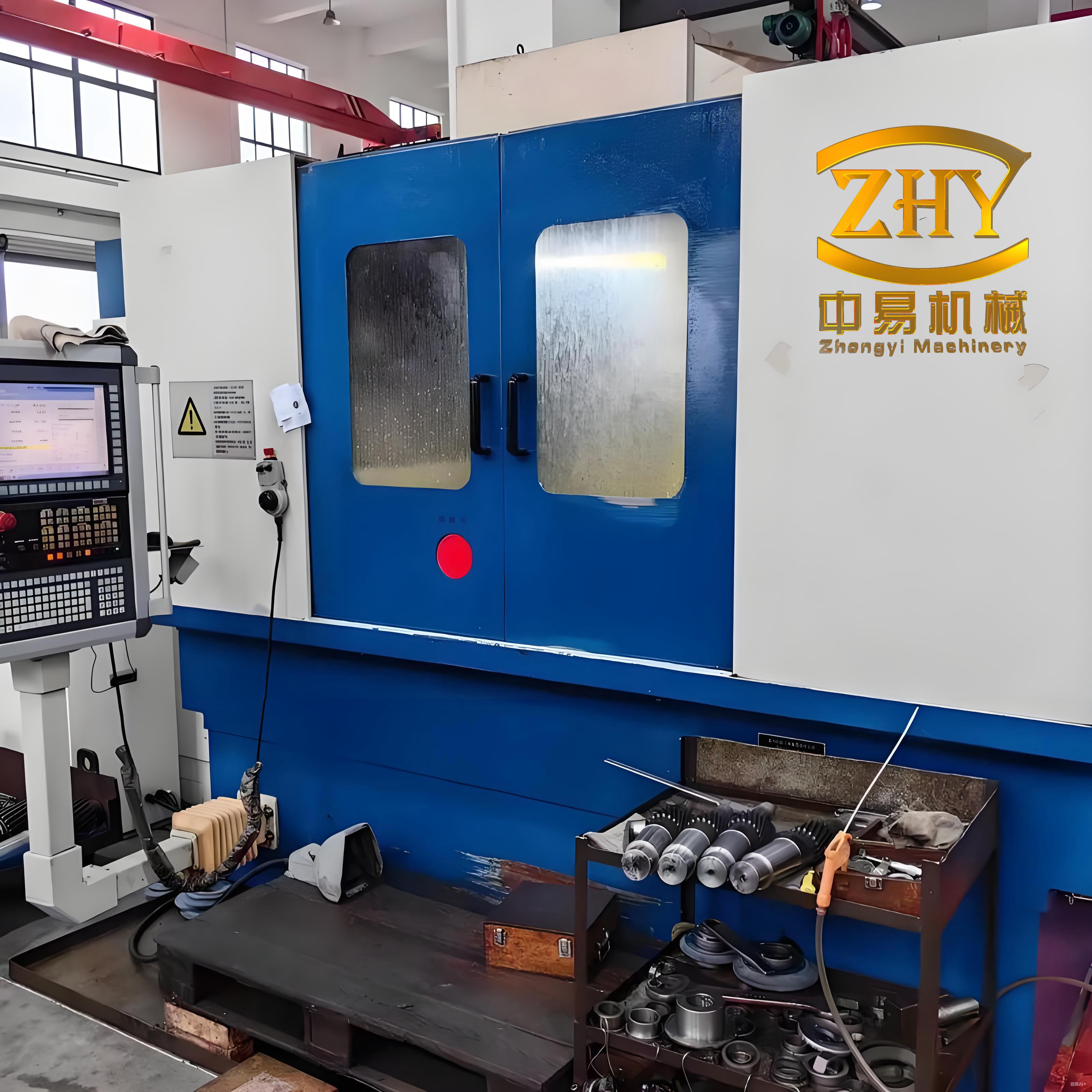
In the context of gear profile grinding, which is a precision process for achieving final tooth geometry, the presence of pre-grinding errors can lead to inconsistent material removal and potential defects. For example, if the tooth trace error (fHβ) is not uniform, the grinding wheel may engage unevenly, causing localized stress concentrations that evolve into grinding cracks. These cracks compromise gear durability, especially in high-torque applications. My analysis involved monitoring the grinding process after implementing error mitigation strategies, such as improved fixture designs and pre-grinding inspections. By correlating the error data with grinding outcomes, I developed a predictive model for optimal grinding parameters. The relationship between initial error and grinding correction can be expressed as: $$ C_g = k \cdot E_{\text{total}} $$ where C_g is the required grinding correction and k is a process-dependent constant. This approach helps in minimizing the risk of grinding cracks and ensures consistent gear quality.
| Sample ID | M Value (μm) | Fp (μm) | ||||
|---|---|---|---|---|---|---|
| Before Heat Treatment | After Heat Treatment | After Welding | Before Heat Treatment | After Heat Treatment | After Welding | |
| 2 | -0.010 | 0.089 | 0.069 | 12.10 | 33.90 | 50.10 |
| 3 | -0.025 | 0.109 | 0.079 | 7.10 | 44.10 | 56.60 |
| 5 | -0.020 | 0.069 | 0.059 | 13.10 | 40.70 | 58.30 |
| 6 | -0.015 | 0.109 | 0.099 | 11.40 | 50.00 | 67.70 |
| 9 | -0.010 | 0.119 | 0.099 | 10.10 | 65.60 | 87.40 |
| 11 | 0.005 | 0.089 | 0.089 | 17.00 | 69.20 | 110.80 |
| 12 | -0.010 | 0.109 | 0.069 | 19.90 | 75.20 | 93.10 |
| 14 | 0.015 | 0.119 | 0.119 | 8.70 | 44.90 | 41.00 |
| 0 | 0.010 | 0.119 | 0.089 | 7.30 | 30.90 | 41.60 |
| Average | -0.00667 | 0.10344 | 0.08567 | 11.86 | 50.50 | 67.40 |
In conclusion, my investigation into the machining errors between gear-shaft compression welding and gear grinding reveals that heat treatment deformation is the dominant factor, followed by positioning errors and welding effects. By adopting flat placement with support during heat treatment, refining clamping techniques, and optimizing welding parameters, I successfully reduced pre-grinding errors, leading to improved gear grinding outcomes. The consistent appearance of keywords like gear grinding, grinding cracks, and gear profile grinding throughout this study underscores their importance in achieving high-precision gears for electric vehicles. Future work should focus on real-time monitoring during gear grinding to detect and prevent grinding cracks, further enhancing the reliability of these critical components. Through continuous improvement in process control, the integration of compression welding and gear grinding can meet the stringent demands of modern automotive transmissions, ensuring durability and efficiency in high-speed, high-torque environments.