
In the study of gear transmission systems, screw gears represent a critical category of spatial meshing mechanisms, particularly in applications requiring high reduction ratios and compact design. Among these, right-angle cylindrical screw gears, where the worm and worm wheel axes are orthogonal, offer unique advantages in power transmission and motion control. However, analyzing their meshing characteristics often involves complex spatial geometry and kinematics, which can be computationally intensive. In this article, I propose a simplified method that transforms this spatial meshing problem into an equivalent rack-and-pinion meshing problem. This approach not only streamlines design calculations but also provides deeper insights into the meshing behavior of screw gears. I will delve into the transformation of meshing conditions, equivalent meshing equations, first-type and second-type limit conditions, and the concept of meshing axes, all while emphasizing the relevance of screw gears in engineering applications. Throughout, I will use numerous formulas and tables to summarize key points, ensuring clarity and practicality for engineers and researchers.
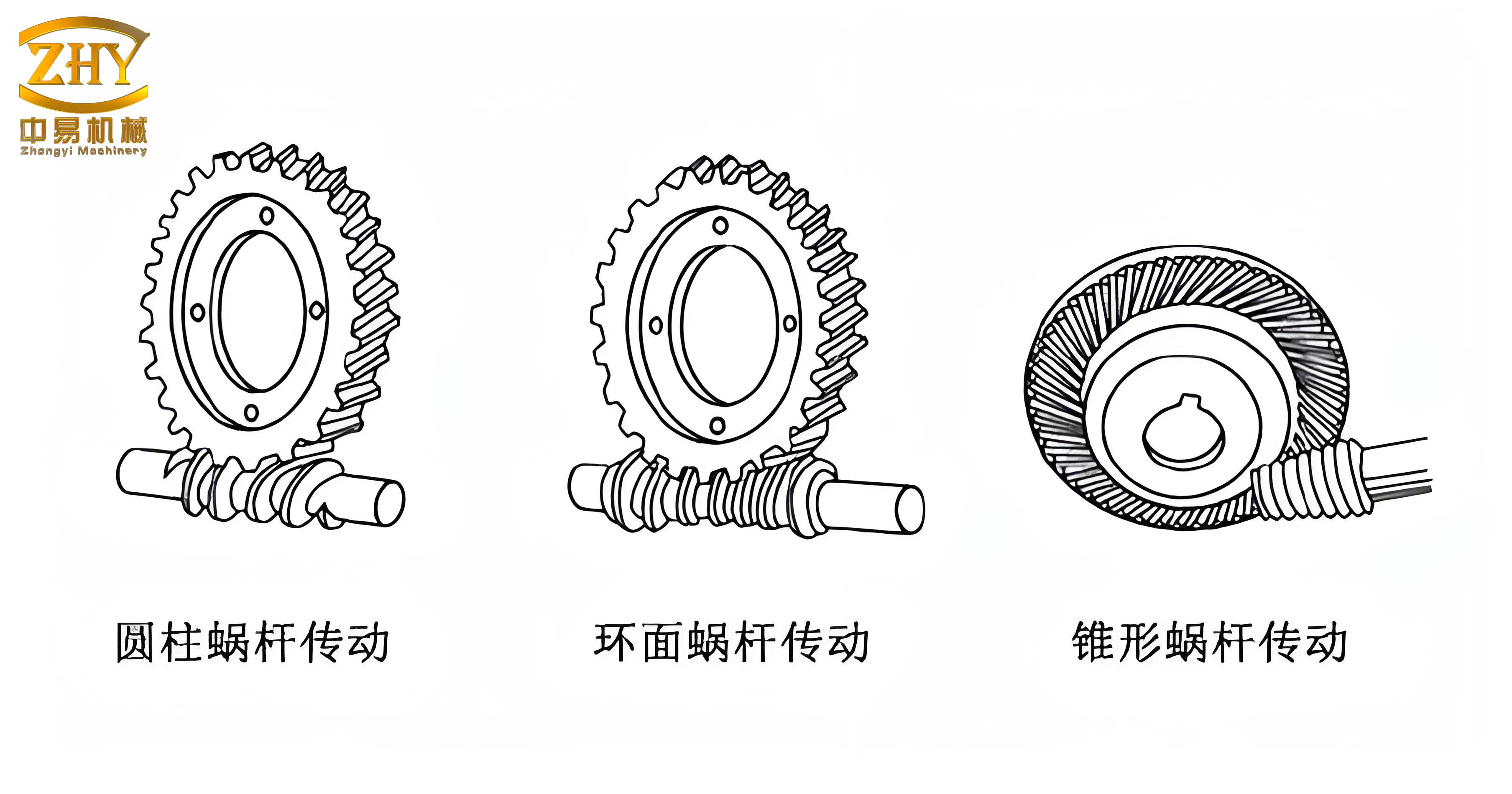
The fundamental challenge in analyzing screw gears lies in their three-dimensional engagement, which requires sophisticated mathematical modeling. By leveraging the orthogonality condition in cylindrical worm drives, I demonstrate that the relative motion between the worm and worm wheel can be effectively converted into a planar gear-and-rack interaction. This conversion hinges on the helical nature of screw gears, where the worm’s spiral surface can be treated as a translating rack rather than a rotating body. This perspective simplifies the derivation of meshing conditions and facilitates the analysis of contact patterns, stress distribution, and efficiency in screw gears. In the following sections, I will systematically explore this transformation, starting with the establishment of coordinate systems and proceeding to detailed kinematic and geometric analyses.
To begin, consider the coordinate systems for the worm and worm wheel in a right-angle cylindrical screw gear pair. Let the worm coordinate system be denoted as \( o_1 – \mathbf{i}_1, \mathbf{j}_1, \mathbf{k}_1 \), where \( \mathbf{k}_1 \) aligns with the worm’s angular velocity vector \( \boldsymbol{\omega}^{(1)} \). The worm wheel coordinate system is \( o_2 – \mathbf{i}_2, \mathbf{j}_2, \mathbf{k}_2 \), with \( \mathbf{k}_2 \) aligned with the worm wheel’s angular velocity vector \( \boldsymbol{\omega}^{(2)} \). The axes are orthogonal, such that \( \mathbf{i}_2 = -\mathbf{i}_1 \), \( \mathbf{j}_2 = -\mathbf{k}_1 \), and \( \mathbf{k}_2 = -\mathbf{j}_1 \). The center distance is \( A \), and the speed ratio is \( I = |\boldsymbol{\omega}^{(2)}| / |\boldsymbol{\omega}^{(1)}| \). For simplicity, assume \( |\boldsymbol{\omega}^{(1)}| = 1 \) and \( |\boldsymbol{\omega}^{(2)}| = I \). The helical surface of the worm, a key component of screw gears, can be expressed as:
$$ \mathbf{R}^{(1)} = \xi(u) \mathbf{e}(\lambda) + \eta(u) \mathbf{e}_1(\lambda) + (\zeta(u) + p\lambda) \mathbf{k}_1 $$
Here, \( u \) and \( \lambda \) are surface parameters, \( p \) is the spiral constant (related to the lead of the screw gears), and \( \mathbf{e}(\lambda) \) and \( \mathbf{e}_1(\lambda) \) are circular vector functions: \( \mathbf{e}(\lambda) = \cos \lambda \, \mathbf{i}_1 + \sin \lambda \, \mathbf{j}_1 \) and \( \mathbf{e}_1(\lambda) = -\sin \lambda \, \mathbf{i}_1 + \cos \lambda \, \mathbf{j}_1 \). This formulation captures the helical motion inherent in screw gears, which is essential for their meshing action.
The family of worm surfaces due to rotation is given by:
$$ \mathbf{r}^{(1)} = B_1(\phi_1) \mathbf{R}^{(1)} = \xi(u) \mathbf{e}(\lambda + \phi_1) + \eta(u) \mathbf{e}_1(\lambda + \phi_1) + (\zeta(u) + p\lambda) \mathbf{k}_1 $$
where \( B_1(\phi_1) \) is the rotation matrix representing the worm’s motion, and \( \phi_1 \) is the family parameter. Similarly, the worm wheel surface and its family are denoted as \( \mathbf{R}^{(2)} \) and \( \mathbf{r}^{(2)} \), with \( \mathbf{r}^{(2)} = B_2(\phi_2) \mathbf{R}^{(2)} \). The meshing condition for screw gears, derived from the relative velocity and surface normal, is traditionally expressed as:
$$ f(u, \lambda, \phi_1) = (\boldsymbol{\omega}^{(2)} \times \mathbf{r}^{(2)} – \boldsymbol{\omega}^{(1)} \times \mathbf{r}^{(1)}) \cdot \mathbf{n} = 0 $$
where \( \mathbf{n} = \mathbf{r}^{(1)}_u \times \mathbf{r}^{(1)}_\lambda \) is the normal vector to the worm surface. For helical surfaces like those in screw gears, the identity \( (p \boldsymbol{\omega}^{(1)} + \boldsymbol{\omega}^{(1)} \times \mathbf{r}^{(1)}) \cdot \mathbf{n} = 0 \) holds, allowing the meshing condition to be rewritten as:
$$ f(u, \lambda, \phi_1) = [\boldsymbol{\omega}^{(2)} \times \mathbf{r}^{(2)} – (-p \boldsymbol{\omega}^{(1)})] \cdot \mathbf{n} = 0 $$
This transformed equation reveals a critical insight: the worm can be viewed as a rack translating with velocity \( -p \boldsymbol{\omega}^{(1)} \) without rotation, while the worm wheel rotates as a gear. Thus, the spatial meshing of screw gears is converted into a planar rack-and-pinion meshing problem. The equivalent pitch radius of the worm wheel is \( R_{2j} = p / I \), which directly relates to the design parameters of screw gears. This conversion simplifies the analysis significantly, as planar meshing theories can be directly applied to screw gears.
To further illustrate this transformation, consider the equivalent meshing equations. Let the equivalent pitch radius of the worm be \( R_{1j} = A – R_{2j} \). The instantaneous axis of rotation (or pitch axis) for the rack-and-pinion analogy is given by:
$$ \mathbf{r}_j = R_{1j} \mathbf{i}_1 – Q \mathbf{j}_1 $$
where \( Q \) is a parameter. According to the fundamental theorem of gear meshing, the common normal at any contact point must pass through the pitch axis. Therefore, for screw gears, we have:
$$ \mathbf{r}^{(1)} + S_0 \mathbf{n} = R_{1j} \mathbf{i}_1 – Q_0 \mathbf{j}_1 $$
with \( S_0 = -\mathbf{r}^{(1)} \cdot \mathbf{k}_1 / (\mathbf{n} \cdot \mathbf{k}_1) \) and \( Q_0 = -(\mathbf{r}^{(1)} + S_0 \mathbf{n}) \cdot \mathbf{j}_1 \). Dotting both sides with \( \mathbf{j}_1 \times \mathbf{n} \) yields the simplified meshing condition:
$$ (\mathbf{r}^{(1)} \times \mathbf{j}_1 – R_{1j} \mathbf{k}_1) \cdot \mathbf{n} = 0 $$
This equation is equivalent to the original spatial meshing condition but framed in terms of the rack-and-pinion model. It serves as the cornerstone for analyzing screw gears using planar methods. To make this more tangible for engineering applications, we can examine cross-sections of the screw gears. By taking a plane perpendicular to the worm wheel axis \( \mathbf{k}_2 \), we obtain a pair of conjugate profiles: the worm cross-section is a rack curve, and the worm wheel cross-section is the corresponding gear tooth profile. The meshing condition for these profiles aligns with the above equation, as stated in Proposition 1.
Proposition 1: For any non-singular point on a surface, if a cutting plane intersects the surface, the normal vector of the cut curve, the surface normal, and the normal vector of the cutting plane are coplanar.
Thus, the meshing condition for the cross-sectional profiles of screw gears is:
$$
\begin{cases}
(\mathbf{r}^{(1)} \times \mathbf{j}_1 – R_{1j} \mathbf{k}_1) \cdot \mathbf{n} = 0 \\
\mathbf{r}^{(1)} \cdot \mathbf{j}_1 = C
\end{cases}
$$
where \( C \) is a constant determined by the cutting plane position. The conjugate worm wheel profile is then given by:
$$ \mathbf{R}^{(2)} = B_2^{-1}(\phi_2) (\mathbf{r}^{(1)} – A \mathbf{i}_1) $$
This reduces the spatial problem to a planar one, where the intersection of the cutting plane with the pitch axis is the pitch point, and with the worm wheel axis is the rotation center. The line of action (or meshing line) is the intersection with the meshing surface. For common types of cylindrical screw gears, such as Archimedean, involute, and normal straight-sided worm gears, this planar approach yields straightforward results. For example, in the cross-section where \( \mathbf{r}^{(1)} \cdot \mathbf{j}_1 = 0 \) for Archimedean screw gears, the worm profile is a straight rack with a constant pressure angle, and the conjugate worm wheel profile is an involute curve. Similarly, for involute screw gears at \( \mathbf{r}^{(1)} \cdot \mathbf{j}_1 = R_b \) (base radius) and for normal straight-sided screw gears at \( \mathbf{r}^{(1)} \cdot \mathbf{j}_1 = -R_h \) (reference cylinder radius), the worm rack profiles are linear, leading to involute worm wheel profiles. This uniformity simplifies the design and manufacturing of screw gears.
To summarize the cross-sectional characteristics of different screw gear types, I present Table 1, which outlines key parameters and outcomes based on the planar transformation method.
| Type of Screw Gears | Cutting Plane Condition | Worm Profile (Rack) | Worm Wheel Profile | Design Implications |
|---|---|---|---|---|
| Archimedean Screw Gears | \(\mathbf{r}^{(1)} \cdot \mathbf{j}_1 = 0\) | Straight line with constant pressure angle | Involute curve | Simplified tooling and high manufacturability |
| Involute Screw Gears | \(\mathbf{r}^{(1)} \cdot \mathbf{j}_1 = R_b\) | Straight line (based on base circle) | Involute curve | Improved meshing smoothness and load capacity |
| Normal Straight-Sided Screw Gears | \(\mathbf{r}^{(1)} \cdot \mathbf{j}_1 = -R_h\) | Straight line (based on reference cylinder) | Involute curve | Enhanced alignment and reduced wear in screw gears |
Next, I analyze the first-type limit points in screw gears, which correspond to points where the meshing line intersects the boundaries of the active profile, potentially leading to undercutting or interference. In spatial meshing, determining these points is complex, but the planar transformation simplifies it. From Proposition 2 and its corollary, we can derive conditions for first-type limits in screw gears.
Proposition 2: For a given surface, the first-type limit points on its conjugate surface correspond to points on the meshing surface where the normal vector of the meshing surface intersects the rotation axis of the conjugate surface.
Corollary: For a planar curve, the first-type limit points on its conjugate curve correspond to points on the meshing line where the normal vector of the meshing line passes through the rotation center of the conjugate curve.
Using the meshing condition, we solve for \( \phi_1 = \phi_1(u, \lambda) \) and substitute into the worm wheel surface equation to obtain the meshing surface:
$$ \mathbf{r}^{(2)} = \mathbf{r}^{(2)}(\phi_1(u, \lambda), u, \lambda) $$
The normal vector to this meshing surface is:
$$ \mathbf{n}_p = \mathbf{r}^{(2)}_u \times \mathbf{r}^{(2)}_\lambda $$
Thus, the first-type limit condition for screw gears is:
$$ (\mathbf{r}^{(2)}, \mathbf{n}_p, \mathbf{k}_2) = 0 $$
where the triple product denotes the scalar triple product. For the cross-sectional profiles, this reduces to:
$$
\begin{cases}
(\mathbf{r}^{(2)}, \mathbf{n}_p, \mathbf{k}_2) = 0 \\
\mathbf{r}^{(2)} \cdot \mathbf{k}_2 = C
\end{cases}
$$
This condition identifies points where the meshing line is tangent to the worm wheel profile, indicating the onset of undercutting. In screw gears, avoiding such points is crucial for ensuring continuous and smooth transmission. For instance, in involute screw gears, first-type limits often occur near the root of the worm wheel teeth, necessitating careful design of tooth geometry.
Moving to second-type limit points, these define the boundaries of the meshing zone, where contact lines on the worm surface envelope a curve that separates regions of conjugation and non-conjugation. In screw gears, second-type limits are associated with the tangency between the pitch axis and the normal line surface of the worm. Consider the normal line surface formed by the worm surface normals as the worm rotates:
$$ \mathbf{r}_h(\lambda, u, \phi_1, s) = \mathbf{r}^{(1)} + s \mathbf{n} $$
where \( s \) is a parameter along the normal line. In the conjugation region, for \( |\phi_1| < 2\pi \), the normal lines intersect the pitch axis twice; in the non-conjugation region, they do not intersect. At the second-type limit point, the pitch axis is tangent to this normal line surface at \( s = S_0 \). Therefore, the condition for second-type limits in screw gears is:
$$
\begin{cases}
(\mathbf{r}_{h\phi_1}, \mathbf{r}_{hs}, \mathbf{j}_1) = 0 \\
s = S_0
\end{cases}
$$
This geometric interpretation provides an intuitive way to locate second-type limits in screw gears, aiding in the design of optimal tooth profiles that maximize contact area and minimize stress concentrations.
Another important concept in screw gears is the meshing axis, which is a fixed line in space through which all surface normals at contact points pass at a given instant. For spatial gearing with one helical surface, such as screw gears, meshing axes exist and can be derived from the kinematics. From the rack-and-pinion analogy, the pitch axis is one meshing axis. The second meshing axis can be expressed as:
$$ \mathbf{r}_{2f} = R_{2f} \mathbf{i}_1 + v (-\cos \alpha \, \mathbf{k}_1 + \sin \alpha \, \mathbf{j}_1) $$
where \( R_{2f} \) is the intercept on the \( \mathbf{i}_1 \)-axis, \( \alpha \) is the angle with \( \mathbf{k}_1 \), and \( v \) is a parameter. The angular velocity vectors for the two components are \( \boldsymbol{\omega}_1 = \omega_1 \mathbf{j}_1 \) and \( \boldsymbol{\omega}_2 = \omega_2 (-\cos \alpha \, \mathbf{k}_1 + \sin \alpha \, \mathbf{j}_1) \). Using the conditions for equivalent motion:
$$
\begin{align*}
\boldsymbol{\omega}_1 + \boldsymbol{\omega}_2 &= \boldsymbol{\omega}^{(2)} – \boldsymbol{\omega}^{(1)} \\
R_{1j} \mathbf{i}_1 \times \boldsymbol{\omega}_1 + R_{2f} \mathbf{i}_1 \times \boldsymbol{\omega}_2 – A \mathbf{i}_1 \times \boldsymbol{\omega}^{(2)} &= 0
\end{align*}
$$
Solving these yields \( R_{2f} = 0 \) and \( \tan \alpha = p / R_{1j} \), where \( \alpha \) is the lead angle of the worm at the pitch cylinder. This result confirms that meshing axes are inherent to screw gears and can be used to analyze contact patterns and load distribution.
To further elaborate on the practical benefits of this transformation method, consider the design calculations for screw gears. Traditional spatial analysis requires solving complex differential equations, but the planar approach reduces this to algebraic and geometric operations. For example, the contact path on the worm wheel surface can be determined by solving the meshing equation in the cross-sectional plane, then transforming back to three dimensions. This simplifies tasks like tooth contact analysis (TCA) and stress evaluation, which are critical for high-performance screw gears in automotive, aerospace, and industrial machinery.
Moreover, the method applies universally to any cylindrical screw gear pair satisfying the orthogonality and constant lead conditions, whether the worm surface is ruled or non-ruled. This includes exotic profiles like convolute or globoid screw gears, though additional considerations may be needed for non-cylindrical variants. Table 2 summarizes the applicability of the transformation method to various screw gear types, highlighting key equations and design parameters.
| Screw Gear Type | Worm Surface Equation | Transformed Meshing Condition | Key Design Parameters | Typical Applications |
|---|---|---|---|---|
| Archimedean Screw Gears | \(\mathbf{R}^{(1)} = u \mathbf{e}(\lambda) + p\lambda \mathbf{k}_1\) | \((\mathbf{r}^{(1)} \times \mathbf{j}_1 – R_{1j} \mathbf{k}_1) \cdot \mathbf{n} = 0\) | Pressure angle \( \alpha \), lead \( p \) | Power transmission in conveyors |
| Involute Screw Gears | \(\mathbf{R}^{(1)} = R_b (\mathbf{e}(\lambda) + \lambda \mathbf{e}_1(\lambda)) + p\lambda \mathbf{k}_1\) | Same as above | Base radius \( R_b \), spiral angle \( \beta \) | High-speed reducers in robotics |
| Normal Straight-Sided Screw Gears | \(\mathbf{R}^{(1)} = \xi(u) \mathbf{e}(\lambda) + \eta(u) \mathbf{e}_1(\lambda) + p\lambda \mathbf{k}_1\) | Same as above | Reference radius \( R_h \), normal module \( m_n \) | Precision positioning systems |
| Non-Ruled Screw Gears | General helical surface | Same as above | Custom profile parameters | Specialized machinery and actuators |
In addition to theoretical insights, this method facilitates computational modeling of screw gears. Using software tools, engineers can implement the planar equations to simulate meshing behavior, predict efficiency losses, and optimize tooth geometries. For instance, finite element analysis (FEA) of screw gears can be simplified by applying loads based on the planar contact forces derived from the rack-and-pinion model. This accelerates the design process and reduces prototyping costs, making screw gears more accessible for innovative applications.
Furthermore, the transformation method sheds light on the lubrication and wear characteristics of screw gears. By analyzing the sliding velocities and contact pressures in the planar analogy, one can estimate friction losses and select appropriate lubricants. For example, in right-angle screw gears, the sliding motion along the tooth flanks is analogous to that in a rack-and-pinion system, allowing for the use of established tribological models. This is particularly important for screw gears operating under heavy loads or high speeds, where efficient lubrication is essential for longevity.
To illustrate the mathematical depth, let’s derive the equivalent pitch radius in more detail. From the meshing condition transformation, the worm’s translational velocity is \( -p \boldsymbol{\omega}^{(1)} \), and the worm wheel’s rotational velocity is \( \boldsymbol{\omega}^{(2)} \). In the rack-and-pinion analogy, the pitch point is where the linear velocity of the rack equals the tangential velocity of the gear. Thus, we have:
$$ p |\boldsymbol{\omega}^{(1)}| = R_{2j} |\boldsymbol{\omega}^{(2)}| $$
Given \( |\boldsymbol{\omega}^{(1)}| = 1 \) and \( |\boldsymbol{\omega}^{(2)}| = I \), we solve for \( R_{2j} \):
$$ R_{2j} = \frac{p}{I} $$
This radius is fundamental in screw gear design, as it defines the reference for tooth proportions and center distance adjustments. Similarly, the worm’s equivalent pitch radius is \( R_{1j} = A – R_{2j} \), which influences the lead angle and efficiency. These parameters are interlinked, and their optimization is key to achieving desired performance in screw gears.
Another aspect worth exploring is the impact of manufacturing errors on screw gears. The planar transformation method allows for sensitivity analysis by introducing deviations in the rack profile or pitch parameters. For example, if the worm tooth profile has a slight curvature error due to machining, it can be modeled as a perturbation in the planar rack curve, and its effect on the worm wheel profile can be computed using the conjugate equations. This helps in setting tolerances and ensuring quality control in screw gear production.
In conclusion, the transformation of spatial meshing to planar rack-and-pinion meshing offers a powerful simplification for analyzing right-angle cylindrical screw gears. This method elucidates meshing conditions, limit points, and meshing axes, all while reducing computational complexity. By applying planar gear theory, engineers can design screw gears with improved accuracy, efficiency, and reliability. The versatility of this approach extends to various screw gear types, making it a valuable tool in advanced mechanical design. As screw gears continue to evolve in applications like renewable energy and automation, such analytical advancements will drive innovation and performance enhancements.
Finally, I emphasize that this method not only streamlines calculations but also deepens the understanding of screw gear dynamics. Future work could integrate this with digital twin technologies for real-time monitoring and optimization of screw gear systems. By embracing these simplified yet robust analytical techniques, the engineering community can further harness the potential of screw gears in transforming motion and power transmission across industries.