
In modern agricultural machinery, gear transmission systems play a pivotal role in conveying motion and power efficiently. Among various gear types, the involute spur cylindrical gear is widely adopted due to its stable transmission performance, high load-bearing capacity, and resistance to impact. However, during the meshing process of these cylindrical gears, stiffness excitation arising from elastic deformation is a primary source of noise and vibration, which can compromise the durability and efficiency of agricultural equipment. Therefore, accurately calculating the mesh stiffness of cylindrical gears is essential for optimizing design, enhancing performance, and reducing operational costs. In this study, I employ the potential energy method to investigate the mesh stiffness of involute spur cylindrical gears, leveraging principles from material mechanics and elasticity theory. This approach not only provides a theoretical foundation for improving agricultural machinery but also ensures higher design quality and productivity. The focus is on cylindrical gears, which are integral to applications such as fruit tree seedling machines, and the analysis aims to address the periodic stiffness variations during single and double-tooth engagement.
The significance of cylindrical gears in agricultural machinery cannot be overstated. These gears are commonly used in tractors, harvesters, and irrigation systems, where reliable power transmission is critical. The involute profile of cylindrical gears ensures smooth engagement and constant velocity ratio, but the time-varying mesh stiffness due to alternating tooth contact introduces dynamic激励 that can lead to premature wear and failure. By applying the potential energy method, I derive analytical expressions for mesh stiffness, considering factors like bending, shear, axial compression, and Hertzian contact. This method simplifies the cylindrical gear tooth into a cantilever beam model, facilitating accurate calculations that account for real-world operating conditions. Throughout this article, I will emphasize the importance of cylindrical gears in agricultural contexts, repeatedly highlighting their role in transmission systems.
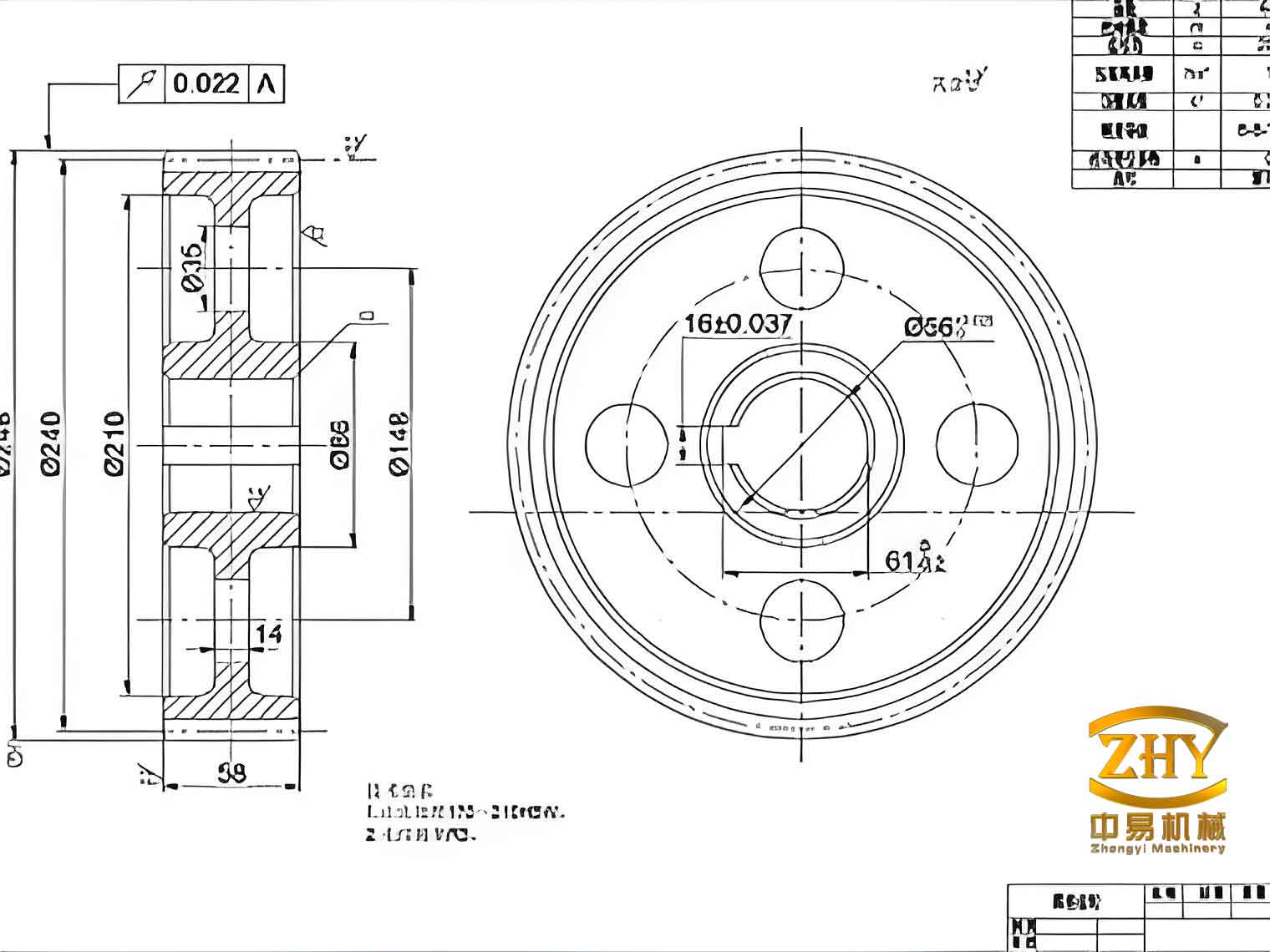
To understand the meshing behavior of cylindrical gears, it is essential to review their fundamental principles. The correct meshing condition for a pair of involute spur cylindrical gears requires that the normal base pitch be equal for both gears, ensuring a constant instantaneous transmission ratio. Mathematically, this condition is expressed as: $$m_1 = m_2 = m$$ and $$\alpha_1 = \alpha_2 = \alpha$$, where \(m\) represents the module and \(\alpha\) denotes the pressure angle. The meshing process occurs along the line of action, which is a straight line tangent to the base circles of the gears. Key characteristics include a constant velocity ratio, linear contact path, and a contact ratio \(\varepsilon \geq 1\), which ensures continuous engagement by having at least one pair of teeth in contact at all times. For cylindrical gears, the contact ratio is crucial for smooth operation, and it is calculated based on the geometry of the gear teeth. The following table summarizes the basic parameters involved in cylindrical gear meshing:
| Parameter | Symbol | Description |
|---|---|---|
| Module | \(m\) | Measure of tooth size, critical for standardization |
| Pressure Angle | \(\alpha\) | Angle between tooth profile and radial line, typically 20° |
| Number of Teeth | \(z\) | Determines gear ratio and diameter |
| Base Circle Radius | \(r_b\) | Radius of circle from which involute profile is generated |
| Contact Ratio | \(\varepsilon\) | Number of tooth pairs in contact during meshing |
The potential energy method is a powerful analytical tool for computing the mesh stiffness of cylindrical gears. It is based on the principle that the total potential energy stored in a gear tooth during deformation comprises several components: bending energy \(U_b\), shear energy \(U_s\), axial compressive energy \(U_a\), and Hertzian contact energy \(U_h\). Each energy component corresponds to a specific stiffness type: bending stiffness \(k_b\), shear stiffness \(k_s\), axial stiffness \(k_a\), and Hertzian stiffness \(k_h\). By modeling the cylindrical gear tooth as a cantilever beam fixed at the root, I can derive these stiffness values using material mechanics. The force \(F\) acting at the meshing point is decomposed into tangential \(F_b\) and radial \(F_a\) components, given by: $$F_b = F \cos \alpha_1$$ and $$F_a = F \sin \alpha_1$$, where \(\alpha_1\) is the pressure angle at the meshing point. The geometry of the cylindrical gear tooth is defined by parameters such as the distance from the base circle \(x\), tooth width \(L\), and height \(h\). The following formulas outline the stiffness expressions derived from energy principles:
Bending stiffness: $$\frac{1}{k_b} = \int_{-\alpha_1}^{\alpha_2} \frac{3\{1 + \cos \alpha_1[(\alpha_2 – \alpha) \sin \alpha – \cos \alpha]\}^2 (\alpha_2 – \alpha) \cos \alpha}{2EL[\sin \alpha + (\alpha_2 – \alpha) \cos \alpha]^3} d\alpha$$
Shear stiffness: $$\frac{1}{k_s} = \int_{-\alpha_1}^{\alpha_2} \frac{1.2(1 + \nu)(\alpha_2 – \alpha) \cos \alpha \cos^2 \alpha_1}{EL[\sin \alpha + (\alpha_2 – \alpha) \cos \alpha]} d\alpha$$
Axial stiffness: $$\frac{1}{k_a} = \int_{-\alpha_1}^{\alpha_2} \frac{(\alpha_2 – \alpha) \cos \alpha \sin^2 \alpha_1}{2EL[\sin \alpha + (\alpha_2 – \alpha) \cos \alpha]} d\alpha$$
Hertzian stiffness: $$k_h = \frac{\pi E L}{4(1 – \nu^2)}$$
In these equations, \(E\) is Young’s modulus, \(\nu\) is Poisson’s ratio, \(L\) is the face width of the cylindrical gear, and \(\alpha_2\) is the pressure angle at the addendum circle, calculated as: $$\alpha_2 = \arccos\left(\frac{r_b}{r_a}\right)$$, where \(r_a\) is the addendum radius. The integration limits \(\alpha_1\) and \(\alpha_2\) correspond to the pressure angles at the start and end of meshing, respectively. For cylindrical gears, these angles are derived from the gear geometry and meshing conditions.
To solve the mesh stiffness model, I combine the individual stiffness components to obtain the total mesh stiffness for a cylindrical gear pair. The total potential energy \(U_{\text{total}}\) is the sum of the energies from both the driving and driven gears: $$U_{\text{total}} = U_b^{(1)} + U_s^{(1)} + U_a^{(1)} + U_h^{(1)} + U_b^{(2)} + U_s^{(2)} + U_a^{(2)} + U_h^{(2)}$$. This can be expressed in terms of stiffness as: $$U_{\text{total}} = \frac{F^2}{2k_{\text{mesh}}}$$, where \(k_{\text{mesh}}\) is the overall mesh stiffness. Therefore, the mesh stiffness for a pair of cylindrical gears is given by: $$\frac{1}{k_{\text{mesh}}} = \frac{1}{k_b^{(1)} + k_s^{(1)} + k_a^{(1)} + k_h^{(1)}} + \frac{1}{k_b^{(2)} + k_s^{(2)} + k_a^{(2)} + k_h^{(2)}}$$. However, this expression often overestimates stiffness because it neglects the deflection caused by gear body flexibility. To account for this, the foundation stiffness \(k_f\) is introduced, which considers the deformation of the gear tooth base. The foundation stiffness is computed using empirical formulas from literature, such as: $$k_f = \frac{E L}{\cos^2 \alpha} \left( \frac{L^*}{8} + M^* \left( \frac{s_f}{h_f} \right) + P^* (1 + Q^* \tan^2 \alpha) \right)$$, where \(L^*\), \(M^*\), \(P^*\), and \(Q^*\) are coefficients dependent on gear geometry, and \(s_f\) and \(h_f\) are dimensions related to the tooth root. For cylindrical gears with a contact ratio \(\varepsilon > 1\), multiple tooth pairs may be in contact simultaneously. In such cases, the total mesh stiffness is the sum of the stiffness contributions from all engaged tooth pairs: $$k_{\text{total}} = \sum_{i=1}^{n} k_{\text{mesh}, i}$$, where \(n\) is the number of tooth pairs in contact. This periodic variation in stiffness is a key dynamic激励 in cylindrical gear systems, influencing noise and vibration levels in agricultural machinery.
The application of the potential energy method to cylindrical gears offers significant advantages for agricultural machinery design. For instance, in a fruit tree seedling machine, cylindrical gears are used to transmit power from the engine to the planting mechanism. By calculating the mesh stiffness, I can optimize gear parameters to minimize vibration and enhance durability. The table below illustrates typical parameters for a cylindrical gear pair in such an application, along with computed stiffness values using the potential energy method:
| Parameter | Value (Driving Gear) | Value (Driven Gear) | Unit |
|---|---|---|---|
| Module \(m\) | 3 | 3 | mm |
| Number of Teeth \(z\) | 20 | 30 | – |
| Pressure Angle \(\alpha\) | 20° | 20° | degree |
| Face Width \(L\) | 20 | 20 | mm |
| Young’s Modulus \(E\) | 210 | 210 | GPa |
| Poisson’s Ratio \(\nu\) | 0.3 | 0.3 | – |
| Bending Stiffness \(k_b\) | 1.2 × 10⁸ | 9.5 × 10⁷ | N/m |
| Shear Stiffness \(k_s\) | 2.8 × 10⁸ | 2.3 × 10⁸ | N/m |
| Axial Stiffness \(k_a\) | 3.5 × 10⁹ | 2.9 × 10⁹ | N/m |
| Hertzian Stiffness \(k_h\) | 4.1 × 10⁹ | 4.1 × 10⁹ | N/m |
| Total Mesh Stiffness \(k_{\text{mesh}}\) | 6.7 × 10⁸ | N/m | |
These calculations demonstrate how the potential energy method provides detailed insights into the stiffness characteristics of cylindrical gears. By adjusting parameters like module or face width, designers can tailor the mesh stiffness to reduce dynamic loads in agricultural equipment. Furthermore, the time-varying nature of mesh stiffness in cylindrical gears necessitates consideration in dynamic modeling. The stiffness varies cyclically with the gear rotation angle, and this variation can be approximated using Fourier series: $$k(\theta) = k_0 + \sum_{n=1}^{\infty} (a_n \cos(n\omega t) + b_n \sin(n\omega t))$$, where \(k_0\) is the average stiffness, \(\omega\) is the meshing frequency, and \(a_n\), \(b_n\) are coefficients derived from the potential energy method. This representation is useful for simulating the vibrational response of cylindrical gear systems in agricultural machinery.
In terms of research methodology, I employed a literature review approach to gather existing knowledge on cylindrical gear dynamics and mesh stiffness calculations. This involved analyzing studies from various sources, including journals and books, focusing on cylindrical gear applications in agriculture. Additionally, material mechanics principles were applied to model cylindrical gear teeth as cantilever beams, enabling the derivation of stiffness formulas. The potential energy method, as described, integrates these principles to offer a comprehensive analytical solution. Compared to finite element analysis (FEA), which is computationally intensive, the potential energy method provides faster results with acceptable accuracy, making it suitable for initial design phases of cylindrical gears in agricultural machinery.
The current research landscape on cylindrical gear mesh stiffness reveals several gaps. While many studies focus on gear design and fatigue analysis, few delve deeply into stiffness computation using energy-based methods. Traditional approaches often rely on simplified formulas that neglect effects like shear deformation or gear body flexibility. Moreover, research on cylindrical gears in agricultural contexts is limited, with most work centered on industrial applications. By applying the potential energy method, this study addresses these gaps by offering a systematic, physics-based model for cylindrical gear mesh stiffness that accounts for multiple deformation modes. Future work could explore the influence of manufacturing tolerances, lubrication, and temperature variations on the stiffness of cylindrical gears, further refining their design for agricultural use.
To illustrate the practical implications, consider the case of a cylindrical gear pair in a tractor transmission. The gears experience fluctuating loads due to terrain variations, leading to dynamic stresses that depend on mesh stiffness. Using the potential energy method, I can compute the stiffness variation over a meshing cycle and correlate it with vibration data. This analysis helps in selecting optimal gear materials and geometries to prolong service life. For example, increasing the face width \(L\) of cylindrical gears generally enhances stiffness but also adds weight; thus, a balance must be struck through iterative design. The following equation summarizes the relationship between mesh stiffness and dynamic load for cylindrical gears: $$F_{\text{dynamic}} = k_{\text{mesh}} \cdot \delta$$, where \(\delta\) is the deflection under load. By minimizing stiffness fluctuations, dynamic loads can be reduced, leading to quieter and more reliable agricultural machinery.
In conclusion, the potential energy method is a robust analytical tool for evaluating the mesh stiffness of involute spur cylindrical gears in agricultural machinery. By deriving stiffness components from energy principles, this approach enables accurate modeling of gear deformation under load, facilitating optimized design for reduced noise and vibration. The repeated focus on cylindrical gears throughout this analysis underscores their critical role in power transmission systems. As agricultural equipment evolves towards higher efficiency and automation, precise stiffness calculations will become increasingly important for ensuring durability and performance. This study lays a foundation for further research into dynamic behavior and advanced materials for cylindrical gears, ultimately contributing to smarter and more sustainable agricultural practices. The integration of such analytical methods into design processes can shorten development cycles, lower costs, and enhance the overall quality of agricultural machinery.