
The study of gear dynamics is fundamental to the design of reliable and efficient mechanical transmission systems. Among the various excitation sources, the time-varying mesh stiffness (TVMS) is a critical parameter, originating from the periodic change in the number of gear teeth in contact. While extensive research has been devoted to standard spur gears, the influence of practical factors like profile shifting (a common design modification), tooth surface friction, and manufacturing errors like geometric eccentricity on the mesh stiffness of spur gears warrants a detailed, consolidated investigation. This analysis delves into these aspects, presenting refined analytical models and exploring their combined effects on the meshing characteristics of spur gear pairs.
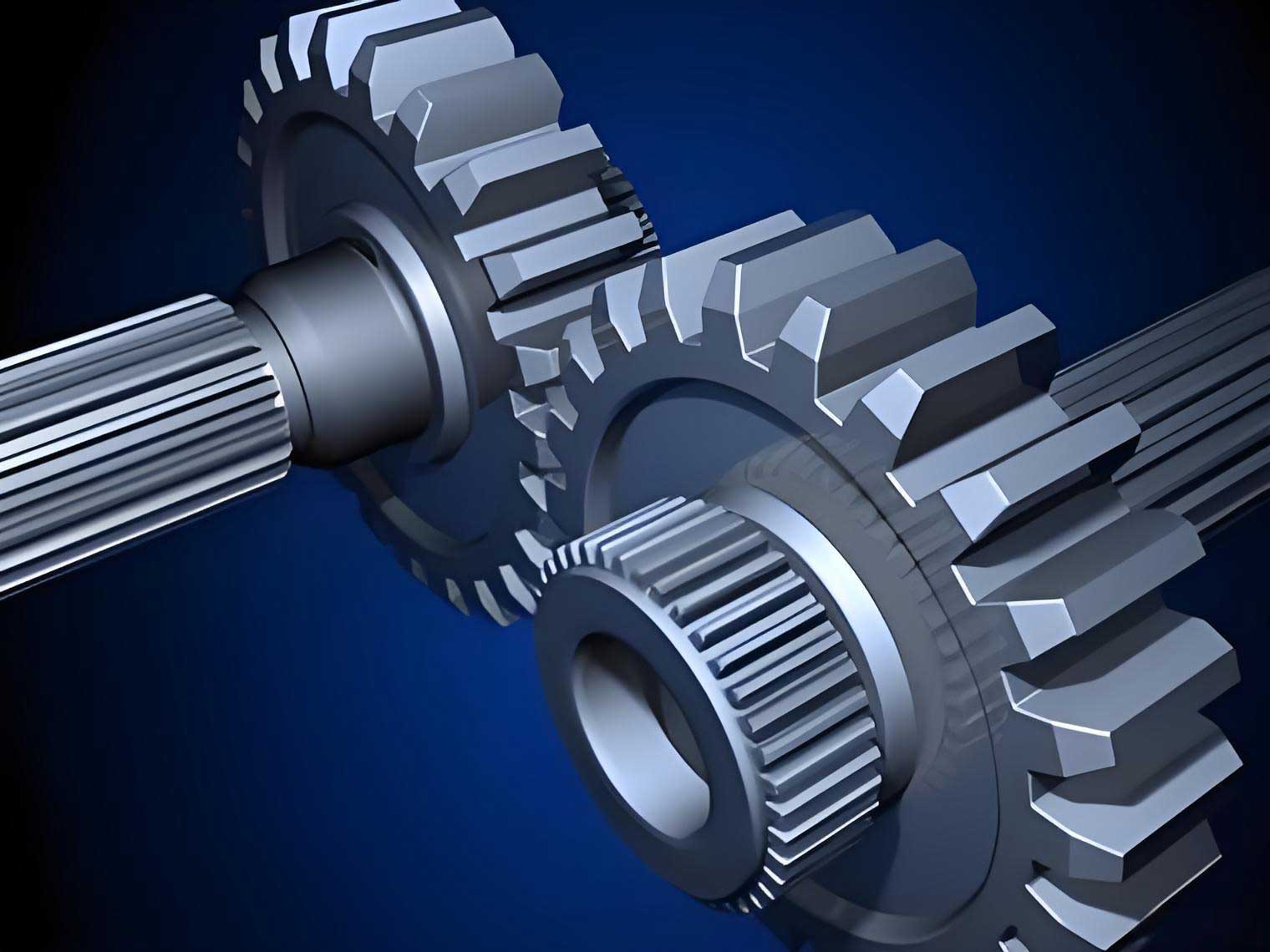
Spur gears are among the most common types of gears due to their simplicity and efficiency in transmitting motion and power between parallel shafts. The accurate prediction of their dynamic behavior hinges on a precise calculation of the mesh stiffness. The energy method, which sums various potential energy components stored in a deflected gear tooth, offers an efficient analytical approach. For a pair of spur gears, the total mesh stiffness per unit face width $k_m$ for a single tooth pair in contact can be expressed as the series combination of individual stiffness components:
$$ \frac{1}{k_t} = \frac{1}{k_H} + \sum_{i=p,g} \left( \frac{1}{k_{b,i}} + \frac{1}{k_{s,i}} + \frac{1}{k_{a,i}} + \frac{1}{k_{f,i}} \right) $$
Here, $k_H$ is the nonlinear Hertzian contact stiffness, $k_b$, $k_s$, and $k_a$ are the bending, shear, and axial compressive stiffnesses of the tooth, and $k_f$ is the fillet foundation stiffness. The subscripts $p$ and $g$ denote the pinion (driver) and gear (driven), respectively. The Hertzian contact stiffness for spur gears is given by:
$$ \frac{1}{k_H} = \frac{1.275}{E^{*0.9} B^{0.8} F_m^{0.1}} $$
where $E^* = 2E_1 E_2 / (E_1 + E_2)$ is the equivalent Young’s modulus, $B$ is the face width, and $F_m$ is the meshing force at the contact point.
Modifications for Profile Shifted Spur Gears
Profile shifting, or addendum modification, is a fundamental design technique for spur gears. It involves offsetting the cutting tool relative to the gear blank during manufacture. A positive profile shift coefficient ($x > 0$) moves the tool away from the blank, resulting in a thicker tooth root and a thinner tip, while a negative shift ($x < 0$) does the opposite. This modification alters key geometrical parameters without changing the module $m$ or the base circle diameter $d_b = m Z \cos\alpha_0$, where $Z$ is the number of teeth and $\alpha_0$ is the standard pressure angle (typically 20°). For profile shifted spur gears, several key formulas in the stiffness calculation must be revised.
The half-tooth angle on the base circle $\theta_b$ and the half-tooth angle on the root circle $\theta_f$ are modified as follows:
$$ \theta_b = \frac{\pi}{2Z} + \text{inv}(\alpha_0) + \frac{2x \tan\alpha_0}{Z} $$
$$ \theta_f = \frac{1}{Z} \left[ \frac{\pi}{2} + 2(h_a^* – r_c^*) \tan\alpha_0 + \frac{2r_c^*}{\cos\alpha_0} \right] + \frac{2x \tan\alpha_0}{Z} $$
where $\text{inv}(\alpha_0) = \tan\alpha_0 – \alpha_0$ is the involute function, $h_a^*$ is the addendum coefficient (usually 1), and $r_c^*$ is the tool tip radius coefficient (often 0.38 for a standard rack). The radius of the start of active profile (SAP) $R_c$, which marks the boundary between the involute and the root fillet, also changes:
$$ R_c = \sqrt{ \left[ r_b \tan\alpha_0 – \frac{(h_a^* – x)m}{\sin\alpha_0} \right]^2 + r_b^2 } $$
These modifications directly affect the integration limits and the tooth profile function used in calculating the bending, shear, and axial stiffnesses for the spur gear tooth. Furthermore, the operating center distance $a_w$ and the working pressure angle $\alpha_w$ for a pair of profile shifted spur gears are determined by:
$$ a_w = \frac{m(Z_1 + Z_2)}{2} \frac{\cos\alpha_0}{\cos\alpha_w} $$
$$ \text{inv}(\alpha_w) = \text{inv}(\alpha_0) + \frac{2(x_1 + x_2)}{Z_1 + Z_2} \tan\alpha_0 $$
where $x_1$ and $x_2$ are the profile shift coefficients for the pinion and gear, respectively. Gears with $x_1 + x_2 = 0$ are called “profile shifted gears with modified center distance” (often incorrectly referred to as “zero-backlash” gears), while those with $x_1 + x_2 \neq 0$ are “profile shifted gears with altered center distance.”
Incorporating Tooth Surface Friction
In real spur gears meshing under load, sliding friction exists along the tooth flanks. This friction force, proportional to the normal load $F$ via a friction coefficient $\mu$, acts perpendicular to the line of action. Its direction reverses at the pitch point. This frictional force affects the internal stress distribution within the tooth and thus its compliance. When calculating the tooth stiffness components using the energy method, the normal force $F$ and friction force $\mu F$ must be resolved into radial ($F_r$) and tangential ($F_t$) components relative to the tooth centerline. For the driving spur gear tooth, these components are:
$$
F_r = \begin{cases}
F \sin\beta + \mu F \cos\beta, & \beta < \theta_p \\
F \sin\beta, & \beta = \theta_p \\
F \sin\beta – \mu F \cos\beta, & \beta > \theta_p
\end{cases}
$$
$$
F_t = \begin{cases}
F \cos\beta – \mu F \sin\beta, & \beta < \theta_p \\
F \cos\beta, & \beta = \theta_p \\
F \cos\beta + \mu F \sin\beta, & \beta > \theta_p
\end{cases}
$$
Here, $\beta$ is the angle between the force vector and the tooth centerline at the contact point, and $\theta_p$ is the value of $\beta$ at the pitch point. These force components are then integrated along the tooth profile to calculate the bending ($1/k_b$), axial ($1/k_a$), and shear ($1/k_s$) compliances. The revised bending compliance formula, considering both the involute and fillet sections, becomes:
$$ \frac{1}{k_b} = \int_{\gamma_1}^{\gamma_2} \frac{[( \cos\beta \mp \mu \sin\beta)(y_\beta – y) – x_\beta (\sin\beta \pm \mu \cos\beta)]^2}{E I_y} \left| \frac{dy}{d\gamma} \right| d\gamma $$
where the upper sign applies for $\beta < \theta_p$ (approach) and the lower sign for $\beta > \theta_p$ (recess). Similar integrations are performed for axial and shear stiffnesses. The fillet foundation stiffness model, which accounts for the deformation of the gear body, must also be modified to include the effect of the tangential component of the friction force on the induced deflection.
Modeling Geometric Eccentricity
Geometric eccentricity is a common manufacturing and assembly error where the axis of rotation does not coincide with the geometric center of the spur gear. This introduces a time-varying center distance $L(t)$ and a correspondingly time-varying operating pressure angle $\alpha(t)$, even for otherwise perfect spur gears. The instantaneous center distance for a pair of spur gears with eccentricities $e_1$ and $e_2$, and initial phases $\theta_1$ and $\theta_2$, is given by:
$$ L(t) = \sqrt{ [a_w – e_1 \cos(\omega_1 t + \theta_1) – e_2 \cos(\omega_2 t + \theta_2)]^2 + [e_2 \sin(\omega_2 t + \theta_2) – e_1 \sin(\omega_1 t + \theta_1)]^2 } $$
The instantaneous operating pressure angle is then:
$$ \alpha(t) = \arccos\left( \frac{r_{b1} + r_{b2}}{L(t)} \right) $$
The pressure angle at the contact point on the pinion, $\alpha_{p}(t)$, is governed by the kinematic relationship:
$$ \tan\alpha_{p}(t + \Delta t) = \int_{t}^{t+\Delta t} \omega_1(\tau) d\tau + \tan\alpha_{p}(t) $$
This coupling between time-varying geometry and kinematics fundamentally alters the path of contact and the function $\beta(t)$, which is the primary input for the time-varying mesh stiffness calculation: $\beta(t) = \alpha_p(t) – \theta_b$.
Effects of Profile Shift on Mesh Stiffness of Spur Gears
The profile shift coefficient significantly impacts the static transmission error and the TVMS of spur gears. To quantify this, analyses were performed on spur gear pairs with different shift configurations. The base parameters of the spur gear pair used for analysis are summarized in Table 1.
| Parameter | Pinion (Driver) | Gear (Driven) |
|---|---|---|
| Number of Teeth, $Z$ | 55 | 75 |
| Module, $m$ (mm) | 2 | 2 |
| Face Width, $B$ (mm) | 20 | 20 |
| Pressure Angle, $\alpha_0$ (°) | 20 | 20 |
| Young’s Modulus, $E$ (GPa) | 206 | 206 |
| Poisson’s Ratio, $\nu$ | 0.3 | 0.3 |
| Input Torque, $T_{in}$ (Nm) | 50 | – |
1. Effect of Individual Gear Shift (Angular Shift): When only one gear in the spur gear pair is shifted, the center distance changes. Table 2 shows the parameters for cases where only the pinion is shifted.
| Case | $x_1$ | $x_2$ | Center Distance, $a_w$ (mm) | Contact Ratio, $\varepsilon_\alpha$ |
|---|---|---|---|---|
| P1 | -1.0 | 0 | 128.3 | 1.92 |
| P2 | -0.6 | 0 | 129.2 | 1.89 |
| P3 | -0.2 | 0 | 130.0 | 1.83 |
| P4 | +0.2 | 0 | 130.8 | 1.75 |
| P5 | +0.6 | 0 | 131.6 | 1.67 |
| P6 | +1.0 | 0 | 132.3 | 1.57 |
As the pinion shift coefficient increases from -1.0 to +1.0, the TVMS amplitude increases. This is because a positive shift thickens the pinion tooth root, increasing its resistance to bending. Concurrently, the increased center distance reduces the contact ratio, shortening the double-tooth-pair contact (DT) zones and lengthening the single-tooth-pair contact (ST) zone within one mesh cycle. The fundamental harmonic (1x mesh frequency) amplitude of the TVMS increases monotonically with $x_1$, while higher harmonics like the 2nd can exhibit non-monotonic behavior. Similar trends are observed when shifting only the larger gear in the spur gear pair.
2. Effect of Balanced Shift (High/Low Shift): In a balanced design where $x_1 = -x_2$, the nominal center distance remains equal to the standard center distance ($a_w = m(Z_1+Z_2)/2$). The primary effect is a redistribution of tooth thickness and tip geometry between the mating spur gears. As shown in Table 3, the contact ratio is maximized for small absolute shift values and decreases for larger values.
| Case | $x_1$ | $x_2$ | Center Distance, $a_w$ (mm) | Contact Ratio, $\varepsilon_\alpha$ |
|---|---|---|---|---|
| B1 | -1.0 | +1.0 | 130.0 | 1.70 |
| B2 | -0.6 | +0.6 | 130.0 | 1.77 |
| B3 | -0.2 | +0.2 | 130.0 | 1.80 |
| B4 | +0.2 | -0.2 | 130.0 | 1.78 |
| B5 | +0.6 | -0.6 | 130.0 | 1.73 |
| B6 | +1.0 | -1.0 | 130.0 | 1.63 |
For spur gears with large balanced shifts (e.g., B1 and B6), the overall TVMS magnitude in both DT and ST zones is generally lower compared to spur gears with smaller shifts (e.g., B3, B4). This is due to the thinning of one of the mating teeth. The fundamental harmonic amplitude, however, may still increase with the absolute shift value due to changes in the shape of the stiffness waveform.
Interaction of Friction and Profile Shift in Spur Gears
The influence of tooth surface friction on TVMS is not independent of profile shift. The key mechanism is the reversal of the friction force direction at the pitch point. The location of the pitch point within the meshing cycle is determined by the working pressure angle $\alpha_w$, which is a function of the profile shift coefficients. For standard spur gears ($x_1=x_2=0$), the pitch point typically lies in the middle of the single-tooth-pair contact (ST) zone. For profile shifted spur gears, this is no longer guaranteed.
The relationship between the operating pressure angle $\alpha_w$ and the angular span of the meshing interval (from start to end of contact) changes with shift. Analysis shows that for spur gears with significant positive shift on the pinion (or negative on the gear), $\alpha_w$ increases and can move into the double-tooth-pair contact (DT) zone near the pinion root. Conversely, for significant negative shift on the pinion, $\alpha_w$ decreases and can move into the DT zone near the pinion tip.
This shift-induced migration of the pitch point alters the friction effect. When friction is considered, the single-tooth stiffness curve shows an increase from the start of contact up to the pitch point, and a decrease from the pitch point to the end of contact. If the pitch point lies in a DT zone for a profile shifted spur gear, the characteristic “kink” in the TVMS due to friction direction reversal will also appear in a DT zone, rather than the ST zone as in standard spur gears. This fundamentally changes the shape of the TVMS excitation. For instance, if the pitch point is in the DT zone near the pinion root (positive pinion shift), the friction force during most of the meshing cycle acts in the direction that reduces the effective tooth stiffness, leading to an overall lower TVMS compared to the frictionless case. The opposite occurs if the pitch point is in the DT zone near the pinion tip.
Impact of Geometric Eccentricity on Spur Gear Mesh Stiffness
Geometric eccentricity introduces a low-frequency modulation to the TVMS of spur gears. The time-varying center distance $L(t)$ causes a periodic fluctuation in the length of the line of action and the instantaneous contact ratio. This results in a periodic variation of the peak-to-peak value of the TVMS over one revolution of the eccentric gear. The amplitude of this variation increases with the magnitude of the eccentricity error, $e$.
In the frequency domain, eccentricity imprints specific sideband patterns around the mesh frequency $f_m$ and its harmonics. For a spur gear pair where only the pinion has an eccentricity $e_1$:
- The TVMS spectrum contains the pinion rotational frequency $f_1$.
- Sidebands appear at $f_m \pm n f_1$ (where n=1,2,…) around the mesh frequency harmonics.
For a spur gear pair where only the gear has an eccentricity $e_2$:
- The spectrum contains the gear rotational frequency $f_2$.
- Sidebands appear at $f_m \pm n f_2$.
For the case where both spur gears have eccentricities:
- The spectrum contains both $f_1$ and $f_2$.
- Sidebands appear at $f_m \pm n f_1$ and $f_m \pm n f_2$.
- Additionally, new sidebands can emerge at $f_m \pm (n f_1 \pm m f_2)$, particularly at $f_m \pm (f_1 – f_2)$, due to the combined modulation effect.
These spectral features are diagnostic indicators of eccentricity faults in spur gear systems. The effect of eccentricity is present regardless of profile shift, although the nominal TVMS waveform being modulated is itself shaped by the shift coefficients.
Combined Effects on Mesh Stiffness of Spur Gears
The simultaneous presence of profile shift, friction, and eccentricity leads to a complex TVMS characteristic for spur gears. The profile shift defines the baseline stiffness waveform and the position of the pitch point. The friction effect superimposes a localized stiffness variation (increase before, decrease after the pitch point) whose location within the mesh cycle is dictated by the shift. Finally, geometric eccentricity amplitude-modulates this entire waveform at the rotational frequencies, altering its peak-to-peak magnitude cyclically and generating sidebands in the frequency domain.
In extreme combinations, the interaction can be pronounced. For example, a spur gear pair with a specific profile shift that places the pitch point very close to the boundary of a meshing zone, combined with eccentricity that momentarily alters the contact path, could cause the pitch point to intermittently jump between single and double contact zones. This would create a highly nonlinear and variable friction effect. Similarly, large eccentricity in a negatively shifted spur gear pair could exacerbate the reduction in contact ratio during part of the revolution, potentially leading to loss of contact or severe impact. A summary of the individual and combined influence trends is presented in Table 4.
| Factor | Primary Effect on TVMS | Key Parameter | Interaction Notes |
|---|---|---|---|
| Positive Profile Shift | Increases stiffness amplitude; decreases contact ratio & DT zone length. | Shift coefficient $x$ | Determines baseline waveform and pitch point location. Alters friction effect zone. |
| Tooth Surface Friction | Increases stiffness before pitch point, decreases it after. Creates a ‘kink’ in TVMS. | Friction coefficient $\mu$ | Effect is localized at the pitch point. Its position is controlled by profile shift. |
| Geometric Eccentricity | Modulates TVMS amplitude at rotational frequency. Introduces sidebands in spectrum. | Eccentricity magnitude $e$ | Modulates the waveform created by shift and friction. Sideband spacing identifies faulty component. |
| Combined (Shift + Friction) | Friction-induced stiffness change occurs in DT or ST zone depending on shift. Alters harmonic content. | $x$ and $\mu$ | Can make friction effect more or less significant relative to overall stiffness variation. |
| Combined (All Factors) | Complex waveform with amplitude modulation and a phase-modulated friction feature. Rich sideband structure. | $x$, $\mu$, $e_1$, $e_2$ | Represents a realistic operational condition. Essential for accurate dynamic modeling of non-ideal spur gears. |
Conclusion
This analysis has systematically examined the influences of profile shift, tooth surface friction, and geometric eccentricity on the mesh stiffness of spur gears. The energy method provides a robust framework, but its formulas require careful modification to account for these practical factors prevalent in real spur gear applications. Profile shifting is a powerful design tool that directly alters tooth strength, contact ratio, and the meshing kinematics, thereby significantly shaping the TVMS waveform. The inclusion of tooth surface friction reveals that its effect is not merely a constant reduction in stiffness but a directional phenomenon whose impact zone within the meshing cycle is governed by the profile shift. Geometric eccentricity, a common manufacturing imperfection, acts as a low-frequency modulator of the TVMS, increasing its peak-to-peak variation and introducing distinctive sideband families in the frequency domain that can serve as fault indicators.
The most critical insight is that these factors do not act in isolation. In a real spur gear transmission, they interact. The profile shift sets the stage by determining where the pitch point—the location of friction reversal—resides. Eccentricity then causes this entire sequence to fluctuate over each revolution. Therefore, for high-fidelity dynamic modeling and accurate diagnosis of spur gear systems, particularly those employing non-standard profile shifted designs, it is imperative to use a mesh stiffness model that can incorporate these coupled effects. The refined analytical models discussed here provide a pathway towards such comprehensive simulations, leading to better predictions of noise, vibration, fatigue life, and overall performance of spur gear drives.