
In high-speed rolling mills, the gear transmission within the roll housing acts as the critical link in the modular power transmission chain. Its performance directly dictates the operational reliability and product quality of the entire mill. A significant challenge arises during the rolling process: the wear and subsequent re-grinding of the rolls mounted on the roll shafts. To maintain a constant roll gap between the two working rolls after their diameter is reduced, the center distance between the two roll shafts must be adjusted. This adjustment, in turn, alters the operating center distance of the mating helical cylindrical gears on these shafts, typically within a range of 0 to 3 mm. This variation in meshing center distance exacerbates the already harsh meshing conditions of these high-speed, heavily loaded cylindrical gears, increasing the risk of gear failure and accentuating gear whine noise, which ultimately compromises the precision and performance of the mill’s output. Therefore, investigating the influence laws of variable center distance on the meshing performance of roll shaft helical cylindrical gears and conducting subsequent optimization design is of paramount importance for enhancing the reliability of mill drives and the efficiency and accuracy of the rolling process.
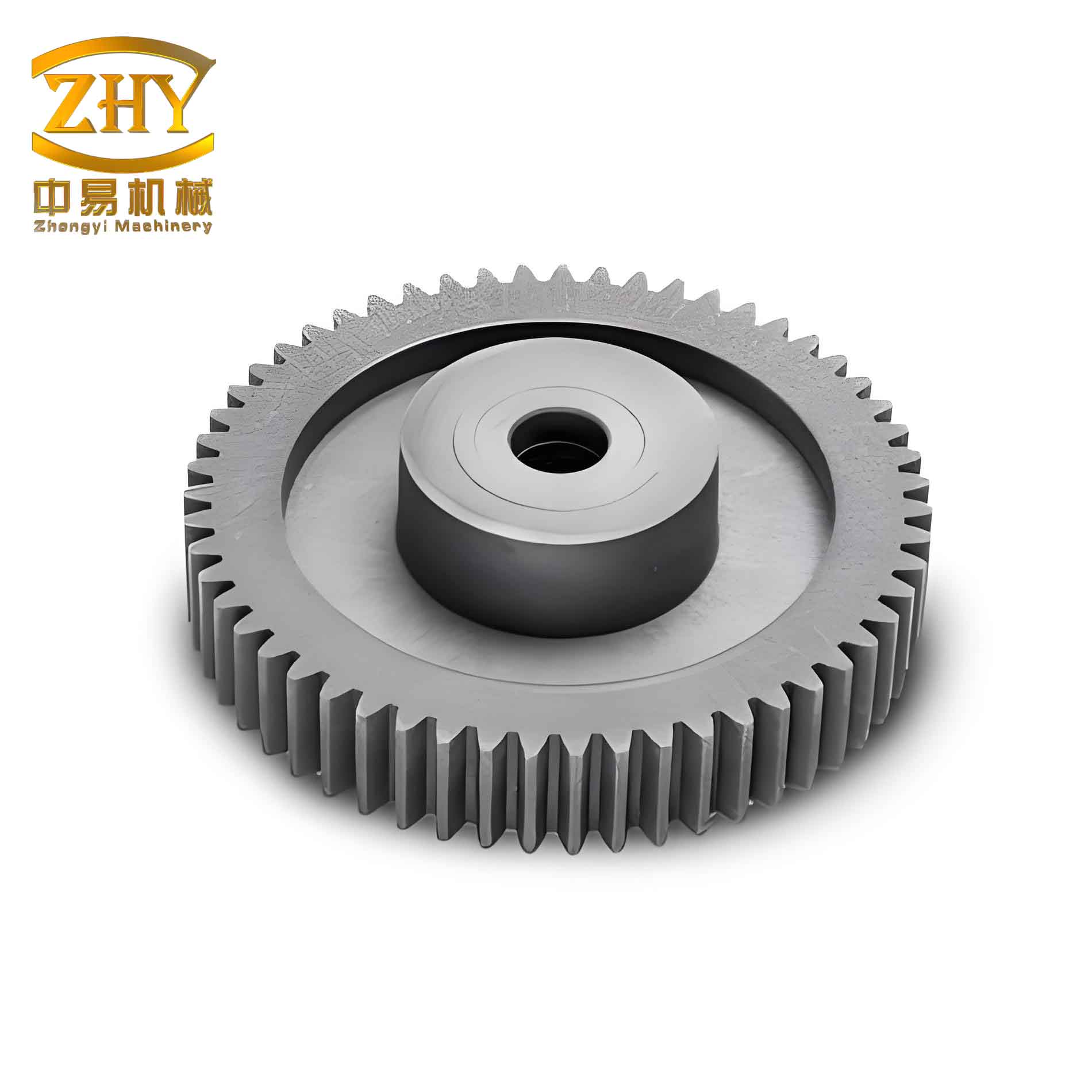
This study focuses on the helical cylindrical gears of a specific high-speed rolling mill. Considering the gear misalignment caused by system deformation under load, a finite element tooth contact analysis (TCA) model is established in Abaqus. The meshing characteristics under typical operating conditions are simulated and analyzed to elucidate the impact of center distance variation on key performance parameters. Based on these findings, an optimized tooth surface modification strategy is proposed, employing a comprehensive approach combining lead crowning, lead relief, and profile tip relief. A comparative analysis of the meshing performance before and after modification is then conducted.
1. Modeling of Helical Cylindrical Gears with Variable Center Distance
1.1 Mill Drive System and Principle
The drive system of the rolling mill consists of a pair of bevel gears with a 90° shaft angle and two pairs of helical cylindrical gears. Power is input at one end of the long shaft carrying the bevel gears. After being increased in speed by the bevel gear pair, it is then reduced by the roll shaft helical cylindrical gear pairs to drive the work rolls.
The variation in the center distance between the two roll shafts is achieved through the rotation of eccentric sleeves. During operation, re-grinding the roll rings necessitates an adjustment of the roll shaft center distance to preserve the roll gap, consequently changing the operational center distance of their mating cylindrical gears. The variation range for the roll shaft gear pair center distance (a) is from a minimum of 184 mm to a maximum of 186.93 mm.
1.2 Gear Mesh Misalignment
During rolling, the roll shafts are subjected to substantial rolling forces and torques. This leads to deformations in the housing, bearings, shafts, and the gears themselves, causing the gears to deviate from their ideal aligned meshing position. This deviation is quantified as mesh misalignment.
Mesh misalignment (\(f_{sh}\)) refers to the displacement along the line of action at one end of the gear pair after the other end has engaged. It causes load distribution bias across the tooth face, increases the fluctuation amplitude of transmission error, and consequently exacerbates gear vibration and noise. Using MASTA software for the loaded system analysis, the mesh misalignment for the helical cylindrical gears in this mill drive is calculated as \(f_{sh} = 61.36 \, \mu m\).
1.3 Finite Element Meshing Model
Considering the calculated mesh misalignment, a finite element model for the involute helical cylindrical gear pair is established. To enhance computational efficiency, a segment of 11 teeth is modeled for the contact analysis. The basic geometric parameters of the gear pair are listed in Table 1. The operational center distance varies from 184 mm to 186.93 mm. For the Abaqus simulation, five distinct center distances are selected: 184 mm, 184.73 mm, 185.465 mm, 186.20 mm, and 186.93 mm.
| Parameter | Pinion | Gear |
|---|---|---|
| Hand of Helix | Right | Left |
| Number of Teeth, \(z\) | 33 | 37 |
| Normal Module, \(m_n\) (mm) | 5 | 5 |
| Normal Pressure Angle, \(\alpha_n\) (°) | 20 | 20 |
| Helix Angle, \(\beta\) (°) | 18 | 18 |
| Face Width, \(B\) (mm) | 132 | 132 |
| Profile Shift Coefficient, \(x\) | 0 | -0.042 |
| Operating Center Distance, \(a\) (mm) | 184 ~ 186.93 | 184 ~ 186.93 |
The gear material is 18CrNiMo7-6, with a density of 7850 kg/m³, an Elastic Modulus of 206 GPa, and a Poisson’s ratio of 0.3. The allowable contact stress is 1500 MPa, and the allowable bending stress is 500 MPa. In the simulation, a rotational displacement is applied to the pinion to turn it through an angle corresponding to 2.0 rad (covering 11 teeth). A resisting torque of 6800 N·m, representing the rolling torque, is applied to the gear. The contacting tooth flanks of the 11 tooth pairs are defined as contact pairs with a frictionless formulation. The mesh is refined with hexahedral elements in the contact zones and coarser elsewhere.
2. Influence of Center Distance Variation on Meshing Characteristics
2.1 Influence on Contact Ratio
The contact ratio is a key indicator of gear transmission smoothness. For helical cylindrical gears, the total contact ratio (\(\varepsilon_{\gamma}\)) is the sum of the transverse contact ratio (\(\varepsilon_{\alpha}\)) and the face contact ratio (\(\varepsilon_{\beta}\)), calculated as follows:
$$ \varepsilon_{\alpha} = \frac{1}{2\pi} \left[ z_1 (\tan\alpha_{at1} – \tan\alpha_t’) + z_2 (\tan\alpha_{at2} – \tan\alpha_t’) \right] $$
$$ \varepsilon_{\beta} = \frac{B \sin\beta}{\pi m_n} $$
$$ \varepsilon_{\gamma} = \varepsilon_{\alpha} + \varepsilon_{\beta} $$
where \(z_1\) and \(z_2\) are the number of teeth on the pinion and gear, \(\alpha_{at1}\) and \(\alpha_{at2}\) are the transverse pressure angles at the tip circles, \(\alpha_t’\) is the operating transverse pressure angle, \(B\) is the face width, and \(\beta\) is the helix angle. The calculated contact ratios at different center distances are shown in the table below.
| Center Distance, \(a\) (mm) | Transverse Contact Ratio, \(\varepsilon_{\alpha}\) | Face Contact Ratio, \(\varepsilon_{\beta}\) | Total Contact Ratio, \(\varepsilon_{\gamma}\) |
|---|---|---|---|
| 184.00 | 1.483 | 2.558 | 4.041 |
| 184.73 | 1.418 | 2.558 | 3.976 |
| 185.47 | 1.354 | 2.558 | 3.912 |
| 186.20 | 1.291 | 2.558 | 3.849 |
| 186.93 | 1.229 | 2.558 | 3.787 |
The analysis reveals that increasing the center distance reduces the transverse contact ratio while the face contact ratio remains constant. As the center distance increases from 184 mm to 186.93 mm, the total contact ratio decreases by approximately 0.5. This degradation adversely affects meshing smoothness, potentially increasing vibration and noise.
2.2 Influence on Contact Pattern
The contact stress distribution on the tooth surface, or contact pattern, is extracted from the finite element analysis for different center distances. The unmodified gears exhibit severe load bias and edge contact near the tooth tips due to the existing misalignment. Furthermore, as the center distance increases, the contact pattern becomes narrower, and edge contact intensifies.
The percentage of the theoretical contact area (face width × active profile depth) effectively covered by the contact pattern is calculated. The results, shown in the table below, indicate that the contact pattern area percentage decreases by about 10% as the center distance changes from its minimum to its maximum value, signifying a significant loss of effective contact.
| Center Distance, \(a\) (mm) | Contact Pattern Area Percentage (%) |
|---|---|
| 184.00 | 78.5 |
| 184.73 | 75.2 |
| 185.47 | 72.8 |
| 186.20 | 70.1 |
| 186.93 | 68.4 |
2.3 Influence on Contact and Bending Stresses
Tooth bending fracture and surface pitting are primary failure modes for cylindrical gears. Bending fracture, in particular, can lead to catastrophic system failure. Given the harsh operating conditions and variable center distance, analyzing these stresses is crucial.
The maximum contact stress and the root bending stress distribution along the face width are calculated for both pinion and gear. The results for maximum contact stress are summarized below:
| Center Distance, \(a\) (mm) | Max. Contact Stress – Pinion (MPa) | Max. Contact Stress – Gear (MPa) |
|---|---|---|
| 184.00 | 1616 | 1580 |
| 184.73 | 1694 | 1657 |
| 185.47 | 1778 | 1740 |
| 186.20 | 1870 | 1830 |
| 186.93 | 1970 | 1928 |
The maximum contact stress increases with center distance. For the unmodified gears, the stress at the maximum center distance (1970 MPa) exceeds the material’s allowable contact stress (1500 MPa), posing a high risk of surface failure.
The bending stress distribution shows that the maximum stress occurs near the end of the face width due to misalignment-induced bias load. The peak values also rise with increasing center distance, as shown below:
| Center Distance, \(a\) (mm) | Max. Bending Stress – Pinion (MPa) | Max. Bending Stress – Gear (MPa) |
|---|---|---|
| 184.00 | 316 | 298 |
| 184.73 | 322 | 304 |
| 185.47 | 329 | 310 |
| 186.20 | 336 | 317 |
| 186.93 | 344 | 325 |
Although the maximum bending stress (344 MPa) remains below the allowable limit (500 MPa), its location at the tooth end increases the risk of corner fracture under high loads or impact.
2.4 Influence on Transmission Error
Static transmission error (TE) is a primary excitation source for gear dynamics and noise. It is calculated from the finite element results as:
$$ TE = \varphi_2 – \varphi_1 \times \frac{z_1}{z_2} $$
where \(\varphi_2\) is the gear rotation angle and \(\varphi_1\) is the pinion rotation angle.
The peak-to-peak value of the transmission error (PPTE) is a critical metric. The calculated PPTE for different center distances is presented below:
| Center Distance, \(a\) (mm) | Peak-to-Peak Transmission Error, PPTE (\(\mu m\)) |
|---|---|
| 184.00 | 3.82 |
| 184.73 | 4.95 |
| 185.47 | 6.38 |
| 186.20 | 8.21 |
| 186.93 | 10.62 |
The PPTE increases markedly with center distance, nearly tripling as the center distance changes from 184 mm to 186.93 mm. This substantial increase would lead to significantly higher vibration and noise levels.
3. Tooth Surface Optimization and Post-Modification Analysis
3.1 Optimized Modification Parameters
The analysis confirms that the macro-geometry of the cylindrical gears provides sufficient bending strength and contact ratio. However, the severe bias load and edge contact, combined with the significant performance degradation under variable center distance, necessitate tooth surface modifications. The goal is to correct load distribution and enhance the gear pair’s tolerance to center distance variation.
An optimized modification strategy is proposed:
- Lead Modifications on the Gear: A combination of lead relief (slope) and lead crowning (parabolic) is applied to the gear to centralize the contact pattern and eliminate edge contact along the face width.
- Profile Modification on Both Gears: Tip relief is applied to both the pinion and gear to prevent engagement impacts at the tip and root, avoiding edge contact along the profile.
The specific modification parameters are detailed in the table below.
| Modification Direction | Parameter | Pinion | Gear |
|---|---|---|---|
| Lead Direction | Start of Relief (Left), mm | 0 | 0 |
| Start of Relief (Right), mm | 132 | 132 | |
| Lead Relief (Slope) Amount, \(f_{H\beta}\) (\(\mu m\)) | 0 | 60 | |
| Lead Crowning Amount, \(C_{\beta}\) (\(\mu m\)) | 0 | 35 | |
| Profile Direction | Start Diameter of Relief, \(P2\) (mm) | 176.491 | 194.009 |
| End Diameter of Relief, \(P1\) (mm) | 183.491 | 204.509 | |
| Parabolic Tip Relief Amount, \(\Delta Q_t\) (\(\mu m\)) | 60 | 55 |
3.2 Post-Modification Contact Pattern
After applying the optimized modifications, the contact pattern becomes centered on the tooth flank for all center distances, effectively eliminating the bias load and severe edge contact observed in the unmodified gears.
The contact pattern area percentage remains relatively stable across the center distance range, as shown below, demonstrating the modification’s ability to compensate for the center distance variation.
| Center Distance, \(a\) (mm) | Contact Pattern Area Percentage – Modified (%) |
|---|---|
| 184.00 | 72.3 |
| 184.73 | 71.8 |
| 185.47 | 71.5 |
| 186.20 | 71.1 |
| 186.93 | 70.7 |
3.3 Post-Modification Stresses
The maximum contact stress is dramatically reduced after modification. The comparison for the pinion is summarized below:
| Center Distance, \(a\) (mm) | Max. Contact Stress – Unmodified (MPa) | Max. Contact Stress – Modified (MPa) |
|---|---|---|
| 184.00 | 1616 | 782 |
| 184.73 | 1694 | 836 |
| 185.47 | 1778 | 893 |
| 186.20 | 1870 | 954 |
| 186.93 | 1970 | 1022 |
The modified maximum contact stress (1022 MPa at max center distance) is nearly 1000 MPa lower than its unmodified counterpart and well within the allowable limit. While stress still increases with center distance, the increment over the range is reduced from 354 MPa (unmodified) to 240 MPa (modified), showing improved robustness.
The bending stress distribution becomes uniform, with the peak stress located at the mid-face width, significantly reducing the risk of corner fracture. The maximum bending stress is also slightly reduced, as shown for the pinion:
| Center Distance, \(a\) (mm) | Max. Bending Stress – Unmodified (MPa) | Max. Bending Stress – Modified (MPa) |
|---|---|---|
| 184.00 | 316 | 288 |
| 184.73 | 322 | 294 |
| 185.47 | 329 | 300 |
| 186.20 | 336 | 308 |
| 186.93 | 344 | 316 |
3.4 Post-Modification Transmission Error
The transmission error characteristics are also improved. The PPTE values for the modified gears are lower than those for the unmodified gears across the entire center distance range, as compared below:
| Center Distance, \(a\) (mm) | PPTE – Unmodified (\(\mu m\)) | PPTE – Modified (\(\mu m\)) |
|---|---|---|
| 184.00 | 3.82 | 2.15 |
| 184.73 | 4.95 | 3.01 |
| 185.47 | 6.38 | 4.10 |
| 186.20 | 8.21 | 5.55 |
| 186.93 | 10.62 | 7.51 |
This reduction in PPTE indicates that the optimized modifications will lead to lower vibration and noise excitation, even when the center distance varies.
4. Conclusions
1) This study investigates the helical cylindrical gears in a high-speed rolling mill drive system operating under variable center distance conditions. A finite element tooth contact model incorporating calculated mesh misalignment was established in Abaqus to analyze the influence of center distance variation on meshing performance.
2) For the unmodified cylindrical gears, significant bias load and edge contact were present due to misalignment. Increasing the center distance from 184 mm to 186.93 mm led to: a decrease in total contact ratio by approximately 0.5; a reduction in contact pattern area percentage by about 10%; an increase in maximum contact and bending stresses; and a near tripling of the peak-to-peak transmission error. The maximum contact stress exceeded the material’s allowable limit, indicating high risk of surface failure.
3) An optimized tooth surface modification strategy was proposed, combining lead crowning/relief and profile tip relief. This strategy effectively centralized the contact pattern, eliminated edge contact, and substantially reduced the maximum contact and bending stresses. More importantly, the modified tooth surfaces demonstrated a greatly enhanced ability to compensate for center distance variation, as evidenced by the stabilized contact pattern percentage, the reduced sensitivity of stress increase, and the consistently lower transmission error across the operating range. This optimization provides a valuable reference for the design of robust cylindrical gear pairs in applications with variable center distances.