
In high-speed rolling mills, the cylindrical gear transmission in the roll box is a critical component of the power transmission chain, directly impacting the performance and reliability of the mill. During actual rolling processes, the roll rings on the roll shafts wear out, and after regrinding, their diameters decrease. To maintain a constant roll gap between the two roll rings, the center distance between the roll shafts must be adjusted, consequently affecting the center distance between the roll shafts and their corresponding cylindrical gears. The center distance variation range for helical cylindrical gears is approximately 0 to 3 mm. This change in center distance exacerbates the meshing conditions of cylindrical gears under high-speed and heavy-load conditions, increasing the risk of gear failure and exacerbating gear whine noise, which severely affects product precision and performance. Therefore, studying the influence of variable meshing center distance on the meshing performance of helical cylindrical gear pairs in roll shafts and conducting optimization design are crucial for improving the reliability of mill gear transmissions and enhancing the production efficiency and accuracy of rolled products.
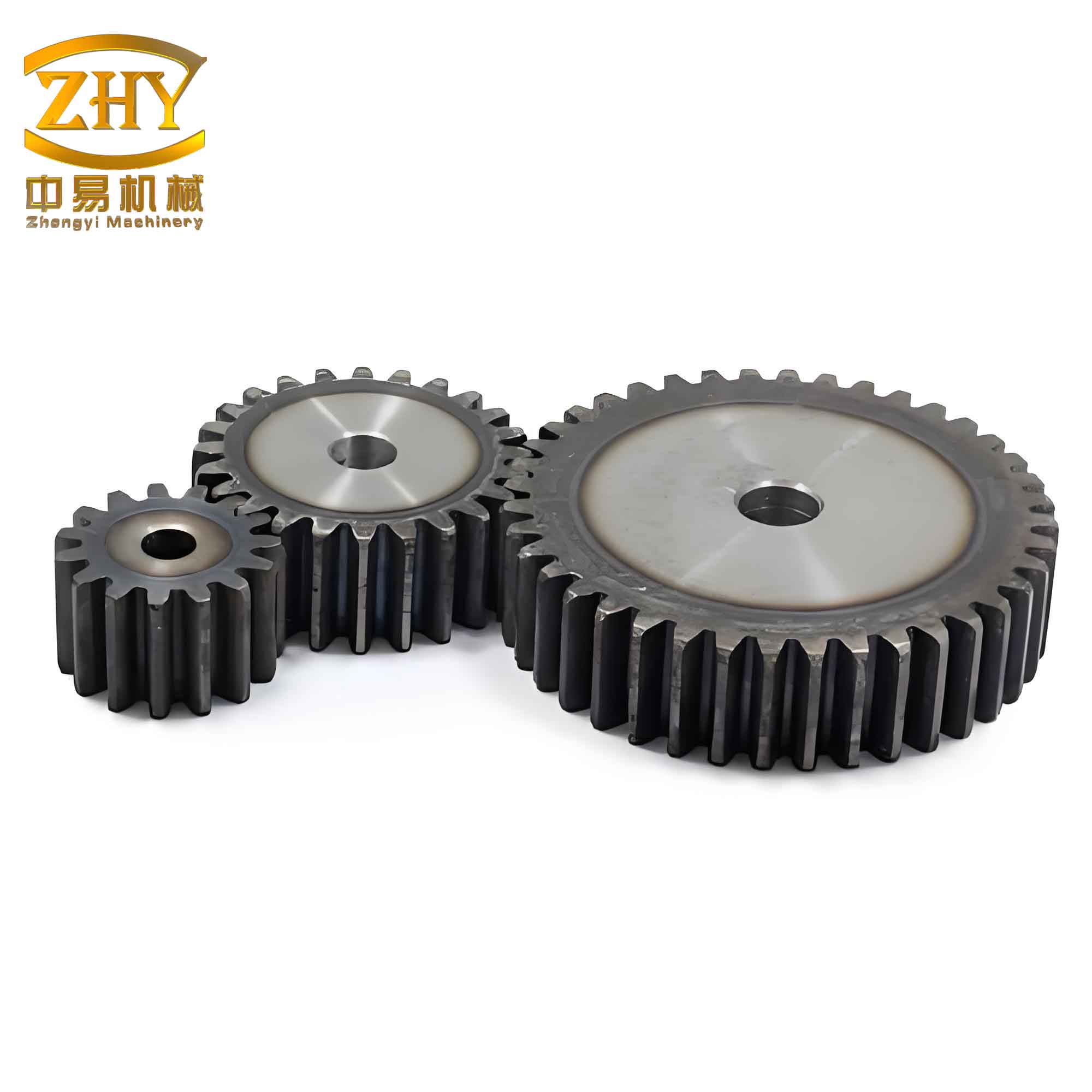
My research focuses on helical cylindrical gears in a high-speed rolling mill transmission system. I consider the unique operating condition where the center distance varies due to roll ring regrinding. In this study, I establish a finite element meshing model in Abaqus, incorporating gear meshing misalignment. I perform tooth contact analysis under typical working conditions to investigate the effects of center distance changes on various meshing performance parameters. Based on the findings, I propose an optimized tooth surface modification scheme, combining linear relief and crowning relief in the tooth lead direction with tip relief in the tooth profile direction. I then compare the meshing performance before and after modification.
The transmission system of the mill consists of a pair of bevel gears with a 45° shaft angle and two pairs of helical cylindrical gears. Power is input from one end of the long shaft where the bevel gears are located, increased in speed by the bevel gears, and then reduced by the roll shaft helical cylindrical gear pairs before being transmitted to the roll shafts. The change in center distance between the two roll shafts is achieved by rotating eccentric sleeves. During rolling, as the roll rings require regrinding but the roll gap must remain constant, the center distance between the roll shafts is adjusted, affecting the center distance of the corresponding cylindrical gears. The variation range for the roll shaft cylindrical gears is from 184 mm to 186.93 mm.
During operation, the roll shafts of the mill withstand significant rolling forces and moments. Deformations in the transmission system housing, bearings, shafts, and the gears themselves cause the gears to deviate from their ideal meshing positions, resulting in gear misalignment. The meshing misalignment refers to the displacement along the line of action at one end of the gear pair after the other end engages. Misalignment leads to load bias on the tooth surface, increases transmission error fluctuations, and subsequently causes gear vibration and noise. Using Masta transmission system design software and considering the rolling forces and moments, I calculate the meshing misalignment for the helical cylindrical gears in this mill transmission system as \( f_{sh} = 61.36 \, \mu m \).
Considering the gear meshing misalignment, I develop a finite element model for involute helical cylindrical gear meshing based on the finite element method. To enhance computational efficiency, I model only 11 teeth for contact analysis. The geometric parameters of the gear pair are listed in Table 1. The meshing center distance varies from 184 mm to 186.93 mm. In Abaqus, I analyze the contact characteristics at five different center distances: 184 mm, 184.73 mm, 185.465 mm, 186.20 mm, and 186.93 mm.
| Basic Parameter | Pinion | Gear |
|---|---|---|
| Hand of Helix | Right | Left |
| Number of Teeth \( z \) | 33 | 37 |
| Normal Module \( m_n \) (mm) | 5 | 5 |
| Pressure Angle \( \alpha_n \) (°) | 20 | 20 |
| Helix Angle \( \beta \) (°) | 18 | 18 |
| Face Width \( B \) (mm) | 132 | 132 |
| Profile Shift Coefficient \( x \) | 0 | -0.042 |
| Meshing Center Distance \( a \) (mm) | 184–186.93 | 184–186.93 |
The gear material is 18CrNiMo7-6, with a density of 7850 kg/m³, elastic modulus of 206 GPa, Poisson’s ratio of 0.3, allowable contact stress of 1500 MPa, and allowable bending stress of 500 MPa. I apply a rotation to the pinion so that it rotates through an angular displacement of 2.0 rad, covering 11 teeth. A rolling torque of 6800 N·m is applied to the gear. During analysis, I define the 11 pairs of contacting tooth surfaces as contact pairs with frictionless contact. For meshing, I use finer hexahedral elements on the working tooth surfaces of the contact pairs and coarser elements elsewhere.
The contact ratio is a key indicator for evaluating the smoothness of gear transmission. For helical cylindrical gears, the total contact ratio \( \varepsilon_{\gamma} \) is the sum of the transverse contact ratio \( \varepsilon_{\alpha} \) and the axial contact ratio \( \varepsilon_{\beta} \), calculated as follows:
$$ \varepsilon_{\alpha} = \frac{1}{2\pi} \left[ z_1 (\tan \alpha_{at1} – \tan \alpha_t’) + z_2 (\tan \alpha_{at2} – \tan \alpha_t’) \right] $$
$$ \varepsilon_{\beta} = \frac{B \sin \beta}{\pi m_n} $$
$$ \varepsilon_{\gamma} = \varepsilon_{\alpha} + \varepsilon_{\beta} $$
where \( z_1 \) and \( z_2 \) are the numbers of teeth for the pinion and gear, respectively; \( \alpha_{at1} \) and \( \alpha_{at2} \) are the transverse pressure angles at the tip circles of the pinion and gear; \( \alpha_t’ \) is the operating transverse pressure angle; \( B \) is the face width; and \( \beta \) is the helix angle. Using these formulas, I calculate the transverse, axial, and total contact ratios at different center distances, as shown in Figure 1.
My analysis reveals that, with all other geometric parameters constant, an increase in the meshing center distance reduces the transverse contact ratio of the cylindrical gears, while the axial contact ratio remains unchanged. When the center distance increases from 184 mm to 186.93 mm, the total contact ratio decreases by approximately 0.5. This deterioration in meshing conditions increases vibration and noise in the cylindrical gear transmission.
After performing finite element analysis in Abaqus, I extract the tooth surface contact stresses at different meshing center distances. The distribution of contact patterns on the cylindrical gear tooth surfaces under various center distances is illustrated in Figure 2. The analysis shows that due to shaft deformation under load causing gear misalignment, significant load bias occurs on the tooth surface, with severe edge contact at the tooth tips. Furthermore, as the meshing center distance increases, the contact patterns become narrower, and edge contact becomes more pronounced. The percentage of contact pattern area relative to the total tooth surface area at different center distances is shown in Figure 3. The contact pattern area percentage decreases by 10% when the center distance changes from the minimum to the maximum.
Tooth bending fracture and surface pitting are primary failure modes for cylindrical gears. Compared to other failure modes like wear, tooth fracture can jam the transmission system and even cause serious accidents. In mill transmission systems, due to harsh working conditions and the special circumstance of variable center distance meshing for roll shaft gears, tooth breakage is relatively frequent. Using the finite element method, I calculate the maximum tooth surface contact stresses and root bending stresses for both pinion and gear at different meshing center distances.
Figure 4 shows the maximum tooth surface contact stresses for the pinion and gear at different center distances. Figures 5 and 6 depict the distribution of root bending stresses along the face width for the pinion and gear, respectively, at various center distances. Figure 7 presents the maximum root bending stresses for both gears at different center distances.
The results indicate that as the meshing center distance increases, the maximum tooth surface contact stresses for both pinion and gear increase. Without modification, edge contact causes the maximum contact stress to reach 1970 MPa at a center distance of 186.93 mm, exceeding the allowable contact stress of 1500 MPa for the cylindrical gear material, making contact failure likely. Similarly, the root bending stresses for both gears increase with center distance. At the maximum center distance, the maximum bending stress for the pinion is 344 MPa, below the allowable bending stress of 500 MPa, indicating good bending strength for this helical cylindrical gear. However, due to misalignment-induced load bias without modification, the maximum bending stress occurs near the tooth ends, increasing the risk of tooth breakage.
Static transmission error is a major parameter for assessing the dynamic performance of cylindrical gears, calculated as:
$$ TE = \varphi_2 – \varphi_1 \times \frac{z_1}{z_2} $$
where \( \varphi_2 \) is the rotation angle of the gear, \( \varphi_1 \) is the rotation angle of the pinion, \( z_1 \) is the number of teeth on the pinion, and \( z_2 \) is the number of teeth on the gear. Based on finite element analysis, I compute the transmission error at different meshing center distances to study the effect of center distance variation. The transmission error curves and peak-to-peak values at different center distances are shown in Figures 8 and 9, respectively. The analysis shows that as the meshing center distance increases, the peak-to-peak transmission error increases. When the center distance rises from 184 mm to 186.93 mm, the peak-to-peak transmission error nearly doubles.
From the above analysis, I conclude that the cylindrical gear pair has a relatively high contact ratio and adequate bending strength, so the macro parameters are reasonable. However, severe tooth surface load bias exists, leading to excessive contact stress. Additionally, the roll shafts endure significant impact loads and rolling forces, reducing the load-bearing capacity of the cylindrical gears. Moreover, when adjusting the roll ring diameter changes the meshing center distance, the contact pattern area varies considerably; unmodified tooth surfaces have almost no ability to compensate for the effects of increased center distance. Therefore, tooth surface modification for the roll shaft cylindrical gear pair is necessary to improve load distribution and enhance compensation capability for center distance changes.
To address the load bias issue in helical cylindrical gear pairs with variable center distance, I propose an optimized modification scheme. The method involves applying helix angle modification and crowning in the tooth lead direction to the gear to improve load distribution and eliminate edge contact at the tooth ends, along with tip relief in the tooth profile direction for both pinion and gear to prevent edge contact at the tooth tips and roots. The optimized modification parameters for the helical cylindrical gear pair are listed in Table 2, and the schematic and curves of the modifications are shown in Figure 10.
| Modification Direction | Modification Parameter | Pinion | Gear |
|---|---|---|---|
| Tooth Lead Direction | Start Point of Lead Modification Left (mm) | 0 | 0 |
| Start Point of Lead Modification Right (mm) | 132 | 132 | |
| Helix Angle Modification Amount \( f_{H\beta} \) (μm) | 0 | 60 | |
| Crowning Amount \( C_{\beta} \) (μm) | 0 | 35 | |
| Tooth Profile Direction | Start Circle of Tip Relief \( P_2 \) (mm) | 176.491 | 194.009 |
| End Circle of Tip Relief \( P_1 \) (mm) | 183.491 | 204.509 | |
| Parabolic Relief Amount \( \Delta Q_t \) (μm) | 60 | 55 |
After applying the optimized modifications, the contact patterns on the cylindrical gear tooth surfaces are shown in Figure 11. The contact patterns are concentrated in the middle of the tooth surfaces, significantly improving the load bias and edge contact observed without modification. The percentage of contact pattern area after optimization is shown in Figure 12. As the center distance increases, the contact pattern percentage shows no significant change, indicating that this optimization scheme can compensate to some extent for the effects of center distance variation.
Figure 13 compares the maximum tooth surface contact stresses for the pinion before and after optimization at different meshing center distances. After optimization, the maximum contact stress is 953.2 MPa, nearly 1000 MPa lower than the 1970 MPa without modification. Thus, the optimization scheme effectively improves edge contact and increases the contact strength of the cylindrical gear. As the center distance increases, the maximum contact stress tends to rise. The maximum increase in contact stress across different center distances after optimization is 172 MPa, compared to 354 MPa without modification, a reduction of 182 MPa, demonstrating the scheme’s compensation capability.
Figures 14 and 15 show the distribution of root bending stresses along the face width for the pinion and gear, respectively, after optimized modification. Figure 16 compares the maximum root bending stresses for the pinion before and after optimization at different center distances. After modification, the maximum root bending stresses for both pinion and gear are located at the middle of the face width, significantly reducing the risk of tooth breakage compared to the unmodified case. The maximum bending stress for the pinion after optimization is 316 MPa, 28 MPa lower than without modification, indicating improved bending strength for the cylindrical gear.
Using finite element analysis, I compute the transmission error after optimized modification at different meshing center distances and compare it with the unmodified case. The transmission error curves and peak-to-peak values after optimization are shown in Figures 17 and 18, respectively. As the meshing center distance increases, the peak-to-peak transmission error for the optimized scheme tends to rise. At center distances from 184 mm to 186.2 mm, the peak-to-peak transmission error after optimization is much lower than without modification. At the maximum center distance of 186.93 mm, the optimized value is slightly lower. Therefore, this optimization scheme can reduce transmission error and minimize gear vibration and noise when cylindrical gears operate under variable center distance conditions.
In summary, my research on helical cylindrical gears with variable center distance in high-speed rolling mill transmission systems yields the following conclusions. First, considering gear meshing misalignment, I establish a finite element meshing model in Abaqus and analyze the influence of different meshing center distances on cylindrical gear meshing performance. The results show that due to misalignment, severe load bias and edge contact occur on the tooth surfaces. When the center distance increases from 184 mm to 186.93 mm, the total contact ratio decreases by about 0.5, the contact pattern area percentage drops by 10%, and the maximum contact and bending stresses increase, along with the peak-to-peak transmission error. The maximum contact stress exceeds the allowable limit, risking contact failure, while the maximum bending stress near the tooth ends increases the risk of tooth breakage.
Second, I propose an optimized modification scheme involving helix angle modification and crowning in the tooth lead direction and tip relief in the tooth profile direction. This approach effectively mitigates load bias and edge contact. After modification, the maximum contact and bending stresses are substantially reduced, enhancing the contact and bending strength of the cylindrical gears. When the center distance varies from 184 mm to 186.93 mm, the contact pattern area percentage remains relatively stable, the increases in maximum stresses are much smaller than without modification, and the peak-to-peak transmission error is lower across all center distances. Thus, the optimization scheme provides compensation for the effects of center distance changes.
This study offers valuable insights for the tooth surface optimization design of cylindrical gears in mill transmission systems, contributing to improved reliability and performance under variable operating conditions. Further research could explore dynamic characteristics and long-term durability of optimized cylindrical gears in practical rolling mill applications.