
Abstract
Spiral bevel gears (SBGs) are critical components in heavy-load transmission systems, yet they are prone to tooth root cracks under alternating loads, leading to catastrophic failures. This study investigates the influence of crack types (plane, spatial, and broken tooth) on meshing characteristics, including stiffness degradation, contact stress redistribution, and bending stress variations. A finite element model (FEM) of spiral bevel gears was developed using ANSYS, where crack faults were introduced via a node replacement method. Static contact simulations revealed that meshing stiffness decreases as cracks propagate, with maximum reductions of 27.58% (plane crack), 14.12% (spatial crack), and 32.82% (broken tooth). The position and depth of cracks significantly alter stress distributions, impacting gear reliability. These findings provide theoretical foundations for fault diagnosis and condition monitoring in spiral bevel gear systems.
1. Introduction
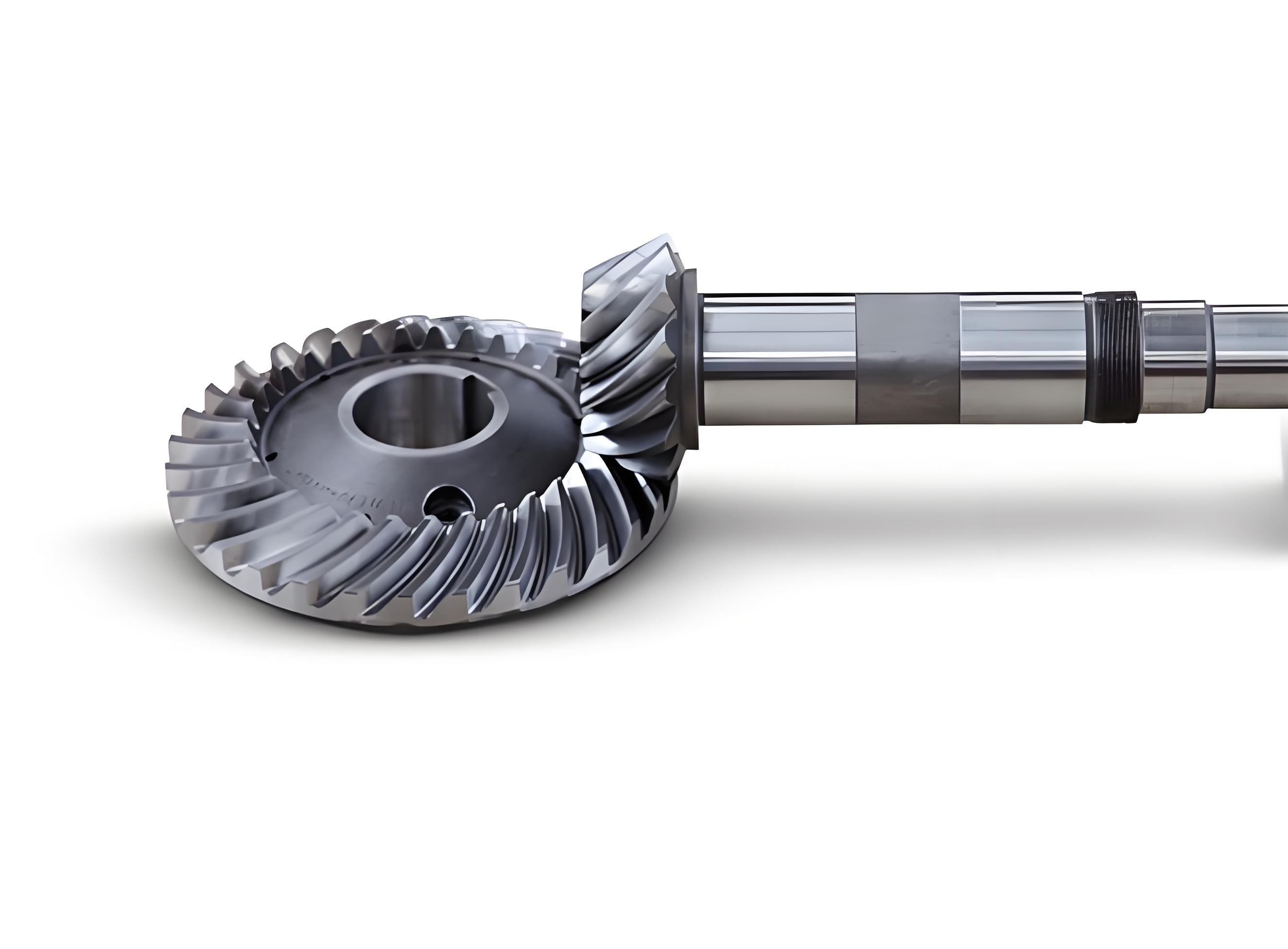
Spiral bevel gears are widely used in aerospace, automotive, and industrial machinery due to their high torque transmission efficiency and compact design. However, their complex geometry and dynamic loading conditions make them susceptible to fatigue cracks, particularly at the tooth root. Previous studies have focused on crack initiation mechanisms, lubrication effects, and dynamic responses, yet the quantitative relationship between crack parameters (type, depth, location) and meshing characteristics remains underexplored.
This research addresses this gap by analyzing spiral bevel gears with plane cracks, spatial cracks, and broken teeth. A validated FEM-based approach quantifies stiffness degradation, contact stress redistribution, and bending stress variations, offering insights into failure progression and diagnostic criteria.
2. Methodology
2.1 Finite Element Model Construction
The FEM of spiral bevel gears was developed using SOLID185 hexahedral elements in ANSYS. Key steps include:
- Tooth Surface Generation: The tooth profile was derived from machining coordinates using the transformation matrix:
Mj=MikMksmMskmMmuMsjMj=MikMksmMskmMmuMsj
where Mik,Mksm,Mskm,Mmu,Mik,Mksm,Mskm,Mmu, and MsjMsj represent coordinate transformations for tool positioning, radial/angular shifts, and workpiece rotation.
- Contact Pair Definition: Conta174 and Targe170 elements simulated gear meshing. Six-tooth models reduced computational complexity while maintaining accuracy (Figure 1).
- Boundary Conditions: Torque was applied to a rigid reference point coupled with the gear hub. Displacement constraints ensured stable load transmission.
2.2 Crack Implementation
Cracks were introduced via a node replacement method:
- Plane Cracks: Extended along the tooth width (WW) and depth (PP).
- Spatial Cracks: Propagated at angles α1,α2,α3α1,α2,α3 relative to the tooth axis.
- Broken Teeth: Simulated complete tooth loss.
Crack parameters are summarized in Tables 1 and 2.
Table 1: Plane Crack Parameters
| Case | Width (WW) | Depth (PP) |
|---|---|---|
| 1 | W/3W/3 | P/6P/6 |
| 2 | W/3W/3 | P/3P/3 |
| … | … | … |
| 15 | WW | 5P/65P/6 |
Table 2: Spatial Crack Parameters
| Case | Angle (°) | Depth (SS) |
|---|---|---|
| 1 | α1α1 | S/6S/6 |
| 2 | α1α1 | S/3S/3 |
| … | … | … |
| 18 | α3α3 | Broken |
2.3 Meshing Stiffness Calculation
Meshing stiffness (kk) was defined as:k=FEk=EF
where FF is the normal force and EE is the total deformation. Torque (TT) and geometric parameters (e.g., spiral angle ββ, pressure angle αα) were incorporated to compute FF and EE.
3. Results and Discussion
3.1 Meshing Stiffness Degradation
Figure 2 illustrates the time-varying meshing stiffness under different crack conditions:
- Plane Cracks: Stiffness decreased gradually as the contact ellipse approached the crack zone. Case 15 (full depth) showed a 27.58% reduction.
- Spatial Cracks: Stiffness dropped by 14.12% (Case 15) due to asymmetric load redistribution.
- Broken Teeth: Severe stiffness fluctuations (32.82% reduction) occurred due to single-tooth engagement.
Table 3: Maximum Stiffness Reduction
| Crack Type | Reduction (%) |
|---|---|
| Plane Crack | 27.58 |
| Spatial Crack | 14.12 |
| Broken Tooth | 32.82 |
3.2 Stress Distribution Analysis
3.2.1 Contact Stress
- Plane Cracks: Contact stress decreased by 8.91% when the ellipse traversed the crack (Case 15).
- Spatial Cracks: Stress concentrated near crack edges, with inner regions experiencing 15.26% higher stress (Case 5).
3.2.2 Bending Stress
- Plane Cracks: Stress at the crack tip increased by 47.11% (Case 15).
- Spatial Cracks: Bending stress reduced by 47.11% post-crack traversal (Case 5).
4. Conclusion
- Meshing Stiffness: Plane cracks caused prolonged stiffness degradation, while spatial cracks led to localized effects. Broken teeth induced severe instability.
- Stress Redistribution: Crack geometry and contact ellipse position dictated stress trends. Plane cracks intensified root bending stress, whereas spatial cracks redistributed contact loads.
- Diagnostic Implications: Stiffness reduction thresholds (e.g., >25% for plane cracks) can serve as early failure indicators in spiral bevel gear systems.
This study advances the understanding of crack propagation effects on spiral bevel gears, enabling predictive maintenance and optimized design.