
In the field of automotive drivetrains, hypoid gears are widely used in rear axle differentials due to their high contact ratio, smooth transmission, and strong load-bearing capacity. Among these, extended epicycloid hypoid gears, often referred to as Oerlikon-type gears, offer advantages such as high production efficiency, low cost, and reduced noise. However, the meshing characteristics of these gears, which directly influence vibration and noise, require detailed investigation. This article aims to analyze the meshing properties of extended epicycloid hypoid gears through finite element simulation and experimental validation, focusing on contact patterns, bending stress, contact ratio, and transmission error. The findings are intended to guide the design and application of hypoid gears in automotive systems.
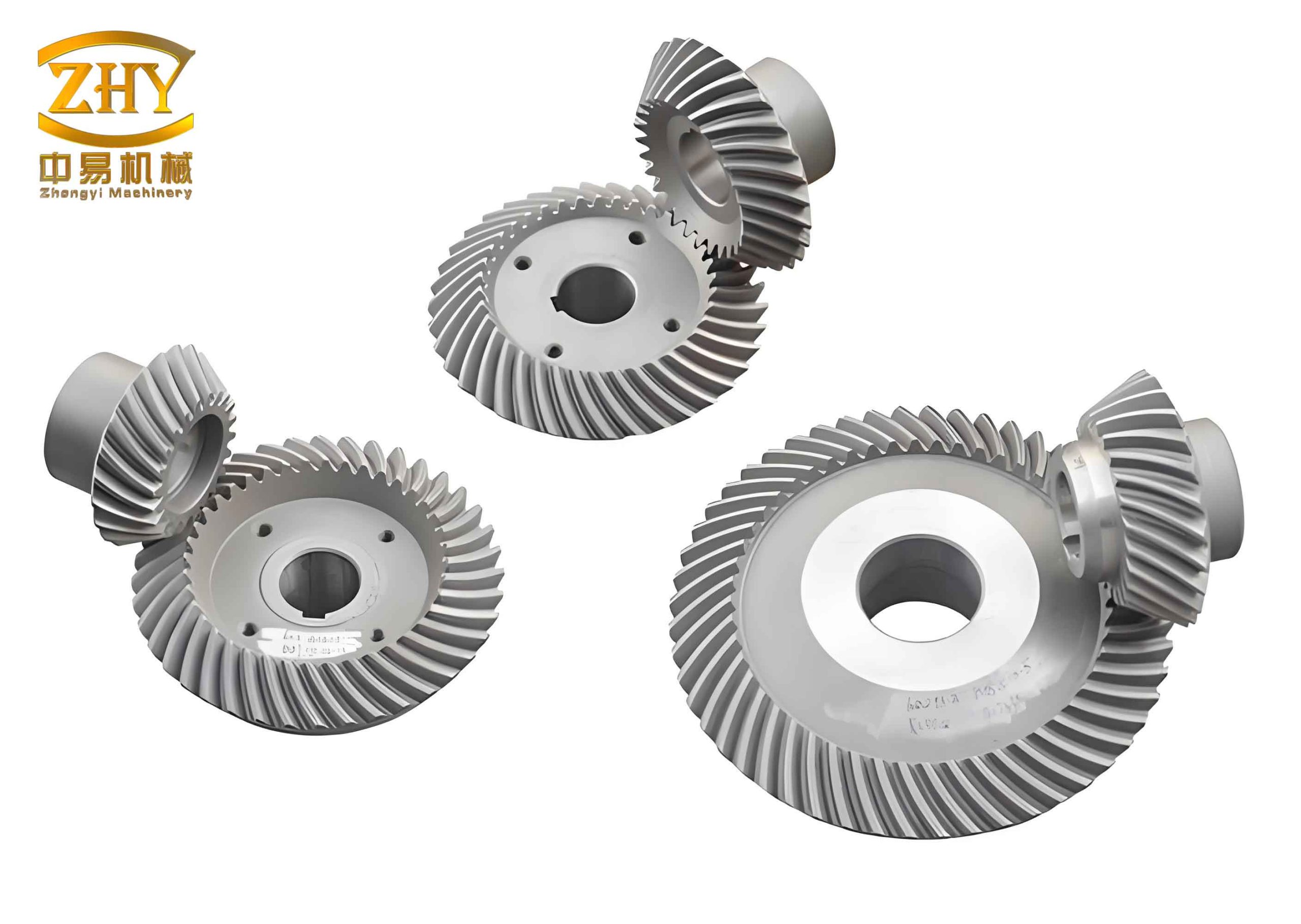
The study of hypoid gears is crucial because their meshing behavior generates excitations that contribute significantly to drivetrain NVH (Noise, Vibration, and Harshness). While much research has been conducted on Gleason-type arc teeth hypoid gears, limited literature exists on the loaded tooth contact analysis (LTCA) of extended epicycloid hypoid gears. Therefore, I employ finite element methods to model and simulate these gears, complemented by experimental tests to verify the results. The analysis covers dynamic meshing under various loads, providing insights into how hypoid gears perform in real-world conditions.
Finite Element Modeling of Hypoid Gears
To accurately simulate the meshing characteristics of hypoid gears, I developed a detailed finite element model. The process involved mesh generation, material property definition, and contact configuration, ensuring both computational efficiency and accuracy.
Mesh Generation
I used HyperMesh software to discretize the hypoid gear assembly. The mesh was composed of hexahedral elements, with a focus on maintaining high quality—specifically, a Jacobian coefficient greater than 0.7—to avoid convergence issues. The element count was optimized to balance simulation time and result precision. For instance, the pinion and gear were meshed with approximately 500,000 elements each, capturing the intricate tooth profiles of hypoid gears.
Material Properties
The meshed model was imported into ABAQUS software, where material properties were assigned. The hypoid gears were typically made of alloy steel, with Young’s modulus of 210 GPa, Poisson’s ratio of 0.3, and density of 7850 kg/m³. A dynamic implicit analysis step was selected for the simulation, as it effectively handles nonlinear contact problems with good convergence.
Contact Configuration
For forward meshing, the concave surface of the pinion and the convex surface of the gear were defined as the contact pair, using a “surface-to-surface” discretization method. Tangential and normal behaviors were set with a friction coefficient of 0.1. This setup mimics the actual engagement of hypoid gears under load. The contact algorithm accounted for large deformations and sliding, which are common in hypoid gear operations.
Analysis of Contact Patterns on Tooth Surfaces
Contact patterns indicate the area on the tooth surface where load is transmitted during meshing. I analyzed these patterns for both forward and reverse driving conditions to understand the dynamic behavior of hypoid gears.
Forward Meshing
In forward meshing, the concave side of the pinion engages with the convex side of the gear. At any given moment, the contact area resembles an ellipse. During the meshing cycle, this elliptical area on a single tooth surface initially increases, reaches a maximum, and then decreases. The engagement starts at the heel (large end) and ends at the toe (small end) for both gears. This pattern ensures smooth load transition and is critical for the durability of hypoid gears.
To quantify this, I calculated the contact area over time. For example, at a load torque of 1000 Nm, the maximum contact area was approximately 15 mm². The table below summarizes the contact area variation during forward meshing for different loads.
| Load Torque (Nm) | Initial Contact Area (mm²) | Maximum Contact Area (mm²) | Final Contact Area (mm²) |
|---|---|---|---|
| 500 | 5.2 | 12.8 | 4.5 |
| 1000 | 6.1 | 15.3 | 5.0 |
| 1500 | 6.5 | 16.7 | 5.3 |
Reverse Meshing
In reverse meshing, the convex side of the pinion contacts the concave side of the gear. The engagement begins at the toe and ends at the heel, opposite to forward meshing. The contact area also follows an elliptical shape, with similar expansion and contraction dynamics. This asymmetry in meshing directions affects the stress distribution and noise generation in hypoid gears, highlighting the importance of designing for both driving conditions.
Bending Stress at the Tooth Root
Bending stress is a key factor in gear fatigue and failure. I examined the stress distribution at the tooth root of both pinion and gear under various loads. The results show that the danger points—locations of maximum stress—are primarily subjected to tensile stress.
For a load torque of 1000 Nm, the bending stress cloud plots reveal that the tooth root experiences tensile stress, while the contact zones exhibit compressive stress. The principal stress variation at the danger points over the pinion rotation angle was analyzed. The pinion’s danger point initially undergoes tensile stress, which then transitions to compressive stress, whereas the gear’s danger point shows the opposite trend: starting with compressive stress and moving to tensile stress.
This behavior can be described by the bending stress formula for hypoid gears:
$$ \sigma_b = \frac{F_t \cdot K_a \cdot K_v \cdot K_m}{b \cdot m_n \cdot Y} $$
where \( \sigma_b \) is the bending stress, \( F_t \) is the tangential load, \( K_a \), \( K_v \), and \( K_m \) are application, dynamic, and load distribution factors, \( b \) is the face width, \( m_n \) is the normal module, and \( Y \) is the geometry factor. For hypoid gears, the complex curvature requires finite element analysis for accurate stress prediction.
The table below compares the maximum tensile stress at the tooth root for different loads.
| Load Torque (Nm) | Pinion Max Tensile Stress (MPa) | Gear Max Tensile Stress (MPa) |
|---|---|---|
| 500 | 320 | 290 |
| 1000 | 450 | 410 |
| 1500 | 520 | 480 |
These stresses are within acceptable limits for alloy steel, but the alternating stress patterns emphasize the need for robust design in hypoid gears to prevent fatigue cracks.
Contact Ratio of Hypoid Gears
The contact ratio, defined as the average number of tooth pairs in contact, is a measure of transmission smoothness and load capacity. Hypoid gears typically have high contact ratios, which increase with load due to tooth deflection.
I calculated the contact ratio from the simulated contact forces over time. When multiple teeth are engaged, the contact force on each pair varies. The contact ratio \( \epsilon \) is given by:
$$ \epsilon = \frac{\Delta T}{\Delta t} $$
where \( \Delta T \) is the single-tooth meshing time and \( \Delta t \) is the time interval between successive teeth entering meshing. At light loads, the contact ratio is close to 1, but as load increases, it rises significantly, reaching up to 2.5 for hypoid gears under high torque.
The relationship between load and contact ratio is summarized in the table below.
| Load Torque (Nm) | Contact Ratio |
|---|---|
| 10 | 1.0 |
| 500 | 1.8 |
| 1000 | 2.2 |
| 1500 | 2.4 |
This increase enhances the stability of hypoid gears under heavy loads, reducing vibration and noise. The high contact ratio is one reason why hypoid gears are preferred in automotive drivetrains.
Transmission Error Analysis
Transmission error (TE) is the deviation between the actual and theoretical angular positions of the driven gear, reflecting dynamic performance. It is a major source of gear noise and vibration, especially in hypoid gears.
Definition of Transmission Error
The transmission error \( TE \) is expressed as:
$$ TE = \phi_2 – \left( \frac{Z_1}{Z_2} (\phi_1 – \phi_1^{(0)}) + \phi_2^{(0)} \right) $$
where \( \phi_1 \) and \( \phi_2 \) are the instantaneous angular positions of the pinion and gear, \( \phi_1^{(0)} \) and \( \phi_2^{(0)} \) are their initial positions, and \( Z_1 \) and \( Z_2 \) are the tooth numbers. This formula accounts for the gear ratio and initial misalignment.
Simulation Results
I simulated TE under various load torques, from 10 Nm to 2000 Nm. The TE curves show that at light loads (e.g., 10 Nm), TE exhibits a parabolic shape with peaks at each tooth engagement. As load increases, the TE curve shifts downward, and its amplitude decreases initially, reaches a minimum around 500 Nm, then increases to a maximum near 1000 Nm, before gradually stabilizing. This non-monotonic behavior is due to tooth deflection compensating for errors at moderate loads, but at higher loads, nonlinear effects dominate.
The TE amplitude variation with load is critical for designing quiet hypoid gears. Below is a table of TE amplitudes for different loads in forward and reverse driving.
| Load Torque (Nm) | Forward TE Amplitude (arcsec) | Reverse TE Amplitude (arcsec) |
|---|---|---|
| 10 | 120 | 150 |
| 500 | 40 | 60 |
| 1000 | 80 | 100 |
| 1500 | 70 | 90 |
Experimental Validation
To validate the simulations, I conducted experiments on a drivetrain test rig. The differential was locked to ensure synchronous rotation of both half-shafts, allowing accurate TE measurement. The results confirmed the simulation trends: TE amplitude is highest at low loads, decreases with load, and shows a peak around 1000 Nm. Temperature variations had negligible effect on TE, consistent with the simulation assumptions.
The experimental setup involved encoders to measure angular positions, and data was processed to compute TE using the same formula. The close agreement between simulation and experiment underscores the reliability of the finite element model for hypoid gears.
Conclusion
This comprehensive analysis of extended epicycloid hypoid gears reveals several key insights into their meshing characteristics. The contact patterns on tooth surfaces are elliptical and vary dynamically during engagement, with differences between forward and reverse meshing. Bending stress at the tooth root is predominantly tensile, with alternating patterns that depend on the gear role. The contact ratio increases with load, enhancing transmission smoothness and load capacity. Transmission error is highly load-dependent, exhibiting complex behavior that impacts NVH performance.
These findings have practical implications for the design and application of hypoid gears in automotive drivetrains. By optimizing tooth geometry and load distribution, engineers can reduce transmission error and stress concentrations, leading to quieter and more durable gears. Future work could explore the effects of lubrication and thermal effects on hypoid gear meshing, further refining the models.
In summary, the study of hypoid gears through finite element analysis and experimentation provides valuable guidance for improving drivetrain systems. The high performance of hypoid gears makes them indispensable in modern vehicles, and understanding their meshing behavior is essential for advancing automotive technology.