
In the field of mechanical engineering, gear transmission systems play a pivotal role in power and motion transfer, with spur gears being one of the most common types due to their simplicity and efficiency. The meshing characteristics of spur gears directly influence system performance, including noise, vibration, and durability. Among various design parameters, the modification coefficient, often referred to as the addendum modification coefficient, is crucial for optimizing gear tooth profiles to minimize stress concentrations and improve meshing behavior. In this study, I conduct a comprehensive analysis of the meshing characteristics of spur gears, focusing on the impact of the modification coefficient using advanced finite element methods. By leveraging explicit dynamics simulations, I aim to elucidate dynamic phenomena such as contact forces and transmission errors, which are essential for designing high-performance spur gear systems.
The importance of spur gears in industrial applications cannot be overstated; they are widely used in automotive transmissions, machine tools, and robotics. However, under high-speed or heavy-load conditions, spur gears may experience significant dynamic effects, including冲击 and resonance, leading to increased wear and failure. Traditional static analyses often fall short in capturing these dynamics, necessitating dynamic simulations. The modification coefficient alters the tooth profile by shifting the reference profile, thereby affecting the contact pattern and load distribution. In this paper, I explore how varying the modification coefficient influences the dynamic meshing characteristics of spur gears, with a particular emphasis on transmission error—a key indicator of gear quality and performance.
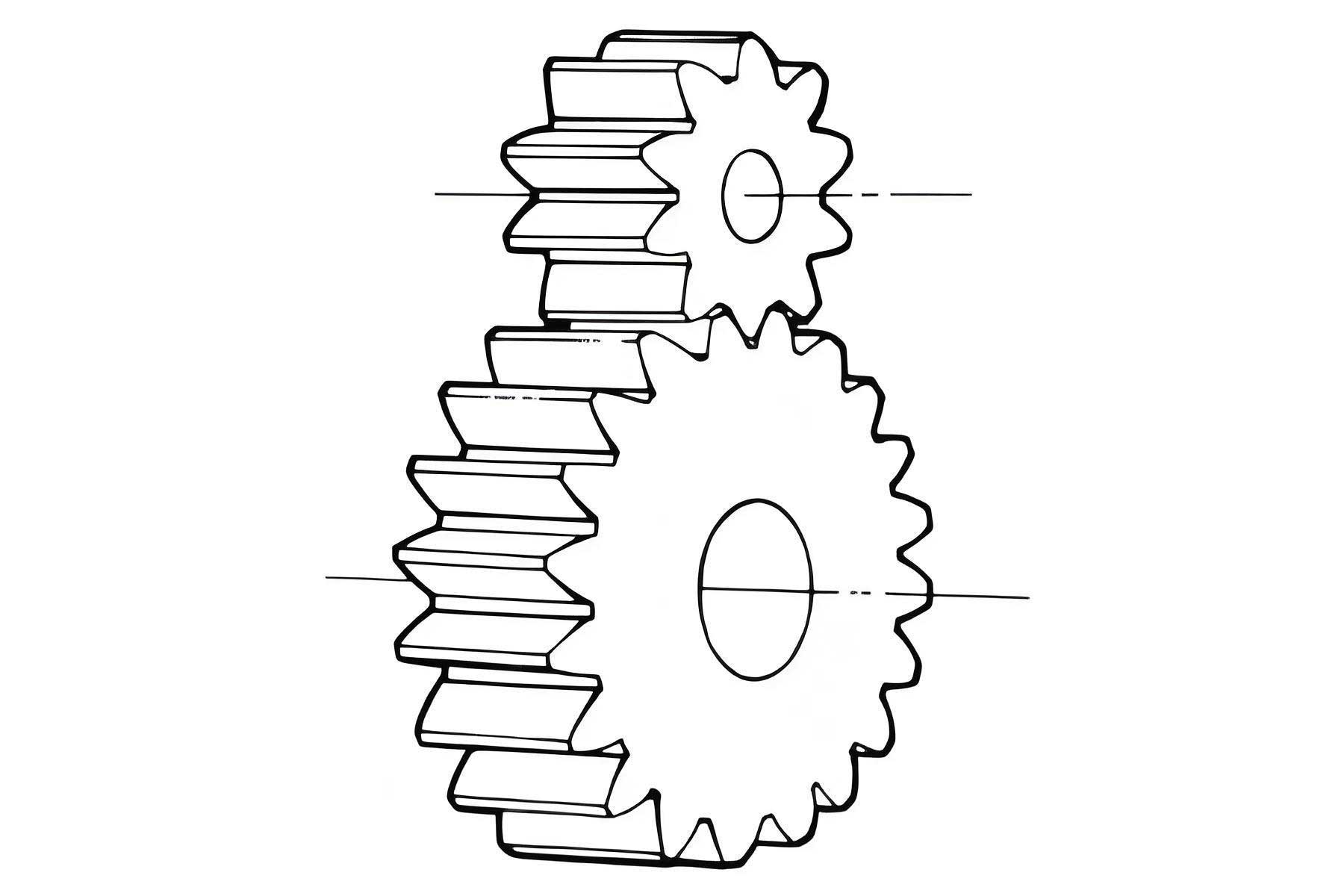
To achieve this, I employ a finite element approach, which has become increasingly viable with advancements in computational power. The modeling and simulation are performed using ANSYS software, with parametric models built via APDL (ANSYS Parametric Design Language) and dynamic analyses conducted in LS-DYNA, an explicit dynamics solver. This combination allows for accurate representation of transient meshing events, including contact impacts and elastic deformations. The explicit dynamics method, based on central difference time integration, is well-suited for simulating high-speed spur gear engagements, as it avoids matrix inversion and handles nonlinearities efficiently. The governing equations for explicit dynamics in LS-DYNA are summarized below.
The acceleration vector at the end of the n-th time step, \( t_n \), is computed as:
$$ \mathbf{a}(t_n) = \mathbf{M}^{-1} \left[ \mathbf{P}(t_n) – \mathbf{F}^{\text{int}}(t_n) \right], $$
where \( \mathbf{M} \) is the mass matrix, \( \mathbf{P} \) is the external force vector, and \( \mathbf{F}^{\text{int}} \) is the internal force vector. The internal force includes contributions from stress, hourglass resistance, and contact forces:
$$ \mathbf{F}^{\text{int}} = \int_V \mathbf{B}^T \sigma \, dV + \mathbf{F}^{\text{hourglass}} + \mathbf{F}^{\text{contact}}. $$
Here, \( \mathbf{B} \) is the strain-displacement matrix, \( \sigma \) is the stress tensor, and the integration is over the volume. The velocity and displacement vectors are updated using:
$$ \mathbf{v}(t_{(n+1)/2}) = \mathbf{v}(t_{(n-1)/2}) + 0.5 \mathbf{a}(t_n) (\Delta t_{n-1} + \Delta t_n), $$
$$ \mathbf{u}(t_{n+1}) = \mathbf{u}(t_n) + \mathbf{v}(t_{(n+1)/2}) \Delta t_n, $$
with \( \Delta t_{n-1} = t_n – t_{n-1} \) and \( \Delta t_n = t_{n+1} – t_n \). The critical time step for stability is given by:
$$ \Delta t_{\text{cr}} = \frac{2}{\omega_{\text{max}}}, $$
where \( \omega_{\text{max}} \) is the highest natural frequency of the model. LS-DYNA uses variable time stepping to ensure computational efficiency and accuracy.
For the spur gear analysis, I develop a parametric finite element model of a spur gear pair based on standard involute and transition curve equations. The gear parameters are derived from a practical application in a machine tool servo drive, as detailed in Table 1. The model includes both gears, with the inner bores defined as rigid bodies using SHELL163 elements to apply rotational motions, while the teeth and other parts are meshed with SOLID164 elements to capture elastic deformations. The material properties are typical for steel gears: density \( \rho = 7800 \, \text{kg/m}^3 \), Young’s modulus \( E = 210 \, \text{GPa} \), and Poisson’s ratio \( \nu = 0.3 \). The total model comprises 34,760 nodes and 21,680 solid elements, ensuring sufficient resolution for contact analysis.
| Parameter | Value |
|---|---|
| Number of teeth (pinion) | 24 |
| Number of teeth (gear) | 40 |
| Module (mm) | 3 |
| Pressure angle (°) | 20 |
| Face width (mm) | 20 |
| Modification coefficient (pinion) | Variable: 0, 0.2, 0.35, 0.5407 |
| Modification coefficient (gear) | 0 (fixed) |
| Operating speed (rpm) | 4000 |
| Torque load (Nm) | Approx. 50 |
The loading conditions simulate realistic operation: the driving spur gear is subjected to an angular velocity that ramps up from 0 to 4000 rpm over 5 ms, then remains constant, while the driven spur gear experiences a resistive torque that similarly increases linearly. This ramp-up mimics startup transients in machinery. The boundaries constrain all translational degrees of freedom and rotations about axes other than the rotational axis for both spur gears, ensuring proper meshing engagement. The simulation runs for 40 ms to capture steady-state behavior after transients decay.
The results from the dynamic simulation reveal several key aspects of spur gear meshing. First, the angular velocity response of the driven spur gear exhibits fluctuations around the theoretical value, as shown in Figure 2. During acceleration, minor oscillations occur, but at the end of the ramp-up (5 ms), a significant冲击 is observed due to the abrupt change in acceleration. This冲击 causes a temporary spike in velocity deviation, which gradually dampens out, reaching a quasi-steady state by 15 ms. Even in steady state, small periodic fluctuations persist, attributed to interference at the meshing entry and exit points caused by elastic deformations of the spur gear teeth. These dynamics underscore the importance of considering transient effects in spur gear design.
Next, the dynamic contact force between the spur gear teeth is analyzed. The contact force varies over time, mirroring the velocity trends. During acceleration, the force oscillates, with a pronounced peak at 5 ms corresponding to the冲击 event. In steady state, the contact force shows periodic variations with multiple peaks per meshing cycle, as illustrated in Figure 3. For a single tooth engagement, the contact force rises sharply upon entry due to干涉, leading to a meshing冲击, followed by several peaks during the meshing period. Notably, the magnitude of the dynamic contact force exceeds the static theoretical value calculated from equilibrium (approximately 1180 N), highlighting the amplification effects of dynamics. This excess force can accelerate wear and fatigue in spur gears, emphasizing the need for dynamic analysis.
To quantify meshing quality, I compute the transmission error (TE), defined as the deviation between the actual and ideal angular positions of the driven spur gear. The dynamic transmission error (DTE) over the simulation is plotted in Figure 4. It shows large fluctuations during acceleration, peaking at 5 ms, and then settling into a periodic pattern after 15 ms. The DTE amplitude in steady state is around 5–7 μm, which is significant for precision applications. The frequency content of the DTE is examined through spectral analysis, focusing on how the modification coefficient affects it. For this, I simulate four cases with different modification coefficients for the driving spur gear: \( x = 0.5407 \), \( 0.35 \), \( 0.2 \), and \( 0 \), while keeping the driven spur gear unmodified. The meshing frequency \( f_m \) is calculated based on gear geometry and speed:
$$ f_m = \frac{N \cdot \omega}{60}, $$
where \( N \) is the number of teeth on the driving spur gear and \( \omega \) is the rotational speed in rpm. For this spur gear pair, \( f_m \approx 1133 \, \text{Hz} \). The natural frequency of the spur gear pair is estimated using an equivalent stiffness-mass model:
$$ f_n = \frac{1}{2\pi} \sqrt{\frac{k_{\text{eq}}}{m_{\text{eq}}}}, $$
with \( k_{\text{eq}} \) and \( m_{\text{eq}} \) derived from gear parameters. The natural frequencies for the four modification coefficients are approximately 2847 Hz, 2811 Hz, 2770 Hz, and 2732 Hz, respectively.
The frequency spectra of DTE for each case are summarized in Table 2, with key frequency components identified. In all cases, the meshing frequency \( f_m \) is dominant, but other harmonics and sidebands appear, influenced by the modification coefficient. Notably, frequencies close to the natural frequency, such as \( 2f_m \) or \( 3f_m \), show amplified amplitudes when they align with resonant conditions. For example, at \( x = 0.5407 \), the component near \( 2f_m \) has a higher amplitude than \( f_m \), while at \( x = 0 \), the component near \( 3f_m \) becomes prominent. This suggests that the modification coefficient can shift the dynamic response of spur gears, potentially exciting different resonance modes.
| Modification Coefficient (\( x \)) | Dominant Frequency Components (Hz) | Amplitude Trends |
|---|---|---|
| 0.5407 | \( f_m \approx 1133 \), \( 2f_m \approx 2266 \), \( f_n \approx 2847 \) | \( 2f_m \) amplitude > \( f_m \) amplitude |
| 0.35 | \( f_m \approx 1133 \), \( 2f_m \approx 2266 \), \( f_n \approx 2811 \) | \( f_m \) amplitude dominates, \( 2f_m \) reduced |
| 0.2 | \( f_m \approx 1133 \), \( 2f_m \approx 2266 \), \( f_n \approx 2770 \) | \( f_m \) amplitude high, \( 2f_m \) minimal |
| 0 | \( f_m \approx 1133 \), \( 3f_m \approx 3399 \), \( f_n \approx 2732 \) | \( 3f_m \) amplitude > \( f_m \) amplitude |
To further understand the dynamics, I compare the dynamic transmission error with the static transmission error (STE) obtained from a quasi-static finite element analysis. In the static analysis, the driven spur gear is fixed, and a torque is applied to the driving spur gear to simulate a steady meshing condition. The STE for one meshing cycle is extended and compared with the DTE in both time and frequency domains, as shown in Figures 5 and 6. The DTE is approximately 3.5 times larger in amplitude than the STE, due to inertial and damping effects. Moreover, the DTE exhibits a phase lag relative to the STE, attributed to system damping during dynamic oscillations. In the frequency domain, the STE spectrum lacks the natural frequency component \( f_n \), as static analysis cannot capture dynamic resonances. This absence highlights a critical limitation of static methods for high-speed spur gear analysis, where dynamic effects are non-negligible.
The differences between DTE and STE underscore the importance of dynamic simulations for spur gears operating at high speeds. The STE, while useful for preliminary design, fails to account for冲击, vibrations, and resonance phenomena that characterize real-world spur gear performance. For instance, the amplified amplitudes at frequencies near \( f_n \) in the DTE spectrum indicate potential resonance risks that could lead to noise and failure. By adjusting the modification coefficient, designers can tailor the frequency response of spur gears to avoid such resonances, thereby improving reliability.
In addition to transmission error, other meshing characteristics like contact stress and root bending stress are influenced by the modification coefficient. Although not detailed here, parametric studies show that optimal modification can reduce stress concentrations on spur gear teeth, extending service life. The finite element model allows for stress visualization, but the focus of this paper remains on dynamic meshing behavior.
The methodology presented here—combining APDL for parametric modeling and LS-DYNA for explicit dynamics—provides a robust framework for analyzing spur gears under various conditions. Future work could explore more complex spur gear systems, such as those with misalignments or non-standard profiles, or extend to helical gears for broader applications. Additionally, experimental validation using strain gauges or accelerometers on physical spur gear setups would enhance the credibility of simulation results.
In conclusion, this study demonstrates the significant impact of the modification coefficient on the meshing characteristics of spur gears. Through dynamic finite element analysis, I show that the modification coefficient alters the frequency content of transmission error, with potential excitations near natural frequencies. The dynamic transmission error exceeds its static counterpart in amplitude and includes resonant components, emphasizing the need for dynamic simulations in high-speed spur gear design. By carefully selecting the modification coefficient, engineers can optimize spur gear performance, minimizing vibrations and improving efficiency. This research contributes to the ongoing efforts to advance gear technology, ensuring that spur gears continue to meet the demands of modern machinery.
To summarize key findings in a formulaic manner, the relationship between modification coefficient \( x \) and dynamic response can be expressed through an empirical equation for spur gears:
$$ \text{DTE}_{\text{peak}} = k_1 \cdot x^2 + k_2 \cdot x + k_3, $$
where \( k_1 \), \( k_2 \), and \( k_3 \) are constants derived from regression analysis of simulation data. Similarly, the contact force amplitude \( F_c \) correlates with \( x \) as:
$$ F_c = F_0 \cdot (1 + \alpha \cdot e^{-\beta x}), $$
with \( F_0 \) being the static force and \( \alpha \), \( \beta \) as damping factors. These equations, while simplified, capture trends observed in the study and can guide preliminary design of spur gears.
Overall, the integration of advanced simulation tools with parametric design enables a deeper understanding of spur gear dynamics, paving the way for quieter, more durable transmissions. As computational resources grow, such analyses will become standard practice in the industry, ultimately benefiting a wide range of mechanical systems reliant on spur gears.